Lenny.com
Explore
Create
ActivitiesNewMathEnglish Language ArtsScience & EngineeringSocial StudiesGlobal LanguagesHealth & Physical EducationSpecial EducationCounseling & Life SkillsArts & CreativityESL
Lenny.com
Lenny.com
Explore
Create
ActivitiesNewMathEnglish Language ArtsScience & EngineeringSocial StudiesGlobal LanguagesHealth & Physical EducationSpecial EducationCounseling & Life SkillsArts & CreativityESL
Lenny.com
Lenny.com

Solutions

Lenny for EducatorsLenny for SchoolsLenny for Districts

Product

ExploreSign inCreateSupportAbout

Resources

Getting startedMTSS Acceleration Program

© 2026 Lenny Learning Inc.

TermsPrivacyAccessibility
LinkedInInstagramX
Lenny
MathNumbers & CountingCounting ObjectsNumber NamesComparing NumbersNumber OperationsCounting SequenceNumbers 0-10Place Value Understanding and SystemAdd and Subtract Within 20Addition and Subtraction ConceptsAddition and Subtraction EquationsAddition and Subtraction ProblemsFoundations for MultiplicationMultiplication and Division PropertiesMultiply and Divide Within 100Multiplication and Division ProblemsFactors and MultiplesProperties of OperationsPatterns and RelationshipsGenerate and Analyze PatternsMulti-Digit ArithmeticPlace Value OperationsMulti-Digit and Decimal OperationsNumerical ExpressionsFour Operations and PatternsFour Operations Problem SolvingMeasurement & DataMeasurable AttributesMeasuring LengthsMeasure and Estimate Lengths in Standard UnitsRelate Addition and Subtraction to LengthClassifying and Counting ObjectsTime and MoneyArea Concepts and MeasurementPerimeter and Area MeasuresAngle Concepts and MeasurementTime, Volume, and MassMeasurement Unit ConversionsGeometryIdentifying ShapesShapes and AttributesShape Attributes and ReasoningShapes and CompositionClassifying 2D FiguresGeometric Figures and RelationshipsLines, Angles, and ShapesAngle, Area, and VolumeGeometric MeasurementVolume of 3D ShapesCoordinate Plane ApplicationsTransformations in the PlaneCongruence and SimilarityUnderstand congruence in terms of rigid motionsSimilarity and TransformationsProve Theorems Involving SimilarityPythagorean TheoremTrigonometry for General TrianglesMake Geometric ConstructionsProve Geometric TheoremsTheorems About CirclesFind Arc Lengths And Areas of Sectors of CirclesVolume FormulasRelationships Between Two-Dimensional and Three-Dimensional ObjectsProve Simple Geometric Theorems AlgebraicallyTranslate Between Geometric Description and Equation for Conic SectionApply Geometric Concepts in Modeling SituationsFractions & DecimalsFractions as NumbersBuilding FractionsFraction Equivalence and OrderingAdding and Subtracting FractionsMultiplying and Dividing FractionsDividing FractionsDecimal FractionsMulti-Digit Computation and FactorsAdd, Subtract, Multiply, and Divide Rational NumbersRational Number SystemIrrational Numbers and ApproximationsRatiosRatios and ProportionsProportional RelationshipsUnit RateAlgebraAlgebraic ExpressionsGenerate Equivalent ExpressionsQuantitative RelationshipsProportional Relationships and Linear EquationsEquations and InequalitiesEquation Solving and ReasoningLinear Equations and SystemsGraph Equations and InequalitiesSystems of EquationsReal-World Algebraic ProblemsQuantitative Reasoning with UnitsExpression StructureEquivalent Expression FormsRadicals and Integer ExponentsRational ExponentsRational and Irrational NumbersPolynomial OperationsPolynomial IdentitiesPolynomial Zeros and FactorsRational ExpressionsComplex Number OperationsComplex Numbers in PolynomialsComplex Numbers on PlaneStatistics & ProbabilityRepresent and Interpret DataData DistributionsStatistical VariabilityProbability ModelsCompound Event ProbabilitiesStatistical SamplingInterpret Categorical and Quantitative DataBivariate Data PatternsInterpret Linear ModelsComparing Two PopulationsRandom Processes in StatisticsIndependence and Conditional ProbabilityExpected ValuesProbability-Based Decision MakingStatistical Inference and ConclusionsFunctionsFunction Concepts and NotationDefine and Compare FunctionsInterpret Functions in ContextAnalyze Function RepresentationsModel Relationships with FunctionsIdentify Linear vs Exponential GrowthDistinguish Between Function TypesCompare Growth RatesInterpret Function ExpressionsBuild Functions from RelationshipsConstruct and Model FunctionsTransform and Combine FunctionsModel Comparison and SelectionSolve Exponential EquationsTrigonometryTrigonometric Ratios Involving Right TrianglesTrigonometric Functions and Unit CircleModel with Trigonometric FunctionsTrigonometric IdentitiesVectors & MatricesIntroduction to Vectors and MatricesVector QuantitiesVector OperationsMatrix OperationsCalculusLimits and ContinuityDerivative Concepts and NotationDerivative Rules and TechniquesApplications of DerivativesOptimization ProblemsRelated RatesCurve Sketching and AnalysisIntegration Concepts and NotationAntiderivatives and Indefinite IntegralsDefinite Integrals and AreaFundamental Theorem of CalculusIntegration TechniquesApplications of IntegrationDifferential EquationsSequences and SeriesParametric and Polar FunctionsVector-Valued Functions

TSIA2 Math Blitz

A comprehensive 15-day review program for the TSIA2 mathematics assessment, featuring daily high-yield questions covering all four core areas (Quantitative, Algebraic, Geometric, and Probabilistic reasoning) alongside a structured student tracking and reflection log.

PRPenne Reed

TSIA2 Math Blitz

A comprehensive 15-day review program for the TSIA2 mathematics assessment, featuring daily high-yield questions covering all four core areas (Quantitative, Algebraic, Geometric, and Probabilistic reasoning) alongside a structured student tracking and reflection log.

PRPenne Reed

DAY 2 BLUEPRINT SOLUTIONS

Answer Key

Q1 Correct Answer: A (15)

Hint: Consecutive interior angles are supplementary (add up to \(180^\circ\)).

Explanation:

  1. Set up the sum: \((4x + 10) + (6x + 20) = 180\).
  2. Combine terms: \(10x + 30 = 180\).
  3. Subtract 30: \(10x = 150\).
  4. Divide by 10: \(x = 15\).

Q2 Correct Answer: C (3.5 points)

Hint: Find the mean before and after removing the lowest value.

Explanation:

  1. Original Mean: \(\frac{70+80+80+90+100}{5} = \frac{420}{5} = 84\).
  2. New Mean: \(\frac{80+80+90+100}{4} = \frac{350}{4} = 87.5\).
  3. Increase: \(87.5 - 84 = 3.5\) points.

Compare these techniques to your own work. Slide 5 of 32


DAY 3 QUESTIONS

Algebraic & Quantitative

Q1 Quantitative Reasoning

A blueprint model of a rocket uses a linear scale of \(1\text{ inch} = 12\text{ feet}\). If the actual rocket is \(156\text{ feet}\) tall, how tall is the physical model?

A) 11 inches

B) 12 inches

C) 13 inches

D) 14 inches

Q2 Algebraic Reasoning

In the system of equations, what is the value of \(y\)?
\[2x + 3y = 12\] \[x - y = 1\]

A) 1

B) 2

C) 3

D) 4

Proportions and linear systems are guaranteed core exam concepts! Slide 6 of 32


DAY 3 BLUEPRINT SOLUTIONS

Answer Key

Q1 Correct Answer: C (13 inches)

Hint: Write a proportion: \(\frac{1\text{ in}}{12\text{ ft}} = \frac{x}{156\text{ ft}}\).

Explanation:

  1. Cross-multiply: \(12x = 156\).
  2. Divide both sides by 12.
  3. \(x = 13\).
  4. The model rocket is exactly \(13\) inches tall.

Q2 Correct Answer: B (2)

Hint: Express \(x\) from the second equation: \(x = y + 1\).

Explanation:

  1. Substitute \(x = y + 1\) into the first equation.
  2. \(2(y + 1) + 3y = 12\).
  3. Distribute & combine: \(2y + 2 + 3y = 12 \Rightarrow 5y + 2 = 12\).
  4. Solve: \(5y = 10 \Rightarrow y = 2\).

Substitution or elimination? Choose the faster path. Slide 7 of 32


DAY 4 QUESTIONS

Geometric & Probabilistic

Q1 Geometric Reasoning

A 13-foot vertical ladder leans up against a flat building wall. If the base of the ladder is placed exactly 5 feet away from the wall, how high up the wall does it reach?

A) 8 feet

B) 10 feet

C) 12 feet

D) 12.5 feet

Q2 Probabilistic Reasoning

A bag contains 4 red, 6 blue, and 5 green marbles. If you draw one random marble from the bag, what is the exact probability that it is NOT blue?

A) 1/3

B) 2/5

C) 3/5

D) 4/5

Don't forget to simplify all fractions in probability questions! Slide 8 of 32


DAY 4 BLUEPRINT SOLUTIONS

Answer Key

Q1 Correct Answer: C (12 feet)

Hint: Use Pythagorean Theorem: \(a^2 + b^2 = c^2\) with hypotenuse \(c = 13\).

Explanation:

  1. Formula: \(5^2 + h^2 = 13^2\).
  2. Evaluate: \(25 + h^2 = 169\).
  3. Isolate: \(h^2 = 144\).
  4. Square root: \(h = 12\). (This is a 5-12-13 triple).

Q2 Correct Answer: C (3/5)

Hint: Probability of NOT blue = \(\frac{\text{Red + Green}}{\text{Total Marbles}}\).

Explanation:

  1. Find total marbles: \(4 + 6 + 5 = 15\).
  2. Count non-blue: \(4\text{ red} + 5\text{ green} = 9\).
  3. Set up fraction: \(\frac{9}{15}\).
  4. Simplify by dividing by 3: \(\frac{3}{5}\).

Recognizing Pythagorean Triples will save valuable test time! Slide 9 of 32


DAY 5 QUESTIONS

Algebraic & Quantitative

Q1 Quantitative Reasoning

Simplify the numerical expression and write the final result in scientific notation:
\[(3 \times 10^5) \times (4 \times 10^{-3})\]

A) \(1.2 \times 10^2\)

B) \(1.2 \times 10^3\)

C) \(1.2 \times 10^4\)

D) \(12 \times 10^2\)

Q2 Algebraic Reasoning

Factor the quadratic trinomial expression completely:
\[x^2 - 5x - 24\]

A) \((x-8)(x+3)\)

B) \((x+8)(x-3)\)

C) \((x-6)(x-4)\)

D) \((x-12)(x+2)\)

End of Week 1! Finish strong. Slide 10 of 32


DAY 5 BLUEPRINT SOLUTIONS

Answer Key

Q1 Correct Answer: B (\(1.2 \times 10^3\))

Hint: Multiply coefficients and add exponents of base 10.

Explanation:

  1. Multiply front numbers: \(3 \times 4 = 12\).
  2. Add exponents: \(10^5 \times 10^{-3} = 10^{5 + (-3)} = 10^2\).
  3. Combine terms: \(12 \times 10^2\).
  4. Normalize to scientific: \(1.2 \times 10^3\) (move decimal left, increase exponent).

Q2 Correct Answer: A (\((x-8)(x+3)\))

Hint: Find two numbers that multiply to \(-24\) and add to \(-5\).

Explanation:

  1. Factors of \(-24\): \((-24, 1)\), \((-12, 2)\), \((-8, 3)\), \((-6, 4)\).
  2. Test sum: \(-8 + 3 = -5\). This works!
  3. Write as factors: \((x - 8)(x + 3)\).
  4. FOIL to verify: \(x^2 + 3x - 8x - 24 = x^2 - 5x - 24\).

Now complete the Phase 1 Review on your reflection sheet! Slide 11 of 32


DAY 6 QUESTIONS

Geometric & Probabilistic

Q1 Geometric Reasoning

A cylindrical shipping tank has a radius of 3 meters and a height of 10 meters. What is the total volume in cubic meters? (Leave in terms of \(\pi\)).

A) \(30\pi\)

B) \(60\pi\)

C) \(90\pi\)

D) \(120\pi\)

Q2 Probabilistic Reasoning

Find the exact median value of the following list of numbers:
\[14, 8, 19, 23, 11, 15, 19\]

A) 14

B) 15

C) 16

D) 19

Week 2 starts now! Let's elevate our pacing. Slide 12 of 32


DAY 6 BLUEPRINT SOLUTIONS

Answer Key

Q1 Correct Answer: C (\(90\pi\))

Hint: Cylinder Volume formula is \(V = \pi r^2 h\).

Explanation:

  1. Substitute values: \(r = 3\) and \(h = 10\).
  2. Calculate radius squared: \(r^2 = 3^2 = 9\).
  3. Multiply by height: \(9 \times 10 = 90\).
  4. Volume = \(90\pi\) cubic meters.

Q2 Correct Answer: B (15)

Hint: You must sort the numerical list from least to greatest first!

Explanation:

  1. Sort the values: \(8, 11, 14, 15, 19, 19, 23\).
  2. Find total terms: \(n = 7\) (odd number).
  3. The middle term is at index \(\frac{7+1}{2} = 4\).
  4. The 4th number is \(15\), which is the median.

Did you forget to sort the list? Always double-check! Slide 13 of 32


DAY 7 QUESTIONS

Algebraic & Quantitative

Q1 Quantitative Reasoning

An organic grocery store sells loose raw almonds for $8.40 per pound. If a dynamic recipe requires exactly \(1\frac{3}{4}\) pounds of almonds, what is the total cost?

A) $12.60

B) $13.20

C) $14.70

D) $15.40

Q2 Algebraic Reasoning

Solve the linear inequality for \(x\):
\[-3x + 8 > 20\]

A) \(x < -4\)

B) \(x > -4\)

C) \(x < 4\)

D) \(x > 4\)

Be careful with negative coefficients in inequalities! Slide 14 of 32


DAY 7 BLUEPRINT SOLUTIONS

Answer Key

Q1 Correct Answer: C ($14.70)

Hint: Convert the mixed number into a decimal: \(1\frac{3}{4} = 1.75\).

Explanation:

  1. Cost = \(\text{Weight} \times \text{Rate}\).
  2. Cost = \(1.75 \times 8.40\).
  3. Break down multiplication:
    \(1 \times 8.40 = 8.40\),
    \(0.75 \times 8.40 = 6.30\).
  4. Add values: \(8.40 + 6.30 = 14.70\).

Q2 Correct Answer: A (\(x < -4\))

Hint: Flipping the inequality sign is required when multiplying or dividing by a negative number.

Explanation:

  1. Subtract 8: \(-3x > 12\).
  2. Divide by \(-3\) and flip inequality sign:
    \(x < \frac{12}{-3}\).
  3. Result: \(x < -4\).

Always circle/highlight negative signs to avoid minor mistakes. Slide 15 of 32


DAY 8 QUESTIONS

Geometric & Probabilistic

Q1 Geometric Reasoning

A coordinate rectangle is drawn with vertices located at \((1, 2)\), \((1, 8)\), \((5, 8)\), and \((5, 2)\). What is the total perimeter of this rectangle?

A) 10

B) 16

C) 20

D) 24

Q2 Probabilistic Reasoning

A standard 6-sided die is rolled and a fair coin is flipped. What is the probability of rolling an odd number AND flipping tails?

A) 1/12

B) 1/4

C) 1/2

D) 3/4

Are the outcomes independent or dependent? Think carefully! Slide 16 of 32


DAY 8 BLUEPRINT SOLUTIONS

Answer Key

Q1 Correct Answer: C (20)

Hint: Distance = difference between coordinate values along axes.

Explanation:

  1. Find height (change in \(y\)): \(8 - 2 = 6\).
  2. Find width (change in \(x\)): \(5 - 1 = 4\).
  3. Perimeter formula: \(2 \times (\text{width} + \text{height})\).
  4. Perimeter = \(2 \times (4 + 6) = 2 \times 10 = 20\).

Q2 Correct Answer: B (1/4)

Hint: Multiply individual probabilities of independent events: \(P(A \cap B) = P(A) \times P(B)\).

Explanation:

  1. Probability of odd number: \(\frac{3}{6} = \frac{1}{2}\).
  2. Probability of tails: \(\frac{1}{2}\).
  3. Combine: \(\frac{1}{2} \times \frac{1}{2} = \frac{1}{4}\).

Keep practicing compound events. They make up key TSIA2 stats. Slide 17 of 32


DAY 9 QUESTIONS

Algebraic & Quantitative

Q1 Quantitative Reasoning

Evaluate the exact value of the numeric expression:
\[| -5 - 12 | - 3 | 4 - 9 |\]

A) -12

B) 2

C) 14

D) 32

Q2 Algebraic Reasoning

Simplify the complex rational algebraic expression:
\[\frac{(2x^3 y^{-2})^3}{4x^5 y}\]

A) \(2x^4 y^{-7}\)

B) \(2x^4 y^{-5}\)

C) \(\frac{2x^4}{y^7}\)

D) \(\frac{x^4}{2y^5}\)

Exponent laws are vital! Pay close attention to negatives. Slide 18 of 32


DAY 9 BLUEPRINT SOLUTIONS

Answer Key

Q1 Correct Answer: B (2)

Hint: Absolute value is always non-negative: \(|a| \ge 0\).

Explanation:

  1. Simplify inner terms first:
    \(| -17 | - 3 | -5 |\).
  2. Evaluate absolute values:
    \(17 - 3(5)\).
  3. Perform multiplication: \(17 - 15\).
  4. Subtract: \(17 - 15 = 2\).

Q2 Correct Answer: C (\(\frac{2x^4}{y^7}\))

Hint: \((ab)^n = a^n b^n\) and \(\frac{x^a}{x^b} = x^{a-b}\).

Explanation:

  1. Expand numerator: \(2^3 (x^3)^3 (y^{-2})^3 = 8 x^9 y^{-6}\).
  2. Set up fraction: \(\frac{8 x^9 y^{-6}}{4 x^5 y^1}\).
  3. Simplify coefficients: \(\frac{8}{4} = 2\).
  4. Subtract powers: \(x^{9-5} = x^4\), and \(y^{-6-1} = y^{-7}\).
  5. Move negative powers: \(\frac{2x^4}{y^7}\).

Keep negative exponents in mind during algebraic simplifications. Slide 19 of 32


DAY 10 QUESTIONS

Geometric & Probabilistic

Q1 Geometric Reasoning

A circle has a radius of exactly 6 cm. What is the area of a sector with a central angle of \(60^\circ\)? (Leave in terms of \(\pi\)).

A) \(\pi\)

B) \(3\pi\)

C) \(6\pi\)

D) \(12\pi\)

Q2 Probabilistic Reasoning

In a numerical set: 5, 12, 12, 15, 18, 22, 95. If the outlier 95 is removed, how does the range of the dataset change?

A) Decreases by 73

B) Decreases by 78

C) Decreases by 85

D) Stays the same

Completed Day 10! Time for mid-point evaluation in your log. Slide 20 of 32


DAY 10 BLUEPRINT SOLUTIONS

Answer Key

Q1 Correct Answer: C (\(6\pi\))

Hint: Sector Area = \(\frac{\theta}{360} \times \pi r^2\).

Explanation:

  1. Substitute values: \(\theta = 60\), \(r = 6\).
  2. Fraction of circle: \(\frac{60}{360} = \frac{1}{6}\).
  3. Total Area: \(\pi \times 6^2 = 36\pi\).
  4. Sector Area: \(\frac{1}{6} \times 36\pi = 6\pi\).

Q2 Correct Answer: A (Decreases by 73)

Hint: Range = Maximum value - Minimum value.

Explanation:

  1. Original Range: \(95 - 5 = 90\).
  2. New Range (without outlier 95): \(22 - 5 = 17\).
  3. Calculate difference: \(90 - 17 = 73\).
  4. The range decreases by exactly \(73\).

How are you doing so far? Update your goals on Page 2! Slide 21 of 32


DAY 11 QUESTIONS

Algebraic & Quantitative

Q1 Quantitative Reasoning

An industrial printer prints exactly 150 pages in 4 minutes. At this constant speed, how many pages will it print in 10 minutes?

A) 325

B) 350

C) 375

D) 400

Q2 Algebraic Reasoning

What are the solutions/roots to the quadratic equation?
\[x^2 - 6x + 8 = 0\]

A) \(x = -4, -2\)

B) \(x = 2, 4\)

C) \(x = -8, -1\)

D) \(x = 1, 8\)

Welcome to the final week! Pacing is everything. Slide 22 of 32


DAY 11 BLUEPRINT SOLUTIONS

Answer Key

Q1 Correct Answer: C (375)

Hint: Find the rate of pages per minute first: \(\frac{\text{Pages}}{\text{Minutes}}\).

Explanation:

  1. Find rate: \(\frac{150\text{ pages}}{4\text{ mins}} = 37.5\) pages/minute.
  2. Multiply by 10 minutes: \(37.5 \times 10\).
  3. Total pages = \(375\).

Q2 Correct Answer: B (\(x = 2, 4\))

Hint: Factor or use the quadratic formula to solve for \(x\).

Explanation:

  1. Factor: \((x - 4)(x - 2) = 0\).
  2. Set each factor equal to zero:
    \(x - 4 = 0 \Rightarrow x = 4\),
    \(x - 2 = 0 \Rightarrow x = 2\).
  3. Solutions are \(x = 2, 4\).

Did you get negative signs? Always watch out for sign flips! Slide 23 of 32


DAY 12 QUESTIONS

Geometric & Probabilistic

Q1 Geometric Reasoning

What is the exact equation of the line that passes directly through coordinate points \((2, 5)\) and \((4, 11)\)?

A) \(y = 3x - 1\)

B) \(y = 3x + 1\)

C) \(y = 2x + 1\)

D) \(y = 2x + 7\)

Q2 Probabilistic Reasoning

Out of 50 students surveyed, 30 like rock, 15 like pop, and 5 like both. What is the probability that a student chosen at random likes rock OR pop?

A) 70%

B) 80%

C) 85%

D) 90%

Keep tracking correct answers & confidence levels! Slide 24 of 32


DAY 12 BLUEPRINT SOLUTIONS

Answer Key

Q1 Correct Answer: A (\(y = 3x - 1\))

Hint: Find slope first: \(m = \frac{y_2 - y_1}{x_2 - x_1}\), then use point-slope form.

Explanation:

  1. Slope: \(m = \frac{11 - 5}{4 - 2} = \frac{6}{2} = 3\).
  2. Point-slope: \(y - y_1 = m(x - x_1)\).
  3. Using point \((2, 5)\): \(y - 5 = 3(x - 2)\).
  4. Distribute & solve: \(y - 5 = 3x - 6 \Rightarrow y = 3x - 1\).

Q2 Correct Answer: B (80%)

Hint: Use Addition Rule: \(P(A \cup B) = P(A) + P(B) - P(A \cap B)\).

Explanation:

  1. Count unique students: \(30 + 15 - 5 = 40\).
  2. Calculate probability: \(\frac{40}{50} = \frac{4}{5}\).
  3. Convert to percentage: \(\frac{4}{5} = 80\%\).

Venn diagrams or set formula? Whichever works best for you! Slide 25 of 32


DAY 13 QUESTIONS

Algebraic & Quantitative

Q1 Quantitative Reasoning

What is the Greatest Common Factor (GCF) of the following set of three integers?
\[36, 54, 72\]

A) 6

B) 9

C) 18

D) 36

Q2 Algebraic Reasoning

What is the exact restricted domain of the real-valued function?
\[f(x) = \frac{x + 4}{\sqrt{x - 2}}\]

A) \(x \ge 2\)

B) \(x > 2\)

C) \(x \ne 2\)

D) All real numbers

Keep algebraic domains clear: avoid zero denominators & negative square roots. Slide 26 of 32


DAY 13 BLUEPRINT SOLUTIONS

Answer Key

Q1 Correct Answer: C (18)

Hint: Use prime factorization or list all factors.

Explanation:

  1. Factors of 36: \(1, 2, 3, 4, 6, 9, 12, 18, 36\).
  2. Factors of 54: \(1, 2, 3, 6, 9, 18, 27, 54\).
  3. Factors of 72: \(1, 2, 3, 4, 6, 8, 9, 12, 18, 24, 36, 72\).
  4. Greatest common intersection is \(18\).

Q2 Correct Answer: B (\(x > 2\))

Hint: The radical must be positive, and cannot equal zero because it is in the denominator.

Explanation:

  1. For \(\sqrt{x - 2}\), must have \(x - 2 \ge 0\).
  2. Since it's a denominator: \(\sqrt{x - 2} \ne 0 \Rightarrow x - 2 \ne 0\).
  3. Combine rules: \(x - 2 > 0\).
  4. Result: \(x > 2\).

GCF and LCM are fundamental TSIA2 numerical checks! Slide 27 of 32


DAY 14 QUESTIONS

Geometric & Probabilistic

Q1 Geometric Reasoning

Triangle ABC is similar to Triangle DEF (\(\Delta ABC \sim \Delta DEF\)). If \(AB = 6\), \(BC = 8\), and \(DE = 9\), what is the length of \(EF\)?

A) 11

B) 12

C) 13.5

D) 15

Q2 Probabilistic Reasoning

A card is drawn from a standard deck of 52 cards and is NOT replaced. A second card is drawn. What is the probability that both cards are Aces?

A) 1/221

B) 1/169

C) 4/663

D) 1/17

Almost done! Prepare yourself for the final review tomorrow. Slide 28 of 32


DAY 14 BLUEPRINT SOLUTIONS

Answer Key

Q1 Correct Answer: B (12)

Hint: Setting up a ratio of corresponding sides is key: \(\frac{AB}{DE} = \frac{BC}{EF}\).

Explanation:

  1. Substitute values: \(\frac{6}{9} = \frac{8}{EF}\).
  2. Simplify ratio: \(\frac{2}{3} = \frac{8}{EF}\).
  3. Cross-multiply: \(2 \times EF = 24\).
  4. Divide by 2: \(EF = 12\).

Q2 Correct Answer: A (1/221)

Hint: Without replacement, the total pool of cards decreases: \(P(A \cap B) = P(A) \times P(B|A)\).

Explanation:

  1. Probability first card is an Ace: \(\frac{4}{52} = \frac{1}{13}\).
  2. Probability second card is an Ace: \(\frac{3}{51} = \frac{1}{17}\).
  3. Multiply probabilities: \(\frac{1}{13} \times \frac{1}{17} = \frac{1}{221}\).

Did you multiply by \(\frac{4}{52}\) twice? Watch for "not replaced"! Slide 29 of 32


DAY 15 QUESTIONS — THE FINAL SHOWDOWN

Mixed Review & Synthesis

Q1 Mixed Core Review

A rental car company charges $40 per day plus $0.15 per mile driven. If Sarah rents a car for exactly 3 days and her total bill is $156, how many miles did she drive?

A) 120 miles

B) 180 miles

C) 240 miles

D) 300 miles

Q2 Geometric Probability

A square target with a side length of 10 inches contains a circular bullseye with a diameter of 6 inches centered inside it. If a randomly thrown dart hits the target, what is the probability it lands inside the bullseye? (Round to nearest percent).

A) 22%

B) 28%

C) 56%

D) 79%

Final test! Let's lock in those correct responses. Slide 30 of 32


DAY 15 BLUEPRINT SOLUTIONS

Answer Key

Q1 Correct Answer: C (240 miles)

Hint: Write a linear equation: \(\text{Cost} = \text{Daily Rate} \times \text{Days} + \text{Mile Rate} \times m\).

Explanation:

  1. Formulate: \(156 = 40(3) + 0.15m\).
  2. Subtract daily fee: \(156 - 120 = 0.15m \Rightarrow 36 = 0.15m\).
  3. Divide by 0.15: \(m = \frac{36}{0.15}\).
  4. Calculate miles: \(m = 240\).

Q2 Correct Answer: B (28%)

Hint: Probability = \(\frac{\text{Area of Circle}}{\text{Area of Square}}\). Watch diameter vs radius!

Explanation:

  1. Square Area: \(10 \times 10 = 100\) sq inches.
  2. Radius of circle: \(\frac{6}{2} = 3\) inches.
  3. Circle Area: \(\pi r^2 = \pi \times 3^2 = 9\pi \approx 28.27\).
  4. Calculate Probability: \(\frac{28.27}{100} = 28.27\%\).
  5. Rounded value is \(28\%\).

Excellent job! The 15-day blitz is fully complete. Slide 31 of 32


College Readiness Program Blitz Accomplished

Ready for the TSIA2 Exam

Review your 15-Day Reflection Log carefully. Locate your highest-yield areas (Quantitative, Algebraic, Geometric, Probabilistic) and target any lingering weak spots.

Final Checklists before Test Day:

  • Review the top 3 formulas listed in your mid-way check-in.
  • Keep an eye out for negative sign flips in algebraic expressions.
  • Identify coordinates and draw quick sketches for geometric questions.

Congratulations on finishing the review! Slide 32 of 32
You might also like

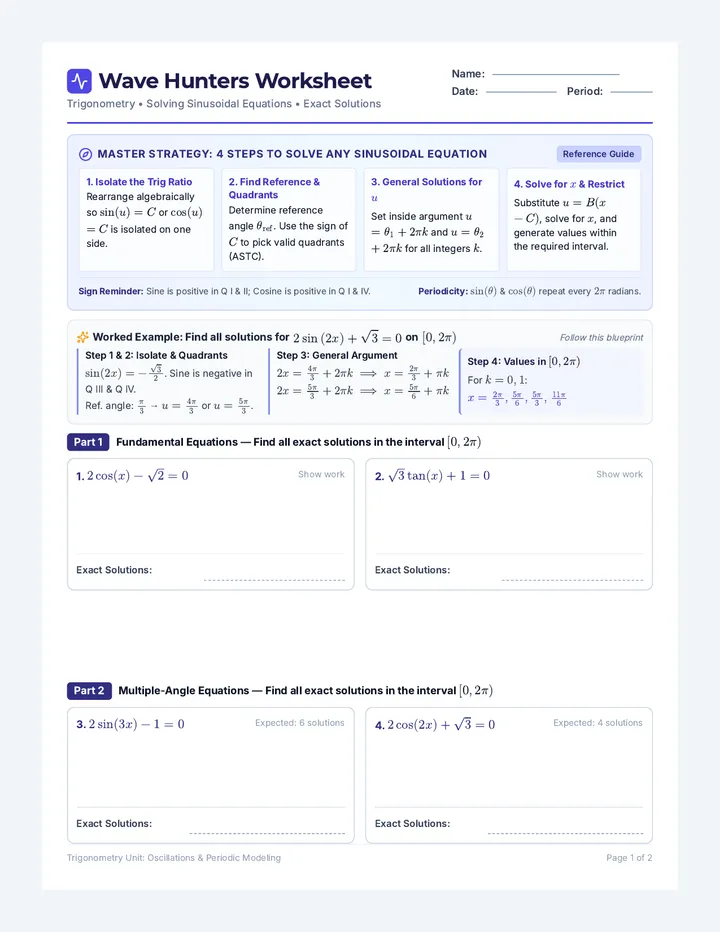
Wave Hunters Worksheet

Math and Economics

A secondary curriculum sequence covering advanced mathematical modeling alongside foundational economic systems and financial literacy concepts.

JT

Jasia Tahir

4
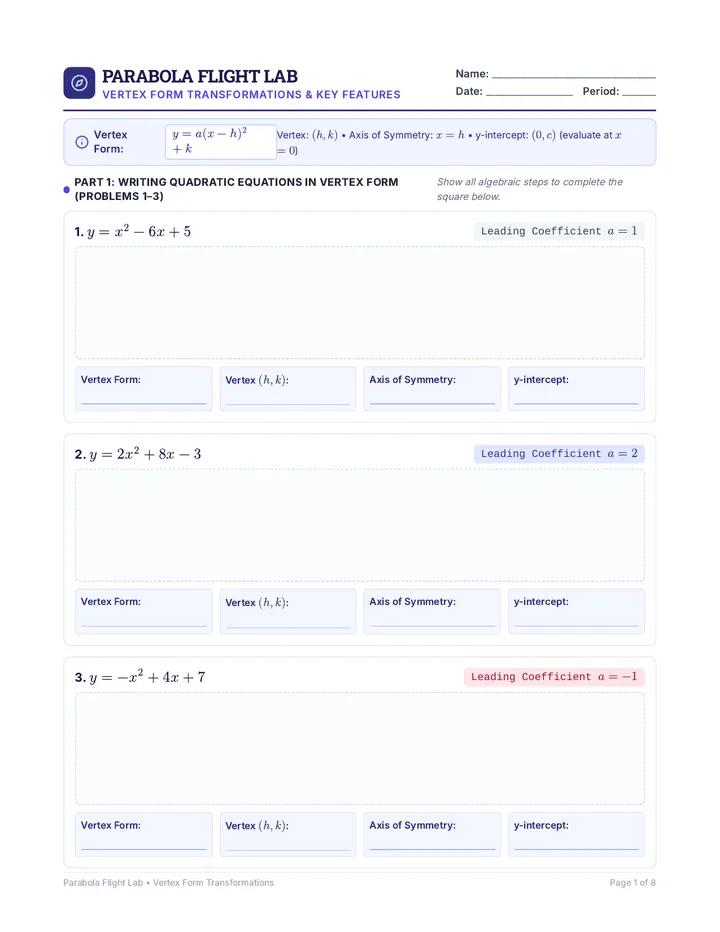
Parabola Flight Worksheet

Parabola Flight Lab

A comprehensive quadratic functions lesson exploring vertex form transformations, graphing quadratic equations and inequalities, and modeling vertical motion projectile problems. Students master completing the square, key feature identification, and real-world trajectory analysis.

AR

Angie Rice

2
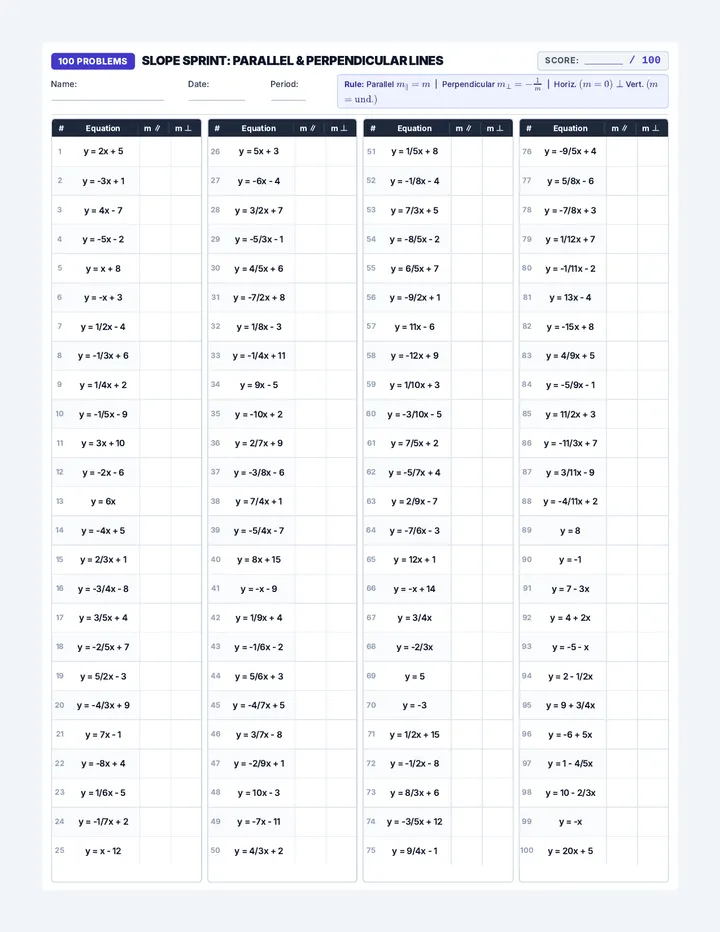
Slope Sprint Worksheet

Slope Sprint Worksheet

A high-density 100-question practice worksheet designed for rapid mastery of parallel and perpendicular slopes from slope-intercept equations. All one hundred problems are compactly formatted onto a single printable page with dedicated answer columns and single-line equations.

J

jeffreychadwick.inspiretx

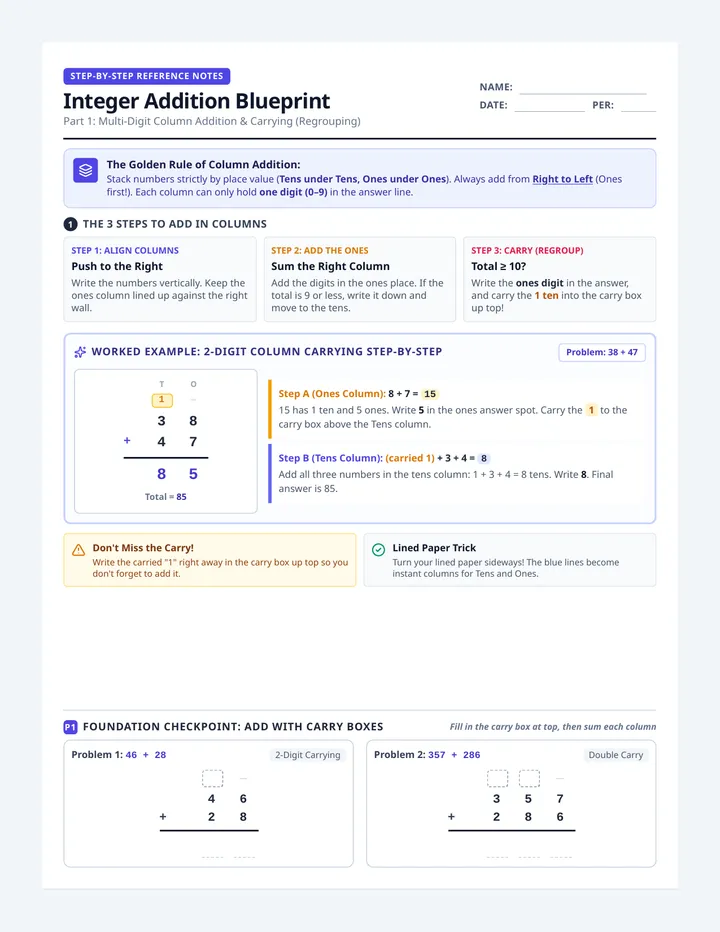
Integer Addition Blueprint Notes Sheet

Integer Operations Mastery

A comprehensive 9th-grade algebra readiness sequence covering addition with regrouping and conceptual integer multiplication through skip counting and repeated addition.

S

Shannon

3
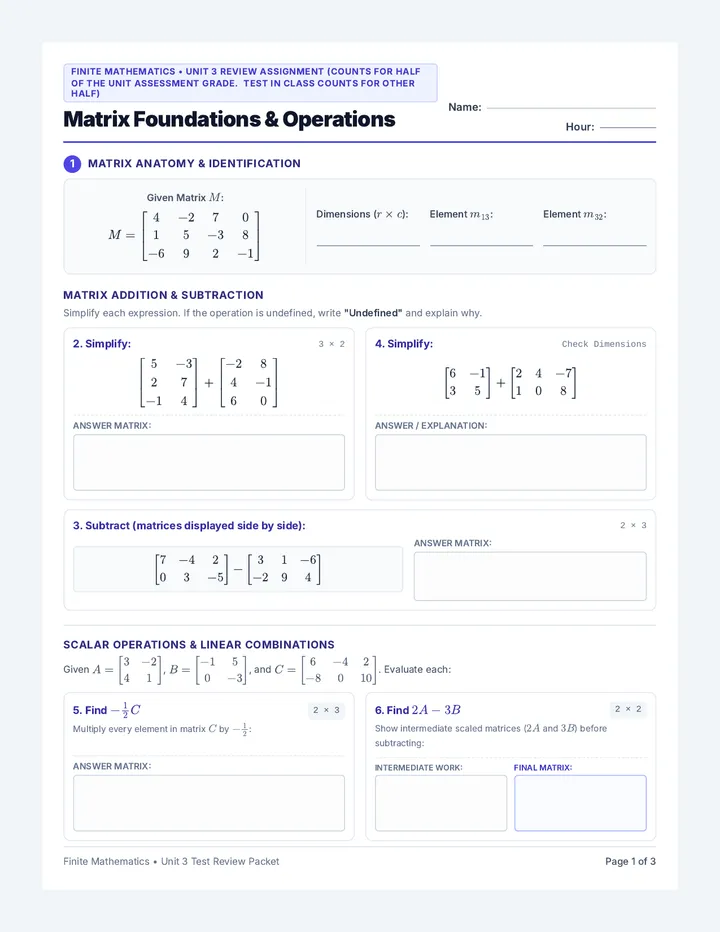
Matrix Systems Review Worksheet

Matrix Mastery

A high school finite mathematics unit review introducing matrix anatomy, operations, matrix multiplication, linear systems solved by graphing and elimination, and augmented matrices with calculator-based RREF applications.

RB

Ronald Berg

2
Parabola Flight Answer Key

Parabola Flight Answer Key

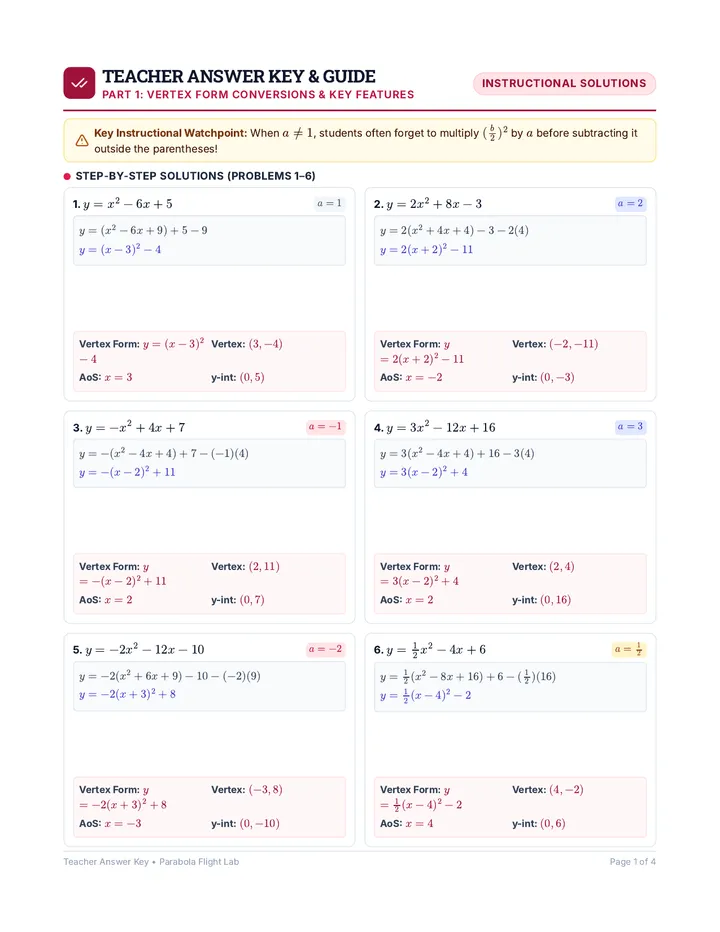
Detailed 4-page teacher answer key and instructional guide containing complete algebraic derivations, key feature answers, accurate coordinate graphs with shaded inequalities, and step-by-step vertical motion solutions.

AR

Angie Rice

Graph Steepness Slides

Rise and Run

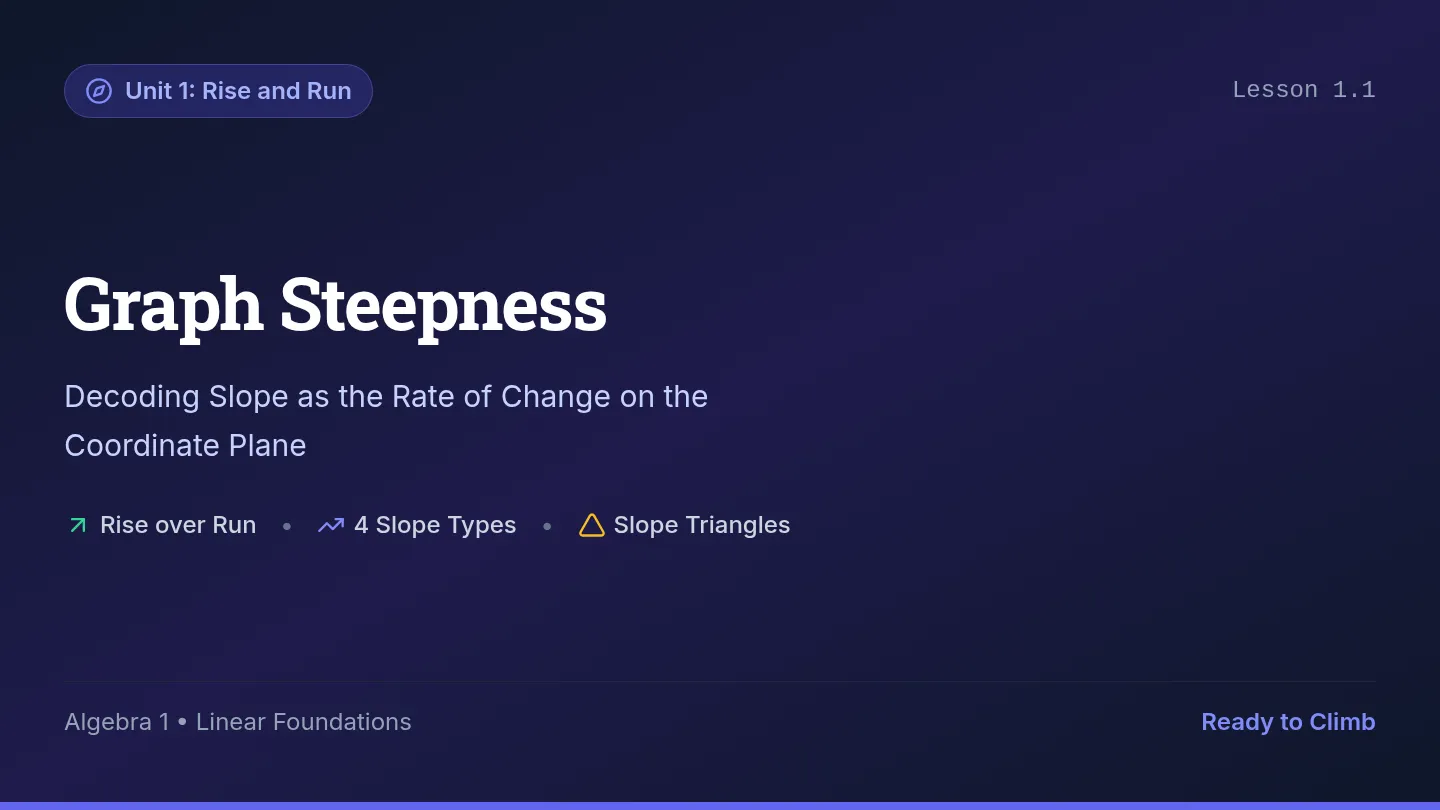
A hands-on, two-part unit exploring slope as a rate of change, visual steepness on coordinate planes, and algebraic calculations using coordinate pairs. Students transition smoothly from counting rise and run on graphs to mastering the slope formula in real-world contexts.

K

kstanfield

6
Data Detective Assessment

Statistics Foundations

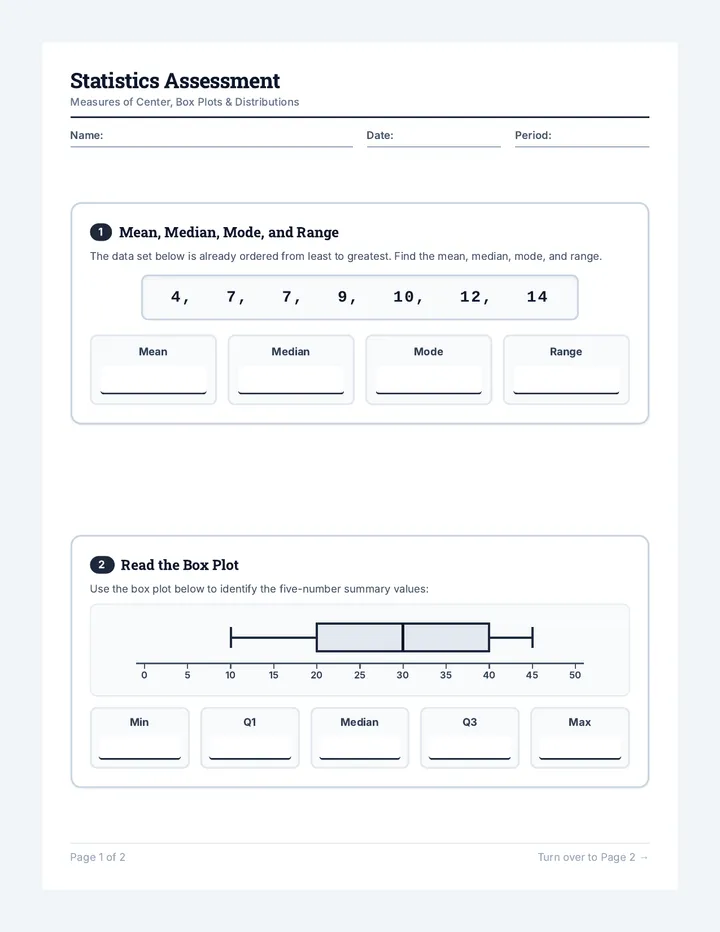
A foundational statistics lesson focusing on calculating measures of center and spread, constructing and interpreting box plots, and recognizing distribution shapes.

CF

Chad Forde

2
Parabola Flight Worksheet

Parabola Flight Worksheet

Comprehensive 4-page student worksheet containing 6 vertex form conversions with key features, 4 quadratic equation and inequality graphing problems with coordinate grids, and 10 vertical motion application word problems.

AR

Angie Rice

Circle Dynamics Lesson Plan

Trig Arc

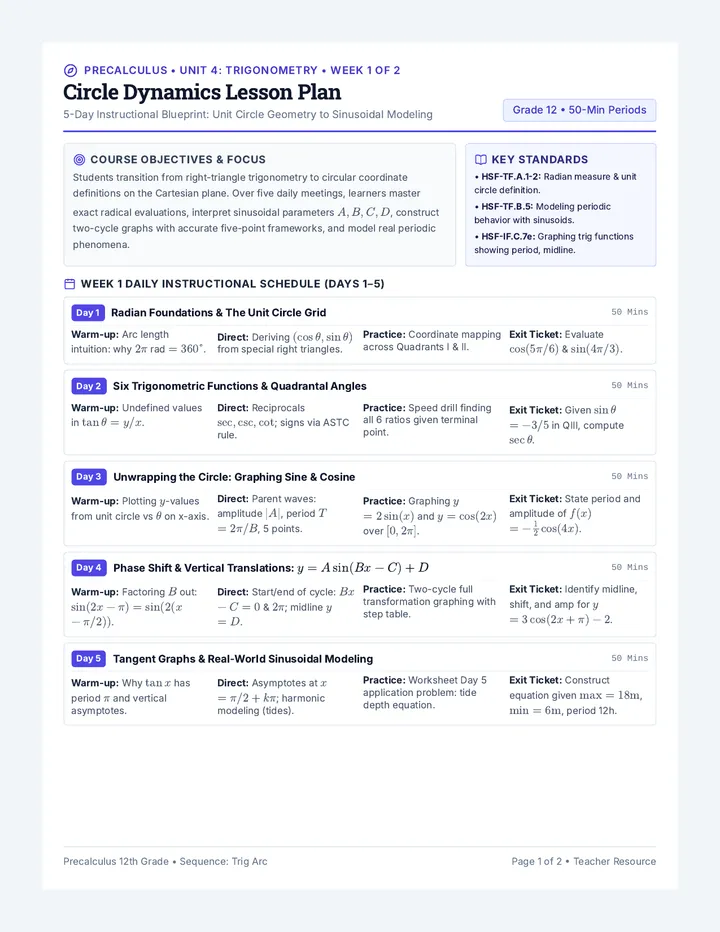
A complete 10-day Precalculus trigonometry unit for 12th grade spanning two weeks of daily classes, covering radian foundations, unit circle values, sinusoidal graphs and transformations, periodic modeling, analytical identities, and equation solving.

JT

Jasia Tahir

24