Foundations Slides Foundations & Formulas
Algebra Archive Review: Day 1
Functions Inequalities Literal Equations
Today's Roadmap
Identifying Functions
Master sets, mapping, and the Vertical Line Test.
Function Notation
Evaluating \(f(x)\) for complex expressions.
Domain & Range
Determining bounds from graphs and scenarios.
Literal Equations
Isolating variables in multi-variable formulas.
Is it a Function?
Archive Ref: P5, P8
A relation is a function if and only if every input (\(x\)) has exactly one output (\(y\)).
Ordered Pairs
Check for repeated x-values with different y-values.
{(2,3), (4,5), (2,6)}
Graphs
Use the Vertical Line Test (VLT).
Equations
Solve for \(y\). Is there only one result?
\(y = 2x + 1\)
Evaluating \(f(x)\)
Archive Ref: P7, P17
Example 1
If \(f(n) = (n+2)^2 - 4n\), find \(f(-3)\).
Example 2
If \(g(x) = \frac{\sqrt{x+7}}{2x-1}\), find \(g(2)\).
Strategy Tip
Always use parentheses when substituting!
Be careful with signs (especially negatives).
Follow PEMDAS/GEMA order of operations.
For fractions, simplify the numerator and denominator separately first.
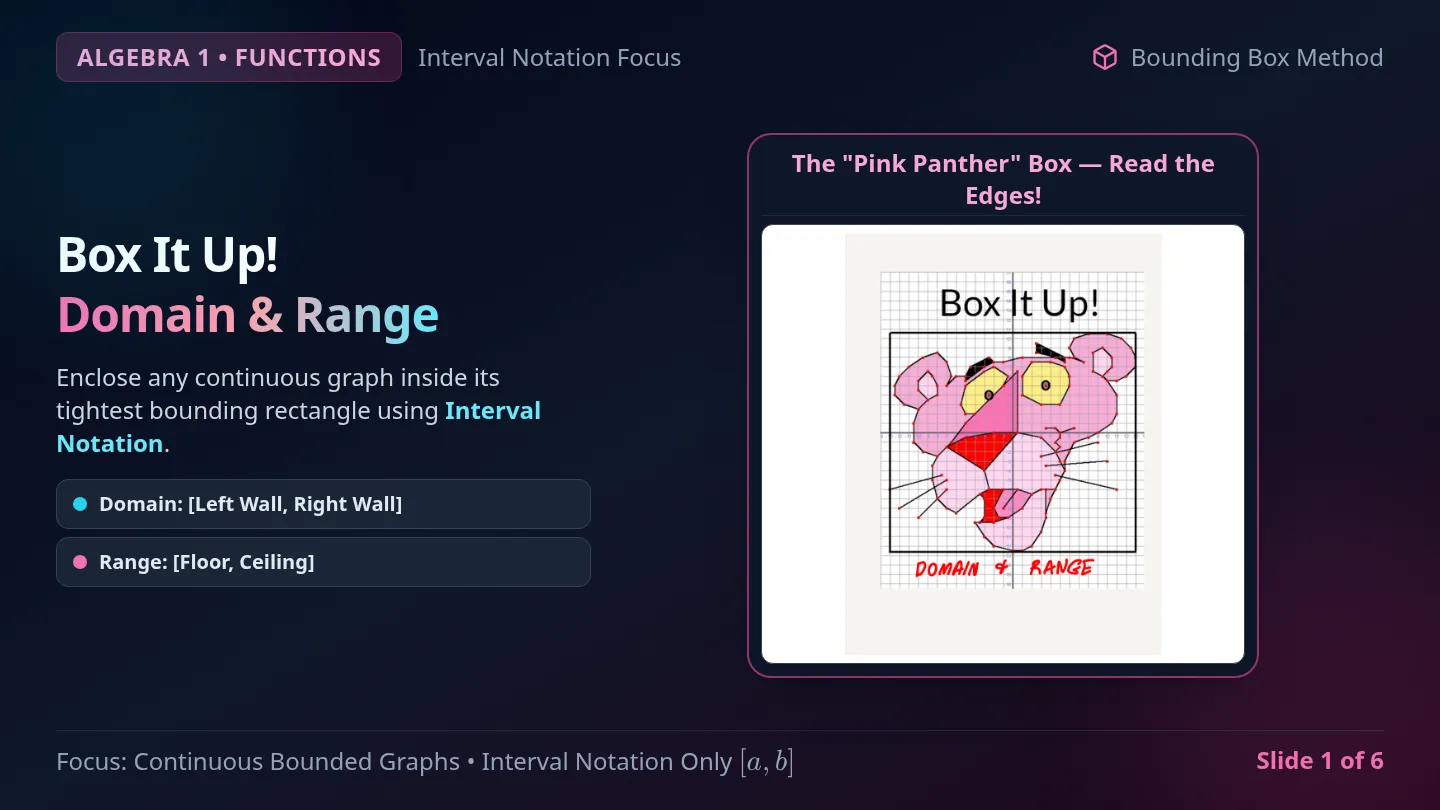
The Bounds: Domain & Range
Archive Ref: P1, P29
Domain (Inputs)
All possible \(x\)-values. Look Left to Right.
"How far left does the graph go? How far right?"
Range (Outputs)
All possible \(y\)-values. Look Bottom to Top.
"What is the lowest point? What is the highest point?"
Real-World Note (P24):
If we are counting "whole things" (people, songs, cars), the domain is whole numbers or integers, not all real numbers.
Multi-Step Inequalities
Archive Ref: P18, P30
Solve for \(y\):
\(3(y - 5) \le 5(y + 1)\)
1. Distribute across parentheses.
2. Move all \(y\) terms to one side.
3. Move constants to the other side.
4. Divide/Multiply (Watch the flip!).
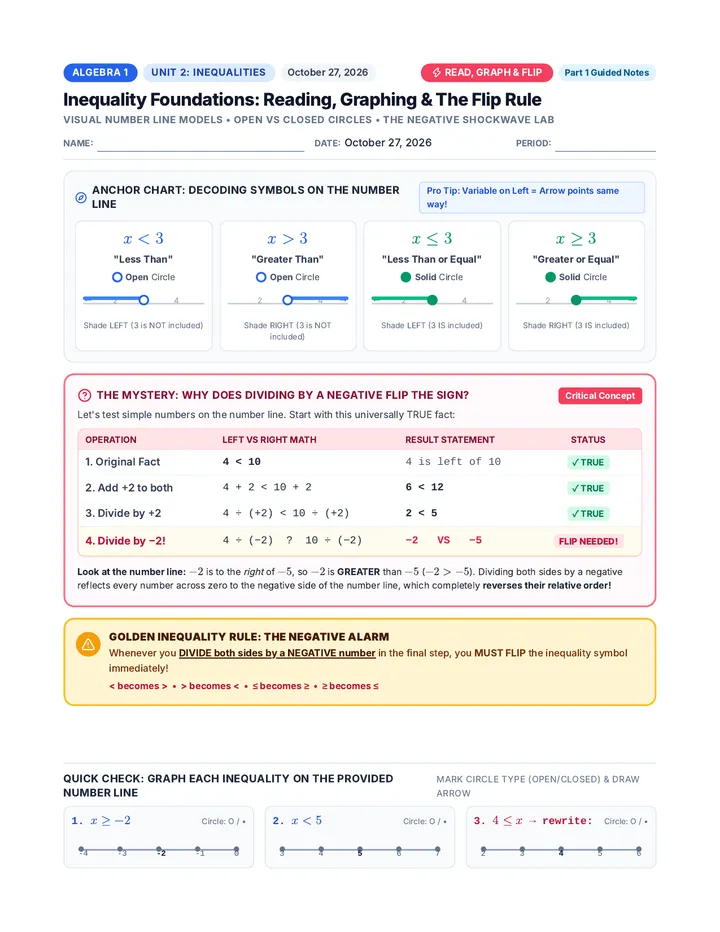
THE FLIP RULE
When you multiply or divide both sides by a negative number, you MUST flip the inequality sign.
Check Your Answer
Pick a number in your solution set and plug it into the original inequality. Does it make a true statement?
Literal Equations (Variable Juggling)
Archive Ref: P3, P22
Solve the formula for \(w\):
\(P = 2l + 2w\)
The Mission
Isolate the specified variable using inverse operations.
Common Trap
Watch out for variables in denominators. Multiply to clear them first!
Decoding Word Problems
Archive Ref: P12, P34, P35
Archive Task: The Snowboard Case
"Sarah wants to buy a snowboard for $650. She has $150 saved. She earns $100/week babysitting and saves 4/5 of it for the board."
Translate to Inequality:
\(150 + \frac{4}{5}(100)w \ge 650\)
Keyword Decoder
"At least": \(\ge\)
"No more than": \(\le\)
"Is": \(=\)
"Initial cost": y-intercept (\(b\))
"Per week/item": slope (\(m\))
Lesson 1: Exit Check
Quickly solve these on your scratchpad!
Check 1: Literal Equations
Solve for \(h\):
\(V = \frac{1}{3}\pi r^2 h\)
Check 2: Function Value
If \(f(x) = x^2 - 5x + 2\), find \(f(-2)\).
A) -12 B) 16 C) 8 D) -4
Submit your scratchpad before you leave!
Foundations Worksheet Rev Foundations & Formulas
Algebra Archive Review: Lesson 1 Practice
Name:
Date:
Part I: Foundations Review
The range of the function \(f(x) = x^2 - 4x + 1\) is all real numbers
(1) Less than or equal to -3
(2) Greater than or equal to -3
(3) Less than or equal to 1
(4) Greater than or equal to 1
The volume of a cylinder is given by the formula \(V = \pi r^2 h\). Which equation is correctly solved for \(r\)?
(1) \(r = \sqrt{\frac{V}{\pi h}}\)
(2) \(r = \frac{V}{\pi h}\)
(3) \(r = \sqrt{V - \pi h}\)
(4) \(r = \frac{\sqrt{V}}{\pi h}\)
Marcus wrote four sets of ordered pairs. Which set represents a function?
(1) \(\{(1,2), (3,4), (1,5), (6,7)\}\)
(2) \(\{(0,1), (0,2), (0,3), (0,4)\}\)
(3) \(\{(-2,4), (-1,1), (0,0), (1,1)\}\)
(4) \(\{(5,10), (5,15), (10,20), (10,25)\}\)
If \(g(x) = \frac{\sqrt{4x+1}}{3x-2}\), what is the value of \(g(2)\)?
(1) \(\frac{3}{2}\)
(2) \(\frac{3}{4}\)
(3) \(\frac{3}{8}\)
(4) \(\frac{9}{4}\)
Part II: Show Your Thinking
Solve the following inequality algebraically for \(x\):
\(5(x - 2) \ge 3(2x + 1)\)
Jada wants to save at least $850 for a new laptop. She currently has $210 in her savings account. Every week, she earns $120 from her part-time job and plans to save \(\frac{2}{3}\) of it for the laptop.
Write an inequality that can be used to determine the minimum number of weeks, \(w\), Jada needs to work to have enough money for the laptop.
Determine and state the minimum number of full weeks Jada needs to work to purchase the laptop.
A local theater sells tickets for $12.50 each. The function \(C(t) = 12.50t\) represents the total cost for \(t\) tickets. State an appropriate domain for this function in the context of the problem and justify your answer.
Foundations Teacher Guide Lesson 1: Facilitation Guide
Foundations & Formulas
75-Minute Pacing Guide
Warm-Up: Notations & Relations 10 min
Direct Instruction: Slides 1-5 15 min
Guided Practice: Slides 6-8 + Worksheet Q1-3 20 min
Independent Lab: Worksheet Q4-7 20 min
Debrief & Exit Ticket: Slide 9 10 min
Key Concepts & Strategies
Function Identification
Remind students that "Function" means "Unique Output." In ordered pairs, look for repeat \(x\)-values. On graphs, use the Vertical Line Test. Students often confuse the VLT with the Horizontal Line Test (which checks for one-to-one/inverses).
Literal Equations
Stress the use of inverse operations. If \(r\) is squared, we square root. If \(\pi\) is multiplied, we divide. The most common error is forgetting to apply the operation to the entire other side.
Common Misconceptions
Inequality Signs: Students frequently forget to flip the sign when multiplying or dividing by a negative.
Intervention: Ask "If -2 < 5, is -(-2) < -(5)?" to show the numerical logic.
Domain Context: Students often default to "all real numbers."
Intervention: Point to the Theater Problem (Q7). Can we buy 2.5 tickets? No—it must be whole numbers.
Discussion Prompts
"How can you tell the difference between the domain and the range just by looking at the axes?"
"If a relation is NOT a function, does that mean we can't graph it? Why or why not?"
Systems Slides Systems & Situations
Algebra Archive Review: Day 2
Systems of Equations Systems of Inequalities Modeling
Today's Roadmap
Function Features
Intercepts, intervals of increase/decrease, and rate of change.
Systems Decoded
Solving systems of equations algebraically and graphically.
Inequality Zones
Shading solution sets for systems of linear inequalities.
Real-World Systems
Translating "wordy" situations into solvable systems.
Comparing Function Features
Archive Ref: P10, P20
Y-Intercept Check
Which has the greatest y-intercept?
1. \(f(x) = 4x + 2\)
2. \(2x + 4y = 12\)
3. Line through (0, 5)
Looking for \(b\)
In graphs, look at where it crosses the y-axis.
In equations, solve for \(y\) to find \(y = mx + b\).
In points, it's the value of \(y\) when \(x = 0\).
Solving Systems: Algebraic
Archive Ref: P16, P25
Substitution
\(y = 3x - 1\)
\(2x + y = 9\)
Elimination
\(3x + 2y = 12\)
\(x - 2y = 4\)
Pro Tip: Equivalent Systems
Two systems have the same solution if one equation is a multiple of another, or if you add/subtract the equations.
System 1: \(x+y=5, x-y=1\)
Shading the Solution Set
Archive Ref: P4, P25
The Checklist:
Boundary: Solid (\(\ge, \le\)) or Dashed (\(>, <\))?
Shading: Above (\(>, \ge\)) or Below (\(<, \le\))?
Label the solution set with a big S!
Is a point in the set?
A point is in the solution set ONLY if it is in the overlapping shaded region.
Note: If it falls on a dashed line, it is NOT a solution.
Translating Situations
Archive Ref: P9, P23
"A group of 15 friends went to the movies. Some bought student tickets for $8 and others bought adult tickets for $12. The total cost was $156."
Equation 1: Quantity
\(s + a = 15\)
Equation 2: Value
\(8s + 12a = 156\)
Total Items
Total Money
Intersection: \(f(x) = g(x)\)
Systems Worksheet Systems & Situations
Algebra Archive Review: Lesson 2 Practice
Name:
Date:
Part I: Systems & Features
Which function has the greatest y-intercept?
(1) \(g(x) = 5x - 2\)
(2) \(3x + 2y = 8\)
(3) The line passing through (1, 6) with a slope of 1.
(4) A line with an x-intercept of 5 and a slope of -2.
A system of equations is given below:
\(x + 3y = 9\) \(2x - y = 4\)
Which system of equations does not have the same solution?
(1) \(2x + 6y = 18, 2x - y = 4\)
(2) \(x + 3y = 9, 6x - 3y = 12\)
(3) \(3x + 2y = 13, 2x - y = 4\)
(4) \(x + 3y = 9, x - y = 2\)
Leo has quarters and dimes totaling $4.15. The number of dimes he has is 4 more than three times the number of quarters, \(q\). Which equation could be used to find the number of quarters he has?
(1) \(0.25q + 0.10(3q + 4) = 4.15\)
(2) \(0.25(3q + 4) + 0.10q = 4.15\)
(3) \(q + (3q + 4) = 4.15\)
(4) \(0.25q + 0.10(3q - 4) = 4.15\)
Part II: Graphing & Modeling
Solve the following system of inequalities graphically. Label the solution set S.
\(y \le -2x + 4\) \(y > x - 3\)
Is the point (0,0) in the solution set? Justify your answer.
At a bake sale, cookies cost $1.50 each and brownies cost $2.25 each. A total of 42 items were sold, and the bake sale brought in $78.75.
Part A: Write a system of equations to represent the number of cookies, \(c\), and brownies, \(b\), that were sold.
Part B: Solve your system of equations algebraically to determine exactly how many cookies and brownies were sold.
Systems Teacher Guide Lesson 2: Facilitation Guide
Systems & Situations
75-Minute Pacing Guide
Warm-Up: Greatest Y-Intercept Comparison 10 min
Direct Instruction: Slides 1-4 (Systems Algebraic) 15 min
Interactive Shading: Slides 5 + Worksheet Q4 20 min
Scenario Modeling: Slide 6 + Worksheet Q3, Q5 20 min
Debrief & Exit Ticket: Slide 8 10 min
Key Concepts & Strategies
Equivalent Systems
Help students see that multiplying an entire equation by a constant doesn't change the "line"—it just scales it. This is the foundation of the elimination method. Students often forget to multiply the constant on the right side of the equals sign.
Graphing Inequalities
Use the "Test Point" method (usually (0,0)) for shading. This is more reliable than "shade up/down" when the equation isn't solved for \(y\). Emphasize that a dashed line means the boundary itself is NOT part of the solution.
Common Misconceptions
Quantity vs. Value: In coin or theater problems, students often write \(0.25q + 0.10d = 15\) (mixing money and counts).
Intervention: Label the units. "Equations should be (Count) + (Count) = (Total Count) or (Money) + (Money) = (Total Money)."
Intersection Solutions: When solving \(f(x) = g(x)\), students often give the \(y\)-coordinate instead of the \(x\)-coordinate.
Intervention: Ask "Are we finding where they meet, or the value of \(x\) that makes them equal?"
Discussion Prompts
"When is substitution faster than elimination? When is elimination better?"
"If two lines are parallel, what happens when you try to solve the system algebraically?"
Polynomial Slides Polynomial Power
Algebra Archive Review: Day 3
Factoring Polynomial Ops Rationality
Today's Roadmap
The Product Power
Multiplying binomials and trinomials with precision.
Mastering Factoring
Trinomials, Difference of Squares, and GCF.
Exponent Equivalents
Analyzing powers of powers and fractional exponents.
Rational or Irrational?
Predicting sums and products of real numbers.
Standard Form Multiplication
Archive Ref: P14, P17
Multiply: \((2x - 3)(x^2 + 4x - 5)\)
The Distributive Strategy
\(2x(x^2 + 4x - 5)\)
PLUS
\(-3(x^2 + 4x - 5)\)
Standard Form Rule
Final answers must be written with exponents in decreasing order.
Example: \(3x^3 + 5x^2 - x + 10\)
The Factoring Toolbox
Archive Ref: P6, P11, P13
1. GCF
Always check this FIRST!
\(4x^2 + 8x \rightarrow 4x(x + 2)\)
2. D.O.P.S.
Difference of Perfect Squares.
\(x^2 - 49 \rightarrow (x+7)(x-7)\)
3. Trinomials
"Multiply to C, Add to B."
\(x^2 + 5x + 6 \rightarrow (x+2)(x+3)\)
Advanced: "Factor Completely"
Archive Ref: P17, P31
Archive Challenge:
\(2x^2 - 18x + 40\)
1. Pull out the GCF of 2.
2. Factor the trinomial inside.
\(2(x - 4)(x - 5)\)
Don't Stop!
If the question says "Factor Completely," there is almost always more than one step.
Check if your factors can be factored again (especially DOPS!).
Rational vs Irrational
Archive Ref: P18, P21
Rational (R)
Terminating or repeating decimals.
Whole numbers: \(5, -2, 0\)
Fractions: \(\frac{2}{3}, 0.75\)
Perfect Roots: \(\sqrt{16}, \sqrt{100}\)
Irrational (I)
Decimals that never end or repeat.
Non-Perfect Roots: \(\sqrt{2}, \sqrt{7}\)
Famous Constants: \(\pi\)
The Golden Rules:
R + R = Rational R + I = Irrational I \(\times\) I = Varies!
Lesson 3: Exit Check
Quickly solve these on your scratchpad!
Polynomial Worksheet Polynomial Power
Algebra Archive Review: Lesson 3 Practice
Name:
Date:
Part I: Polynomial Foundations
Which expression is equivalent to \(81n^2 - 1\)?
(1) \((9n + 1)(9n - 1)\)
(2) \((9n - 1)(9n - 1)\)
(3) \((40n + 1)(40n - 1)\)
(4) \((81n + 1)(81n - 1)\)
Which of the following shows \(x^2 - 4x - 12\) factored completely?
(1) \((x - 6)(x + 2)\)
(2) \((x + 6)(x - 2)\)
(3) \((x - 4)(x + 3)\)
(4) \((x - 12)(x + 1)\)
What is the product of \(3x + 4\) and \(x^2 - 2x + 5\)?
(1) \(3x^3 - 2x^2 + 7x + 20\)
(2) \(3x^3 + 2x^2 - 7x + 20\)
(3) \(3x^3 - 10x^2 + 7x + 20\)
(4) \(3x^3 - 2x^2 + 23x + 20\)
Part II: Skills Practice
Factor the following expression completely:
\(3x^2 - 21x + 30\)
Factor the following expression completely:
\(x^4 - 16\)
Is the sum of \(3\sqrt{2}\) and \(\sqrt{18}\) rational or irrational? Justify your answer.
Is the product of \(\sqrt{5}\) and \(\sqrt{20}\) rational or irrational? Justify your answer.
Polynomial Teacher Guide Lesson 3: Facilitation Guide
Polynomial Power
75-Minute Pacing Guide
Warm-Up: Identifying Perfect Squares 10 min
Direct Instruction: Slides 1-5 (Factoring Methods) 20 min
Guided Practice: Slides 6 + Worksheet Q1-3, Q6 15 min
Independent Lab: Worksheet Q4, Q5, Q7 20 min
Debrief & Exit Ticket: Slide 7 10 min
Key Concepts & Strategies
Factoring Hierarchy
Students must internalize the order: 1. GCF, 2. Count Terms (2 = DOPS?, 3 = Trinomial?). The biggest error is jumping to trinomial factoring while ignoring a GCF that could have made the numbers easier.
Rational Number Logic
Help students distinguish between \(\sqrt{4}\) (rational) and \(\sqrt{8}\) (irrational). Remind them that perfect squares are the only whole numbers with rational square roots. For the Regents, they MUST provide a justification, not just a label.
Common Misconceptions
Factoring Incompletely: Students factor out a GCF and stop, or factor \(x^4-1\) into \((x^2+1)(x^2-1)\) and stop.
Intervention: Always ask "Can any of these parentheses be broken down further?" at the end of every problem.
Standard Form Errors: When multiplying polynomials, students often combine terms that are not "like" (e.g., adding \(x^2\) and \(x\)).
Intervention: Use the "Box Method" (Area Model) to keep terms organized and clear.
Discussion Prompts
"Why is the product of two rational numbers ALWAYS rational?"
"Is there such a thing as a 'sum of squares' that can be factored? Why or why not?"