Lenny.com
Explore
Create
ActivitiesNewMathEnglish Language ArtsScience & EngineeringSocial StudiesGlobal LanguagesHealth & Physical EducationSpecial EducationCounseling & Life SkillsArts & CreativityESL
Lenny.com
Lenny.com
Explore
Create
ActivitiesNewMathEnglish Language ArtsScience & EngineeringSocial StudiesGlobal LanguagesHealth & Physical EducationSpecial EducationCounseling & Life SkillsArts & CreativityESL
Lenny.com
Lenny.com

Solutions

Lenny for EducatorsLenny for SchoolsLenny for Districts

Product

ExploreSign inCreateSupportAbout

Resources

Getting startedMTSS Acceleration Program

© 2026 Lenny Learning Inc.

TermsPrivacyAccessibility
LinkedInInstagramX
Lenny
MathNumbers & CountingCounting ObjectsNumber NamesComparing NumbersNumber OperationsCounting SequenceNumbers 0-10Place Value Understanding and SystemAdd and Subtract Within 20Addition and Subtraction ConceptsAddition and Subtraction EquationsAddition and Subtraction ProblemsFoundations for MultiplicationMultiplication and Division PropertiesMultiply and Divide Within 100Multiplication and Division ProblemsFactors and MultiplesProperties of OperationsPatterns and RelationshipsGenerate and Analyze PatternsMulti-Digit ArithmeticPlace Value OperationsMulti-Digit and Decimal OperationsNumerical ExpressionsFour Operations and PatternsFour Operations Problem SolvingMeasurement & DataMeasurable AttributesMeasuring LengthsMeasure and Estimate Lengths in Standard UnitsRelate Addition and Subtraction to LengthClassifying and Counting ObjectsTime and MoneyArea Concepts and MeasurementPerimeter and Area MeasuresAngle Concepts and MeasurementTime, Volume, and MassMeasurement Unit ConversionsGeometryIdentifying ShapesShapes and AttributesShape Attributes and ReasoningShapes and CompositionClassifying 2D FiguresGeometric Figures and RelationshipsLines, Angles, and ShapesAngle, Area, and VolumeGeometric MeasurementVolume of 3D ShapesCoordinate Plane ApplicationsTransformations in the PlaneCongruence and SimilarityUnderstand congruence in terms of rigid motionsSimilarity and TransformationsProve Theorems Involving SimilarityPythagorean TheoremTrigonometry for General TrianglesMake Geometric ConstructionsProve Geometric TheoremsTheorems About CirclesFind Arc Lengths And Areas of Sectors of CirclesVolume FormulasRelationships Between Two-Dimensional and Three-Dimensional ObjectsProve Simple Geometric Theorems AlgebraicallyTranslate Between Geometric Description and Equation for Conic SectionApply Geometric Concepts in Modeling SituationsFractions & DecimalsFractions as NumbersBuilding FractionsFraction Equivalence and OrderingAdding and Subtracting FractionsMultiplying and Dividing FractionsDividing FractionsDecimal FractionsMulti-Digit Computation and FactorsAdd, Subtract, Multiply, and Divide Rational NumbersRational Number SystemIrrational Numbers and ApproximationsRatiosRatios and ProportionsProportional RelationshipsUnit RateAlgebraAlgebraic ExpressionsGenerate Equivalent ExpressionsQuantitative RelationshipsProportional Relationships and Linear EquationsEquations and InequalitiesEquation Solving and ReasoningLinear Equations and SystemsGraph Equations and InequalitiesSystems of EquationsReal-World Algebraic ProblemsQuantitative Reasoning with UnitsExpression StructureEquivalent Expression FormsRadicals and Integer ExponentsRational ExponentsRational and Irrational NumbersPolynomial OperationsPolynomial IdentitiesPolynomial Zeros and FactorsRational ExpressionsComplex Number OperationsComplex Numbers in PolynomialsComplex Numbers on PlaneStatistics & ProbabilityRepresent and Interpret DataData DistributionsStatistical VariabilityProbability ModelsCompound Event ProbabilitiesStatistical SamplingInterpret Categorical and Quantitative DataBivariate Data PatternsInterpret Linear ModelsComparing Two PopulationsRandom Processes in StatisticsIndependence and Conditional ProbabilityExpected ValuesProbability-Based Decision MakingStatistical Inference and ConclusionsFunctionsFunction Concepts and NotationDefine and Compare FunctionsInterpret Functions in ContextAnalyze Function RepresentationsModel Relationships with FunctionsIdentify Linear vs Exponential GrowthDistinguish Between Function TypesCompare Growth RatesInterpret Function ExpressionsBuild Functions from RelationshipsConstruct and Model FunctionsTransform and Combine FunctionsModel Comparison and SelectionSolve Exponential EquationsTrigonometryTrigonometric Ratios Involving Right TrianglesTrigonometric Functions and Unit CircleModel with Trigonometric FunctionsTrigonometric IdentitiesVectors & MatricesIntroduction to Vectors and MatricesVector QuantitiesVector OperationsMatrix OperationsCalculusLimits and ContinuityDerivative Concepts and NotationDerivative Rules and TechniquesApplications of DerivativesOptimization ProblemsRelated RatesCurve Sketching and AnalysisIntegration Concepts and NotationAntiderivatives and Indefinite IntegralsDefinite Integrals and AreaFundamental Theorem of CalculusIntegration TechniquesApplications of IntegrationDifferential EquationsSequences and SeriesParametric and Polar FunctionsVector-Valued Functions

Polygon Slicers

A three-lesson unit guiding sixth-grade mathematicians to decompose composite polygons into rectangles and triangles to calculate total area. Students learn to spot component shapes, draw strategic slice lines, deduce missing dimensions, and justify multiple decomposition pathways.

MJMeg Jones
Shape Spotters

Students learn to identify familiar sub-shapes within irregular polygons and experiment with sketching different vertical, horizontal, and diagonal decomposition lines on grid canvases.

Area By Parts

Students calculate the area of decomposed figures by deducing missing side lengths, computing individual rectangle and triangle areas, and finding totals using additive and subtractive methods.

Strategy Showdown

Students analyze and compare multiple decomposition methods for identical complex polygons, articulate mathematical justifications, and apply their skills to an architectural blueprint performance task.

Polygon Slicers

A three-lesson unit guiding sixth-grade mathematicians to decompose composite polygons into rectangles and triangles to calculate total area. Students learn to spot component shapes, draw strategic slice lines, deduce missing dimensions, and justify multiple decomposition pathways.

MJMeg Jones

Efficiency: "Why is decomposing into 1 rectangle and 1 triangle easier than decomposing into 3 triangles?"

Cut Line Quest Worksheet: Worked Solutions

Part 1: Hidden Shapes & Part 2: Dual Slicing

Figure 1 (L-Silhouette): Two rectangles (or one rectangle with a cutout).

Figure 2 (House): One triangle (roof) and one rectangle (base).

Strategy 1 (Vertical cut): Piece A: \(2 \times 5\) units; Piece B: \(4 \times 3\) units. Both are rectangles.

Strategy 2 (Horizontal cut): Piece 1: \(2 \times 2\) units; Piece 2: \(6 \times 3\) units. Both are rectangles.

Part 3: Slanted Edges & Complex Polygons

Figure A (Trapezoid): Vertical drop cut creates 1 rectangle (width 4, height 5) and 1 right triangle (base 3, height 5).

Figure B (House): Horizontal cut across eaves creates 1 triangle (base 6, height 2) and 1 rectangle (width 6, height 3).

Figure C (Step Polygon): 2 cuts yield 3 rectangles (e.g., \(2 \times 4\), \(2 \times 2\), and \(3 \times 1\)).

Figure D (Arrow): Vertical cut separating shaft from head creates 1 rectangle (shaft: \(4 \times 2\)) and 1 triangle (head: base 4.5, height 4).

Part 4: Mathematical Reasoning Sample Response

"Taylor's strategy (3 rectangles) is better than Jordan's (5 squares) because calculating 3 areas is faster than calculating 5, and each extra step increases the chance of a math mistake."

Differentiation Strategies

Support (Scaffolding):

Provide students with physical cardstock cutouts of the figures to fold or cut before drawing lines on paper.

Extension (Challenge):

Challenge students to design their own 8-sided polygon that can be decomposed into exactly 1 square, 1 rectangle, and 2 right triangles.

Polygon Slicers • Lesson 1 Teacher Guide Next Lesson: Lesson 2 Area by Parts Page 2 of 2

Garden Ramp Challenge

Find the total area of this trapezoid garden bed.

Hints to guide you:

• Decompose into 1 rectangle + 1 right triangle.

• Triangle base = 12 - 7 = 5 m.

• Remember to divide triangle base × height by 2!

7 m 6 m Total Base = 12 m Worksheet Ready! Let's solve!

Unit: Polygon Slicers Next: Area By Parts Worksheet

  • Vertical Stem: \(5\text{ ft} \times 6\text{ ft} = 30\text{ ft}^2\)
  • Sum: \(56\text{ ft}^2 + 30\text{ ft}^2 = \mathbf{86\text{ ft}^2}\)
  • Subtractive Breakdown:

    • Bounding Box: \(14\text{ ft} \times (4 + 6)\text{ ft} = 14 \times 10 = 140\text{ ft}^2\)
    • Two Missing Cutouts: Width of each cutout = \((14 - 5) / 2 = 4.5\text{ ft}\). Area of each = \(4.5 \times 6 = 27\text{ ft}^2\).
    • Total Cutout Area = \(27 \times 2 = 54\text{ ft}^2\).
    • Difference: \(140 - 54 = \mathbf{86\text{ ft}^2}\).

    Teaching Note: Point out to students that the additive method is much simpler here because the subtractive method requires calculating non-labeled decimal widths (\(4.5\text{ ft}\)). This reinforces choosing the most efficient strategy!

    Problem 6: Community Swimming Pool

    Total Area = 120 m²

    • Main Lap Zone (Rectangle): \(\text{base} \times \text{height} = 12\text{ m} \times 8\text{ m} = \mathbf{96\text{ m}^2}\)
    • Wading Zone (Triangle): Base = \(8\text{ m}\) (shared edge with rectangle). Height = \(6\text{ m}\). Area = \(\frac{1}{2} \times 8\text{ m} \times 6\text{ m} = \frac{48}{2} = \mathbf{24\text{ m}^2}\)
    • Total Combined Pool Area: \(96\text{ m}^2 + 24\text{ m}^2 = \mathbf{120\text{ m}^2}\)

    Observation Check: Confirm that students identified the triangle's base as the shared \(8\text{ m}\) vertical edge and its perpendicular height as the horizontal \(6\text{ m}\) distance.

    Part 4: Sample Student Reflection & Evaluation Criteria

    "I chose the additive method for the T-shape because it only took 1 cut across to make 2 rectangles (\(14 \times 4\) and \(5 \times 6\)). The subtractive box method would have made me calculate the width of two empty corners (\(4.5\text{ ft}\) each), which takes more time and has decimals."

    Full Credit Criteria: Clearly names method used, cites specific dimensions, and provides a logical reason (e.g., fewer steps, avoiding decimals).

    Partial Credit: Names method and calculates correct answer but offers vague justification (e.g., "because it was easier").

    Polygon Slicers • Lesson 2 Teacher Key Ready for Lesson 3: Strategy Showdown Page 2 of 2

    Architect Performance Task Tools: Straightedge, Pencil, Calculation Handout


    Success Criteria Ready to Draft

    The Master Architect Standard

    Your blueprint will be evaluated on precision, efficiency, and clarity of your written defense.

    1. Diagram

    Clean dashed cuts from vertex to vertex.

    2. Dimensions

    All missing lengths deduced correctly.

    3. Math Work

    Full multiplication & correct square units.

    4. Defense

    Justify why your strategy was superior.

    Polygon Slicers Sequence Finale Let the Showdown Begin!

    TOTAL FLOORING CONTRACT BUDGET: $

    Oakridge Youth Center Performance Task Sequence Complete • Excellent Work, Architect! Page 2 of 2

    Zone 1 (Gym Hall): \(40\text{ ft} \times 30\text{ ft}\)

    = 1,200 sq ft

    Zone 2 (Maker Studio): \(20\text{ ft} \times 20\text{ ft}\)

    = 400 sq ft

    Zone 3 (Reading Nook): \(\frac{1}{2} \times 20\text{ ft} \times 12\text{ ft} = 10 \times 12\)

    = 120 sq ft

    TOTAL FLOOR AREA: 1,200 + 400 + 120 = 1,720 sq ft

    Part 4: Contractor Budget Calculation

    \(1,720\text{ sq ft} \times \$4.50/\text{sq ft} = \$7,740.00\)

    Final Budget Approval: $7,740.00

    Part 3: Exemplar Full-Credit Student Memo

    "To calculate the floor area of the Oakridge Youth Center, I placed two vertical cut lines along the natural room transitions. The first cut separates the Gym Hall (\(40 \times 30 = 1,200\text{ sq ft}\)) from the Maker Studio. The second cut separates the Maker Studio (\(20 \times 20 = 400\text{ sq ft}\)) from the triangular Reading Nook (\(\frac{1}{2} \times 20 \times 12 = 120\text{ sq ft}\))."

    "An alternative method would be using a large bounding rectangle (\(72 \times 30 = 2,160\text{ sq ft}\)) and subtracting the empty space above the studio plus the two triangular cutouts outside the nook. However, that requires 4 separate subtractions and calculating multiple unstated dimensions."

    "My 3-zone additive method is more efficient because all three zones use labeled dimensions with clean whole numbers, requiring only 3 multiplications and 1 sum. This minimizes arithmetic errors and accurately yields \(1,720\text{ sq ft}\) with a total flooring cost of \(\$7,740\)."

    Sequence Wrap-Up Note: This capstone demonstrates students' mastery of CCSS 6.G.A.1 by marrying geometric decomposition with practical economic decision-making and formal mathematical communication.

    Polygon Slicers • Complete Unit Key Sequence Ready for Classroom Delivery Page 2 of 2

    You might also like

    Problem Detective Assessment

    Math Goal Mastery

    A targeted sequence of progress monitoring assessments and evaluation guides designed to measure and document key IEP mathematics benchmarks, including multi-step word problems and multi-digit operations.

    JD

    Jenny Daniels

    4
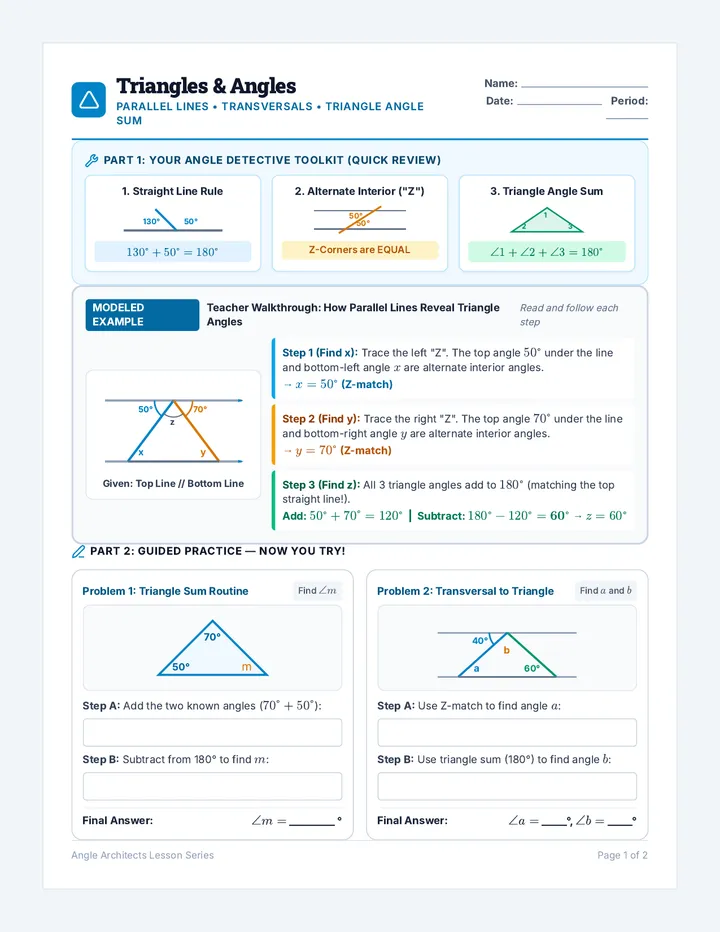
    Triangles & Angles Worksheet

    Angle Architects

    A targeted 8th-grade geometry lesson designed for students performing below grade level, bridging foundational parallel-line transversal angle relationships to the interior angle sum of triangles through visual scaffolding and worked examples.

    L

    Logan-Greene

    5
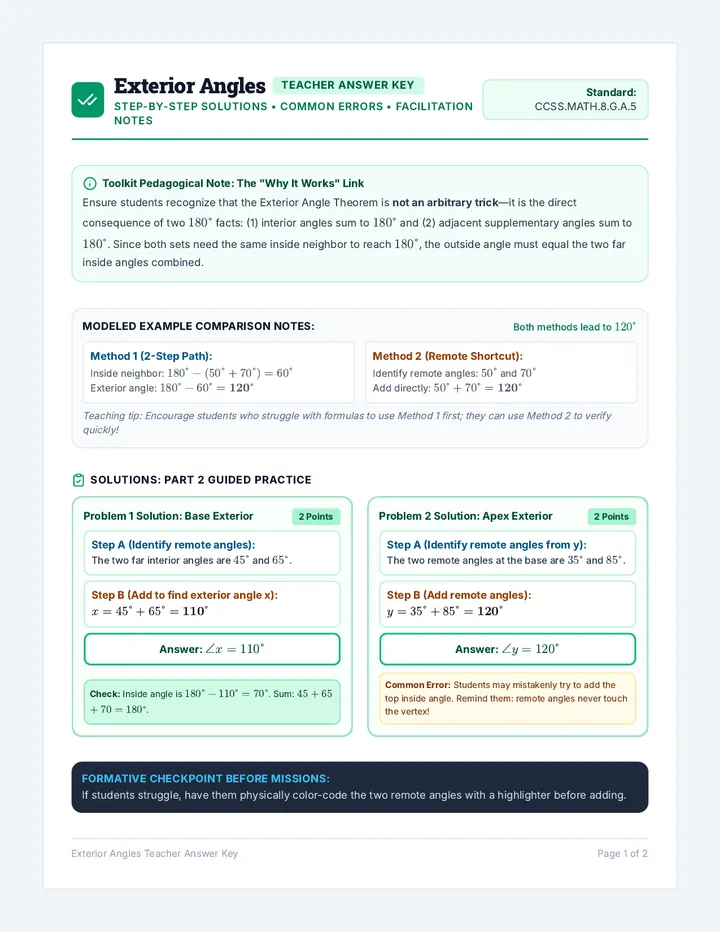
    Exterior Angles Answer Key

    Exterior Angles Answer Key

    Comprehensive teacher answer key for the Exterior Angles Worksheet, featuring step-by-step solutions for both the linear pair method and remote interior shortcut, error analysis, and scoring guidelines.

    L

    Logan-Greene

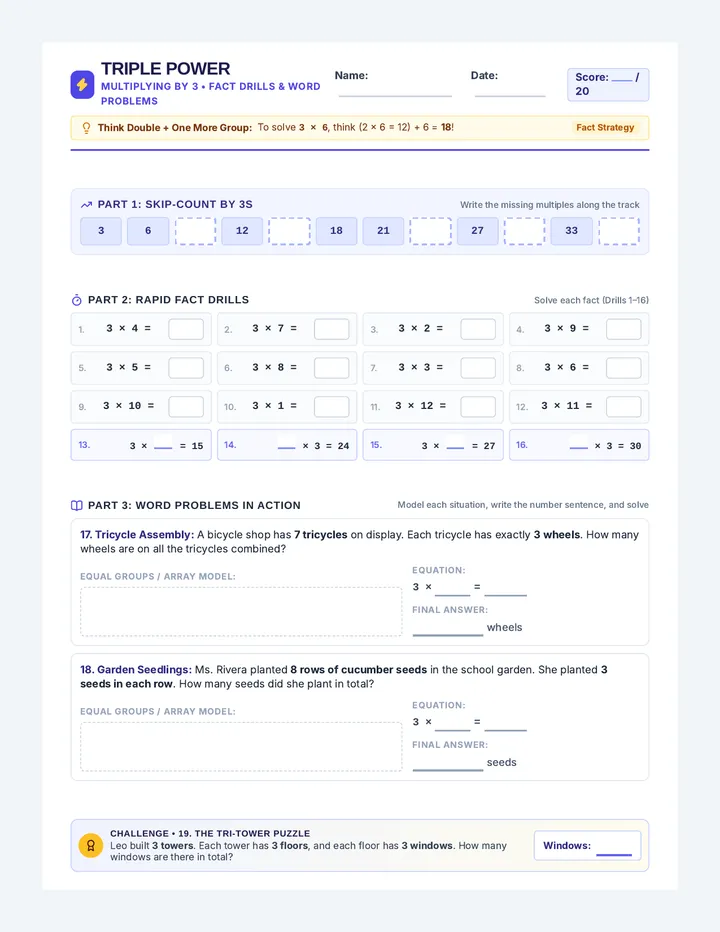
    Triple Power Worksheet

    Fact Power Academy

    A comprehensive multiplication unit guiding elementary students through foundational fact strategies, visual models, rapid drills, and contextual word problems.

    TM

    Tiffany Muniz

    4
    Division Mastery Assessment

    Division Masters

    A progress monitoring lesson focusing on multi-digit whole number division with dividends up to four digits. Students demonstrate conceptual understanding and computational fluency using visual models, partial quotients, or the standard algorithm.

    JD

    Jenny Daniels

    2
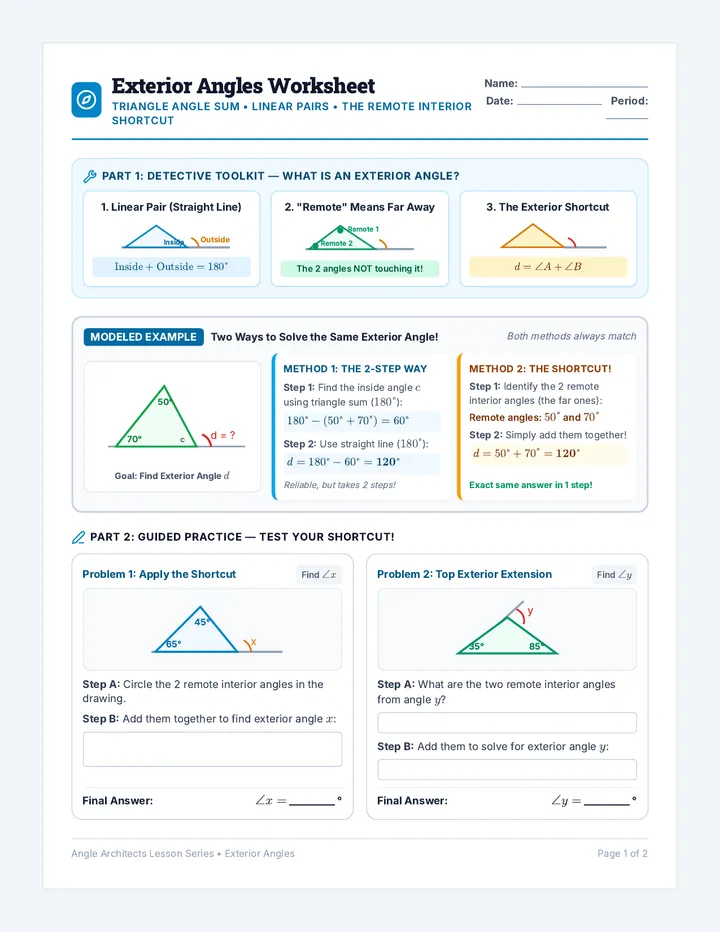
    Exterior Angles Worksheet

    Exterior Angles Worksheet

    Scaffolded 2-page student worksheet introducing the Exterior Angle Theorem for triangles, connecting the straight-line linear pair rule and parallel lines to the remote interior angle shortcut with side-by-side models and leveled detective missions.

    L

    Logan-Greene

    Ratio Launch Slides

    Ratio Quest

    A 4-lesson Indiana Academic Standards ratio sequence preparing 6th graders for ILEARN. Covers ratio representations, equivalent ratio tables and graphs, unit rates, and mixed test-prep items with authentic item formats.

    RG

    Richard Gist

    9
    Problem Detective Assessment

    Problem Detectives

    A targeted assessment and progress monitoring unit focused on multi-step word problem analysis. Students develop skills in determining what is being asked, filtering relevant details from distractors, and selecting sequential operations to solve real-world problems.

    JD

    Jenny Daniels

    2
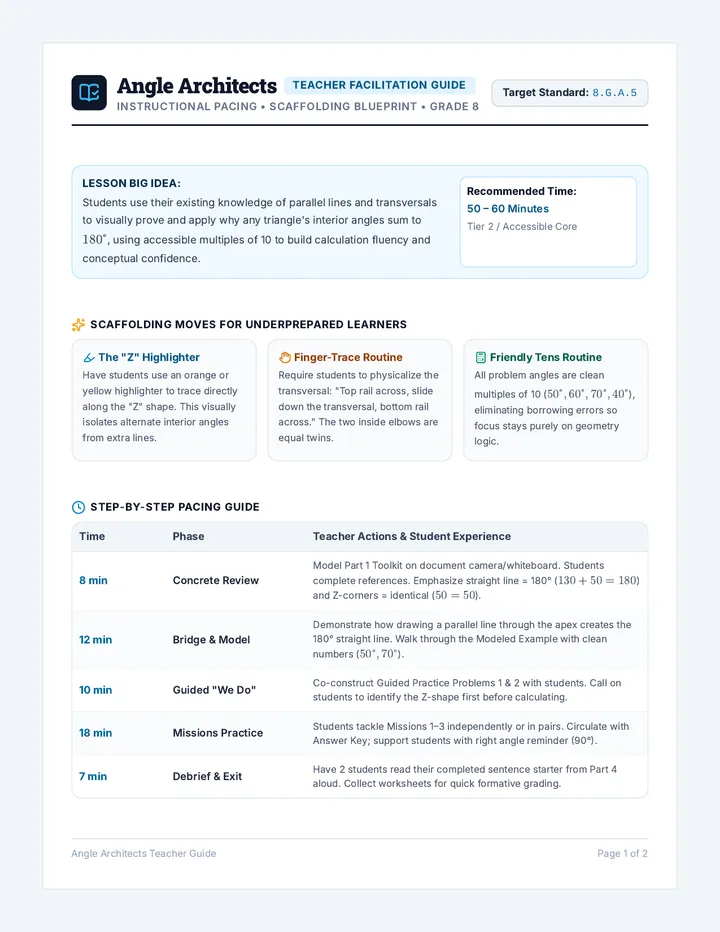
    Angle Architects Teacher Guide

    Angle Architects Teacher Guide

    Actionable teacher facilitation guide with scripted think-alouds, pacing schedules, scaffolding strategies for below-grade-level learners, and document-centered classroom routines.

    L

    Logan-Greene

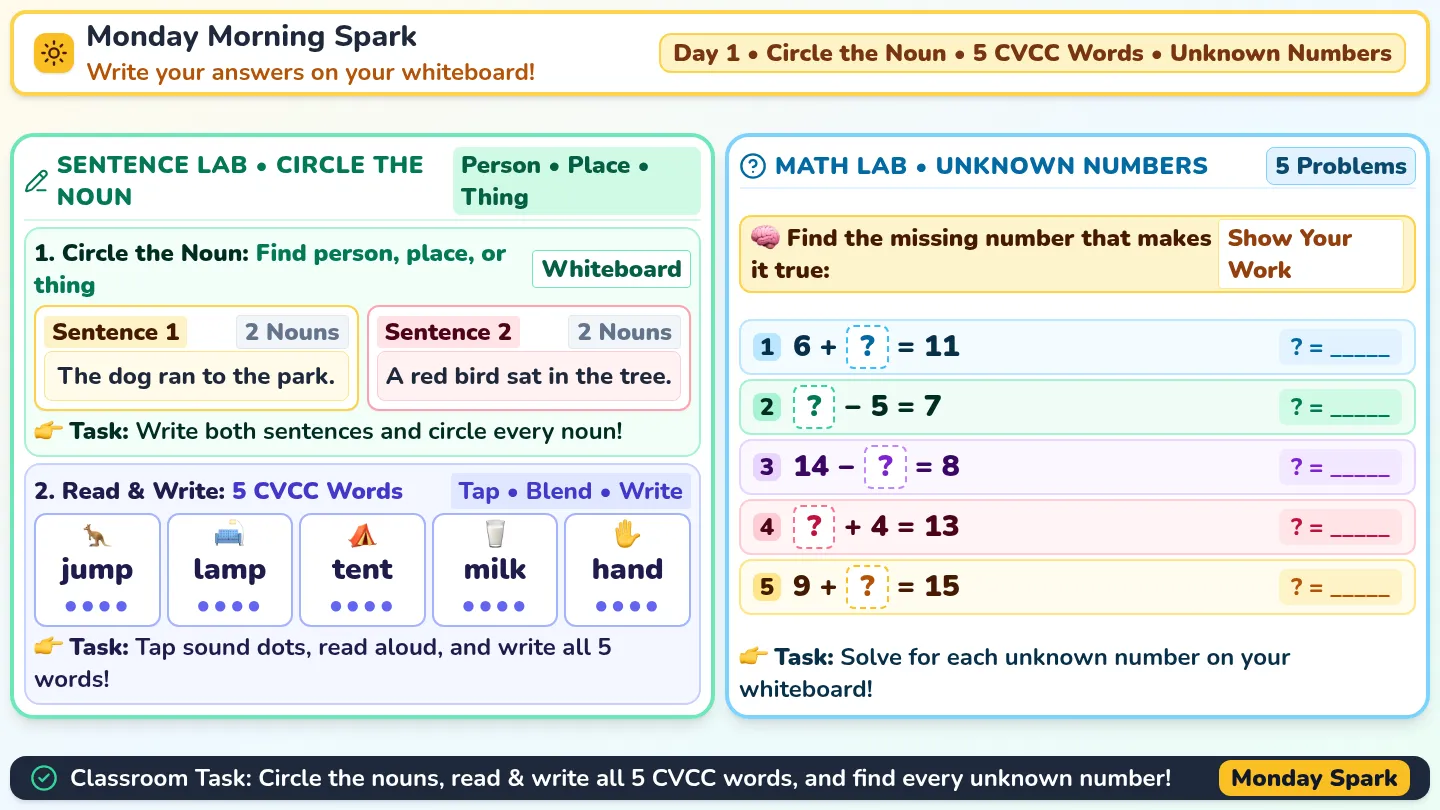
    Monday Morning Spark Slides

    Morning Spark Routine

    A 3-week Grade 1 morning routine sequence featuring daily Circle the Noun sentence challenges, Read and Write with 5 decodable CVCC words, and Math Lab with solving for unknown numbers up to 15.

    CJ

    Creesha Jones-Stone

    15
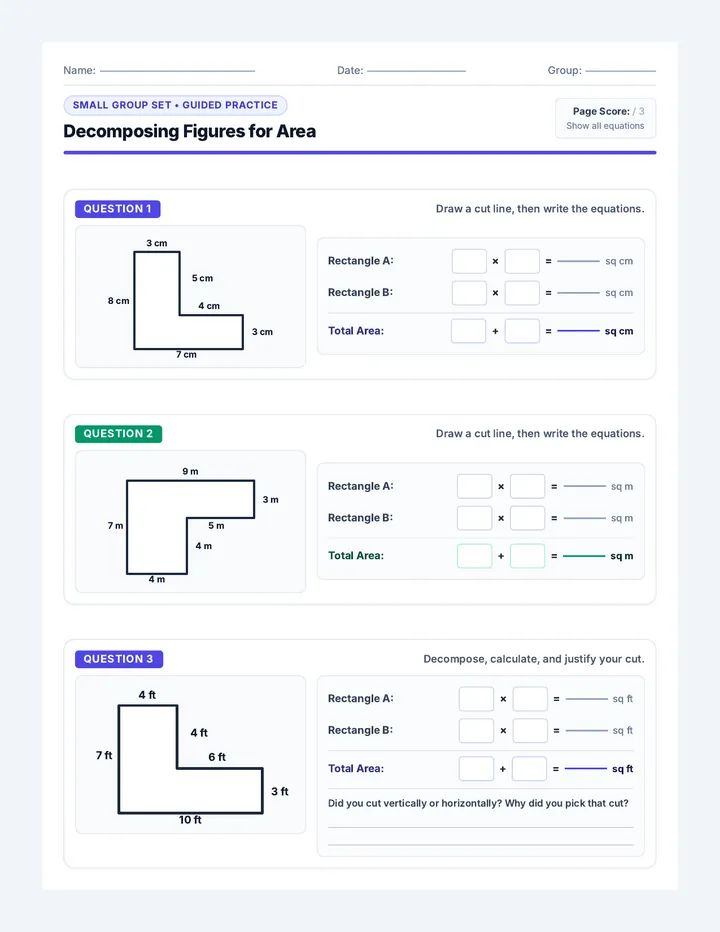
    Decomposing Area Practice Worksheet

    Area Decomposers

    A focused small-group mathematics intervention and practice lesson on decomposing L-shaped rectilinear polygons into non-overlapping rectangles to calculate total area using multiplication and addition.

    DG

    Danielle Garland

    2
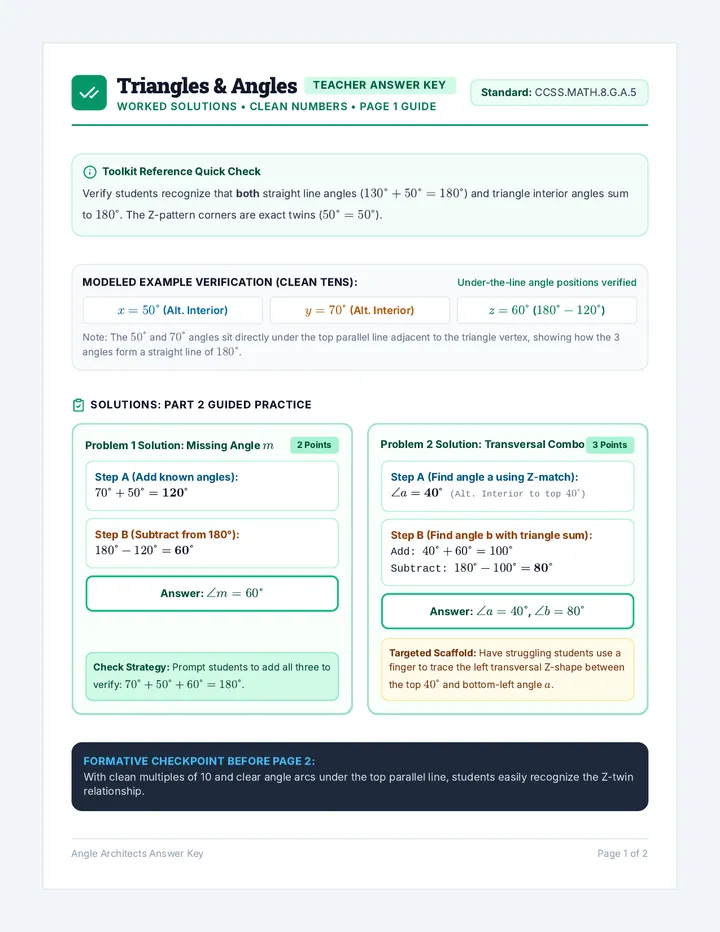
    Triangle & Angles Answer Key

    Triangle & Angles Answer Key

    Comprehensive teacher answer key featuring complete step-by-step solutions with friendly numbers, visual checks, targeted error analysis, and precise angle position notes.

    L

    Logan-Greene