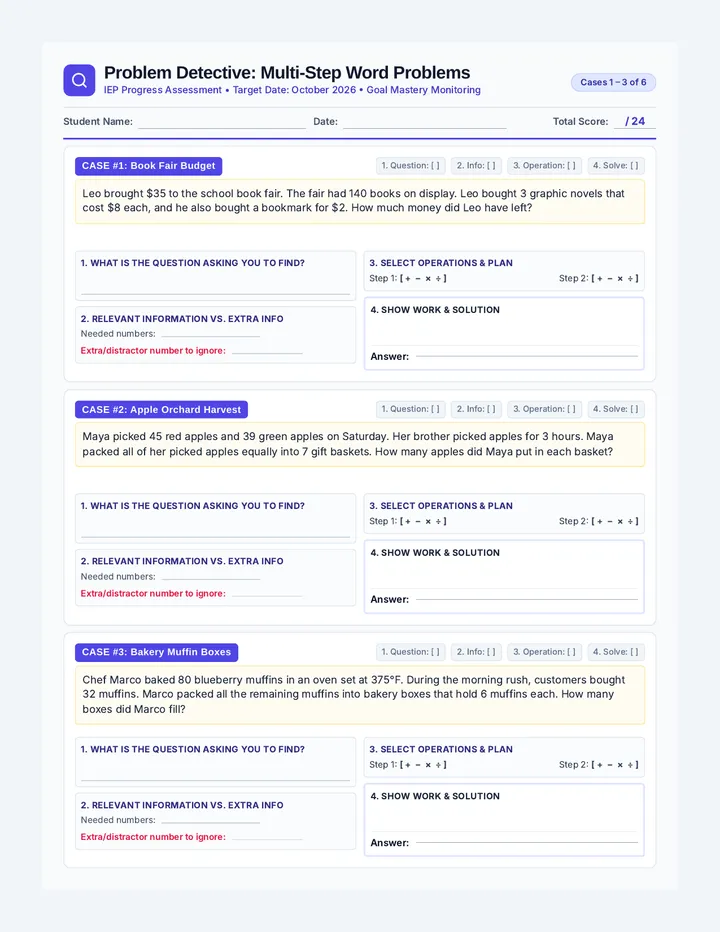
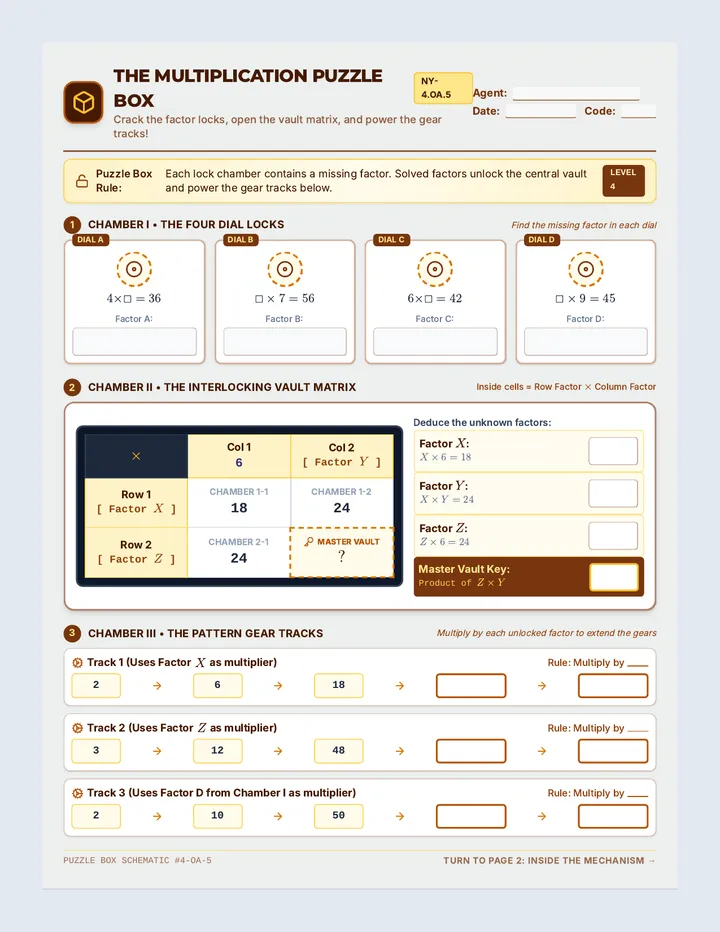
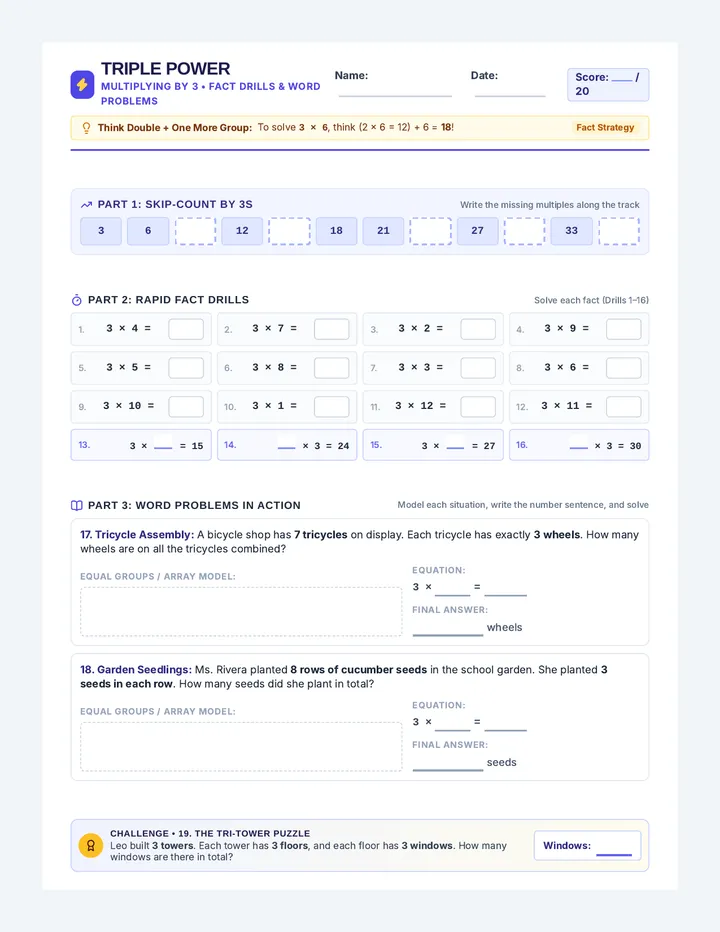
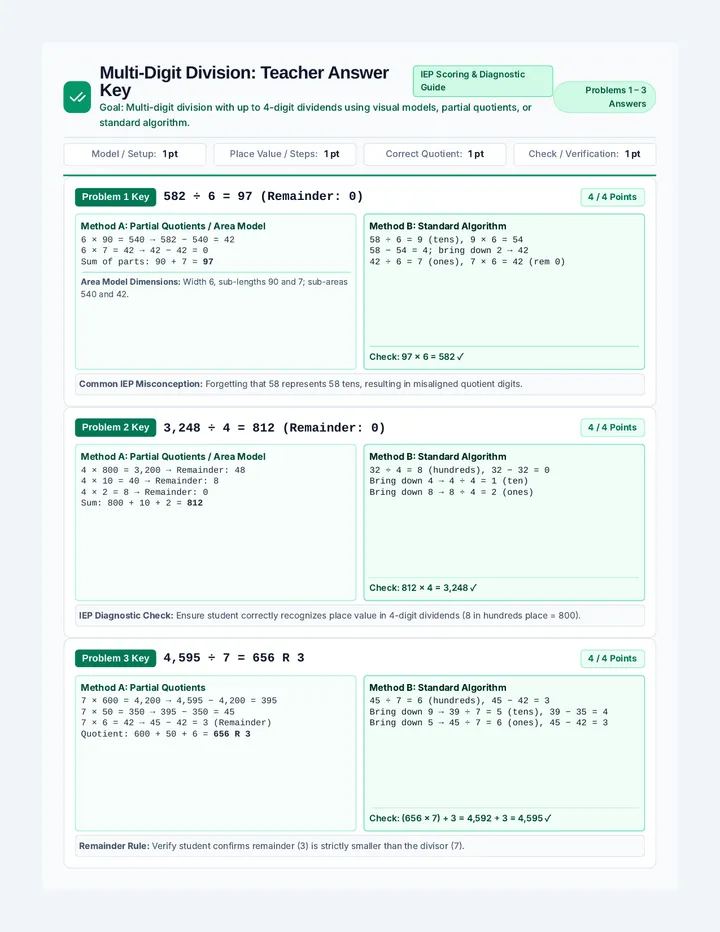
Decomposing Area Practice Worksheet
Name:
Date:
Group:
Small Group Set • Guided Practice
Decomposing Figures for Area
Page Score: / 3
Show all equations
Question 1 Draw a cut line, then write the equations.
3 cm 5 cm 4 cm 3 cm 7 cm 8 cm
Rectangle A:
× = sq cm
Rectangle B:
× = sq cm
Total Area:
Question 2 Draw a cut line, then write the equations.
9 m 3 m 5 m 4 m 4 m 7 m
Rectangle A:
× = sq m
Rectangle B:
× = sq m
Total Area:
Question 3 Decompose, calculate, and justify your cut.
4 ft 4 ft 6 ft 3 ft 10 ft 7 ft
Rectangle A:
× = sq ft
Rectangle B:
× = sq ft
Total Area:
Did you cut vertically or horizontally? Why did you pick that cut?
Name:
Date:
Small Group Set • Independent & Reasoning
Advanced Decomposing & Problem Solving
Page Score: / 3
Show all equations
Question 4 • Missing Side Find the unknown side length first, then solve for area.
6 yd ? yd 5 yd 4 yd 11 yd 10 yd
Missing Side (?):
− = yd
Rectangle A:
× = sq yd
Rectangle B:
× = sq yd
Total Area:
Question 5 • Prove It 2 Ways Show that vertical and horizontal cuts give the same area.
5 mm 5 mm 4 mm 3 mm 9 mm 8 mm
Cut 1: Vertical Cut
A: × =
B: × =
Sum: sq mm
Cut 2: Horizontal Cut
A: × =
B: × =
Sum: sq mm
Question 6 • Spot the Mistake Find the student's misconception and calculate the real area.
8 m 2 m 3 m 4 m 5 m 6 m
Carlos wrote:
(8 × 6) + (3 × 4) = 48 + 12 = 60 sq m
What was Carlos's mistake?
Correct Total Area Calculation:
( × ) + ( × ) = sq m
Decomposing Area Answer Key
Teacher Facilitator Guide & Key Small Group Guided Set • Page 1
Decomposing Figures for Area (Answer Key)
Accept either vertical or horizontal cut solutions. Both valid strategies are shown below.
Question 1 • Solutions Total Area: 36 sq cm
Cut 1 Cut 2 3 cm 5 cm 4 cm 3 cm 7 cm 8 cm
Way 1: Vertical Cut
Rect A: 3 × 8 = 24
Rect B: 4 × 3 = 12
24 + 12 = 36 sq cm
Way 2: Horizontal Cut
Rect A: 3 × 5 = 15
Rect B: 7 × 3 = 21
15 + 21 = 36 sq cm
Coaching Tip: Ask: "When you cut vertically, why can't you multiply 7 × 3 for the right rectangle?" (Because the bottom side 7 was split into 3 and 4).
Question 2 • Solutions Total Area: 43 sq m
Cut 1 Cut 2 9 m 3 m 5 m 4 m 4 m 7 m
Way 1: Vertical Cut
Rect A: 4 × 7 = 28
Rect B: 5 × 3 = 15
28 + 15 = 43 sq m
Way 2: Horizontal Cut
Rect A: 9 × 3 = 27
Rect B: 4 × 4 = 16
27 + 16 = 43 sq m
Coaching Tip: Reinforce that top length 9 m splits into 4 m + 5 m when cut vertically.
Question 3 • Solutions & Reflection Total Area: 46 sq ft
Vertical Cut Strategy
Rect A: 4 × 7 = 28
Rect B: 6 × 3 = 18
28 + 18 = 46 sq ft
Horizontal Cut Strategy
Rect A: 4 × 4 = 16
Rect B: 10 × 3 = 30
16 + 30 = 46 sq ft
Exemplar Student Justification:
"I cut horizontally because multiplying 10 × 3 = 30 and 4 × 4 = 16 used mental math facts that are quick and easy to add (30 + 16 = 46)."
Teacher Facilitator Guide & Key Small Group Independent Set • Page 2
Advanced Decomposing & Challenges (Answer Key)
Key steps for missing dimensions, dual proof comparisons, and error analysis discourse.
Question 4 • Missing Side Key Total Area: 80 sq yd
Step 1: Finding Missing Side
10 yd − 4 yd = 6 yd
The left vertical wall is 10 yd and right wall is 4 yd. The missing vertical inner drop must be the difference: 10 − 4 = 6 yd.
Step 2: Total Area Equations
Vertical Cut:
A: 6 × 10 = 60
B: 5 × 4 = 20
60 + 20 = 80 sq yd
Horizontal Cut:
A: 6 × 6 = 36
B: 11 × 4 = 44
36 + 44 = 80 sq yd
Question 5 • Prove It 2 Ways Key Both Sums: 52 sq mm
Way 1: Vertical Cut
Rectangle A: 5 × 8 = 40
Rectangle B: 4 × 3 = 12
Sum: 40 + 12 = 52 sq mm
Way 2: Horizontal Cut
Rectangle A: 5 × 5 = 25
Rectangle B: 9 × 3 = 27
Sum: 25 + 27 = 52 sq mm
Big Idea for Small Group Discussion: "No matter which direction you slice the figure, the surface area stays conserved. If your two ways don't match, check which side length you accidentally reused!"
Question 6 • Error Analysis Key Real Area: 36 sq m
Carlos's Conceptual Error:
Carlos multiplied the overall outer dimensions (8 m × 6 m = 48 sq m), which calculates a large bounding box that includes empty space not in the shape. Then, instead of subtracting the missing corner, he added (3 m × 4 m = 12 sq m), making the answer way too big (60 sq m).
Correct Decompositions:
Vertical Split:
(5 × 6) + (3 × 2) = 30 + 6 = 36 sq m
Horizontal Split:
(8 × 2) + (5 × 4) = 16 + 20 = 36 sq m
Alternative (Subtraction Method):
(8 × 6) − (3 × 4) = 48 − 12 = 36 sq m