Lenny.com
Explore
Create
ActivitiesNewMathEnglish Language ArtsScience & EngineeringSocial StudiesGlobal LanguagesHealth & Physical EducationSpecial EducationCounseling & Life SkillsArts & CreativityESL
Lenny.com
Lenny.com
Explore
Create
ActivitiesNewMathEnglish Language ArtsScience & EngineeringSocial StudiesGlobal LanguagesHealth & Physical EducationSpecial EducationCounseling & Life SkillsArts & CreativityESL
Lenny.com
Lenny.com

Solutions

Lenny for EducatorsLenny for SchoolsLenny for Districts

Product

ExploreSign inCreateSupportAbout

Resources

Getting startedMTSS Acceleration Program

© 2026 Lenny Learning Inc.

TermsPrivacyAccessibility
LinkedInInstagramX
Lenny
MathNumbers & CountingCounting ObjectsNumber NamesComparing NumbersNumber OperationsCounting SequenceNumbers 0-10Place Value Understanding and SystemAdd and Subtract Within 20Addition and Subtraction ConceptsAddition and Subtraction EquationsAddition and Subtraction ProblemsFoundations for MultiplicationMultiplication and Division PropertiesMultiply and Divide Within 100Multiplication and Division ProblemsFactors and MultiplesProperties of OperationsPatterns and RelationshipsGenerate and Analyze PatternsMulti-Digit ArithmeticPlace Value OperationsMulti-Digit and Decimal OperationsNumerical ExpressionsFour Operations and PatternsFour Operations Problem SolvingMeasurement & DataMeasurable AttributesMeasuring LengthsMeasure and Estimate Lengths in Standard UnitsRelate Addition and Subtraction to LengthClassifying and Counting ObjectsTime and MoneyArea Concepts and MeasurementPerimeter and Area MeasuresAngle Concepts and MeasurementTime, Volume, and MassMeasurement Unit ConversionsGeometryIdentifying ShapesShapes and AttributesShape Attributes and ReasoningShapes and CompositionClassifying 2D FiguresGeometric Figures and RelationshipsLines, Angles, and ShapesAngle, Area, and VolumeGeometric MeasurementVolume of 3D ShapesCoordinate Plane ApplicationsTransformations in the PlaneCongruence and SimilarityUnderstand congruence in terms of rigid motionsSimilarity and TransformationsProve Theorems Involving SimilarityPythagorean TheoremTrigonometry for General TrianglesMake Geometric ConstructionsProve Geometric TheoremsTheorems About CirclesFind Arc Lengths And Areas of Sectors of CirclesVolume FormulasRelationships Between Two-Dimensional and Three-Dimensional ObjectsProve Simple Geometric Theorems AlgebraicallyTranslate Between Geometric Description and Equation for Conic SectionApply Geometric Concepts in Modeling SituationsFractions & DecimalsFractions as NumbersBuilding FractionsFraction Equivalence and OrderingAdding and Subtracting FractionsMultiplying and Dividing FractionsDividing FractionsDecimal FractionsMulti-Digit Computation and FactorsAdd, Subtract, Multiply, and Divide Rational NumbersRational Number SystemIrrational Numbers and ApproximationsRatiosRatios and ProportionsProportional RelationshipsUnit RateAlgebraAlgebraic ExpressionsGenerate Equivalent ExpressionsQuantitative RelationshipsProportional Relationships and Linear EquationsEquations and InequalitiesEquation Solving and ReasoningLinear Equations and SystemsGraph Equations and InequalitiesSystems of EquationsReal-World Algebraic ProblemsQuantitative Reasoning with UnitsExpression StructureEquivalent Expression FormsRadicals and Integer ExponentsRational ExponentsRational and Irrational NumbersPolynomial OperationsPolynomial IdentitiesPolynomial Zeros and FactorsRational ExpressionsComplex Number OperationsComplex Numbers in PolynomialsComplex Numbers on PlaneStatistics & ProbabilityRepresent and Interpret DataData DistributionsStatistical VariabilityProbability ModelsCompound Event ProbabilitiesStatistical SamplingInterpret Categorical and Quantitative DataBivariate Data PatternsInterpret Linear ModelsComparing Two PopulationsRandom Processes in StatisticsIndependence and Conditional ProbabilityExpected ValuesProbability-Based Decision MakingStatistical Inference and ConclusionsFunctionsFunction Concepts and NotationDefine and Compare FunctionsInterpret Functions in ContextAnalyze Function RepresentationsModel Relationships with FunctionsIdentify Linear vs Exponential GrowthDistinguish Between Function TypesCompare Growth RatesInterpret Function ExpressionsBuild Functions from RelationshipsConstruct and Model FunctionsTransform and Combine FunctionsModel Comparison and SelectionSolve Exponential EquationsTrigonometryTrigonometric Ratios Involving Right TrianglesTrigonometric Functions and Unit CircleModel with Trigonometric FunctionsTrigonometric IdentitiesVectors & MatricesIntroduction to Vectors and MatricesVector QuantitiesVector OperationsMatrix OperationsCalculusLimits and ContinuityDerivative Concepts and NotationDerivative Rules and TechniquesApplications of DerivativesOptimization ProblemsRelated RatesCurve Sketching and AnalysisIntegration Concepts and NotationAntiderivatives and Indefinite IntegralsDefinite Integrals and AreaFundamental Theorem of CalculusIntegration TechniquesApplications of IntegrationDifferential EquationsSequences and SeriesParametric and Polar FunctionsVector-Valued Functions

Angle Architects

A targeted 8th-grade geometry lesson designed for students performing below grade level, bridging foundational parallel-line transversal angle relationships to the interior angle sum of triangles through visual scaffolding and worked examples.

LLogan-Greene

Angle Architects

A targeted 8th-grade geometry lesson designed for students performing below grade level, bridging foundational parallel-line transversal angle relationships to the interior angle sum of triangles through visual scaffolding and worked examples.

LLogan-Greene

Mission 2 Solution: Double Z-Angle 3 Pts

Angle w Reasoning:

\(\angle w = \mathbf{50^\circ}\) (Alt. Interior to top \(50^\circ\) under the line)

Angle v Reasoning:

\(\angle v = \mathbf{60^\circ}\) (Alt. Interior to top \(60^\circ\) under the line)

\(\angle w = 50^\circ\), \(\angle v = 60^\circ\)

Students must state "alternate interior" or "Z-pattern with parallel lines" for full credit.

Mission 3 Solution: The Master Blueprint (All Three Angles) 4 Pts

1. Find Angle p:

Left Z-angle under top line matches \(40^\circ\):

\(\angle p = \mathbf{40^\circ}\)

2. Find Angle q:

Right Z-angle under top line matches \(60^\circ\):

\(\angle q = \mathbf{60^\circ}\)

3. Find Angle r:

Triangle sum: \(180 - (40 + 60)\):

\(180 - 100 = \mathbf{80^\circ}\)

Check with Straight Line on Top: \(40^\circ + 80^\circ + 60^\circ = 180^\circ\) Matches perfectly!

Part 4 Debrief: Expected Student Responses 3 Pts

Sentence Starter Fill-ins:

"When we draw a parallel line through the top of a triangle, the three angles sit together on a straight line (or flat line), which always equals 180 degrees."

Acceptable synonyms: "straight angle", "linear pair/trio", "flat line".

13 - 15 Points: Mastered (Ready for algebraic multi-step problems).

10 - 12 Points: Proficient (Minor arithmetic slip; concepts solid).

< 10 Points: Targeted Small Group (Provide angle sum manipulative).

Angle Architects Answer Key Page 2 of 2

Teacher (tracing left side): "I take my finger and slide along the top rail, down the left slanted line, and across the bottom rail. What letter did my finger draw? A 'Z'! That means the top corner and the bottom corner are identical twins. Since the top is \(50^\circ\), angle \(x\) MUST be \(50^\circ\). No math needed—just geometry pattern recognition!"

Teacher (pointing to inside): "Now we have two angles inside: \(50^\circ\) and \(70^\circ\). To find the last angle, we use our golden rule: all 3 must add to \(180^\circ\). Step 1: Add \(50 + 70 = 120^\circ\). Step 2: \(180 - 120 = 60^\circ\). We cracked the case with clean, friendly numbers!"

Common Misconceptions & Real-Time Fixes

Misconception 1: Overlooking Right Angles

Symptom: Students say Mission 1 doesn't have enough numbers to solve.

Fix: "Whenever you see the square box in the corner, immediately write '90°' inside it in pencil!"

Misconception 2: Subtracting from 180°

Symptom: Forgetting that all three interior angles sum to 180° and attempting to subtract from 100° or 360°.

Fix: Connect back to the flat line: "A flat line is always 180°. The triangle sits on that flat line, so we always subtract from 180°!"

Tiered Differentiation Strategies

Tier 2 Support (Needs Scaffold)

  • Provide a pre-printed strip showing multiples of 10 up to 180 (\(10, 20, 30... 180\)).
  • Give 2 physical highlighters (blue for line 1, yellow for transversal).
  • Allow peer-talk before putting pencil to paper on Mission 2.

Extension (Ready for More)

  • Have students solve for \(x\) with simple algebraic expressions (e.g., \(2x = 80^\circ\)).
  • Ask students to discover the Exterior Angle Theorem: Angle exterior equals sum of two remote interior angles!

Exit Ticket Success Indicator Minimum Mastery: 80% on Missions 1 & 2

Because angles are friendly multiples of 10, arithmetic errors are minimized. A student demonstrating the Z-match and the 2-step addition/subtraction routine has successfully met standard 8.G.A.5.

Angle Architects Teacher Guide Page 2 of 2

38° e

Identify both remote angles (including the right angle) and add them:

Solution: \(\angle e = \) ____________ °

Mission 3: Detective in Reverse Find Remote \(\angle k\)

k 48° 125°

The exterior angle is 125°! Use the rule \(125^\circ = 48^\circ + k\) to solve for \(k\):

Solution: \(\angle k = \) ____________ °

Mission 4: Parallel Lines + Exterior Line \(L_1 // L_2\)

42° p 68° z

First find \(p\) using the Z-angle. Then find exterior angle \(z\):

Solution: \(\angle p = \) _____°, \(\angle z = \) _____°

Part 4: Detective Debrief (Explain Your Thinking)

Explain the big secret: Why does adding the two remote interior angles always equal the exterior angle?

Sentence Starter: Both the exterior angle and the two remote interior angles need the exact same inside angle to reach ________ degrees. Therefore, the exterior angle equals ____________________________________.

How do you rate your exterior angle skills?

Need more practice Getting the hang of it Exterior Angle Master!

Angle Architects Lesson Series • Exterior Angles Page 2 of 2

Straight line: \(180^\circ - 60^\circ = \mathbf{120^\circ}\) ✓

\(\angle w = 120^\circ\)

Award 1 pt for shortcut work, 1 pt for verification, 1 pt for final value.

Mission 2 Solution: Right Angle Trap 3 Pts

Right angle square \(= \mathbf{90^\circ}\)

Remote angles: \(90^\circ\) and \(38^\circ\)

\(e = 90^\circ + 38^\circ = \mathbf{128^\circ}\)

\(\angle e = 128^\circ\)

Watch for students writing 90° - 38° by mistake; remind them this is an obtuse exterior angle!

Mission 3 Solution: Detective in Reverse 3 Pts

Rule: \(\text{Exterior} = \text{Remote}_1 + \text{Remote}_2\)

\(125^\circ = 48^\circ + k\)

Subtract: \(k = 125^\circ - 48^\circ = \mathbf{77^\circ}\)

\(\angle k = 77^\circ\)

Check: \(48^\circ + 77^\circ = 125^\circ\). Confirms the subtraction was done correctly.

Mission 4 Solution: Parallel + Exterior 3 Pts

Angle p: \(p = \mathbf{42^\circ}\) (Alt. Interior Z-angle)

Angle z: Remote angles are \(p (42^\circ)\) and \(68^\circ\)

\(z = 42^\circ + 68^\circ = \mathbf{110^\circ}\)

\(\angle p = 42^\circ, \angle z = 110^\circ\)

Alternatively, inside third angle is \(180 - (42 + 68) = 70^\circ\); linear pair \(180 - 70 = 110^\circ\).

Part 4 Debrief: Model Answer 3 Pts

Expected Sentence Completion:

"Both the exterior angle and the two remote interior angles need the exact same inside angle to reach 180 degrees. Therefore, the exterior angle equals the sum of the two remote interior angles."
13 - 15 Points: Mastered exterior angle shortcuts & reverse equations.

10 - 12 Points: Proficient (Understands concept, minor arithmetic slips).

< 10 Points: Targeted review (Emphasize highlighting remote angles).

Exterior Angles Teacher Answer Key Page 2 of 2

You might also like

Problem Detective Assessment

Math Goal Mastery

A targeted sequence of progress monitoring assessments and evaluation guides designed to measure and document key IEP mathematics benchmarks, including multi-step word problems and multi-digit operations.

JD

Jenny Daniels

4
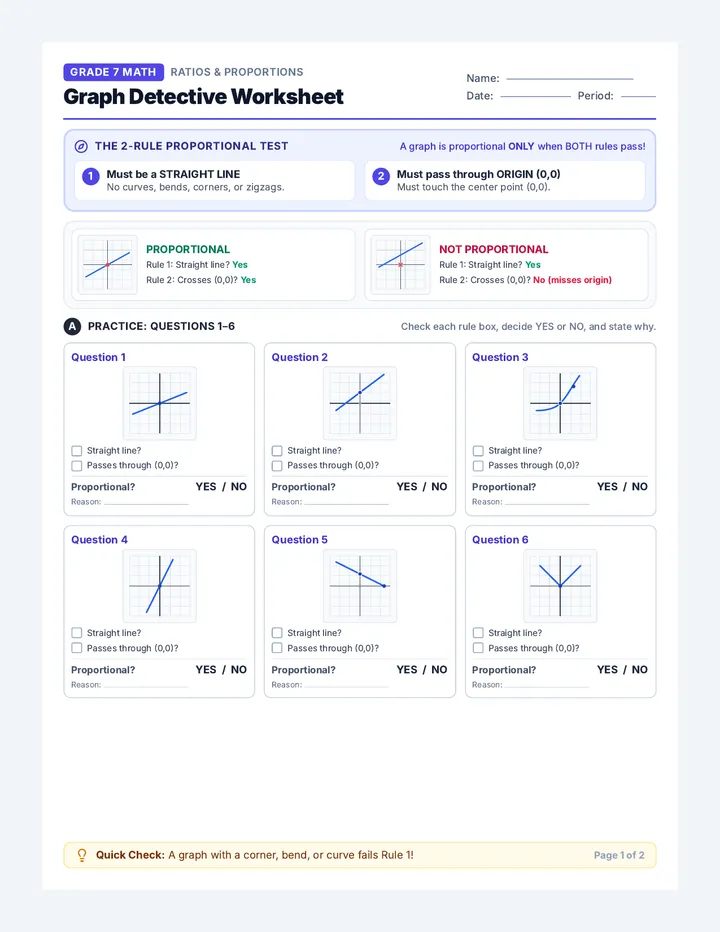
Graph Detective Worksheet

Proportional Graphs

A 7th-grade math lesson on identifying proportional relationships from coordinate plane graphs using the two fundamental criteria: straight line and passing through the origin.

L

Logan-Greene

2
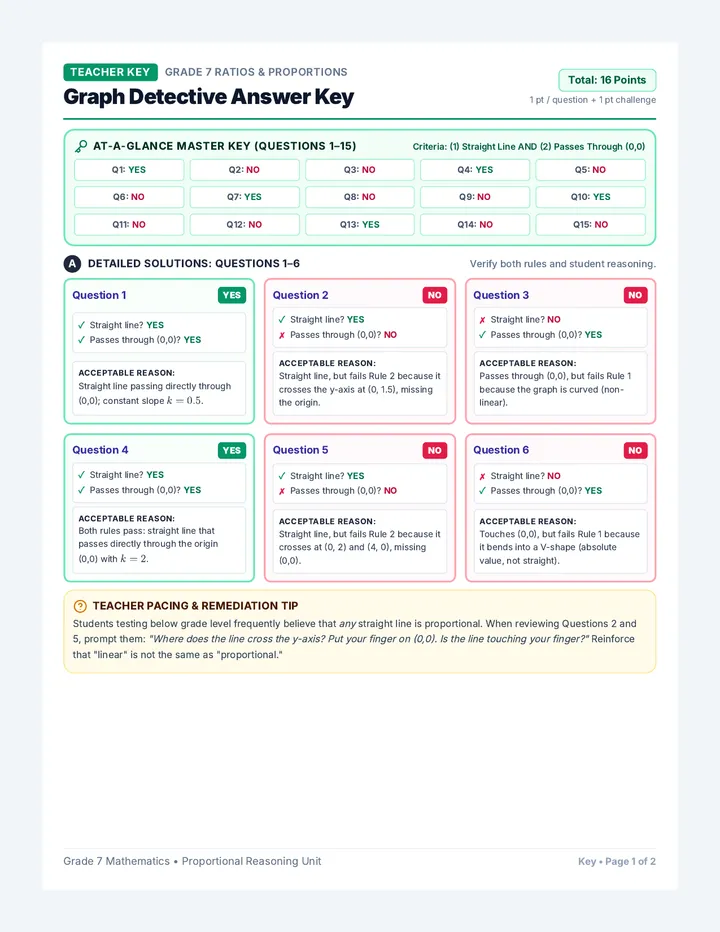
Graph Detective Answer Key

Graph Detective Answer Key

A complete 2-page teacher answer key and grading guide for the Graph Detective Worksheet. Includes detailed question-by-question solutions for all 15 practice graphs, an exemplar response and rubric for the error-analysis challenge, and targeted remediation tips for 7th-grade students.

L

Logan-Greene

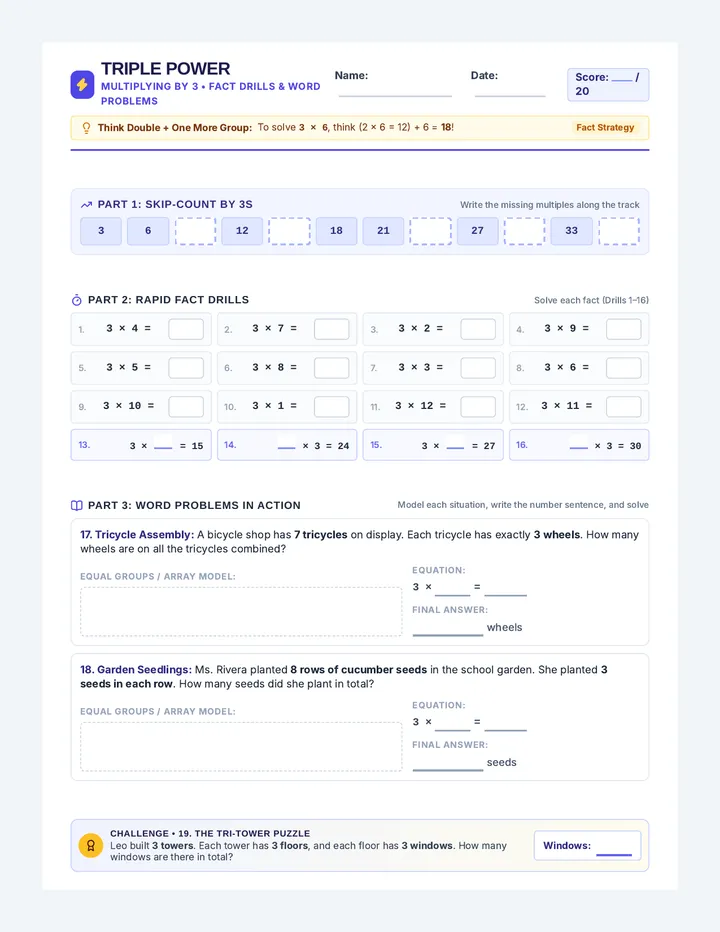
Triple Power Worksheet

Fact Power Academy

A comprehensive multiplication unit guiding elementary students through foundational fact strategies, visual models, rapid drills, and contextual word problems.

TM

Tiffany Muniz

4
Division Mastery Assessment

Division Masters

A progress monitoring lesson focusing on multi-digit whole number division with dividends up to four digits. Students demonstrate conceptual understanding and computational fluency using visual models, partial quotients, or the standard algorithm.

JD

Jenny Daniels

2
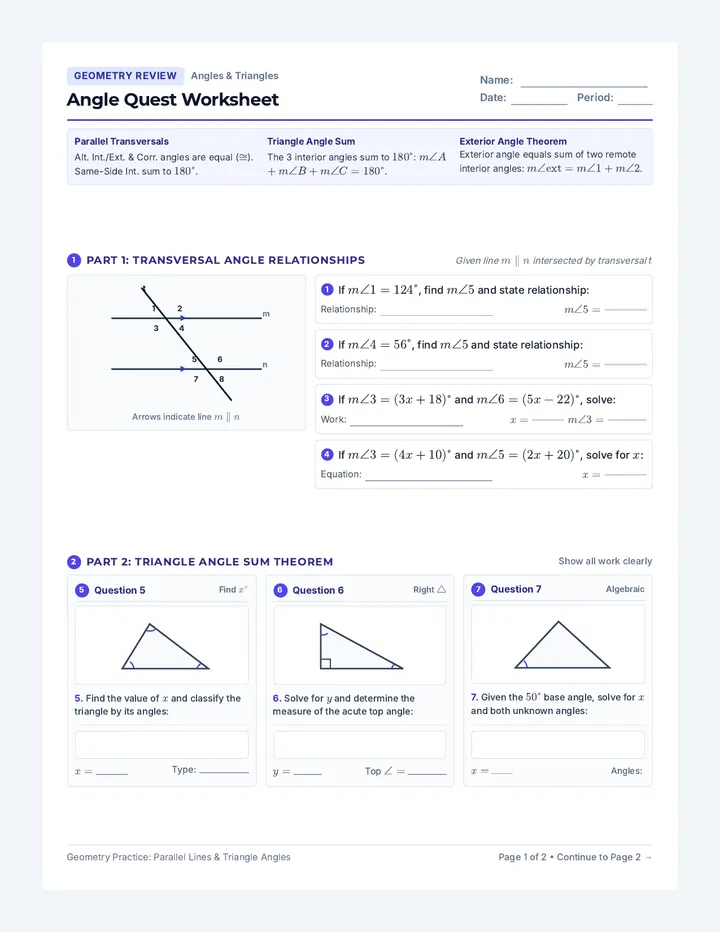
Angle Quest Worksheet

Angle Quest Worksheet

A comprehensive two-page geometry review worksheet covering parallel lines cut by a transversal, the triangle angle sum theorem, and the exterior angle theorem, featuring clearly numbered questions 1-11, concrete numerical angle measurements, and multi-step fusion challenge problems.

L

Logan-Greene

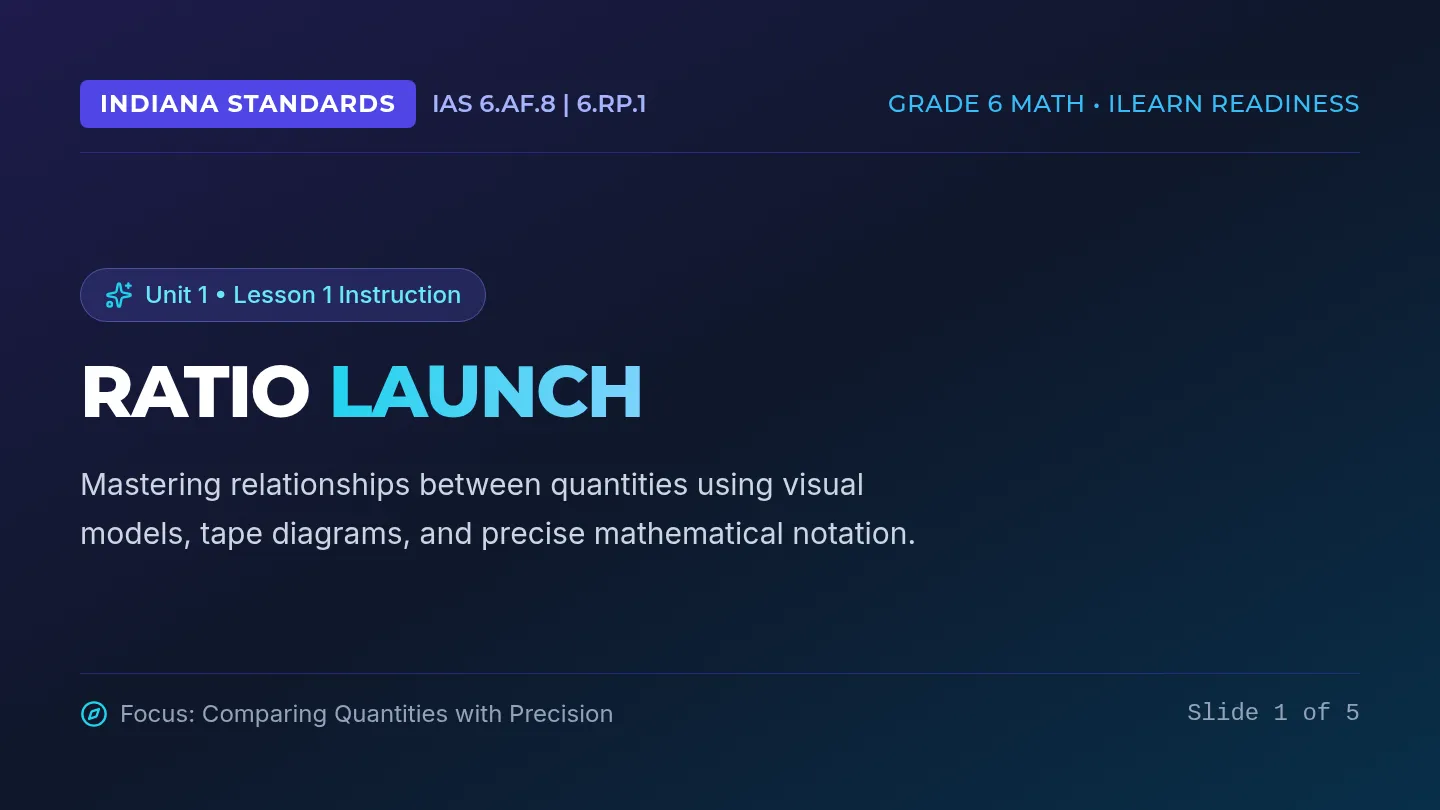
Ratio Launch Slides

Ratio Quest

A 4-lesson Indiana Academic Standards ratio sequence preparing 6th graders for ILEARN. Covers ratio representations, equivalent ratio tables and graphs, unit rates, and mixed test-prep items with authentic item formats.

RG

Richard Gist

9
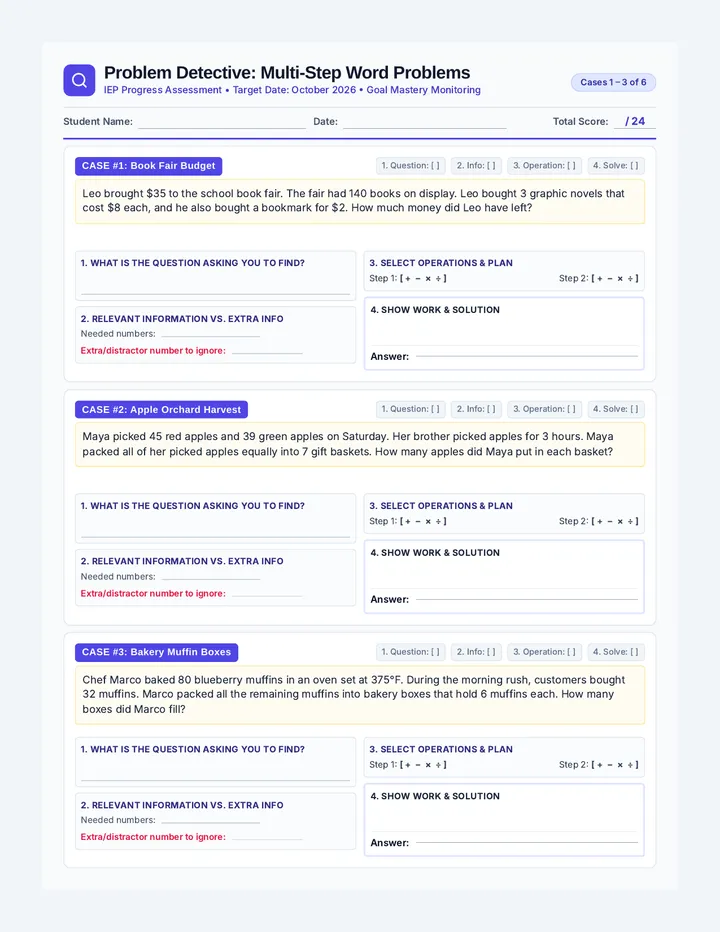
Problem Detective Assessment

Problem Detectives

A targeted assessment and progress monitoring unit focused on multi-step word problem analysis. Students develop skills in determining what is being asked, filtering relevant details from distractors, and selecting sequential operations to solve real-world problems.

JD

Jenny Daniels

2
Graph Detective Worksheet

Graph Detective Worksheet

A scaffolded 2-page math worksheet for 7th grade students identifying proportional relationships on coordinate graphs. Now features 15 practice graphs (balanced across proportional lines, lines missing origin, and non-linear patterns), a 2-rule diagnostic guide, and an error-analysis mastery challenge.

L

Logan-Greene

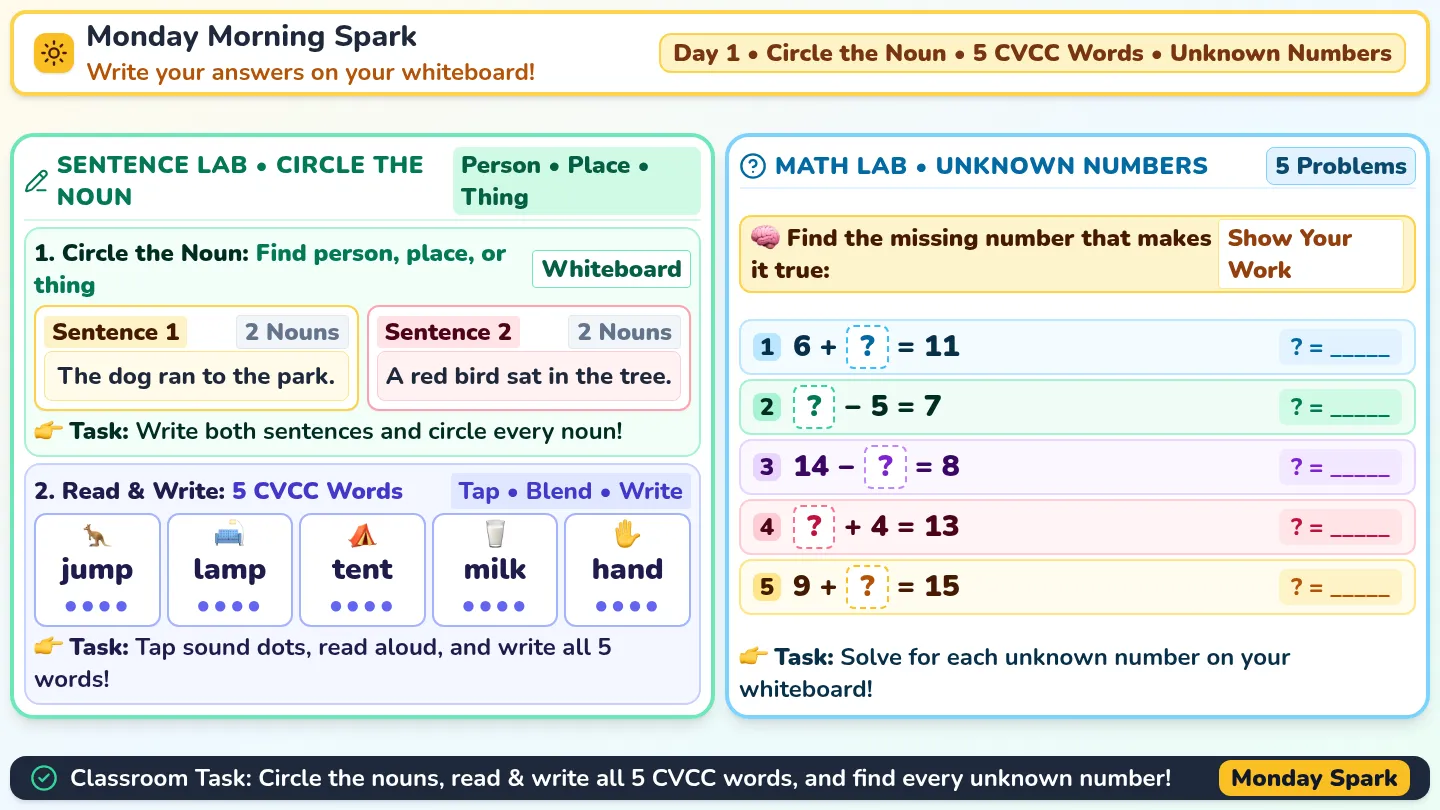
Monday Morning Spark Slides

Morning Spark Routine

A 3-week Grade 1 morning routine sequence featuring daily Circle the Noun sentence challenges, Read and Write with 5 decodable CVCC words, and Math Lab with solving for unknown numbers up to 15.

CJ

Creesha Jones-Stone

15
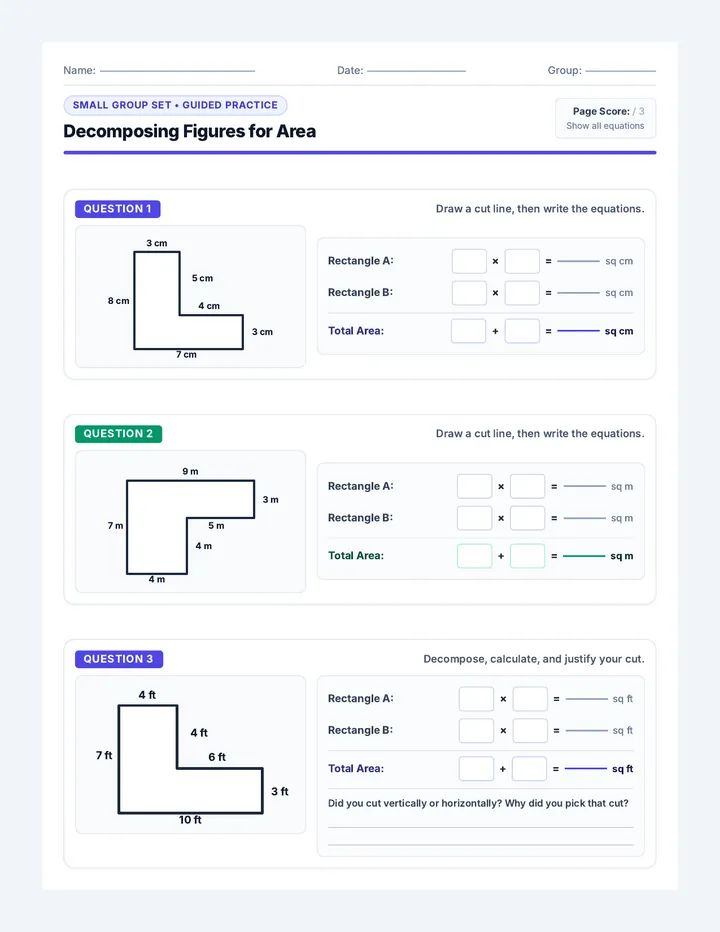
Decomposing Area Practice Worksheet

Area Decomposers

A focused small-group mathematics intervention and practice lesson on decomposing L-shaped rectilinear polygons into non-overlapping rectangles to calculate total area using multiplication and addition.

DG

Danielle Garland

2
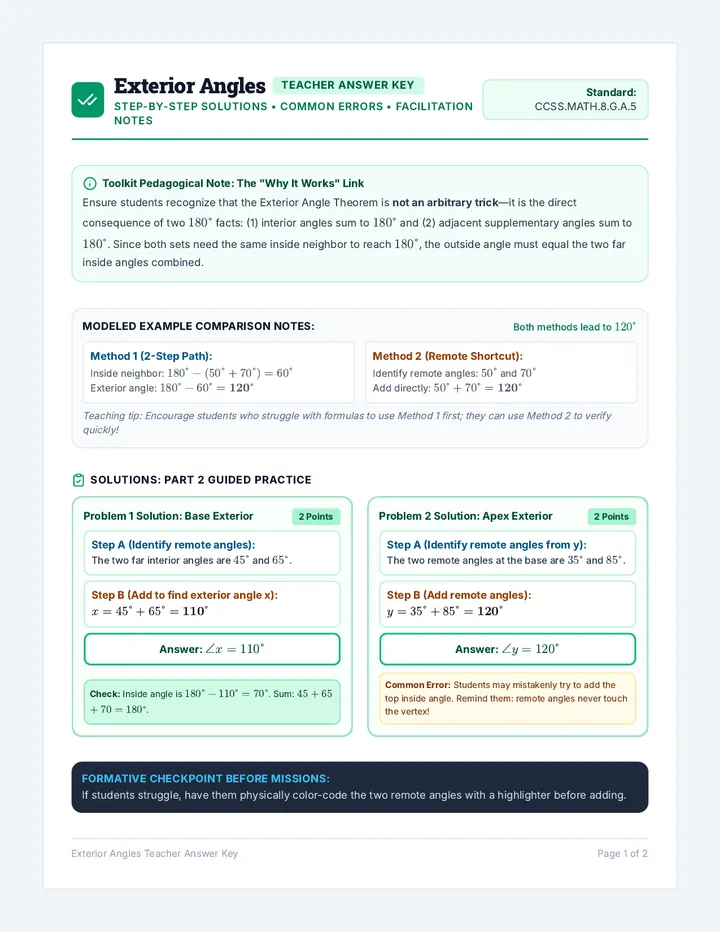
Exterior Angles Answer Key

Exterior Angles Answer Key

Comprehensive teacher answer key for the Exterior Angles Worksheet, featuring step-by-step solutions for both the linear pair method and remote interior shortcut, error analysis, and scoring guidelines.

L

Logan-Greene