Reading Mastery Weekly Packet
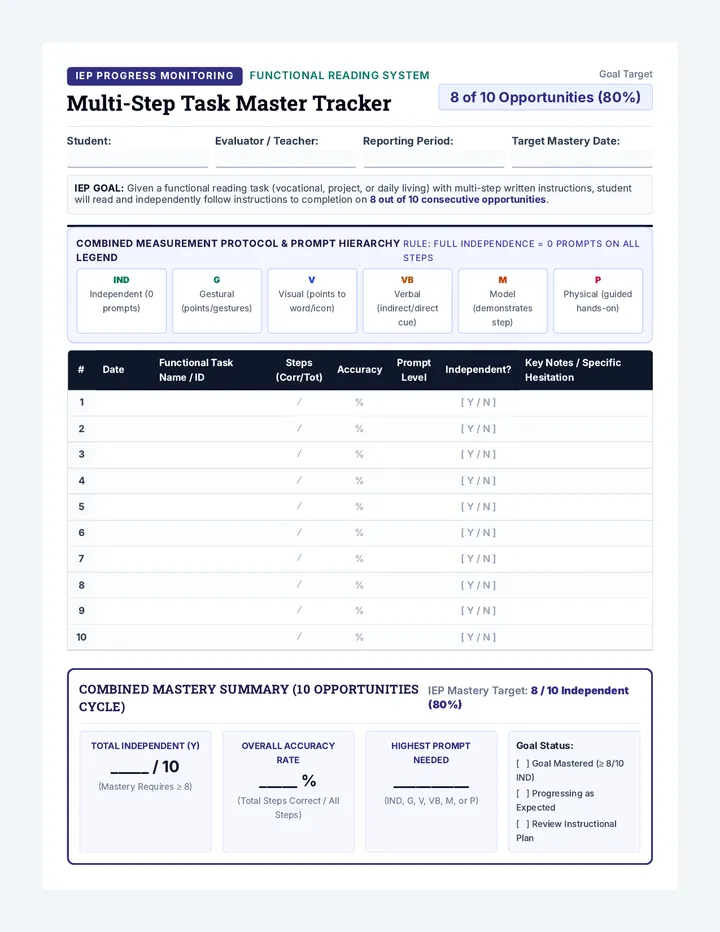
IEP Progress Monitoring Grade 7 • Weekly Probe System
Reading Mastery Weekly Tracker
5-Day Assessment Cycle
Student Name ______________________
Week Of ______________________
Case Manager / Specialist ______________________
Target Grade Level 7th Grade (Lexile 950–1050L)
Goal 1: Reading Comprehension Target: 85% Accuracy
Given text at the 7th-grade level, will comprehend what she reads with 85% accuracy in 3 out of 3 opportunities.
Daily Probe: 5 Questions (20% each) Criterion: ≥ 85% (5/5 = 100%)
Goal 2: Vocabulary in Context Target: 80% Accuracy
Given an unfamiliar vocabulary word within a sentence at the 7th-grade reading level, will identify correct meaning from 4–5 options with 80% accuracy on 3 consecutive assessments.
Daily Probe: 5 Words (20% each) Criterion: ≥ 80% (4/5 = 80%)
Weekly Progress Monitoring Data Sheet
Log daily scores immediately following probe completion
| Day & Probe | Date | Passage Topic | Vocab Score | Vocab % | Met 80%? | Comp Score | Comp % | Met 85%? | Initial |
|---|
| Day 1 (Mon) | ___/___ | Deep-Sea Twilight Zone | ___ / 5 | ___ % | [ ] Y [ ] N | ___ / 5 | ___ % | [ ] Y [ ] N | ______ |
| Day 2 (Tue) | ___/___ | The Great Library Scrolls | ___ / 5 | ___ % | [ ] Y [ ] N | ___ / 5 | ___ % | [ ] Y [ ] N | ______ |
| Day 3 (Wed) | ___/___ | Nature's Biomimicry | ___ / 5 | ___ % | [ ] Y [ ] N | ___ / 5 | ___ % | [ ] Y [ ] N | ______ |
| Day 4 (Thu) | ___/___ | Atacama Superbloom | ___ / 5 | ___ % | [ ] Y [ ] N | ___ / 5 | ___ % | [ ] Y [ ] N | ______ |
| Day 5 (Fri) | ___/___ | Marie Tharp's Ocean Map | ___ / 5 | ___ % | [ ] Y [ ] N | ___ / 5 | ___ % | [ ] Y [ ] N | ______ |
Visual Accuracy Plotting
Goal 2: Vocabulary Accuracy (%) Benchmark: 80%
80% Target
100%
80%
60%
40%
20%
Day 1Day 2Day 3Day 4Day 5
Goal 1: Comprehension Accuracy (%) Benchmark: 85%
85% Target
100%
85%
60%
40%
20%
Day 1Day 2Day 3Day 4Day 5
Key Context & Reading Strategies Used
Definition clues Rereading text Synonym / Antonym Underlining evidence
Weekly IEP Goal Status Determination
Comprehension (3/3 at ≥ 85%): [ ] MET [ ] PROGRESSING (___ / 3)
Vocabulary (3 consec. at ≥ 80%): [ ] MET [ ] PROGRESSING (Streak: ___)
DAY 1 Monday • Progress Probe 1
Name: ________________________ Date: ____________
Science / Marine Biology
The Living Light of the Twilight Zone
Passage Lexile: 980L
Between 650 and 3,300 feet below the ocean surface lies the mesopelagic zone, an abyssal world of perpetual gloom where sunlight cannot support plant life. Yet this shadowy realm is far from dark. Over ninety percent of creatures here produce their own light through bioluminescence, a chemical reaction that generates a cool, eerie glow. Animals deploy this light with remarkable ingenuity. Some squid use counterillumination, emitting light from their bellies that matches the faint downwelling sunlight to trick hungry predators lurking beneath. Deep-sea anglerfish dangle a glowing lure to attract meals in an environment where prey is extremely sparse. In this vast watery expanse, living light is the ultimate tool for survival.
Part A: Vocabulary in Context
5 Items • 80% = 4/5
1. As used in the text, abyssal most nearly means:
(A) tropical and warm
(B) extremely deep
(C) rapidly moving
(D) crowded with ships
2. What is the meaning of bioluminescence?
(A) electricity in storms
(B) light from living things
(C) heat from sea vents
(D) sunlight through ice
3. In the text, the word ingenuity refers to:
(A) clever resourcefulness
(B) physical weakness
(C) violent aggression
(D) careless behavior
4. As used in the passage, predators are organisms that:
(A) graze on seabed algae
(B) hunt other animals
(C) float without moving
(D) hide inside deep shells
5. The word sparse most nearly means:
(A) widely scattered / scarce
(B) overflowing in quantity
(C) harmful or poisonous
(D) simple to locate
Part B: Reading Comprehension
5 Items • 85% Target
1. What is the central idea of the passage?
(A) Sunlight penetrates the ocean down to 3,300 feet.
(B) Marine creatures use bioluminescence to survive deep gloom.
(C) Squid are the most aggressive hunters in the mesopelagic zone.
(D) Chemical light production harms deep-sea food chains.
2. How does counterillumination protect squid from predators?
(A) It blinds predators with sudden white flashes.
(B) It blends the squid's silhouette with faint sunlight above.
(C) It shocks predators with an electrical charge.
(D) It warms the water to repel cold-water hunters.
3. What can be inferred about food availability in this zone?
(A) Food is plentiful due to thick underwater plant beds.
(B) Animals must use specialized adaptations because meals are rare.
(C) Most organisms rely entirely on surface sunlight for nourishment.
(D) Predators never need to compete for daily food sources.
4. Which detail best explains why anglerfish use a glowing lure?
(A) To scare away schools of smaller fish.
(B) To draw scarce prey close in total darkness.
(C) To guide other anglerfish through the depths.
(D) To illuminate the sea floor for building nests.
5. What is the author's primary purpose in this text?
(A) To argue for ending fishing in the mesopelagic zone.
(B) To explain how bioluminescence aids survival in dark waters.
(C) To compare ocean depths with space exploration.
(D) To warn readers about venomous deep-sea marine animals.
Day 1 Probe Score:
Vocab: ___ / 5 (____ %) [ ] Met 80%
Comp: ___ / 5 (____ %) [ ] Met 85%
Consecutive Vocab Day 1: [ ] Pass [ ] Review
DAY 2 Tuesday • Progress Probe 2
Name: ________________________ Date: ____________
History / Ancient World
The Lost Scrolls of Alexandria
Passage Lexile: 1010L
Founded in Egypt during the third century BCE, the Great Library of Alexandria was an extraordinary repository of human knowledge. Its ambitious rulers sought to gather every scroll in existence, dispatching royal agents across the Mediterranean to purchase or copy texts. Ships docking in Alexandria's harbor were searched; any manuscripts on board were seized, meticulously transcribed by scribes on fragile papyrus, and preserved. Renowned scholars gathered there to calculate Earth's circumference and catalogue the heavens. Sadly, repeated fires and civil unrest led to the catastrophic destruction of this intellectual sanctuary. While centuries of literature and scientific discovery vanished into ash, the library's legacy continues to inspire modern efforts to preserve human history from oblivion.
Part A: Vocabulary in Context
5 Items • 80% = 4/5
1. As used in the text, repository most nearly means a:
(A) storage place
(B) market stall
(C) training army
(D) sailing vessel
2. In paragraph 1, papyrus refers to:
(A) stone carving tools
(B) early writing material
(C) clay storage jars
(D) woven wool cloth
3. The word scholars describes individuals who:
(A) govern vast cities
(B) trade luxury goods
(C) study and teach deeply
(D) fight in battle
4. In the passage, catastrophic means:
(A) gradual and slow
(B) minor and harmless
(C) disastrous and ruinous
(D) planned and orderly
5. The word oblivion most nearly means:
(A) total forgetfulness
(B) worldwide fame
(C) careful protection
(D) rapid translation
Part B: Reading Comprehension
5 Items • 85% Target
1. What was the primary goal of Alexandria's rulers?
(A) To conquer neighboring trade routes across Egypt.
(B) To collect every written work of knowledge in existence.
(C) To train thousands of naval soldiers for sea wars.
(D) To build the largest papyrus factory in the ancient world.
2. What action was taken when ships docked in the harbor?
(A) Merchants were forced to pay heavy gold taxes.
(B) Ships were searched and manuscripts were seized to be copied.
(C) Sailors were hired to translate foreign languages.
(D) All foreign scrolls were immediately incinerated.
3. Based on the text, what made Alexandria an intellectual hub?
(A) It possessed both vast textual resources and brilliant thinkers.
(B) It was completely protected from war and civil unrest.
(C) It had modern printing presses that printed books rapidly.
(D) Only royal family members were permitted to read scrolls.
4. Which phrase best describes the lasting impact of the library?
(A) It proved that paper manuscripts are permanent.
(B) It motivates modern efforts to safeguard human records.
(C) It discouraged future civilizations from collecting books.
(D) It halted scientific progress for over a millennium.
5. How does the author structure the passage?
(A) By presenting arguments for and against ancient libraries.
(B) Chronologically from creation and achievement to loss and legacy.
(C) By comparing Alexandria to other ancient Mediterranean cities.
(D) By listing problems and offering modern engineering solutions.
Day 2 Probe Score:
Vocab: ___ / 5 (____ %) [ ] Met 80%
Comp: ___ / 5 (____ %) [ ] Met 85%
Consecutive Vocab Streak: [ ] 2 in a Row!
DAY 3 Wednesday • Progress Probe 3
Name: ________________________ Date: ____________
Technology / Innovation
Nature's Blueprint: The Rise of Biomimicry
Passage Lexile: 1020L
When engineers face stubborn design hurdles, they increasingly turn to the living world for solutions. This practice, known as biomimicry, imitates natural models to solve complex human challenges. When Japan's high-speed bullet train emerged from tunnels, it generated deafening sonic booms that rattled nearby homes. An observant engineer modeled the train's nose after the slender beak of the kingfisher, a bird that dives into water with scarcely a ripple. The resulting redesign eliminated the noise and made the train substantially more aerodynamic. Elsewhere, scientists study how desert beetles harvest moisture from fog or how gecko toes cling without glue to create synthetic adhesives. Nature has refined its structures through millions of years of evolution, leaving behind an exceptionally resilient and innovative catalog of designs.
Part A: Vocabulary in Context
5 Items • 80% = 4/5
1. As used in the text, biomimicry means:
(A) copying nature's designs
(B) training zoo animals
(C) destroying natural forests
(D) breeding hybrid crops
2. In paragraph 1, aerodynamic describes an object that:
(A) weighs very little
(B) moves smoothly through air
(C) stays underwater
(D) runs on solar batteries
3. The word synthetic most nearly means:
(A) grown in organic soil
(B) human-made / artificial
(C) ancient and decayed
(D) purely accidental
4. As used in the passage, resilient means:
(A) fragile and brittle
(B) able to withstand stress
(C) slow to react
(D) brightly colored
5. The word innovative describes something that is:
(A) copied from old books
(B) newly creative and advanced
(C) expensive to purchase
(D) risky and untested
Part B: Reading Comprehension
5 Items • 85% Target
1. What problem did Japanese engineers solve using biomimicry?
(A) Train engines overheating on long mountain climbs.
(B) Loud sonic booms created when trains exited tunnels.
(C) High fuel costs from electric power grid shortages.
(D) Train wheels slipping on icy northern railway tracks.
2. Why was the kingfisher bird chosen as an engineering model?
(A) Its wings flap at tremendous speed in windy weather.
(B) Its beak enters water smoothly without creating ripples.
(C) Its bright feathers reflect harsh tunnel lighting.
(D) Its claws can grip steel surfaces during storms.
3. What does the example of the desert beetle demonstrate?
(A) Nature has developed efficient ways to capture water.
(B) Insects cause damage to delicate electronic equipment.
(C) Desert climates prevent technological advancement.
(D) Beetles move faster than high-speed modern trains.
4. Which statement represents an inference supported by the text?
(A) Human engineers no longer need computers for designing tools.
(B) Observing biological traits can accelerate technological breakthroughs.
(C) Animals are deliberately attempting to assist human scientists.
(D) High-speed trains will soon be completely silent.
5. What is the tone of the author toward biomimicry?
(A) Doubtful and sarcastic
(B) Appreciative and enthusiastic
(C) Neutral and indifferent
(D) Fearful and cautionary
Day 3 Probe Score:
Vocab: ___ / 5 (____ %) [ ] Met 80%
Comp: ___ / 5 (____ %) [ ] Met 85%
Consecutive Vocab Goal: [ ] 3 CONSECUTIVE MET!
DAY 4 Thursday • Progress Probe 4
Name: ________________________ Date: ____________
Earth Science / Ecology
The Awakening of the Atacama Desert
Passage Lexile: 1000L
Stretching across northern Chile, the Atacama Desert is widely recognized as the driest non-polar place on Earth. In some sectors, weather stations have never recorded a single drop of rain. Yet beneath this severely arid and sun-baked crust rests a hidden botanical treasure. Millions of seeds lie dormant in the baked dirt, waiting in a suspended state for years or even decades. Once every five to seven years, unusual Pacific storms unleash an unexpected deluge. Within weeks, the barren gray desert erupts into a dazzling carpet of purple, yellow, and red flowers. This stunning phenomenon, known as the *desierto florido*, is strictly ephemeral. The blossoms must pollinate quickly before the merciless heat returns to reclaim the landscape.
Part A: Vocabulary in Context
5 Items • 80% = 4/5
1. As used in the text, arid most nearly means:
(A) extremely dry
(B) heavily wooded
(C) high in elevation
(D) cold and snowy
2. In the passage, the word dormant describes seeds that are:
(A) dead and rotten
(B) sleeping / inactive
(C) growing rapidly
(D) floating in air
3. The word deluge most nearly means an:
(A) intense downpour
(B) earthquake tremor
(C) icy wind gust
(D) outbreak of disease
4. As used in the text, phenomenon refers to an:
(A) ordinary daily task
(B) extraordinary occurrence
(C) expensive tourist trip
(D) agricultural failure
5. The word ephemeral most nearly means:
(A) lasting forever
(B) short-lived / fleeting
(C) dangerous to humans
(D) completely artificial
Part B: Reading Comprehension
5 Items • 85% Target
1. What triggers the Atacama superbloom?
(A) Volcanic ash settling over desert sand.
(B) Rare, heavy rainfall from Pacific storm systems.
(C) Artificially dug irrigation canals by farmers.
(D) Severe drops in temperature during winter nights.
2. How are seeds in the Atacama able to survive decades without water?
(A) They remain in an inactive, dormant state underground.
(B) They drink water stored in deep desert cactus trunks.
(C) They migrate with the wind to wet coastal beaches.
(D) They produce chemical moisture internally through heat.
3. Why must the desert blossoms reproduce rapidly?
(A) Swarms of insects consume all adult leaves in hours.
(B) Intense desert heat will quickly dry out the ground.
(C) Heavy ocean fog prevents sunlight from reaching petals.
(D) The seeds must freeze before they can develop.
4. Which detail shows the extreme dryness of the Atacama?
(A) The flowers only bloom in bright red and yellow hues.
(B) Some weather stations have never measured rainfall.
(C) Chilean scientists visit the desert once every five years.
(D) The Pacific Ocean lies just west of the desert border.
5. Which is the best summary of this passage?
(A) The Atacama is an uninhabitable wasteland with zero life.
(B) Despite extreme aridity, rare rain triggers a brief floral bloom.
(C) Global weather changes have permanently altered Chilean soil.
(D) Farmers are cultivating foreign crops in the Atacama crust.
Day 4 Probe Score:
Vocab: ___ / 5 (____ %) [ ] Met 80%
Comp: ___ / 5 (____ %) [ ] Met 85%
Comp Goal Check: Opportunity ___ / 3 Met
DAY 5 Friday • Progress Probe 5
Name: ________________________ Date: ____________
Biography / Earth Science
The Cartographer of the Ocean Floor: Marie Tharp
Passage Lexile: 1040L
In the early 1950s, most geologists believed the ocean bottom was a featureless, flat muddy plain. Geologist and cartographer Marie Tharp proved them completely wrong. Because women were barred from research ships at the time, Tharp stayed ashore, meticulously analyzing millions of raw sonar soundings collected by colleagues at sea. By plotting these depth points by hand, she revealed the dramatic topography of the ocean floor, discovering a 40,000-mile submerged mountain chain cut down the center by a massive rift valley. Initially met with fierce skepticism from male peers, her map provided undeniable evidence that Earth's crustal plates were moving apart. Tharp’s unprecedented work transformed modern geology and permanently changed humanity’s view of the planet.
Part A: Vocabulary in Context
5 Items • 80% = 4/5
1. As used in the text, a cartographer is someone who:
(A) navigates sailing ships
(B) draws or makes maps
(C) repairs deep-sea sonar
(D) writes newspaper articles
2. In paragraph 1, topography refers to the:
(A) physical shape of land
(B) chemistry of ocean salt
(C) depth of ship anchors
(D) speed of tidal currents
3. The word rift most nearly means a:
(A) flat stone wall
(B) deep crack or split
(C) steep ocean wave
(D) pile of loose sand
4. As used in the passage, skepticism means:
(A) cheerful acceptance
(B) doubt and disbelief
(C) physical exhaustion
(D) deep religious faith
5. The word unprecedented describes something that is:
(A) never done before
(B) repeated frequently
(C) easy to complete
(D) dangerous to try
Part B: Reading Comprehension
5 Items • 85% Target
1. What widespread belief did Marie Tharp disprove?
(A) That oceanic trenches were filled with magma.
(B) That the ocean seabed was completely flat and featureless.
(C) That sonar soundings could travel through solid rock.
(D) That continents had always remained firmly anchored.
2. Why did Tharp analyze data on land rather than on ships?
(A) She preferred working alone in laboratory basements.
(B) Women were banned from serving on research vessels.
(C) The soundings could only be computed using land machines.
(D) She suffered from chronic sea sickness on long voyages.
3. What critical geologic feature did Tharp discover?
(A) A massive rift valley running along an underwater mountain range.
(B) A sunken continent buried under Arctic ice.
(C) Thousands of extinct coral reefs along the coastline.
(D) An underground river flowing beneath the Atlantic.
4. Tharp's map was essential evidence for which major theory?
(A) The theory of gravitational pull on ocean tides.
(B) The theory of plate tectonics and moving crustal plates.
(C) The theory of global volcanic extinction events.
(D) The theory of underwater oil formation.
5. Which quality best describes Marie Tharp's approach to science?
(A) Careless and hasty
(B) Persistent and meticulous
(C) Passive and easily discouraged
(D) Reckless and impatient
Day 5 Probe Score:
Vocab: ___ / 5 (____ %) [ ] Met 80%
Comp: ___ / 5 (____ %) [ ] Met 85%
Weekly IEP Sign-off: [ ] Transfer to Cover Tracker