Teacher Model & Paragraph Architecture: 5-Sentence Formula
1. Intro Sentence
Topic: extreme deep-sea life
2. Detail #1
Adaptation: pressure or darkness
3. Detail #2
Energy source: chemosynthesis
4. Conclusion
Summary: resilience of trench life
Using facts from today's text, explain how creatures survive in the extreme conditions of the Mariana Trench. Include a clear introduction sentence, at least two supporting details explaining specific animal adaptations or energy sources, and a concluding sentence.
Jot down keywords or draft phrases
1. Introduction Sentence:
2. Supporting Detail #1:
3. Supporting Detail #2:
4. Concluding Sentence:
Remember indentation and complete sentences
Checklist: Clear Intro (1 pt) Detail 1 (1 pt) Detail 2 (1 pt) Conclusion (1 pt) 5+ Sentences (1 pt)
Trial 2 Score: ____ / 5 (____%)
Student Name: Required: Min. 5 Structured Sentences
Teacher Model & Paragraph Architecture: 5-Sentence Formula
1. Intro Sentence
Topic: solar energy power
2. Detail #1
How panels work (silicon)
3. Detail #2
New innovation (floating panels)
4. Conclusion
Summary: clean future energy
Using facts from today's text, explain how solar panels convert sunlight into clean energy and why new innovations are helpful. Include a clear introduction sentence, at least two supporting details with evidence, and a concluding sentence.
Jot down keywords or draft phrases
1. Introduction Sentence:
2. Supporting Detail #1:
3. Supporting Detail #2:
4. Concluding Sentence:
Remember indentation and complete sentences
Checklist: Clear Intro (1 pt) Detail 1 (1 pt) Detail 2 (1 pt) Conclusion (1 pt) 5+ Sentences (1 pt)
Trial 3 Score: ____ / 5 (____%)
Writing Target: 60% (3/5 Criteria)
Student Name: Required: Min. 5 Structured Sentences
Teacher Model & Paragraph Architecture: 5-Sentence Formula
1. Intro Sentence
Topic: Maya pyramid feats
2. Detail #1
Building without modern tools
3. Detail #2
Equinox shadow alignment
4. Conclusion
Summary: ancient genius
Using facts from today's text, explain how the ancient Maya built incredible pyramids using mathematics and astronomy. Include a clear introduction sentence, at least two supporting details explaining their techniques or celestial alignments, and a concluding sentence.
Jot down keywords or draft phrases
1. Introduction Sentence:
2. Supporting Detail #1:
3. Supporting Detail #2:
4. Concluding Sentence:
Remember indentation and complete sentences
Checklist: Clear Intro (1 pt) Detail 1 (1 pt) Detail 2 (1 pt) Conclusion (1 pt) 5+ Sentences (1 pt)
Trial 4 Score: ____ / 5 (____%)
Student Name: Required: Min. 5 Structured Sentences
Teacher Model & Paragraph Architecture: 5-Sentence Formula
1. Intro Sentence
Topic: Aurora Borealis science
2. Detail #1
Solar wind & magnetic field
3. Detail #2
Gases producing vivid colors
4. Conclusion
Summary: sky's greatest wonder
Using facts from today's text, explain what causes the Northern Lights and how they produce their vivid colors. Include a clear introduction sentence, at least two supporting details explaining the science, and a concluding sentence.
Jot down keywords or draft phrases
1. Introduction Sentence:
2. Supporting Detail #1:
3. Supporting Detail #2:
4. Concluding Sentence:
Remember indentation and complete sentences
Checklist: Clear Intro (1 pt) Detail 1 (1 pt) Detail 2 (1 pt) Conclusion (1 pt) 5+ Sentences (1 pt)
Trial 5 Score: ____ / 5 (____%)
| [ ] Yes [ ] No |
| Independent paragraph drafting. |
| Trial 4 (Thursday) | ___ / 5 ( ___% ) | ___ / 5 ( ___% ) | ___ / 4 ( ___% ) | [ ] Yes [ ] No | Criterion evaluation trial. |
| Trial 5 (Friday Review) | ___ / 5 ( ___% ) | ___ / 5 ( ___% ) | ___ / 4 ( ___% ) | [ ] Yes [ ] No | Weekly mastery & maintenance. |
Goal Mastery Status: Reading: [ ] Met [ ] Progressing | Writing: [ ] Met [ ] Progressing | Math: [ ] Met [ ] Progressing
Teacher Signature:
TEACHER GUIDE
Days 1 through 5
Part 1 Reading (Main Idea, 2 Details, Inference, Evidence) & Part 2 Multi-Step Equations
Day 1 (Honeybees): 1. B (Waggle dance communicates food) | 2. Direction/angle to fly relative to the sun | 3. By touching the dancer's antennae to detect floral scent | 4. The food source is roughly three kilometers away (1 sec = 1 km) | 5. It is pitch black inside the hive, so visual signals cannot be seen.
Day 2 (Mariana Trench): 1. B (Extreme conditions, specialized creatures thrive) | 2. Below 3,300 feet | 3. Their bodies lack air-filled spaces that could collapse under pressure | 4. Sunlight cannot reach the trench for photosynthesis, so they must use chemical energy | 5. Scavenging on decaying organic matter drifting down from above.
Day 3 (Solar Energy): 1. B (Panels turn sunlight into clean electricity, innovations boost output) | 2. Photons knock electrons loose from silicon atoms, producing electric current | 3. Up to 15 percent | 4. It generates renewable power while preventing valuable reservoir water from evaporating | 5. It produces clean energy without emitting toxic smoke or fossil fuel pollution.
Day 4 (Maya Pyramids): 1. B (Engineered incredible pyramids using astronomy and geometry) | 2. Metal tools, wheeled carts, and draft animals | 3. A series of triangular shadows forming a slithering feathered serpent | 4. To track seasonal cycles, agricultural planting periods, and sacred dates | 5. Geometry, astronomy, and architectural stone engineering.
Day 5 (Northern Lights): 1. B (Auroras occur when solar wind particles collide with atmospheric gases) | 2. Charged electrons and protons | 3. Oxygen gas | 4. Earth's magnetic field channels incoming particles toward magnetic poles | 5. They thought the glowing lights were spirits or mystical omens.
Day 1 Solutions
P1: \( 4 \times (9) - 12 \)
→ \( 36 - 12 = \mathbf{24} \)
P2: \( 24 \div 6 + 15 \)
→ \( 4 + 15 = \mathbf{19} \)
P3: \( 3x + 10 = 28 \)
→ \( 3x = 18 \) → \( \mathbf{x = 6} \)
P4: \( 20 - 2y = 8 \)
→ \( 2y = 12 \) → \( \mathbf{y = 6} \)
Day 2 Solutions
P1: \( 5 \times 6 + 6 \)
→ \( 30 + 6 = \mathbf{36} \)
P2: \( 9 \times 2 - 12 \)
→ \( 18 - 12 = \mathbf{6} \)
P3: \( 4a - 16 = 16 \)
→ \( 4a = 32 \) → \( \mathbf{a = 8} \)
P4: \( 18 + 2m = 32 \)
→ \( 2m = 14 \) → \( \mathbf{m = 7} \)
Day 3 Solutions
P1: \( 8 + 15 \div 3 \times 2 \)
→ \( 8 + 10 = \mathbf{18} \)
P2: \( 40 \div 5 + 4 \times 5 \)
→ \( 8 + 20 = \mathbf{28} \)
P3: \( 2b + 9 = 25 \)
→ \( 2b = 16 \) → \( \mathbf{b = 8} \)
P4: \( 35 - 3n = 14 \)
→ \( 3n = 21 \) → \( \mathbf{n = 7} \)
Day 4 Solutions
P1: \( 24 \div 4 + 21 - 5 \)
→ \( 6 + 21 - 5 = \mathbf{22} \)
P2: \( 36 - 24 \div 6 \)
→ \( 36 - 4 = \mathbf{32} \)
P3: \( 5c - 16 = 19 \)
→ \( 5c = 35 \) → \( \mathbf{c = 7} \)
P4: \( 6 \times 3 + 4p = 38 \)
→ \( 18 + 4p = 38 \) → \( \mathbf{p = 5} \)
Day 5 Solutions
P1: \( 40 - 4 \times 3 + 8 \)
→ \( 40 - 12 + 8 = \mathbf{36} \)
P2: \( 20 \div 5 \times 6 \)
→ \( 4 \times 6 = \mathbf{24} \)
P3: \( 3d + 18 = 36 \)
→ \( 3d = 18 \) → \( \mathbf{d = 6} \)
P4: \( 32 - 5k = 7 \)
→ \( 5k = 25 \) → \( \mathbf{k = 5} \)
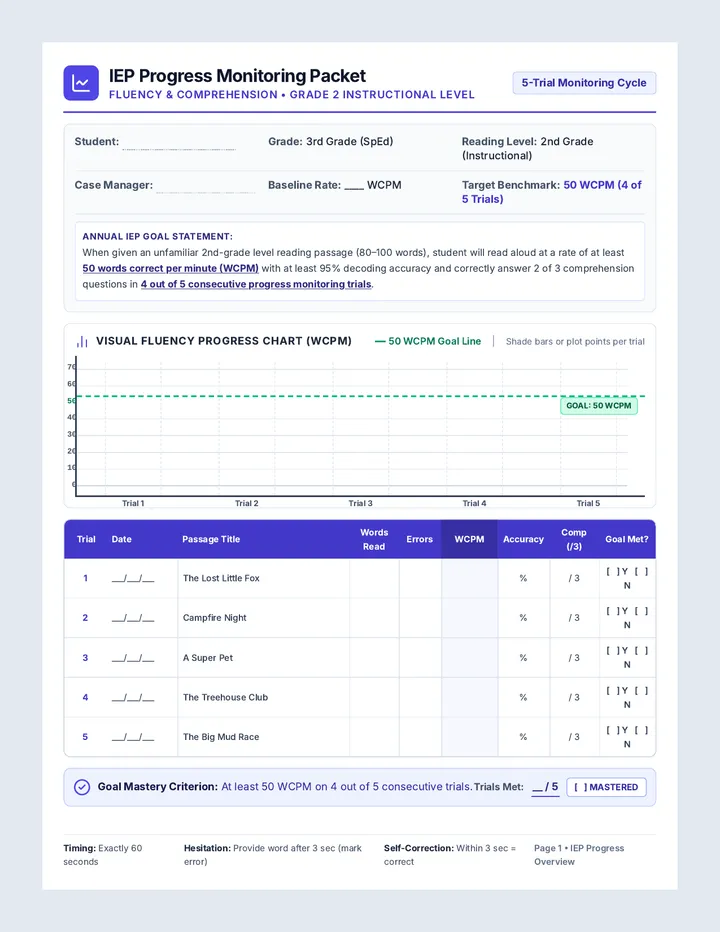
Scoring Guide: Math Goal requires ≥75% (3 out of 4 correct). Reading Goal requires ≥80% (4 out of 5 correct). Mastery Criteria: Met in 3 out of 4 trials
TEACHER GUIDE
Informative Paragraph Scoring
IEP Writing Goal Criterion: 60% Accuracy (3 out of 5 Points) in 3 of 4 Trials
1. Clear Intro (1 pt)
Topic sentence with hook/focus.
2. Detail 1 (1 pt)
First concrete text fact.
3. Detail 2 (1 pt)
Second concrete text fact.
4. Conclusion (1 pt)
Restates main idea clearly.
5. Structure (1 pt)
≥ 5 complete sentences.
Day 1 Exemplar (Honeybees):
[Intro] Honeybees use an extraordinary behavior known as the waggle dance to communicate food locations to their colony. [Detail 1] When a scout bee discovers blooming flowers, the direction she faces during her figure-eight dance tells other bees which angle to fly toward the sun. [Detail 1 Elab.] The duration of her vibration signals exactly how far away the nectar is located. [Detail 2] In addition, surrounding bees touch the dancer's antennae so they can recognize the unique scent of the flowers. [Conclusion] In conclusion, the waggle dance is a vital communication system that ensures the entire hive gathers food efficiently.
Day 2 Exemplar (Mariana Trench):
[Intro] Animals living in the Mariana Trench have developed astonishing adaptations to survive extreme ocean depths. [Detail 1] For example, snailfish have transparent skin and lack air-filled body cavities, allowing them to withstand crushing water pressure. [Detail 2] Furthermore, organisms rely on chemosynthesis to produce energy from hydrothermal chemicals rather than sunlight. [Detail 2 Elab.] Scavengers such as giant amphipods feed on organic matter that sinks down from higher ocean layers. [Conclusion] Ultimately, these specialized creatures demonstrate that life can thrive even in the darkest, coldest depths of our planet.
Day 3 Exemplar (Solar Energy):
[Intro] Solar energy systems provide an innovative way to generate clean electricity from abundant sunlight. [Detail 1] Photovoltaic panels contain silicon cells that create an electric current when hit by sunlight particles called photons. [Detail 2] Recently, engineers created floating solar farms on reservoirs, which boosts power output by fifteen percent through water cooling. [Detail 2 Elab.] These floating panels also help communities by preventing water from evaporating during dry seasons. [Conclusion] In summary, advancing solar technology provides renewable power that protects the environment for future generations.
Day 4 Exemplar (Maya Pyramids):
[Intro] The ancient Maya built awe-inspiring stone pyramids through their mastery of astronomy and architecture. [Detail 1] Maya builders constructed towering limestone temples without modern conveniences like wheeled carts, metal tools, or draft animals. [Detail 2] At El Castillo, they carefully positioned the pyramid so that afternoon sun during the equinox creates the illusion of a giant serpent slithering down the steps. [Detail 2 Elab.] This precise solar alignment allowed Maya priests to track important seasonal farming cycles. [Conclusion] To conclude, Maya pyramids stand as incredible engineering achievements that prove their deep understanding of science.
Accommodations & Differentiation Strategies:
Reading: Allow text-to-speech audio or partner read-aloud for students reading below 700L Lexile.
Writing: Provide sentence starter strips: "One important fact is..." and "Another detail is..."
Math: Provide PEMDAS mnemonic checklists with color-coded highlighters for parentheses and multiplication steps.