Math Calculation Goal Sheet
IEP Goal & Progress Framework
Foundational Multiplication Calculation Goal
Target Grade: 5th Grade
Domain: Mathematics (Operations & Calculation)
Student: _____________________
IEP Date: October 2026
Target Completion: October 2027
Present Level & Baseline Performance
Current Baseline: When presented with single-digit multiplication word calculation problems involving equal groups, the student consistently relies on repeated addition (e.g., solving \(4 \times 6\) as \(6 + 6 + 6 + 6 = 24\)) with 80% accuracy on classroom-based probes.
Current Strengths
Understands equal group grouping in additive contexts; can count by 2s, 5s, and 10s; accurately sets up multi-addend addition columns.
Identified Target Deficit
Lacks 2D spatial array and area models; does not connect multiplication to inverse division; additive strategy becomes inefficient with larger factors.
Standards Alignment & Grade-Level Pathway
Grade 5 Target
Target Standard: CCSS.MATH.CONTENT.5.NBT.B.5
"Fluently multiply multi-digit whole numbers using the standard algorithm."
Instructional Rationale: Fluency with standard multi-digit algorithms requires moving past linear repeated addition to 2D place value area arrays and reciprocal division fact models.
Foundational Bridge Standards:
- • 3.OA.A.1 / 3.OA.A.2: Arrays & quotients
- • 3.OA.B.5 / 3.OA.B.6: Commutative & inverse ops
- • 4.NBT.B.5: Area models & partial products
Annual SMART Calculation Goal
By October 2027, given mathematical calculation problems and contextual word problems requiring multi-digit multiplication, the student will transition from linear repeated addition to utilizing structured arrays, area models, and the inverse relationship of multiplication and division to compute products and quotients for factors up to 2-digits by 1-digit (progressing toward 2-digits by 2-digits) with at least 80% accuracy across 4 out of 5 consecutive bi-weekly work samples and curriculum-based measurement probes.
Measurable Benchmarks: Quarters 1 & 2
Objective 1: Rectangular Arrays & Area Models (Q1) Target: Dec 2026
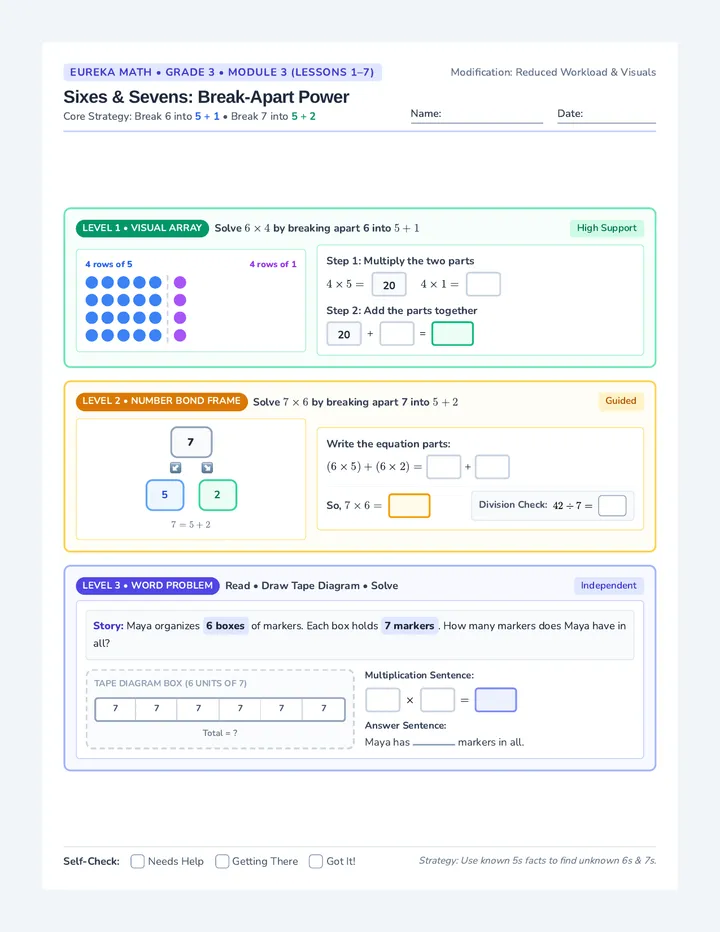
When presented with single-digit multiplication calculation problems (e.g., \(7 \times 8\)), the student will accurately draw a rectangular array or grid area model representing rows and columns, identify the total product, and write the corresponding equation with 85% accuracy in 4 out of 5 trials without using purely 1-by-1 additive tallies.
Objective 2: Inverse Relationship & Fact Families (Q2) Target: March 2027
When given a division calculation problem within 100 (e.g., \(42 \div 6 = \square\)), the student will demonstrate conceptual understanding of division as an unknown-factor multiplication problem (\(6 \times \square = 42\)) by writing the full fact family and determining the quotient with 80% accuracy across 4 consecutive trials.
Section 1: Baseline, Standards, Annual Goal & Objectives 1-2 Page 1 of 2
Instructional Implementation Plan
Calculation Benchmarks, Interventions & Tracking
Math Calculation IEP
Grade 5 Transition to 5.NBT.B.5
Measurable Benchmarks: Quarters 3 & 4
Objective 3: Partial Products (Q3) May 2027
Given 2-digit by 1-digit multiplication tasks (e.g., \(24 \times 6\)), the student will decompose the 2-digit factor by place value \((20 + 4)\), construct an area model, compute partial products \((120 + 24)\), and sum the total with 80% accuracy across 4 of 5 trials.
Objective 4: Multi-Digit Fluency (Q4) Oct 2027
When solving grade-level 2-digit by 2-digit multiplication and mixed word calculation problems, the student will independently select an area model, partial products, or standard algorithm layout and check work using inverse operations with 80% accuracy over 3 consecutive assessments.
Concrete-Representational-Abstract (CRA)
1. Concrete Stage (Hands-On):
Build physical arrays using square centimeter tiles, base-ten rods, and grouping counters to visualize equal rows.
2. Representational Stage (Visual Models):
Draw grid arrays on 1 cm graph paper; transition to open area boxes showing factor lengths and partial product areas.
3. Abstract Stage (Algorithms & Inverses):
Solve numerical equations via partial products and standard algorithm steps; verify results using division fact families.
Specially Designed Instruction
- • Grid Paper: 1/2-inch grid paper for column alignment and drawing arrays.
- • Fact Triangle Anchors: Color-coded visual cues showing product at peak and factors at base.
- • Chunked Tasks: 4-6 calculation problems per page to prevent cognitive overload.
Teacher Tip: Always prompt student: "Can you group these rows instead of adding each item individually?"
Progress Monitoring & Data Log
Frequency: Bi-weekly probe (5 items each)
| Quarter / Date | Target Skill Focus | Strategy Observed | Score / % | Benchmark Met? |
|---|
| Baseline / Oct '26 | Single-digit multiplication words | Repeated Addition only | 4/5 (80%) | Baseline |
| Q1 Probe / ___'26 | Rectangular Array Construction | Tile / Grid / Addition | ___ / 5 (__%) | |
| Q2 Probe / ___'27 | Inverse Operation & Fact Family | Fact Triangle / Model | ___ / 5 (__%) | |
| Q3 Probe / ___'27 | 2-digit by 1-digit Area Model | Partial Products / Box | ___ / 5 (__%) | |
| Q4 Probe / ___'27 | Multi-Digit & Inverse Check | Standard / Area Model | ___ / 5 (__%) | |
Section 2: CRA Implementation, Accommodations & Data Tracking Log Page 2 of 2