Goal Alignment Decision Guide
Special Education Assessment Protocol IDEA Measurement Fidelity
Goal Alignment Decision Guide
Protocol for handling assessment items that exceed the rigor, conditions, or scope of written IEP goals.
The Bottom Line Rule: No, do not count the item as negative progress data. When an assessment item exceeds the conditions or cognitive complexity specified in an IEP goal, counting an error penalizes the student for untargeted skills, violates measurement validity, and distorts official progress reporting.
Why Rigor Mismatch Distorts Progress Data
Construct Validity
Higher-rigor items introduce extraneous cognitive load (e.g., multi-step logic, reading burden), testing auxiliary skills rather than the target IEP standard.
Prevents false-negative data
Legal Fidelity
Under IDEA, progress monitoring must measure progress toward the annual goal as written. Inaccurate low scores jeopardize appropriate placement and FAPE compliance.
IDEA 34 CFR § 300.320 standard
Purpose Separation
Classroom grading evaluates broad curriculum mastery, whereas IEP data tracks individualized baseline progression. Do not merge both into a single metric.
Separate gradebook & IEP logs
Decision Protocol: How to Score the Student's Work
A
If the student misses the higher-rigor question:
Exclude from IEP Calculation
Action: Exclude this score from the IEP progress percentage. The student missed unaligned demands, not necessarily the goal. Administer a quick probe strictly calibrated to the IEP condition to determine true mastery.
B
If the student answers the higher-rigor question correctly:
Count as Skill Generalization
Action: You may record this as positive evidence of skill transfer and generalization. If the student consistently succeeds on higher-rigor items, reconvene the IEP team to formally update and elevate the goal.
C
If the question contains multiple embedded skills:
Disaggregate Specific Sub-Skill
Action: Review student work for the specific IEP sub-skill. If the targeted operation was performed correctly, award IEP goal credit for that step even if the total composite question score was incorrect.
Implementation Protocol for Teachers & Case Managers
Use Calibrated Probes: Gather core progress data through standardized CBMs or targeted mini-probes matching IEP conditions.
Annotate Gradebook: Record general classroom grades separately; mark whether an assessment item reflects IEP-level or grade-level rigor.
Document Qualitative Insights: Note error patterns in progress logs (e.g., “Target math skill intact; errors linked to text reading load”).
Propose Goal Revisions: When students regularly achieve ≥80% on above-goal items, initiate an IEP amendment to prevent academic stagnation.
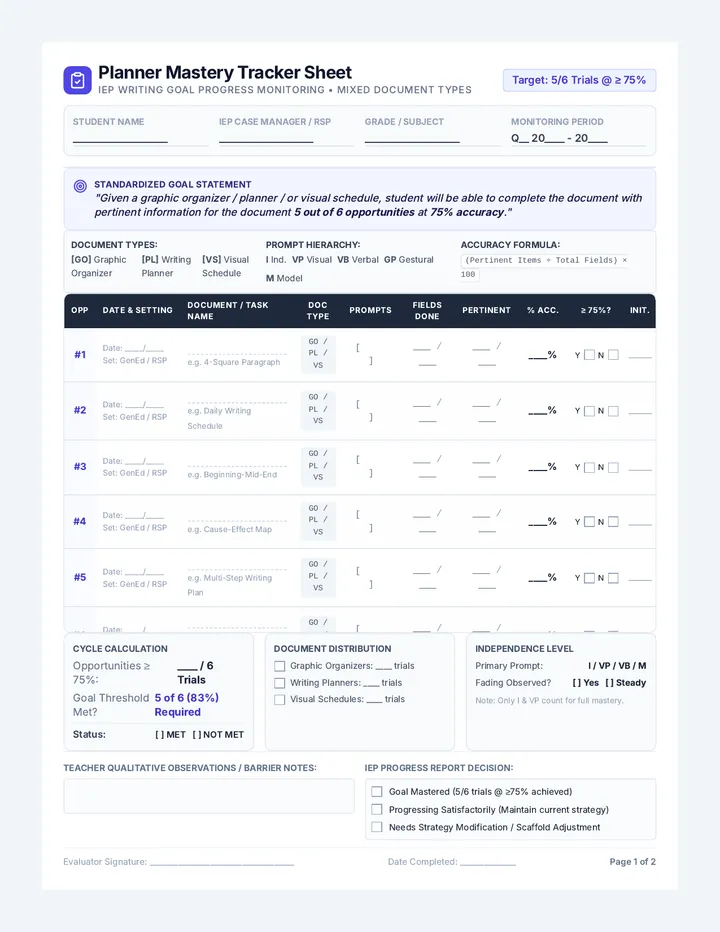
Compliant Progress Report Documentation Phrasing Quarterly Documentation Template
“On targeted probes aligned with written IEP conditions (single-step 2-digit addition without regrouping), the student demonstrated 85% accuracy across 3 trials (Mastery Criterion Met). On composite classroom assessments requiring multi-step word problems, the student scored 60%, with errors attributed to reading comprehension demands rather than computation.”
Special Education Assessment • Data Integrity Protocol IDEA 34 CFR § 300.320(a)(3) Compliance Standards