Engine Drivers Curriculum Guide
OT & Special Education Intervention Curriculum
Engine Drivers Curriculum Guide
15-Session Self-Regulation Plan Aligned with the Alert Program® (“How Does Your Engine Run?”)
Format: 15 x 30-Min Sessions
Setting: OT / Resource / Inclusion
Grades: 1–6 (Adaptive Elementary/MS)
Target IEP Goal Statement
Annual Goal: By [Date], when encountering sensory, emotional, or environmental demands during daily school routines, the student will independently identify their current engine speed (Low, High, or Just Right) and implement a sensory-motor strategy to achieve or maintain a “Just Right” state for learning in 4 out of 5 observed opportunities across 3 consecutive weekly probes.
Obj. 1 (Awareness): Accurately identifies engine level using visual gauges in 80% of trials with ≤1 prompt.
Obj. 2 (Tool Exploration): Identifies ≥2 calming and ≥2 alerting strategies across the 5 sensory pathways.
Obj. 3 (Self-Selection): Selects and initiates an appropriate tool within 2 minutes of speed shift.
Obj. 4 (Generalization): Spontaneously requests pit stops or uses silent desk tools in gen ed setting.
15-Session Scope & Sequence Overview
Stage 1 (S1–S4) • Stage 2 (S5–S11) • Stage 3 (S12–S15)
| Sess. | Stage & Topic | Core Strategy / Sensory Experience | Measurable Artifact |
|---|
| S1 | Engine Metaphor & Speeds | Toy car speeds comparison; high, low, & just right sorting | Speed Badge Card |
| S2 | Feeling the Speeds (Movement) | Kinesthetic simulations: turtle crawl, rocket launch, cruise control | Movement Rating Log |
| S3 | Body Detective (Internal Clues) | Heart rate, muscle tension, breathing, and hand fidget mapping | Body Clues Silhouette |
| S4 | Personal Engine Tachometer | Constructing desk spinner gauge; practicing 5 scenario ratings | Desk Tachometer Dial |
| S5 | Movement: Heavy Work (Proprioception) | Wall presses, chair lifts, resistance bands, weighted ball carries | Heavy Work Rating Sheet |
| S6 | Movement: Vestibular Shifts | Linear rhythmic rocking vs alerting bouncing; dynamic seat cushions | Movement Effect Log |
| S7 | Mouth: Oral-Motor Self-Regulation | Chew (silicone tubes), crunch (pretzels), suck (thick straw), sour spray | Oral Sensory Menu |
| S8 | Touch: Tactile & Deep Pressure | Fidget textures (spiky, smooth, putty) vs weighted lap pads | Tactile Tool Contract |
| S9 | Listen: Auditory Comfort & Rhythm | Noise-canceling headphones, 60 BPM metronome beats, white noise | Sound Strategy Plan |
| S10 | Look: Visual Comfort & Light | Light filters, desk privacy carrels, visual timers, calm jars | Visual Comfort Guide |
| S11 | Sensory Pit Stop Menu (Synthesis) | Multi-sensory circuit: assembling personalized quick-pick sensory card | Personal Pit Stop Card |
| S12 | Mapping Daily School Triggers | Identifying speed shifts: arrival, math, cafeteria, recess transition | Daily Trigger Map |
| S13 | Self-Advocacy & “Pit Stop Passes” | Scripted communication cards to request sensory tools or breaks | Laminated Pit Stop Passes |
| S14 | Simulated Classroom “Driver’s Test” | Mock noisy classroom challenge; unprompted tool selection & use | Simulation Data Rubric |
| S15 | Driver’s License Graduation | Presenting personalized Engine Manual to teacher/parents; celebration | Master Driver License |
Core Philosophy: There are no “bad” engine speeds. All speeds are functional; the goal is matching engine speed to the task. Page 1 of 5
Stage 1
Identifying Engine Speeds (Sessions 1–4)
Objective 1 Focus: Body Awareness & Vocabulary
S1
The Car Show: Introducing the Engine Metaphor
Metaphor & Speeds
Warm-Up (5 min) Display toy sports car, tractor, and regular sedan. Discuss how cars have engines that run fast, slow, or just right for traffic.
Core Experience (18 min) Introduce the 3 Speeds: High (revved, wild), Low (sluggish, sleepy), and Just Right (focused, learning). Sort activity cards into speeds.
Check-In & Log (7 min) Student colors initial Engine Badge. Emphasize: “Engines change all day! High isn’t bad—it’s great for soccer!”
S2
Feeling the Speeds: Kinesthetic Movement Simulation
Physical Contrast
Engine Check (5 min) Student clips their name onto therapist’s engine chart showing their current arrival state.
Movement Lab (18 min) Guided body simulations:
• Low: Snail crawl, dragging heavy feet across mat.
• High: Fast jumping jacks, rapid air drums.
• Just Right: Steady march, beanbag balance walk.
Reflection (7 min) Contrast body feelings: “Which made your heart beat fast? Which made your eyes feel heavy? Which was best for listening?”
S3
The Body Detective: Internal Cues & Interoception
Body Clues Mapping
Detective Badge (5 min) Provide magnifying glass prop: “Today we find clues hiding inside our bodies!”
Clue Mapping (18 min) Map sensations on body outline:
• Heart: Thumping fast (High) vs slow (Low).
• Muscles: Tight/clenched (High) vs limp noodle (Low).
• Hands/Feet: Popcorn tapping vs slumped.
IEP Probe 1 (7 min) Student names 2 personal clues: “When my engine is high, my shoulders feel tight and my feet bounce.”
S4
The Personal Tachometer: Stage 1 Showcase
Tool Creation & Assessment
Dial Crafting (10 min) Build a laminated 3-speed desktop tachometer with movable dial pointer (Blue=Low, Green=Just Right, Red=High).
Scenario Practice (12 min) Read 5 school scenarios (fire drill, silent reading, math test, gym class). Student sets gauge and justifies choice.
Stage 1 Benchmark (8 min) Administer Objective 1 Data Probe: Document baseline accuracy of self-speed identification without adult prompts.
Stage 1 Clinical Rule: Maintain strict neutrality. Never label “High” as misbehavior or “Low” as laziness. Reinforce accurate self-awareness: “I noticed your motor is running fast right now—great detective work noticing that!”
Stage 2 (Part A)
Sensory Pathways: Movement, Oral & Touch (S5–S8)
Objective 2 Focus: Experiencing Tools that Shift Speeds
S5
Move It! Proprioception & “Heavy Work”
Proprioceptive Channel
Engine Check (3 min) Check starting dial. Explain that muscles and joints send calming or organizing signals to the brain.
Heavy Work Lab (20 min) Test 4 proprioceptive exercises:
1. Wall pushes & chair push-ups.
2. Weighted ball or backpack carrying.
3. Theraband leg kicks around chair legs.
4. Animal walks (bear, crab) on mat.
Rating & Log (7 min) Student logs effect: Proprioception lowers a High engine and wakes up a Low engine (the great organizer).
S6
Rock & Roll: Vestibular Input (Calm vs. Alert)
Vestibular Channel
Engine Check (3 min) Contrast linear (straight back-and-forth) vs rotary/rapid movements on brain state.
Movement Lab (20 min) Test movement styles:
• Calming: Slow, rhythmic linear rocking on therapy ball or rocking seat.
• Alerting: Fast bounces or balance board shifts to wake sluggish engine.
• Desk Tool: Inflatable wobble cushion.
Log & Grounding (7 min) Follow with 3 deep wall presses to organize vestibular inputs before transitioning.
S7
Put It in Your Mouth! Oral-Motor Regulation
Oral Motor Channel
Intro & Vagus Nerve (4 min) Explain how jaw work (chewing, crunching, sucking) sends strong calming signals to nervous system.
Taste & Texture Lab (19 min) Sample & evaluate:
• Chewy: Silicone chewelry or tubing.
• Crunchy: Pretzels or carrots (grounds body).
• Sucking: Thick smoothie via thin straw.
• Alerting: Ice water or sour lemon mist.
Classroom Menu (7 min) Identify 2 permissible classroom oral tools (e.g., sports straw water bottle, crunchy snack).
S8
Touch & Feel: Tactile Input & Deep Touch Pressure
Tactile Channel
Engine Check (3 min) Record pre-session engine level on tachometer.
Tactile Exploration (20 min) Compare tactile inputs:
• Deep Pressure: Weighted lap pad (5% body weight) and firm self-hugs.
• Silent Fidgets: Spiky ring, smooth marble maze, dense therapy putty.
Fidget Rules (7 min) Establish the 3 Fidget Rules:
1. In hand or lap, not in the air.
2. Eyes on teacher.
3. Tool for learning, never a toy!
Vestibular Safety: Monitor for autonomic overload (sweating, paleness, nausea, lethargy). Always pair vestibular motion with heavy work (proprioception) to preserve neurological organization.
Stage 2 (Part B) & Stage 3
Sensory Synthesis & Daily Triggers (S9–S12)
Sound, Sight, & Trigger Analysis
S9
Listen Up! Auditory Tools & Sound Sensitivity
Auditory Channel
Sound Audit (4 min) Discuss auditory triggers: cafeteria roar, buzz of fluorescent tubes, sudden bells, chatty small groups.
Auditory Tools Lab (19 min) Test calming vs alerting inputs:
• Passive noise reduction earmuffs.
• Calming rhythmic tempo (60 BPM classical/nature).
• Upbeat marching beat to shift Low engine to Just Right.
Action Plan (7 min) Determine auditory threshold. Set headphone protocol for transition times in IEP notes.
S10
Look Around! Visual Inputs & Environmental Focus
Visual Channel
Visual Check (4 min) Evaluate visual overload: crowded bulletin boards, bright glare, rapid screen transitions.
Visual Tools Lab (19 min) Explore:
• Desk privacy carrels / study shields.
• Colored light filters or baseball cap brim.
• Time Timer® visual countdowns.
• Slow swirl glitter sensory bottles.
IEP Probe 2 (7 min) Verify Objective 2: Student articulates at least 2 functional tools across each sensory channel.
S11
The Multi-Sensory Pit Stop Menu (Synthesis)
Stage 2 Synthesis
Menu Concept (4 min) Race car pit crews keep tools ready before the race. We build a pocket-sized personal Pit Stop Card.
Menu Assembly (19 min) Compile top tools into 2 action lists:
• To Boost a Low Engine: Ice water, brisk wall push, sour snack, upbeat rhythm.
• To Calm a High Engine: Chair push-up, weighted lap pad, chew tool, deep breathing.
Card Lamination (7 min) Laminate pocket card for student desk pencil case.
S12
Stage 3 Launch: Mapping Daily School Triggers
Anticipatory Regulation
Race Track Map (4 min) Draw student’s daily schedule as a race track with curves and pit stops.
Trigger Analysis (19 min) Identify predictable speed shifts:
• Arrival / Unpacking (often Low or High).
• Math seatwork (frustration High or fatigue Low).
• Post-recess re-entry (overstimulated High).
Proactive Plan (7 min) Schedule 2 planned “Proactive Pit Stops” before dysregulation peaks.
Stage 3 Shift: Move from therapist-guided sensory trials to student-initiated regulation. Transition from reactive calming (after meltdown) to proactive maintenance (before engine overheats).
Stage 3 Capstone
Independent Regulation & IEP Progress Tracker
Sessions 13–15 & Measurement Rubric
S13
Self-Advocacy: The “Pit Stop Pass” & Scripts
Staff Communication
Advocacy Script Teach formula: “My engine is running [High/Low]. I need 2 minutes of [heavy work / tool] to get Just Right.”
Roleplay Lab Rehearse silently placing the “Pit Stop Pass” on the teacher’s desk during direct instruction without disruption.
Classroom Hand-Off Provide classroom teacher with laminated pass receiver box and clear time guidelines (2–3 minutes).
S14
The Driver’s Test: Simulated Classroom Simulation
Unprompted Generalization
Simulation Setup Create 15-minute mock classroom session with background chatter audio, timed seatwork task, and pencil drops.
Unprompted Run Therapist offers zero verbal reminders. Observe if student references desk tachometer and initiates appropriate tool.
IEP Probe 3 Data Score Objectives 3 & 4: Record latency between dysregulation sign and autonomous tool implementation.
S15
Driver’s License Graduation & Team Showcase
Mastery Celebration
Student Showcase Student presents their personalized Engine Manual to general ed teacher, showing their top calming and alerting strategies.
Official License Award laminated “Master Engine Driver’s License” signed by student, therapist, and teacher.
Carryover Protocol Establish biweekly inclusion check-in schedule to monitor tool durability and ongoing IEP compliance.
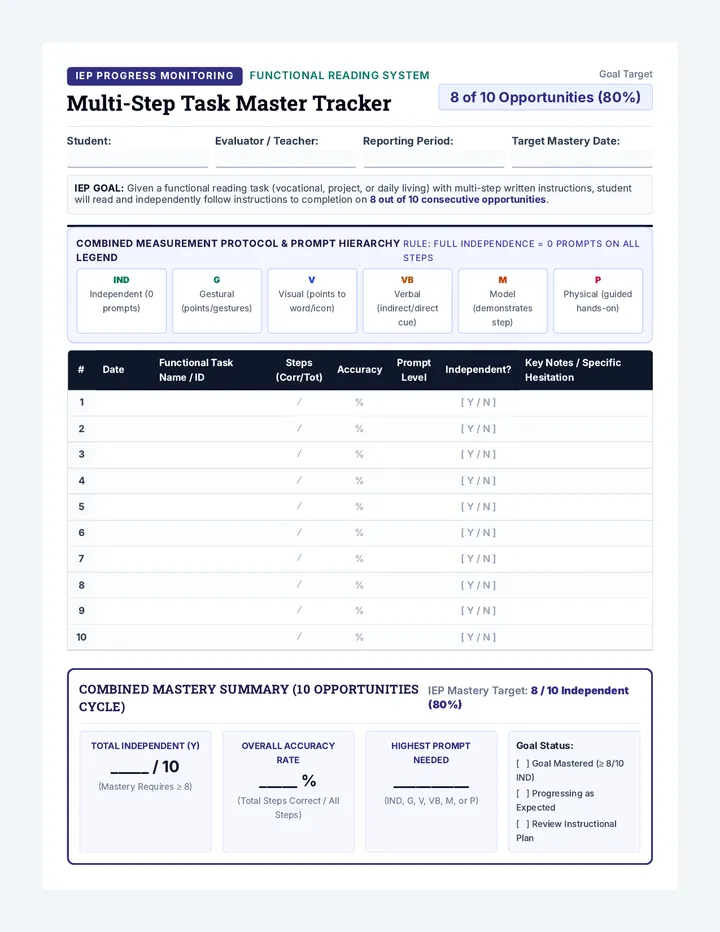
IEP Self-Regulation Scoring Rubric
Use for Progress Reports & Triennials
| Level | Stage | Behavioral Performance Indicator | Score Criteria |
|---|
| Level 1 | Unaware / Resists | Unable to name engine speed; ignores or rejects suggested sensory strategies. | Emerging (<30%) |
| Level 2 | Prompt Dependent | Identifies speed and uses tool only when given direct adult verbal instruction and setup. | Developing (31–60%) |
| Level 3 | Minimally Cued | Identifies speed given nonverbal gesture (pointing to gauge); selects tool from menu. | Proficient (61–79%) |
| Level 4 | Fully Independent | Autonomously checks engine, implements sensory tool, and returns to task within 3 min. | Mastery (≥80%) |
Weekly Carryover Data Entry Table Student: __________________ • Therapist: __________________
| Date/Time | Class Routine / Setting | Observed Speed | Strategy Selected | Independence (1–4) | Post Speed / Notes |
|---|
| | | | | |
| | | | | |
IEP Accommodations: Visual desk tachometer, permitted silent fidgets, scheduled 2-min pit stops, flexible seating.
Alert Program® Aligned • Page 5 of 5