Cool Down Visual Schedule
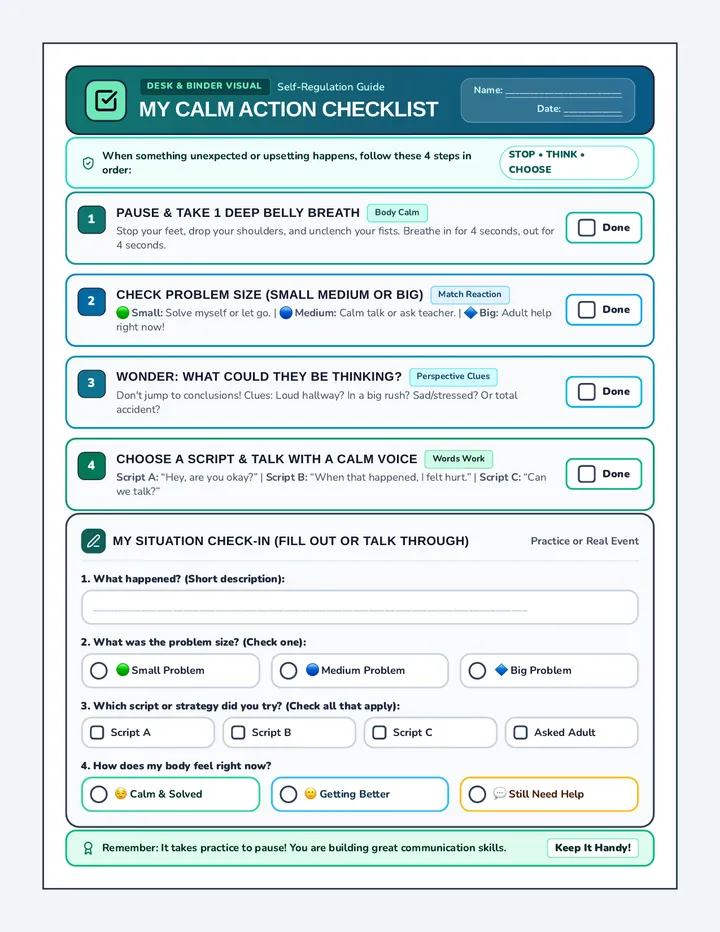
MY COOL DOWN SCHEDULE
Follow the 3 steps to help your mind and body reset
Name:
Calm Spot
1
Stop and Breathe
DONE
Deep Belly Breathing
Breathe in slow through your nose (1-2-3) • Hold gently (1-2) • Breathe out slow (1-2-3)
Repeat 3 Times
Finger Trace Track: Slide finger left to right as you take your 3 deep breaths
Inhale → Hold → Exhale
2
Do Wall Push Ups
DONE
Press Against The Wall
Place palms flat at shoulder height • Bend elbows toward wall • Push firmly back to standing
5 Firm Pushes
Touch or Cross Off Each Push:
1
2
3
4
5
3
Feelings Check
Point to or Select Your Emotion Picture
DONE
Angry Mad • Fast heart
Frustrated Stuck • Overwhelmed
Worried Nervous • Jittery
Sad Tearful • Low
Tired Sleepy • Low Energy
Okay Settling • In Between
Calm Peaceful • Relaxed
Ready Happy • Ready to Try
I can show: "I am ready" OR "I need 2 more minutes"
[ Place Emotion Tile Here ]
Self-Advocacy: All feelings are okay. You can take your time to calm down.
Safe & Supported
PRINTABLE EMOTION TILES & DESK CUES
Cut out and laminate emotion picture cards for tactile communication
Print & Cut Kit
8 Cut-Out Emotion Pictures (Cut Along Dashed Lines • Add Velcro Dot) Standard PECS / Schedule Size
Angry
Frustrated
Worried
Sad
Tired
Okay
Calm
Ready
Portable Mini Desk Strip Laminate & Tape to Desk Corner
3 Steps:
1 Stop & Breathe
2 Wall Push Ups
3 Feelings Check
Check Tokens (Attach Hook Velcro to Back) Place on "DONE" slots
DONE 1
DONE 2
DONE 3
CALM
CALM
READY
Autism Support & Implementation Notes
1. Non-Verbal Emotion Pointing
When dysregulated, verbal speech is overwhelming. Allow the student to simply point or place an emotion tile. Never force verbal explanations.
2. Proprioceptive Heavy Work
Wall push-ups ground the body via joint compression. Guide the student to the wall and count firmly together without extra verbal conversation.
3. Validating 'Not Ready'
If the student points to Angry, Frustrated, or Worried, say: "I see you are still upset. Let's do another round of push-ups." Validate their self-awareness.
4. Practice During Neutral Calm
Walk through these 3 steps when the student is in a peaceful state so the visual pathways are established before high-stress moments occur.
Autism Sensory Support Toolkit • Emotion Identification & Self-Regulation Page 2 of 2