Access By Design Slides
Secondary Faculty Professional Learning • 15 Minutes
Access by Design
Why Differentiation & Accommodations Matter More Than Ever in Grades 6–12
Student Support & Instructional Leadership Team
October 2026
The Secondary Reality Check
Who Is Sitting in Our Classrooms Today?
1
Learning Differences
Students have identified or emerging differences, including ADHD, dyslexia, and processing speed variations.
7x Load
The Secondary Shift
Multiple teachers, distinct grading systems, and changing syllabi multiply executive functioning friction daily.
Masking
Invisible Barriers
In middle and high school, cognitive overwhelm often masks as defiance, disengagement, or "not caring."
Instructional takeaway: Learning differences reflect neurological diversity, not a lack of motivation or intellect.
Essential Clarity
Accommodations vs. Modifications
HOW They Learn
Accommodations
Alters the pathway or environment, keeping grade-level rigor and mastery expectations identical.
- • Audio version of complex reading text
- • Extended time or low-distraction testing room
- • Speech-to-text or structured graphic organizers
WHAT They Learn
Modifications
Alters the standard or curriculum target, changing what the student is expected to demonstrate.
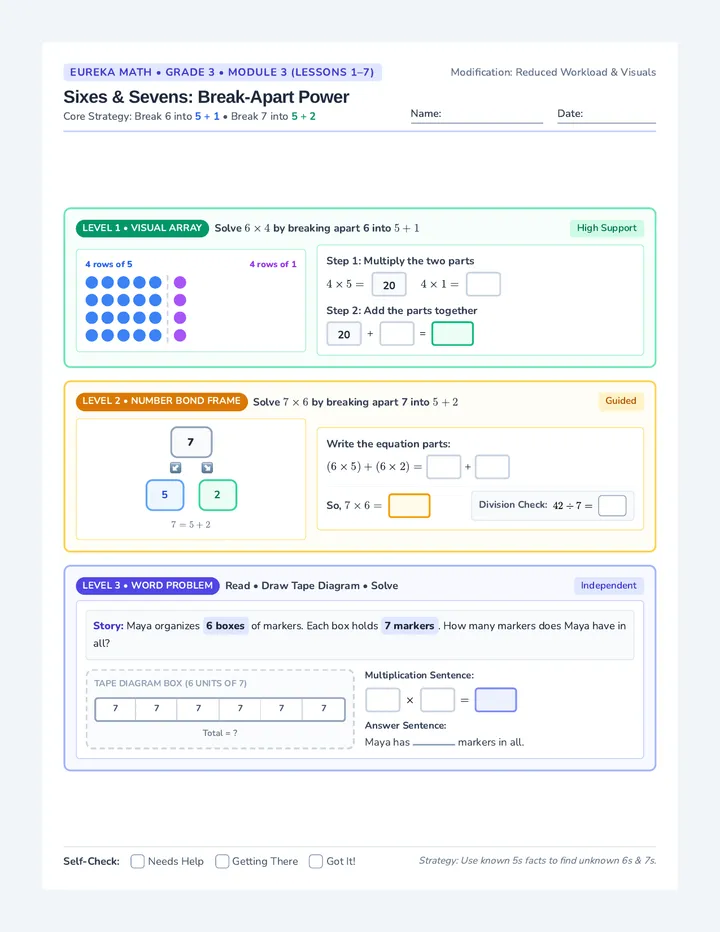
- • Reduced complexity of foundational content
- • Different grading criteria / alternative standards
- •
Accommodations do not grant an unfair advantage—they remove obstacles so true ability can show.
Instructional Design
Four Levers Every Secondary Teacher Controls
1. Content (Input)
How students access concepts
Provide multimodal formats: podcasts, video summaries with captions, annotated readings, and vocabulary word walls.
2. Process (Sense-Making)
How students practice and reflect
Use tiered practice activities, fill-in guided notes, peer discussion protocols, and explicit think-alouds.
3. Product (Demonstration)
How students prove understanding
Offer menu choices: structured analytical essay, recorded screencast presentation, or detailed annotated infographic.
4. Environment (Culture)
How physical and social space functions
Establish designated quiet zones, predictable lesson agendas on the board, and stigma-free scaffold access.
You do not need four separate lesson plans—you need multiple entry ramps into one rigorous plan.
High-Impact, Low-Lift
Four Scaffolds You Can Deploy Tomorrow
1
Visual Agendas & Time Boxing
Write daily milestones on the board with projected time allotments. Externalizes time awareness for students with ADHD.
Executive Support
2
Dual-Channel Directions
Never give spoken directions without an identical written checklist visible on screen or paper. Relieves working memory fatigue.
Processing Support
3
Milestone Chunking
Break 3-week projects into 3 distinct checkpoint deadlines with individual feedback instead of one high-stakes submission.
Pacing Support
4
Speech-to-Text Drafts
Allow students with dysgraphia or working memory delays to dictate initial brainstorming before editing mechanically.
Output Support
Universal Design Principle: Necessary for some students, beneficial for all. Zero extra prep once routinized
Case in Point
Marcus: 9th Grade Biology Research
Student Profile: Inquisitive, strong verbal synthesizer, diagnosed ADHD & Working Memory Deficit.
Without Accommodations
- ✕ Handed a dense 4-page rubric and told: "Due in two weeks."
- ✕ Paralyzed by where to start; misses initial search stages.
- ✕ Turns in blank assignment; receives a zero; feels defeated.
Result: Failure to capture student knowledge
With Target Accommodations
- ✓ Provided graphic research matrix and 3 interim milestone checks.
- ✓ Uses speech-to-text to capture arguments and evidence synthesis.
- ✓ Produces a sophisticated scientific thesis scoring in the top 15%.
Result: Grade-level standard fully mastered
"He didn't need easier content. He needed an accessible runway."
Moving to Practice
Department Next Steps
1
Audit One High-Stakes Task
Review an upcoming major assessment. Add two visual or structural access ramps (checklists, exemplars, organizers).
2
Normalize Universal Tools
Place guided notes, speech-to-text options, and graphic templates in shared folders so zero stigma is attached.
3
Meet with Ms. Ingraham
Monthly curriculum check in and/or schedule a 10-minute check-in with your department's learning specialist to calibrate accommodations on each student's PEP.
Department Table Discussion (5 Mins)
"What is one barrier in your curriculum this month that an accommodation could dismantle for students?"