Academic Resilience Intervention Plan
Tier 2/3 Support IEP / 504 Behavioral Framework
Behavior Intervention Plan
Target Focus: Academic Performance Anxiety, Perfectionism & Task Avoidance
Active Intervention Plan
Review Cycle: 6-8 Weeks
Student Name ________________________
Grade / Placement Grade _____ / GenEd & Res.
Implementation Date September 8, 2026
Case Manager / Specialist ________________________
1
Target Problem Behaviors & Operational Definitions
Task Avoidance High Latency
Pencil sharpening, bathroom/nurse requests within 5 min of independent work distribution, rummaging through bag.
Baseline: 12-18 min latency before initiation.
Perfectionist Erasure Repetitive
Repeatedly erasing legible work to the point of tearing paper, crumbling pages, stating "I can't do this right."
Baseline: 4-6 ripped/discarded sheets/week.
Somatic Shutdown Severe
Head down on desk, pulling hood up, mutism (non-responsive to verbal redirection), intense somatic distress.
Baseline: 2-3 episodes/week during timed work.
2
FBA Summary: Function & Environmental Triggers
| Setting Events (Slow Triggers) | Immediate Antecedents (Fast Triggers) | Hypothesized Behavior Function |
|---|
| | |
- Disrupted sleep or physical fatigue.
- Unannounced routine changes.
- Fear of negative peer evaluation.
|
- Timed tests or visible countdowns.
- Cold calling / reading aloud.
- Unchunked, dense writing prompts.
- Open-ended tasks without models.
|
Negative Reinforcement
Escape/Avoidance of perceived academic failure, social evaluation, and distress from perfectionist standards.
|
3
Proactive Antecedent Modifications (Preventative)
Task Chunking & "First 3" Rule
Fold or mask worksheets so only 3-4 problems are visible at a time. Establish an agreement: "Complete the first 3 items, then we take a 60-second micro-break to review."
Non-Verbal Signals & Pre-Warning
Never cold-call. Provide a 2-minute private pre-warning: "I'll be asking for your thought on question 2 in a moment." Implement a subtle colored desk card to indicate help needed.
Removal of High-Stress Timers
Replace large projector countdown timers with quiet personal sand timers or non-numerical visual progress bars. Allow extended time without spotlighting the student.
"Rough Draft" Normalization
Use colored ink or erasable pens for initial ideation to reduce perfectionist paralysis. Explicitly state: "Messy thinking is required on this stage of the graphic organizer."
Student Support Services • Academic Anxiety Behavior Intervention Plan Page 1 of 2
Intervention & Response Framework
Instruction, Protocol & Accountability
Student: ___________________
4
Replacement Behaviors & Explicit Instruction
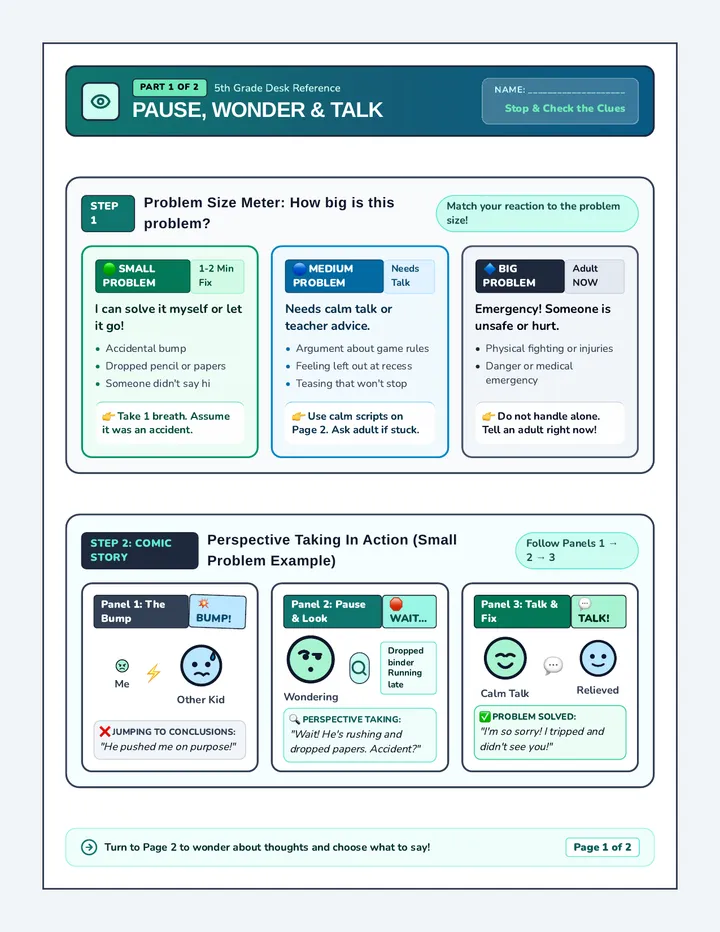
Self-Advocacy & Help-Seeking
Target Skill: Student uses a scripted 2-finger gesture or places a yellow cue card to request teacher check-in instead of task refusal or escaping.
Script: "I'm stuck on step 2, can you model the first calculation?"
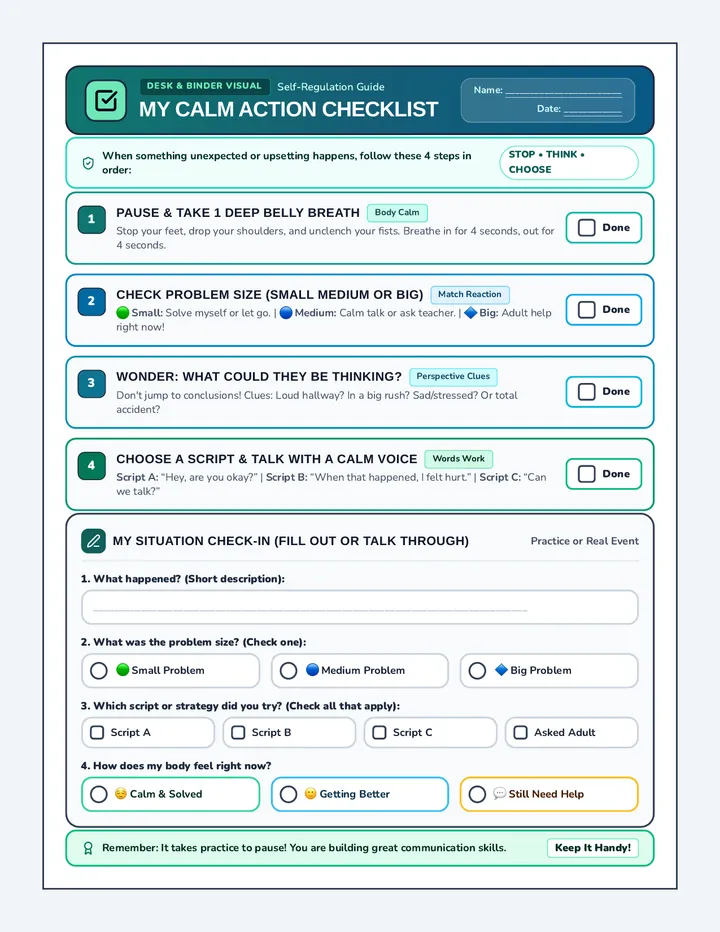
Somatic Coping & "Brain Break" Menu
Target Skill: Use regulated 2-minute reset options: 4-7-8 box breathing, sensory grip squeeze, or water refill before anxiety spikes to shutdown.
Taught explicitly 2x weekly by counselor during morning advisory.
5
Four-Stage De-escalation Protocol
1. Baseline (Calm) Engaged, responsive
Staff Action: Provide 4:1 positive reinforcement for effort. Prompt graphic organizers. Give subtle thumbs-up during smooth transitions.
2. Escalating Worry Pencil tapping, erasing
Staff Action: Low-key proximity. Deliver non-verbal card: "Pick 1 problem, do it with me." Offer choice: "Odd or even numbers first?" Avoid debate.
3. Acute Shutdown Head down, tears, silent
Staff Action: Eliminate verbal stimulation. Place pass for 5-min calm corner. Say quietly once: "Your desk is safe. Take 5 minutes to reset." Allow silence.
4. Recovery Looking up, calm breath
Staff Action: Re-engage with low-demand bridge task (e.g., highlighting vocab). Debrief coping strategy later in the day when fully regulated.
6
Positive Reinforcement & Courage Incentives
Reinforce Strategy Use:
Acknowledge attempting challenging items and using break cards over raw 100% scores.
Immediate Incentive:
Earn "Courage Points" for starting work within 3 minutes; points redeemable for preferred activities.
Feedback Style:
Private, whispered or sticky-note praise ("I noticed how you persisted on problem 4").
7
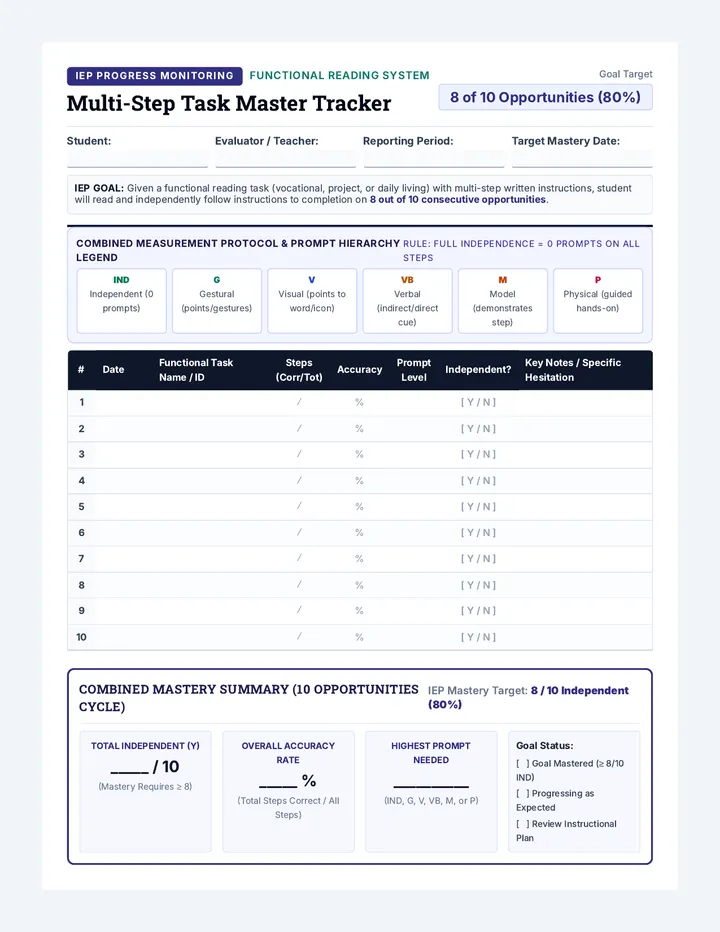
SMART Goals & Progress Monitoring
| Measurable Target Goal | Measurement Method | Review Frequency |
|---|
| Task Initiation: Reduce latency from instruction to task start from 15 min to ≤3 min across 4 out of 5 consecutive academic days. | Latency timer log via classroom teacher tracker. | Weekly chart review |
| Self-Regulation / Coping: Student will initiate a proactive break/scripted cue card prior to reaching shutdown in 80% of identified anxiety triggers. | Counselor self-advocacy check sheet & card tally. | Bi-weekly case review |
8
Team Signatures & Commitment
General Education Teacher
Date: _______________
Special Education Specialist
Date: _______________
School Counselor / Psych
Date: _______________
Parent / Guardian
Date: _______________
Confidential Student Record • Behavior Intervention Plan Page 2 of 2