Signal Hub Lesson Plan Educator Instructional Guide
Signal Hub Lesson Plan
Grades 4–8
Pacing: 60–75 Min (or two 35-min blocks)
Focus Domains
Self-Advocacy, Sensory Needs, Scripting
Core Framework
CASEL Self-Awareness, Executive Function
Classroom Format
Mini-Lesson, Roleplay, Blueprinting
Essential Questions
How does knowing my brain's needs help me thrive in class?
What turns internal frustration into clear communication?
How can I partner with teachers respectfully and clearly?
Learning Objectives
Identify sensory, processing, and executive needs across 4 zones.
Craft a 3-part script: [Context] + [Need] + [Request].
Build a personalized desk signal card or meeting cheat-sheet.
Neurodiversity-Affirming Guiding Principles
Accommodations are not special favors—they are accessibility ramps that enable equitable learning. Sensory sensitivities, processing rhythms, and executive differences are natural variations. Teachers genuinely want to help, but cannot read minds; clear communication builds powerful partnerships.
1 Phase 1: The Signal Station Metaphor (10 Mins)
Hook
Hook Prompt: "Imagine an air traffic controller in dense fog without radio communications. When airplanes need a different altitude, they don't guess—they send clear signals." Explain that students' brains are high-powered signal stations. When classrooms feel loud or rushed, self-advocacy transmits clear radio signals so educators can adjust.
2 Phase 2: Decoding the 4 Signal Zones (20 Mins)
Direct Instruction
Zone 1: Sensory Space
Zone 2: Task Processing
Zone 3: Executive Focus
Zone 4: Energy & Body
Self-Advocacy Signal Hub • Educator Curriculum Guide Page 1 of 3
Facilitation & Communication Scripts
Phase 3 & 4: Practice
3 Phase 3: The 3-Part Advocacy Script Architecture (15 Mins)
Core Formula
Students often struggle because they either complain without an actionable solution or freeze silently. Teach the explicit formula:
A The Context
"When we are doing..." or "During independent reading..."
Names the classroom situation objectively.
B The Internal Need
"My brain needs a visual reminder..." or "Noise makes it hard to focus..."
Explains the neurodivergent mechanism.
C Actionable Request
"May I use my noise dampeners?" or "Can you write step 2 on the board?"
Provides a realistic, concrete solution.
4 Phase 4: Scripted Roleplays & Teacher Demystification (15 Mins)
Active Rehearsal
Model two contrasting interactions to highlight the impact of tone, clarity, and specific requests.
Non-Constructive Scenario (What gets misunderstood)
Student (slumps in desk, throws pencil): "I don't get this! You're going way too fast and everybody is yelling!"Teacher perception: Student appears defiant, off-task, or argumentative. The real auditory processing need is masked.
The Signal Hub Formula Applied (Constructive Advocacy)
Student (approaches during transition or hands desk card): "Ms. Harper, during partner lab work [Context], my brain has a hard time filtering background noise [Need]. May I sit at the perimeter table with my earplugs while we write our hypothesis? [Request]"Teacher response: "Thank you for letting me know exactly what you need. Yes, head over right now."
Best Practices for Low-Anxiety Practice
Never force spontaneous public speaking: Allow students to practice with a trusted peer, write their script, or use non-verbal desk cards.Teach the "When to Signal" protocol: The best windows are transition times, independent work kickoff, or brief check-ins before/after class.Non-verbal fallback options: Normalize flip cards and sticky notes for students who experience selective mutism, overload, or shutdown.
Self-Advocacy Signal Hub • Educator Curriculum Guide Page 2 of 3
Toolkit Blueprint & Differentiation Matrix
Phases 5–6 & Evaluation
5 Phase 5: Toolkit Blueprinting (10 Mins)
Distribute the Accommodation Blueprint Activity . Students review the curated menu, check off high-impact supports, and construct their personal Desk Signal Card.
6 Phase 6: Synthesis & Journaling (5 Mins)
Transition to the Advocacy Signals Journal . Students identify one realistic upcoming challenge (e.g., test day, noisy group project) and pre-draft their exact script.
Master Accommodation Signal Bank (Educator Quick Reference)
Zone Common Learning Need Targeted Classroom Accommodation Sensory Auditory overload during group work Loop earplugs, noise-canceling headphones, perimeter desk Sensory Visual clutter & fluorescent glare Desk carrel, window tinting, tinted glasses, paper overlays Task Processing Fast verbal instructions / working memory drop Written 3-step checklist, visual board steps, peer notes Task Processing Processing lag when called on cold Advance notice ("Think time: I'll ask you question 3 in 2 mins") Executive Difficulty initiating multi-paragraph writing Graphic organizer with sentence stems, 10-minute sprint timer Regulation Restlessness or autonomic dysregulation Wiggle seat cushion, hall water pass, silent tactile fidget
Self-Advocacy Competency Rubric
Emerging (Level 1)
Identifies frustration or sensory friction, but needs adult prompting to specify the zone or verbalize a clear request.
Proficient (Level 2)
Accurately identifies barrier in 1–2 zones; completes a 3-part script with minor scaffold; selects realistic accommodations.
Independent (Level 3)
Proactively initiates self-advocacy using verbal script or desk card during classroom shifts; evaluates if accommodation was effective.
Self-Advocacy Signal Hub • Educator Curriculum Guide Page 3 of 3
Signal Hub Slides Signal Hub Curriculum
Grades 4–8
Signal Hub:
Your Brain, Your Blueprint
Discover how your brain thrives, build your personal toolkit, and master scripts to partner with your teachers.
Self-Advocacy & Learning Preferences Masterclass
Different Brains, Different Blueprints
Core Concept
Unique Wiring
No two minds process lights, sounds, or tasks the same way. Natural variance is human strength.
Internal Static
When the room is too loud or directions rush by, your brain experiences cognitive friction.
Transmit Signals
Teachers cannot read minds. Clear signals turn silent frustration into collaborative teamwork.
Asking for what you need is not asking for a favor—it is setting up your workstation to win.
What is Self-Advocacy?
The Definition
What It Is NOT
• Making excuses to avoid challenging tasks
• Complaining without offering a solution
• Bottling up frustration until a meltdown occurs
What It REALLY Is
• Understanding how your brain learns best
• Communicating specific tools with respect
• Partnering with your teacher to achieve goals
"Self-advocacy is building a bridge between how you learn and how the room is set up."
The 4 Signal Zones
Classroom Radar
Zone 1: Sensory Space
Noise volume, fluorescent glare, temperature, room movement, and seating position.
Zone 2: Task Processing
Multi-step instructions, written steps on the board, processing time before answering.
Zone 3: Executive Focus
Starting tricky assignments, visual timers, checklists, and chunking big projects.
Zone 4: Energy & Body
Movement resets, silent fidgets, deep breathing breaks, and water station access.
Which zone gives your brain the most friction during the day? Identify & Transmit
The 3-Part Signal Script
The Formula
Part 1: When...
The Context
Name the specific classroom moment without blame.
"When we start independent reading..."
Part 2: My brain...
The Internal Need
Explain the way your brain is experiencing the task.
"...my brain has trouble tuning out hallway noise..."
Part 3: May I...
Accommodation Toolkit Activity Student Blueprint Workbook
Accommodation Toolkit Activity
Name:
Date:
Step 1: Identify Your Brain's Operating Tools
Review the 4 Signal Zones below. Check the boxes next to the tools that help you focus and learn best. Then, select your top 3 high-priority tools at the bottom.
Zone 1: Sensory Space
Noise-dampening earplugs or headphones during work Perimeter desk (sitting near the wall or away from high traffic) Reduced glare (tinted glasses, dim corner, or desk carrel) Low-stimulus independent workspace during tests
Zone 2: Task Processing
Written instructions on the board alongside verbal directions Think-time warning before being called on to speak Completed example/model to see what "done" looks like Permission to rephrase directions in my own words
Zone 3: Executive Focus
Visual timer or pacing check-in at the 10-minute mark Step-by-step checklist for multi-part assignments Starter sentence stems to begin writing tasks Quick teacher check-in after completing problem #1
Zone 4: Energy & Body
Silent hand fidget tool or textured focus strip on desk Standing desk option or chair wiggle band 2-minute reset walk to water fountain when overstimulated Brief head-down eye rest break between transitions
My Top 3 Priority Power Tools
From the checklist above or your own experience, write the 3 specific accommodations that make the biggest difference in your learning:
1
2
3
Self-Advocacy Signal Hub • Student Blueprint Page 1 of 2
Desk Signal Card & Script Builder
Step 2: Communications
Foldable Desk Signal Card (Cut along dashed line or keep in binder) Quick Teacher Reference
Card Front: My Signal Status
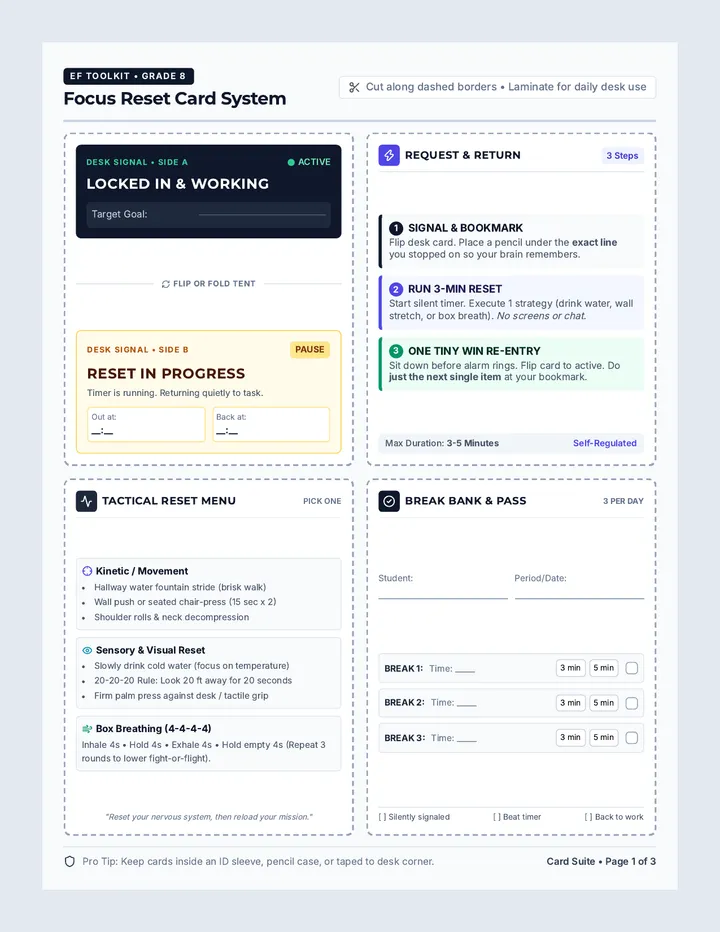
Fold and stand on desk when you need quiet assistance:
Green: Working smoothly
Yellow: Need quick check-in
Red: Brain overload / pause
Best Way to Reach Me:
[ ] Sticky note [ ] Quiet desk whisper
Card Back: My Focus Tools
Fill in your 2 core tools so any teacher knows at a glance:
Tool A:
Tool B:
"When I use these tools, I can show my best thinking."
Step 3: Draft Your 3-Part Advocacy Script
Pick one classroom situation where you often feel stuck or overwhelmed. Draft your complete signal script below:
1 The Context (When does this happen?) Example: "During group discussions..."
2 The Internal Need (What does your brain experience?) Example: "...my brain has trouble filtering noise..."
Advocacy Signals Journal Self-Advocacy Logbook
Advocacy Signals Journal
Name:
Date:
Mission: Tuning In to Your Daily Signals
Self-advocacy begins with noticing how your body and mind react during different parts of the school day. Use this journal to track your energy patterns and articulate your authentic needs.
Part 1: Daily Environment Check-In
Rate how each classroom setting feels for your brain: [A] Smooth , [B] Moderate Static , or [C] High Overload . Check one per row and note the tool that helps:
Whole-Class Teacher Lecture
Smooth Static Overload
Tool: Written notes / think-time
Noisy Group / Partner Lab
Smooth Static Overload
Tool: Earplugs / side table
Independent Silent Seatwork
Smooth Static Overload
Tool: Visual timer / checklist
Timed Quiz or Unit Test
Smooth Static Overload
Tool: Separate space / extra time
Part 2: Real-Life Reflection
Prompt 1: Think of a recent moment in class when you felt stuck, frustrated, or mentally drained. What was happening around you, and what physical or mental signs warned you that your brain needed support?
Prompt 2: Rewind & Transmit. If you could go back to that moment, what specific accommodation or script from the Signal Hub would have helped you communicate with your teacher?
Self-Advocacy Signal Hub • Reflection Journal Page 1 of 2
Scenario Sandbox & Conference Planner
Action Plan
Part 3: Scenario Sandbox (Rehearse Your Script)
Scenario A: The Rapid Math Instructions Processing Zone
Your teacher explains three complex homework problems out loud in two minutes, erases the whiteboard, and tells everyone to begin. You missed steps 2 and 3 and feel frozen.
Your 3-Part Signal Transmission (Write your script):
Scenario B: The Sensory-Overloaded Project Room Sensory & Body Zone
The classroom lights are buzzing, four project groups are speaking at once, and a classmate next to you is tapping a pen. You are feeling a headache and cannot write your paragraph.
Your 3-Part Signal Transmission (Write your script or silent card plan):
Part 4: My Upcoming Teacher Conference Plan
Prepare for a brief 2-minute conversation with one of your teachers this week to share your Signal Hub toolkit.
Teacher Name & Subject:
Best Time to Connect (e.g., before 1st bell, homeroom):