Freeze Routine Anchor Chart
K-1 Attention Getter • Multisensory Signal
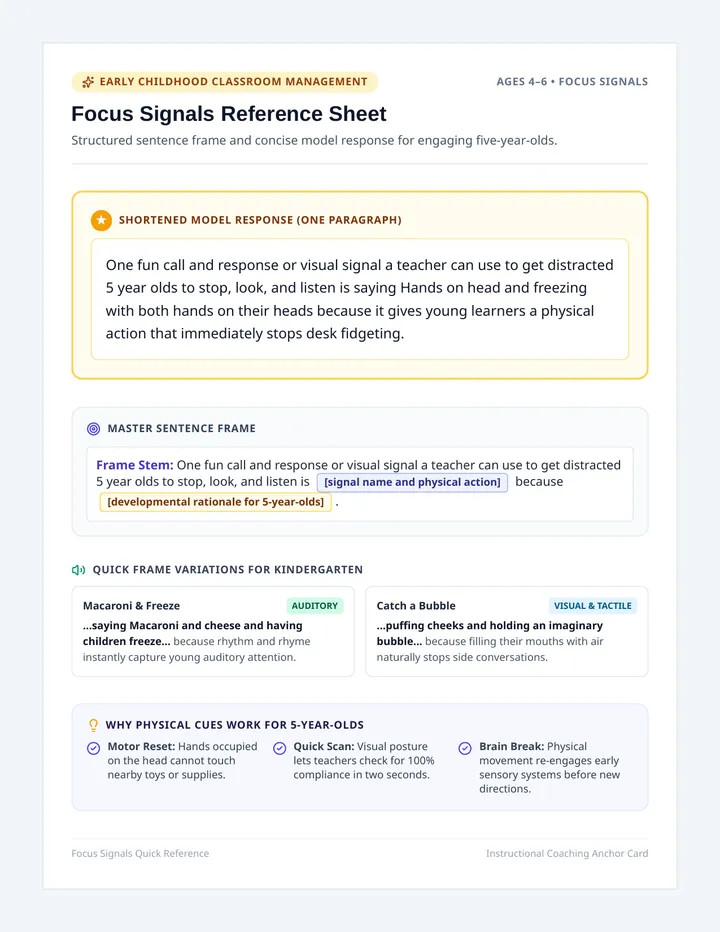
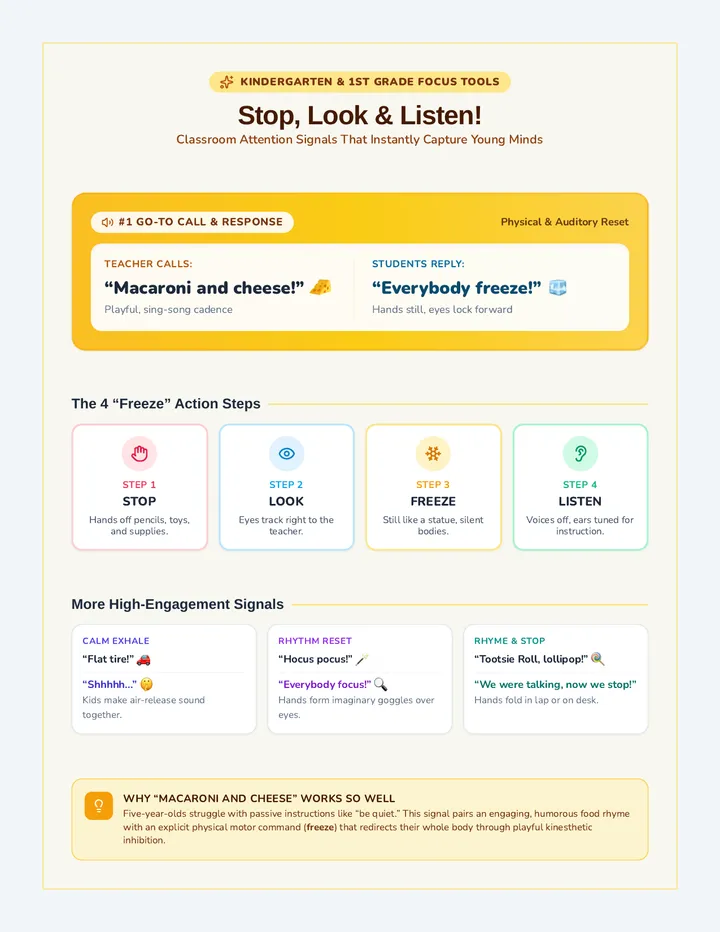
Macaroni & Cheese... Everybody FREEZE!
The ultimate call-and-response that turns whole-body distraction into an instant, playful stop-look-and-listen freeze frame.
Step 1 • Teacher Calls
You say rhythmically:
"Macaroni and Cheese!"
Pro Tip: Clap twice after "Cheese" or whisper it like a top secret mission!
Step 2 • Kids Respond
Students shout & lock:
"Everybody FREEZE!"
Physical Action: Hands instantly drop tools and lock like frozen statues.
3
The 3-Point Body Check (Count to 3 on your fingers)
1. Eyes Clicked
Eyes look directly at teacher's eyes like laser beams.
2. Bubble In
Mouth holds a gentle silent bubble; zero talking.
3. Hands Parked
Hands in lap or still on desk; supplies released.
Why It Works for Age 5
Kindergartners struggle with abstract commands like "pay attention." A physical statue freeze replaces hyperactivity with a concrete motor task, giving impulses an immediate physical brake.
Fun Variations to Rotate
- • Whisper Mode: Whisper it softly to get silent curiosity.
- • Statue Twist: "Freeze like a robot!" or "...like an owl!"
- • Speed Challenge: "Can we freeze in under 2 seconds?"
Day 1 Launch Plan (5-Minute Game) Practice 3x Today
1. Introduce & Model Show your favorite dramatic frozen statue pose. Have students laugh and copy.
2. The "Fake Work" Test Tell them to make noise and pretend to color, then call it out to practice freezing.
3. Celebrate the Win Praise fast statues: "Look at table 2, completely frozen like ice cubes!"
Attention Span Pacing Guide
Developmental Benchmark • Ages 5–6
The 5–6 Year Old Attention Span Guide
Developmental science, direct instruction limits, and the golden pacing formula for K–1 success.
Hands-On Focus
10–15 min
Sustained Attention
2–3 min per year of age. Applies when actively drawing, building, or manipulating tools.
Direct Instruction
5–6 min
Carpet / Mini-Lesson Max
1 min per year of age. Maximum passive listening time before focus collapses into wiggling.
Motor Reset
Every 10 min
Brain & Body Shift
Need a 30-second physical change of state (chant, stretch, or call-and-response) to reboot attention.
The Optimal 20-Minute Lesson Architecture
Chunk & Rotate Strategy
0 – 5 MIN
1. The Hook & Teach
One clear objective, prop, or story. Teacher talk only lasts 4–5 minutes.
Modality: Whole Group
5 – 10 MIN
2. Active Echo
Turn & talk to an elbow buddy, show fingers, or chorally chant answers.
Modality: Peer Pair / Vocal
10 – 12 MIN
3. Physical Reset
Call & response ("Freeze!"), standing stretch, or 60-second transition song.
Modality: Kinesthetic Shift
12 – 20 MIN
4. Hands-On Action
Independent center, math manipulatives, or drawing with fine-motor tools.
Modality: Tactile / Centers
Attention Traps to Avoid
- The 10-Minute Carpet Talk: Expecting quiet listening past 6 minutes triggers inevitable squirming.
- Multi-Step Verbal Prompts: "Get scissors, glue, yellow paper, and sit down" loses 80% of kids by step 2.
- Dead Transition Silence: Waiting between activities without an active song invites chaotic wandering.
Evidence-Based Antidotes
- The 3-Minute Vocal Pop: Have students repeat a vocabulary chant or echo a clap every 3 minutes.
- Visual 1-Step Icons: Show one visual icon at a time rather than listing multiple instructions aloud.
- Rhythmic Chants: Anchor transitions to predictable 30-second clean-up songs or call-and-responses.
The Golden Kindergarten Rule
When 5-year-olds start wiggling, don't demand quieter listening—change the modality from listening to moving, whispering, or hands-on doing!