Freeze Cues Poster
Kindergarten & 1st Grade Focus Tools
Stop, Look & Listen!
Classroom Attention Signals That Instantly Capture Young Minds
#1 Go-To Call & Response Physical & Auditory Reset
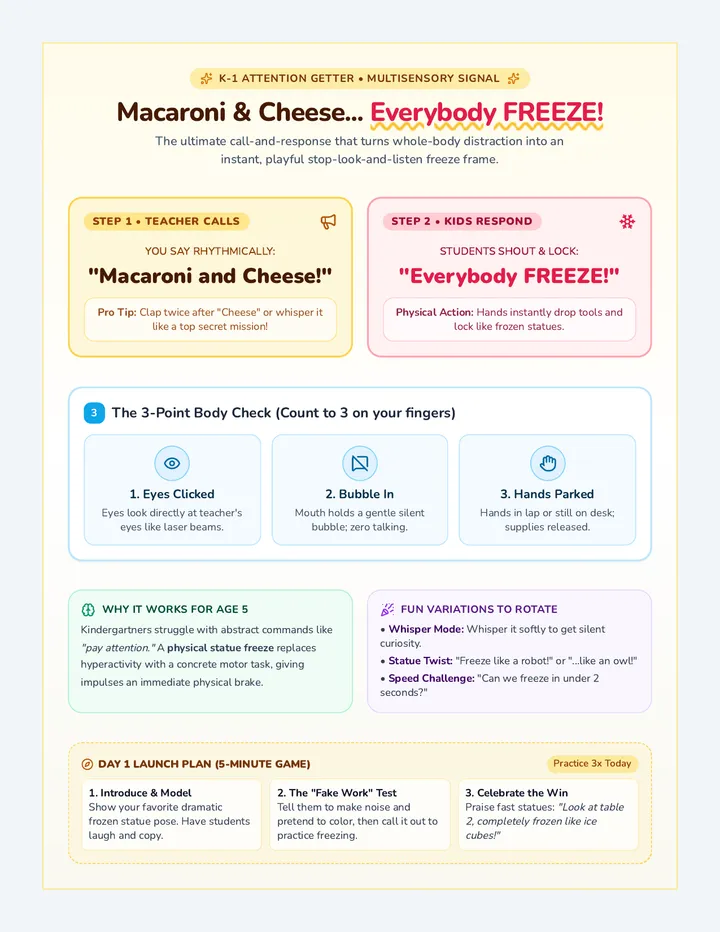
Teacher Calls:
“Macaroni and cheese!” 🧀
Playful, sing-song cadence
Students Reply:
“Everybody freeze!” 🧊
Hands still, eyes lock forward
The 4 “Freeze” Action Steps
Step 1
STOP
Hands off pencils, toys, and supplies.
Step 2
LOOK
Eyes track right to the teacher.
Step 3
FREEZE
Still like a statue, silent bodies.
Step 4
LISTEN
Voices off, ears tuned for instruction.
More High-Engagement Signals
Calm Exhale
“Flat tire!” 🚗
“Shhhhh...” 🤫
Kids make air-release sound together.
Rhythm Reset
“Hocus pocus!” 🪄
“Everybody focus!” 🔍
Hands form imaginary goggles over eyes.
Rhyme & Stop
“Tootsie Roll, lollipop!” 🍭
“We were talking, now we stop!”
Hands fold in lap or on desk.
Why “Macaroni and Cheese” Works So Well
Five-year-olds struggle with passive instructions like “be quiet.” This signal pairs an engaging, humorous food rhyme with an explicit physical motor command (freeze) that redirects their whole body through playful kinesthetic inhibition.
Freeze Routine Teacher Guide
Pedagogical Rationale & Guide Target: Kindergarten & 1st Grade
Attention Routine Rationale
Developmental mechanics and classroom implementation of kinesthetic attention signals.
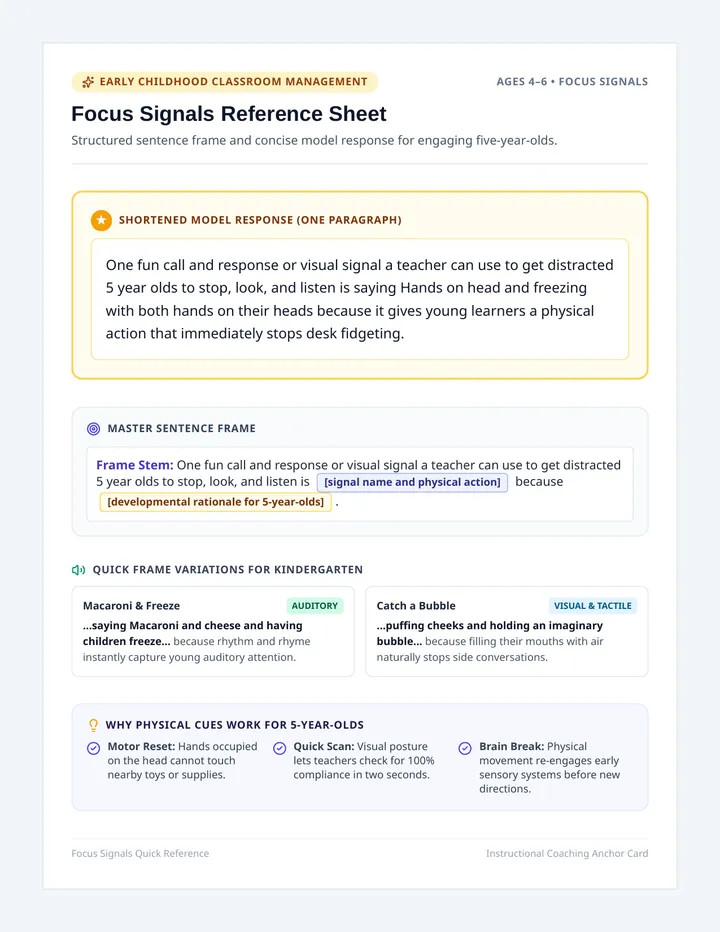
Model Explanatory Paragraph Classroom Management Essay / Unit Summary
One fun call and response a teacher can use to get distracted 5-year-olds to stop, look, and listen is “Macaroni and cheese! / Everybody freeze!” because it replaces abstract behavioral demands with an active, kinesthetic game grounded in early childhood psychology. Young learners have developing executive functioning and struggle to process negative or passive commands like “be quiet,” which require internal impulse suppression without giving the body an alternative action. By pairing an upbeat, familiar food rhyme with an explicit physical motor command (freeze), this signal recruits the brain’s motor cortex, halts extraneous physical movement, and creates an instant collective pause framed around play rather than reprimand. Within seconds, children release whatever materials they are holding, establish direct eye contact with the educator, and quiet their voices in anticipation of the next instruction.
Why It Works: 3 Early Childhood Principles
1. Active Motor Redirection
A Physical Target
Telling 5-year-olds what to do (strike an ice-cube statue pose) is significantly more actionable than telling them what not to do.
2. Auditory Rhythm
Sing-Song Cadence
Musical rhymes pierce through ambient play noise without requiring the teacher to strain their voice or shout across the classroom.
3. Low Affective Filter
Gamified Compliance
Food humor evokes joyful cooperative participation, preventing power struggles and preserving a supportive classroom climate.
4-Step Classroom Rollout Protocol
1
Explicit Teach & Model
Demonstrate what a true “freeze” looks like: hands flat on knees, mouth closed, eyes locked on the teacher.
2
Controlled Practice Game
Invite kids to wiggle and talk, then call the cue. Time how quickly the entire room can freeze in under 3 seconds.
3
Positive Public Narration
Praise specific compliance: “I see Table 2 with hands completely still and eyes right on me. Beautiful!”
4
Immediate Value Delivery
Never call a signal without an immediate direction. Speak calmly the instant silence hits to reward their fast attention.
Nonverbal & Sensory Accommodation
Pair the verbal cue with raised two fingers (peace/listening) for deaf or hard-of-hearing learners and noise-sensitive days.
Universal Design