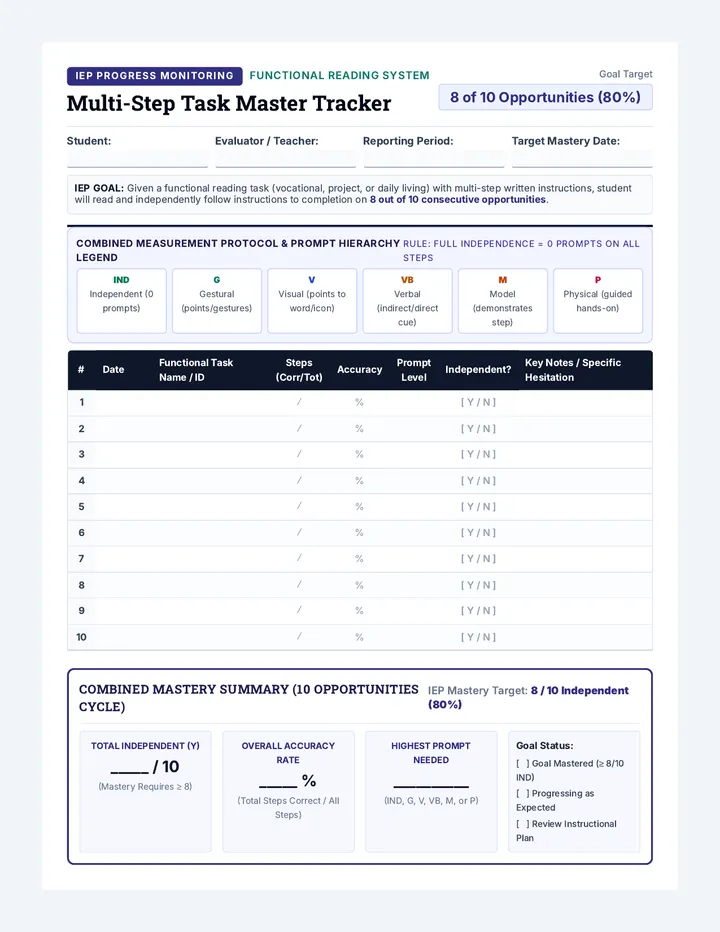
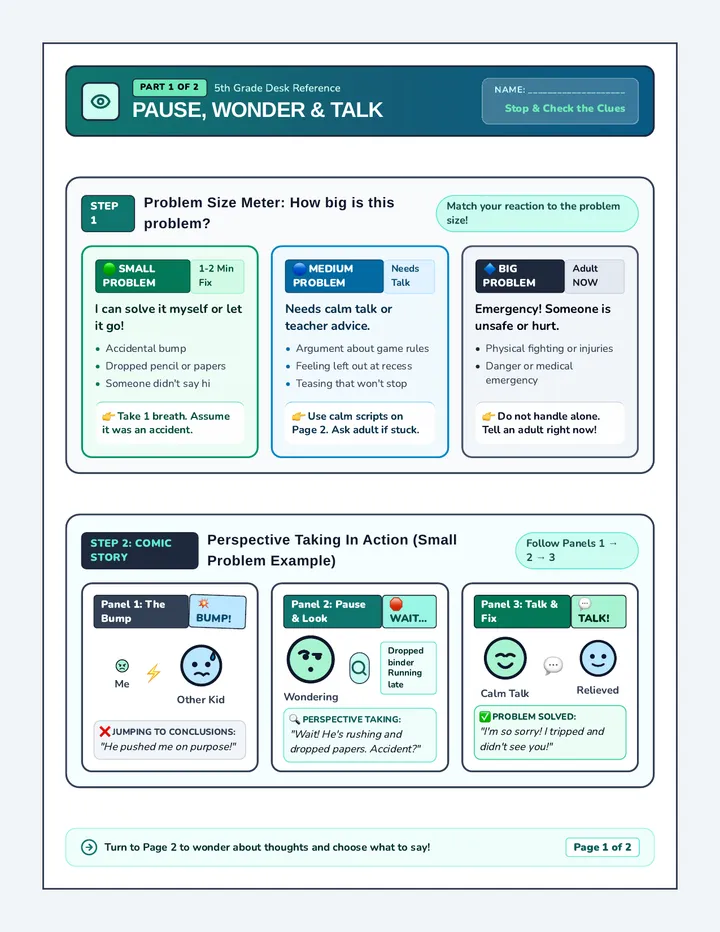
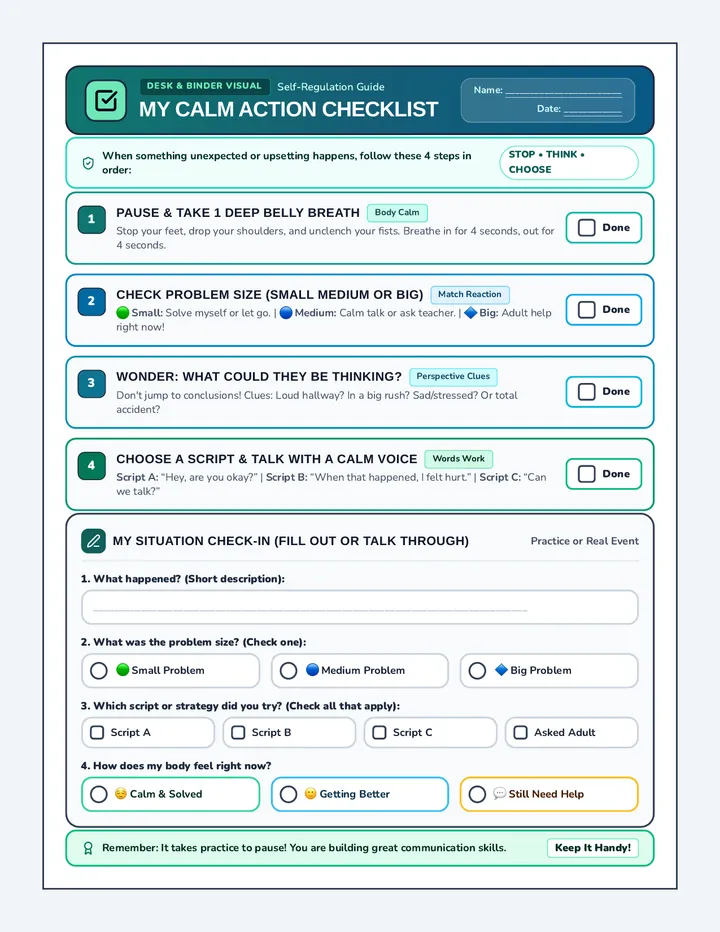
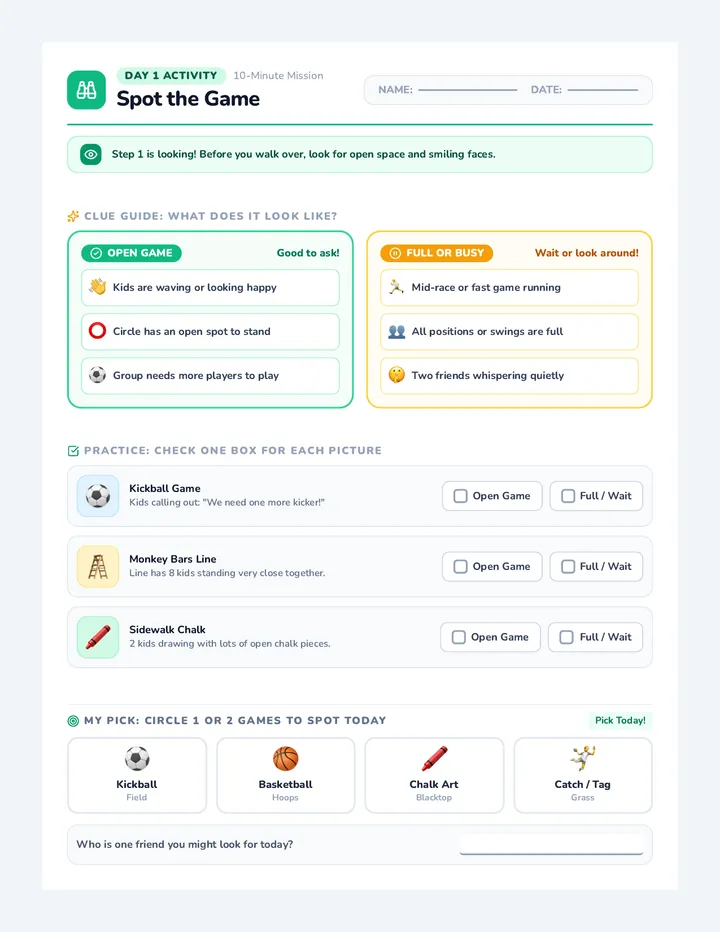
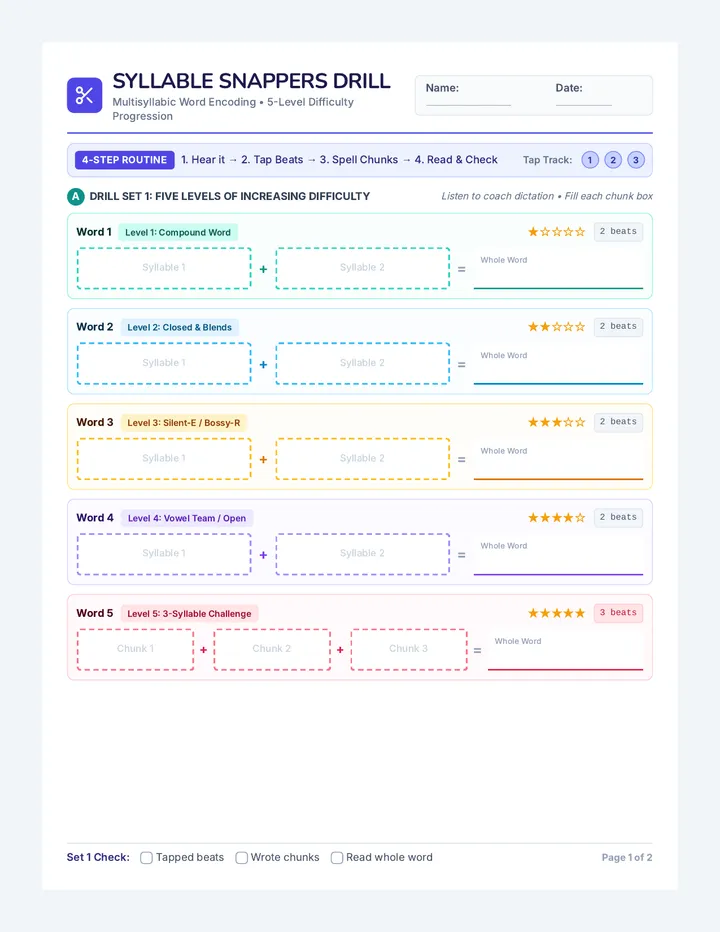
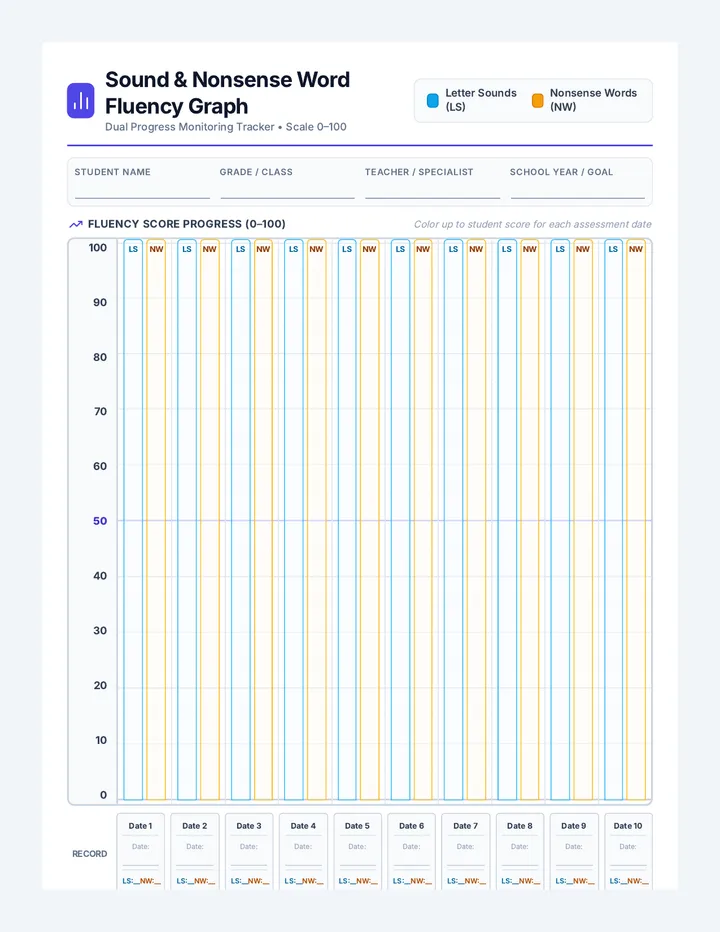
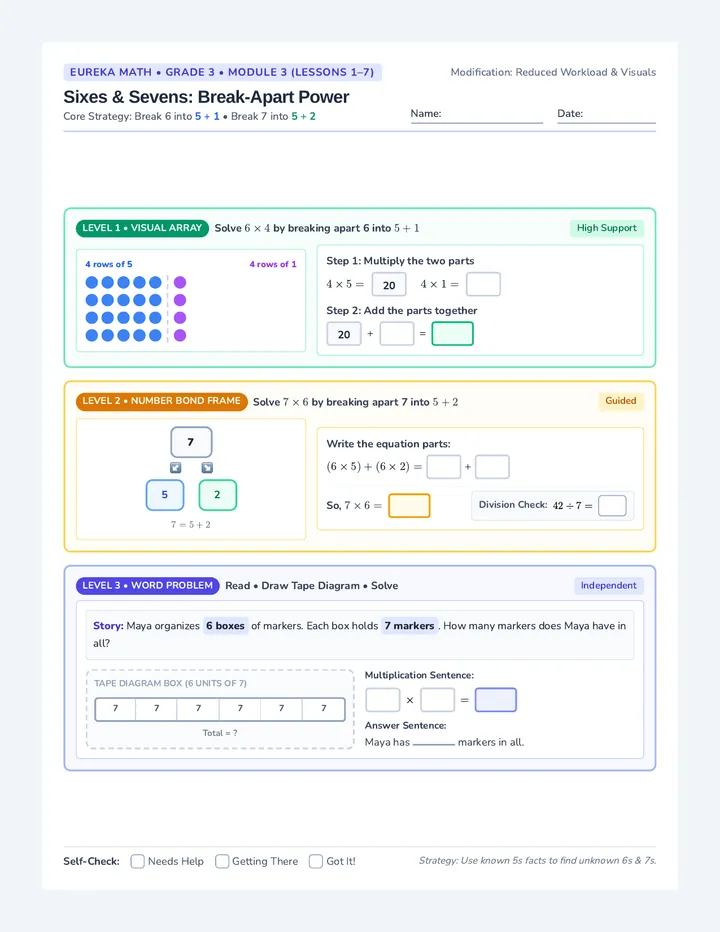
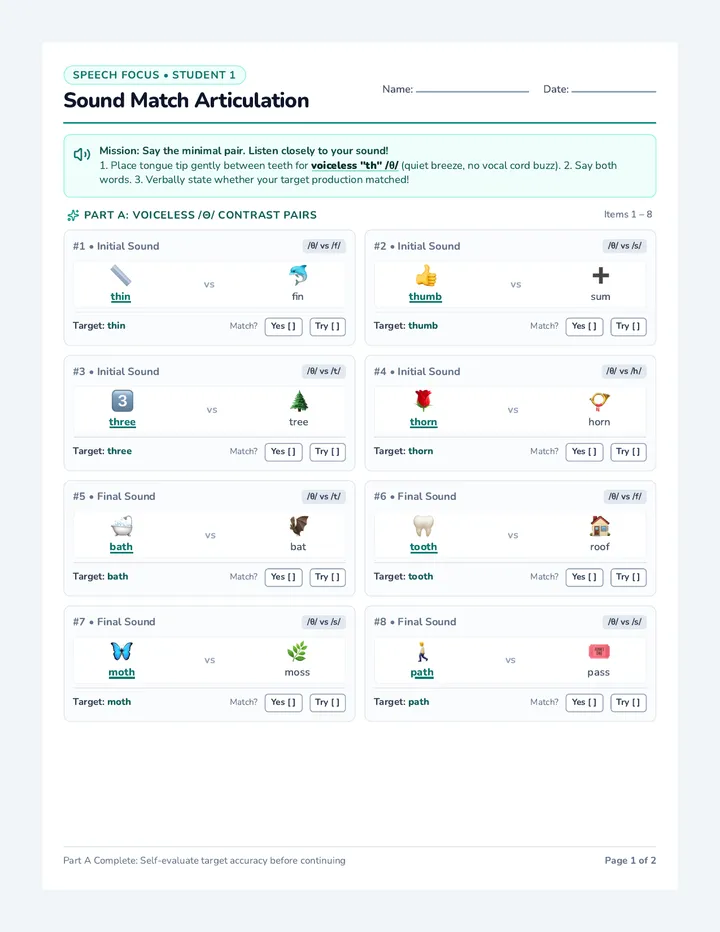
A highly comprehensive and structured suite of standards-aligned IEP Goal Banks spanning 2nd Grade through 6th Grade. Each bank includes ELA, Mathematics, and Executive Function/Behavior goals complete with SMART benchmarks, classroom accommodations, and printable progress tracking templates. Also includes specialized multi-level goal banks for Reading Decoding, Reading Comprehension, Math Computation, Written Expression, and Executive Function.
Annual Goal: By the end of the IEP period, when presented with addition or subtraction fraction equations with unlike denominators, [Student Name] will accurately find equivalent common denominators and solve the equations with [80%] accuracy in [4 out of 5] opportunities.
Benchmark 1
Identify common multiples of single-digit denominators with 70% accuracy.
Benchmark 2
Convert unlike fractions into equivalent common denominator fractions with 75% accuracy.
Benchmark 3
Compute final sum/difference of unlike equations and convert mixed numbers with 80% accuracy.
Decimals & Base Ten
Multi-Digit Decimal Computations
CCSS.MATH.CONTENT.5.NBT.B.7
Annual Goal: By the end of the IEP period, when given addition, subtraction, multiplication, or division problems involving decimals to the hundredths, [Student Name] will compute solutions accurately with [80%] accuracy in [4 out of 5] consecutive evaluation opportunities.
Benchmark 1
Add and subtract decimal values to the hundredths with physical place value alignment support with 70% accuracy.
Benchmark 2
Multiply decimals to hundredths using area models or standard algorithm with 75% accuracy.
Benchmark 3
Solve short-division decimal equations up to the hundredths place with 80% accuracy.
Matched Math Accommodations
Provide a visual common denominator matrix chart
Utilize visual fraction tiles and circles for instruction
Provide pre-drawn place-value grids to align decimal calculations
Read word problems aloud to isolate calculations from reading load
Grade 5 IEP Goal Bank Toolkit Page 2 of 4
H
HORIZON FIVE
IEP Goal Bank & Progress Toolkit
Executive Function & Behavior
Grade 5 Autonomy Pathways
Fifth graders prepare for middle school transitions. Key focus areas include minimizing adult cue dependency and building structured pathways for self-regulation during routine shifts.
Transition Routine
Transition Pace & Preparation
Annual Goal: By the end of the IEP period, when transitioning between academic activities, classes, or locations, [Student Name] will follow transition steps (clean up, move quietly, gather new materials) within [3 minutes] of a single verbal/visual cue in [4 out of 5] opportunities.
Benchmark 1
Clean up task materials and pack backpack within 1 minute of a teacher prompt in 70% of trials.
Benchmark 2
Transition directly to the next classroom area with 2 or fewer prompts in 75% of trials.
Benchmark 3
Complete total shift and gather new materials within 3 minutes with 1 prompt in 80% of trials.
Self-Regulation
De-escalation & Visual break Systems
Annual Goal: By the end of the IEP period, when experiencing learning frustration or sensory overload, [Student Name] will utilize an independent self-regulation routine (e.g., visual break card, deep breathing card) to de-escalate and return to work within [5 minutes], in [4 out of 5] opportunities.
Benchmark 1
Identify feelings of frustration and select a visual "coping card" with direct teacher prompt in 70% of trials.
Benchmark 2
Utilize a quiet 5-minute break area and return to work with 2 or fewer verbal prompts in 75% of trials.
Benchmark 3
Independently initiate a break request card and return to task with 1 or fewer prompts in 80% of trials.
Matched Behavior Accommodations
Use visual checklists with icon symbols for transitions
Provide peer modeling structures during transitions
Establish a designated quiet classroom "cool-down spot"
Provide a visual sequence board of current activities (First/Then)
Grade 5 IEP Goal Bank Toolkit Page 3 of 4
H
HORIZON FIVE
IEP Goal Bank & Progress Toolkit
Teacher Utility
Rubric: Transition and Emotional Regulation
Criteria
1 - Emerging
2 - Developing
3 - Independent
Transition Routine
Requires direct prompts to begin clean up; runs behind time frame.
Performs transition with 2-3 direct prompts and verbal cueing.
Completes entire transition routine independently under 3 minutes.
Frustration Response
Engages in vocal protests, shuts down, or refuses work.
Recognizes frustration and requests break with adult prompting.
Independently recognizes frustration and utilizes a coping strategy.
Coping Tool Success
Cannot settle down during break or refuses to resume work.
Settle down within 5 minutes but requires prompts to return.
Settle down within 5 minutes and returns to task independently.
Printable IEP Weekly Data Log
Student Name:
Target Goal / Standard:
Week Commencing:
Day
Task / Context Description
Prompt Level & Student Performance
Score / %
Mon
Ind Vis Verb
Tue
Ind Vis Verb
Wed
Ind Vis Verb
Thu
Ind Vis Verb
Fri
Ind Vis Verb
Grade 5 IEP Goal Bank Toolkit Page 4 of 4
Fraction Operations
Adding & Subtracting Like Fractions
CCSS.MATH.CONTENT.4.NF.B.3
Annual Goal: By the end of the IEP period, when presented with equations adding or subtracting fractions with like denominators, [Student Name] will compute the solution with [80%] accuracy in [4 out of 5] consecutive math opportunities.
Benchmark 1
Identify numerators and denominators in fractions and model addition visually in 4 out of 5 trials.
Benchmark 2
Add or subtract fractions with like denominators without converting mixed numbers with 75% accuracy.
Benchmark 3
Solve word problems requiring addition/subtraction of like fractions with 80% accuracy.
Operations & Base Ten
Multi-Digit Standard Algorithm
CCSS.MATH.CONTENT.4.NBT.B.4
Annual Goal: By the end of the IEP period, when presented with multi-digit whole number addition or subtraction equations, [Student Name] will compute solutions using the standard algorithm with [80%] accuracy in [4 out of 5] consecutive evaluation opportunities.
Benchmark 1
Align numbers by place value and solve multi-digit equations without regrouping with 70% accuracy.
Benchmark 2
Solve multi-digit equations with 1 regrouping step using grid guidance with 75% accuracy.
Benchmark 3
Independently compute multi-digit whole number problems with multiple regroupings with 80% accuracy.
Matched Math Accommodations
Provide physical fraction strips for concrete exploration
Utilize 1-cm grid paper to ensure place value vertical alignment
Provide a visual "regrouping guide" flow-chart card
Read computational problems aloud to isolate performance focus
Grade 4 IEP Goal Bank Toolkit Page 2 of 4
H
HORIZON FOUR
IEP Goal Bank & Progress Toolkit
Executive Function & Behavior
Organizing the Learning Area
Fourth-grade organization begins to focus on desk systems and self-monitoring task completion. Visual reminder strips attached directly to the student desk provide consistent non-verbal guidance.
Desk Organization
Desk & Material Maintenance
Annual Goal: By the end of the IEP period, when prompted at the end of the academic day, [Student Name] will independently use a 5-step desk organization checklist to clear, sort, and organize their work materials with no more than [1 reminder prompt] in [4 out of 5] opportunities.
Benchmark 1
Identify and throw away trash/scrap paper from the desk surface with 1 prompt in 70% of trials.
Benchmark 2
File worksheets directly into color-coded folders when prompted in 75% of trials.
Benchmark 3
Execute the entire 5-step desk organization routine with 1 or fewer prompts in 80% of trials.
Task Stamina
Focused Work Duration
Annual Goal: By the end of the IEP period, when presented with independent academic tasks, [Student Name] will maintain active focus on the task for [12 consecutive minutes] without off-task behaviors, requiring no more than [1 verbal cue] in [4 out of 5] consecutive observation logs.
Benchmark 1
Maintain continuous academic task focus for up to 6 minutes with 2 or fewer prompts in 70% of trials.
Benchmark 2
Maintain task focus for 9 consecutive minutes with 1 or fewer prompts in 75% of trials.
Benchmark 3
Focus and work continuously on tasks for 12 minutes without off-task distractions in 80% of trials.
Matched Behavior Accommodations
Tape a physical "desk diagram template" directly onto student desk
Utilize visual sand timers or digital focus clocks during work
Chunk independent worksheets into 2-3 manageable sections
Provide seat cushions or sensory wiggle-pads for focused seating
Grade 4 IEP Goal Bank Toolkit Page 3 of 4
H
HORIZON FOUR
IEP Goal Bank & Progress Toolkit
Teacher Utility
Rubric: Desk Organization and Stamina
Criteria
1 - Emerging
2 - Developing
3 - Independent
Desk Management
Desk contains trash and stray papers; items are unfiled.
Desk is mostly organized with direct guidance and adult modeling.
Checks off checklist items and organizes desk in under 3 minutes.
Focused Focus Time
Focusses on work for < 5 minutes before talking or looking away.
Maintains active focus for 6-9 minutes with occasional reminders.
Consistently maintains focus for 12+ minutes with no off-task signs.
Task Redirection
Refuses to focus after multiple verbal reminders.
Requires 2-3 reminders to return to tasks when distracted.
Self-corrects or refocuses quickly upon receiving 1 prompt.
Printable IEP Weekly Data Log
Student Name:
Target Goal / Standard:
Week Commencing:
Day
Task / Context Description
Prompt Level & Student Performance
Score / %
Mon
Ind Vis Verb
Tue
Ind Vis Verb
Wed
Ind Vis Verb
Thu
Ind Vis Verb
Fri
Ind Vis Verb
Grade 4 IEP Goal Bank Toolkit Page 4 of 4
Operations & Algebraic Thinking
Multiplication & Division Word Problems
CCSS.MATH.CONTENT.3.OA.A.3
Annual Goal: By the end of the IEP period, when presented with multiplication or division word problems within 100, [Student Name] will use drawings, arrays, or equal group models to set up and solve the problem with [80%] accuracy in [4 out of 5] opportunities.
Benchmark 1
Represent multiplication problems using arrays or equal circles in 4 out of 5 trials.
Benchmark 2
Solve basic multiplication word problems with facts up to 5x5 with 75% accuracy.
Benchmark 3
Set up and solve multiplication or division word problems within 100 with 80% accuracy.
Fractions Introduction
Part-to-Whole Fraction Representation
CCSS.MATH.CONTENT.3.NF.A.1
Annual Goal: By the end of the IEP period, when given a visual fractional model (such as partitioned circles or squares), [Student Name] will correctly identify, write, or model fractions (with denominators of 2, 3, 4, 6, 8) with [80%] accuracy in [4 out of 5] opportunities.
Benchmark 1
Identify and write unit fractions (e.g., 1/2, 1/4) from visual models with 70% accuracy.
Benchmark 2
Shade a blank geometric model to represent a given fraction with 75% accuracy.
Benchmark 3
Identify and write proper fractions (numerator > 1) from circle or area shapes with 80% accuracy.
Matched Math Accommodations
Provide color-coded counters or tiles to model equal groups
Offer pre-cut fraction circle shapes and partitioned strips
Provide a laminated multiplication table grid (up to 10x10)
Incorporate highlighters to isolate digits and words in problems
Grade 3 IEP Goal Bank Toolkit Page 2 of 4
H
HORIZON THREE
IEP Goal Bank & Progress Toolkit
Executive Function & Behavior
Following Simple Directions
At Grade 3, independent classroom routines become more complex. Introduce first-then schedules and break cue cards to aid verbal prompt reduction and self-regulation.
Task Initiation
Prompt Reduction & Initiation
Annual Goal: By the end of the IEP period, when given a multi-step classroom task, [Student Name] will independently begin the task within [5 minutes] of the initial instruction, requiring no more than [1 verbal cue] in [4 out of 5] opportunities.
Benchmark 1
Initiate a simple task within 5 minutes of a direct, individual prompt in 70% of trials.
Benchmark 2
Locate task materials and begin step 1 with 2 or fewer verbal prompts in 75% of trials.
Benchmark 3
Independently start tasks within 5 minutes of initial whole-group instructions in 80% of trials.
Self-Regulation
Requesting a Sensory Break
Annual Goal: By the end of the IEP period, when experiencing learning frustration or emotional dysregulation, [Student Name] will raise their hand and request a visual break pass, then transition directly to a designated cool-down spot for up to 5 minutes, in [4 out of 5] opportunities.
Benchmark 1
Indicate frustration when asked by an adult using a visual emoticon card in 70% of trials.
Benchmark 2
Use a visual break pass to transition to the calm area when prompted by adult in 75% of trials.
Benchmark 3
Independently initiate raising a break pass to request a 5-minute break when stuck in 80% of trials.
Matched Behavior Accommodations
Provide a physical "First/Then" visual schedule card on desk
Utilize visual token economy boards for task completions
Offer a laminated "break pass" card placed on desk corner
Seat student within arms reach of quiet sensory toy bin
Grade 3 IEP Goal Bank Toolkit Page 3 of 4
H
HORIZON THREE
IEP Goal Bank & Progress Toolkit
Teacher Utility
Rubric: Task Initiation and Break System
Criteria
1 - Emerging
2 - Developing
3 - Independent
Task Initiation
Requires > 3 verbal prompts to initiate academic steps.
Begins work within 5 mins with 2 prompts or modeling support.
Begins task within 5 mins with 1 or fewer verbal reminder.
Frustration Response
Cries, drops head, or refuses to speak when work gets tough.
Uses break card system only after teacher initiates process.
Independently identifies frustration and hands break card to teacher.
Quiet Break Quietness
Distracts others or behaves loudly in the break space.
Settle down quietly but struggles to transition back to desk.
Stays calm in break area and returns to desk within 5 minutes.
Printable IEP Weekly Data Log
Student Name:
Target Goal / Standard:
Week Commencing:
Day
Task / Context Description
Prompt Level & Student Performance
Score / %
Mon
Ind Vis Verb
Tue
Ind Vis Verb
Wed
Ind Vis Verb
Thu
Ind Vis Verb
Fri
Ind Vis Verb
Grade 3 IEP Goal Bank Toolkit Page 4 of 4
Number & Operations
Double-Digit Computations
CCSS.MATH.CONTENT.2.NBT.B.5
Annual Goal: By the end of the IEP period, when presented with addition or subtraction equations within 100, [Student Name] will solve using place value strategies or regrouping algorithms with [80%] accuracy in [4 out of 5] opportunities.
Benchmark 1
Solve addition and subtraction equations within 50 without regrouping steps with 70% accuracy.
Benchmark 2
Solve double-digit equations with 1 regrouping step using tens/ones block frames with 75% accuracy.
Benchmark 3
Independently compute double-digit addition and subtraction equations up to 100 with 80% accuracy.
Operations & Algebraic Thinking
Word Problems within 100
CCSS.MATH.CONTENT.2.OA.A.1
Annual Goal: By the end of the IEP period, when presented with one- or two-step addition and subtraction word problems, [Student Name] will correctly model the problem and calculate the solution with [80%] accuracy over [4 out of 5] consecutive trials.
Benchmark 1
Model basic word problems containing "in all" or "take away" language with 70% accuracy.
Benchmark 2
Solve 1-step addition/subtraction word problems within 100 with 75% accuracy.
Benchmark 3
Solve complex 2-step word problems involving comparison language with 80% accuracy.
Matched Math Accommodations
Provide Base-Ten blocks (tens rods and ones units) during work
Utilize visual hundred-charts taped directly to desk surface
Use double-sided counters to represent addition/subtraction steps
Incorporate math checklists with "Underline, Draw, Write" rules
Grade 2 IEP Goal Bank Toolkit Page 2 of 4
H
HORIZON TWO
IEP Goal Bank & Progress Toolkit
Executive Function & Behavior
Classroom Behavior Focus
Second-grade behaviors center on classroom participation (hand-raising) and following simple 2-step daily routines. Use visual sequence boards to reinforce expectations.
Social-Emotional
Class Participation & Calling-Out
Annual Goal: By the end of the IEP period, during whole-group instruction, [Student Name] will raise their hand and wait to be called on before sharing an answer, with no more than [2 calling-out incidents] per 30-minute block in [4 out of 5] observations.
Benchmark 1
Raise hand when prompted by teacher during lessons in 70% of opportunities.
Benchmark 2
Maintain quiet hands and feet during a 15-minute carpet lesson in 75% of trials.
Benchmark 3
Participate in a 30-minute lesson with 2 or fewer calling-out incidents in 80% of trials.
Routine Independence
Following 2-Step Routines
Annual Goal: By the end of the IEP period, when presented with a 2-step instructional routine (e.g., "put folder away, then sit at your desk"), [Student Name] will independently follow both steps in order, using visual visual schedules, in [4 out of 5] opportunities.
Benchmark 1
Follow the 1st step of a daily routine with 1 prompt in 70% of trials.
Benchmark 2
Point to a visual schedule step and execute it with adult cue in 75% of trials.
Benchmark 3
Independently perform a 2-step transition routine using a visual checklist in 80% of trials.
Matched Behavior Accommodations
Tape a personalized "My Raising Hand Rule" cue card to desk corner
Provide a 2-step visual schedule strip (First/Then) with icons
Give a quiet physical reminder (such as a hand on shoulder) before sharing
Utilize verbal "pre-corrects" immediately prior to transitions
Grade 2 IEP Goal Bank Toolkit Page 3 of 4
H
HORIZON TWO
IEP Goal Bank & Progress Toolkit
Teacher Utility
Rubric: Hand Raising and Routine Following
Criteria
1 - Emerging
2 - Developing
3 - Independent
Hand Raising
Calls out answers constantly; does not wait for recognition.
Raises hand when given a direct visual reminder or warning.
Consistently raises hand and waits to be called on.
Routine Following
Struggles to complete either step; wanders off-task.
Completes 1 of 2 routine steps independently; requires prompts for the second.
Follows both steps of a transition routine in exact order.
Active Carpet Focus
Lies down or plays with other items during carpet instruction.
Sits upright on carpet with occasional verbal redirects.
Maintains quiet hands and body focus on teacher during lessons.
Printable IEP Weekly Data Log
Student Name:
Target Goal / Standard:
Week Commencing:
Day
Task / Context Description
Prompt Level & Student Performance
Score / %
Mon
Ind Vis Verb
Tue
Ind Vis Verb
Wed
Ind Vis Verb
Thu
Ind Vis Verb
Fri
Ind Vis Verb
Grade 2 IEP Goal Bank Toolkit Page 4 of 4
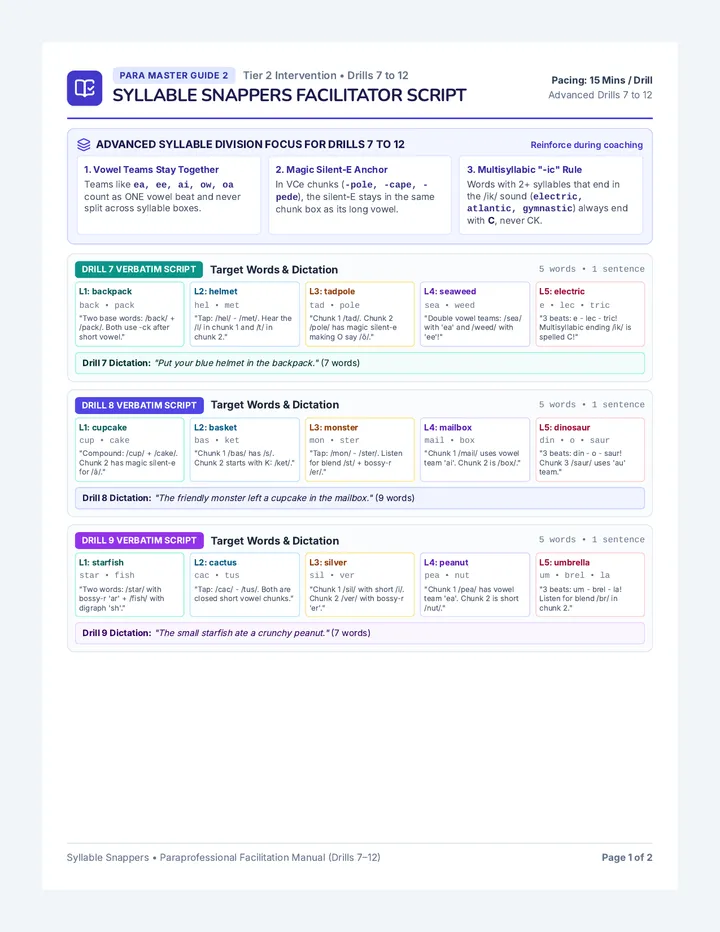
Silent-E (VCe) Word Patterns
CCSS.ELA-LITERACY.RF.2.3.B
Annual Goal: By the end of the IEP period, when given a randomized list of 20 words containing short vowels and long silent-e patterns (e.g., "cap" vs "cape"), [Student Name] will correctly distinguish the vowel sounds and decode the words with [80%] accuracy in [4 out of 5] opportunities.
Benchmark 1
Orally read 10 simple single-syllable VCe words with direct visual highlight support (e.g., silent "e" in blue) with 70% accuracy.
Benchmark 2
Read and contrast matching CVC/VCe word pairs (e.g., "pin" and "pine") with 75% accuracy.
Benchmark 3
Independently decode unhighlighted, isolated VCe words at a rate of 20 words/minute with 80% accuracy.
Level 4: Vowel Teams
Long Vowel Digraph Teams
CCSS.ELA-LITERACY.RF.2.3.B
Annual Goal: By the end of the IEP period, when given a list of 20 words featuring common long vowel team patterns (e.g., ai, ay, ee, ea, oa, oe), [Student Name] will decode and read the words aloud with [80%] accuracy in [4 out of 5] testing opportunities.
Benchmark 1
Identify and isolate vowel teams within printed single-syllable words by underlining them with 70% accuracy.
Benchmark 2
Read 15 words featuring matching vowel team pairings (e.g., ai/ay, ee/ea) with 75% accuracy.
Benchmark 3
Decode and read isolated single-syllable vowel team words independently with 80% accuracy.
Matched Accommodations
Provide a visual "silent-e magic wand" bookmark pointer
Color-code vowel team letters in pink on practice lists
Utilize flip cards where a final -e is added or folded back
Provide high-contrast text sizing on a clean page layout
Grade-Neutral Decoding Goal Bank Page 2 of 4
H
HORIZON DECODING
IEP Goal Bank & Progress Toolkit
Level 5 & 6 Decoding
Morphological Word Construction
At Levels 5 and 6, decoding advances from letter sounds to identifying word structures (morphology), including r-controlled vowels, prefixes, base roots, and suffixes.
Level 5: R-Controlled
R-Controlled Vowel Patterns (Bossy R)
CCSS.ELA-LITERACY.RF.2.3.B
Annual Goal: By the end of the IEP period, when given a list of 20 words featuring r-controlled vowel spellings (ar, er, ir, or, ur), [Student Name] will decode and read the words aloud with [80%] accuracy in [4 out of 5] opportunities.
Benchmark 1
Identify and isolate r-controlled spelling groups by highlighting them in words with 70% accuracy.
Benchmark 2
Read 15 words with ar and or spelling patterns in single-syllable forms with 75% accuracy.
Benchmark 3
Read single-syllable words featuring er, ir, ur patterns in random lists with 80% accuracy.
Level 6: Affixes
Decoding Affixes & Suffixes
CCSS.ELA-LITERACY.RF.3.3.A
Annual Goal: By the end of the IEP period, when given a list of 20 unfamiliar words containing common prefixes (e.g., un-, re-, dis-, pre-) and derivational suffixes (e.g., -ful, -less, -able, -ment), [Student Name] will accurately decode the base word and affix with [80%] accuracy in [4 out of 5] opportunities.
Benchmark 1
Isolate and read the isolated prefix and base word parts in 15 printed card words with 70% accuracy.
Benchmark 2
Read words containing common inflectional suffixes with 75% accuracy.
Benchmark 3
Independently decode and read unfamiliar words containing both a prefix and a suffix with 80% accuracy.
Matched Accommodations
Provide color-coded suffix strips for structural parsing
Utilize physical wooden blocks for prefix/root breakdown
Utilize whiteboards for dividing morphologic roots with slashes
Grade-Neutral Decoding Goal Bank Page 3 of 4
H
HORIZON DECODING
IEP Goal Bank & Progress Toolkit
Advanced & Utility
Level 7: Multisyllabic Division
Syllable Division Rules (VC/CV, V/CV)
CCSS.ELA-LITERACY.RF.4.3.A
Annual Goal: By the end of the IEP period, when given a list of 20 unfamiliar, printed multisyllabic words, [Student Name] will utilize syllable division rules (VC/CV, V/CV, open/closed syllables) to mark, divide, and decode the words with [80%] accuracy in [4 out of 5] opportunities.
Benchmark 1
Identify vowel-consonant combinations and divide 15 VC/CV words with slashes with 70% accuracy.
Benchmark 2
Identify and read open and closed syllables in divided word structures with 75% accuracy.
Benchmark 3
Divide and decode unfamiliar 3-syllable words independently with 80% accuracy.
Printable Phonics & Decoding Diagnostic Log
Student Name:
Target Phonetic Level:
Assessment Date:
Tested Word
Student Phonetic Breakdown
Accuracy
Self-Correct?
1. _________________
/ / / /
✓ ✗
Yes / No
2. _________________
/ / / /
✓ ✗
Yes / No
3. _________________
/ / / /
✓ ✗
Yes / No
4. _________________
/ / / /
✓ ✗
Yes / No
Grade-Neutral Decoding Goal Bank Page 4 of 4
Level 3: Central Message
Central Message & Morals
CCSS.ELA-LITERACY.RL.3.2
Annual Goal: By the end of the IEP period, when given a grade-level fable, folktale, or myth, [Student Name] will recount the story to determine the central message, lesson, or moral with [80%] accuracy in [4 out of 5] trials.
Benchmark 1
Determine the primary conflict of a main character in a fable with 70% accuracy.
Benchmark 2
Select the central moral from a 3-choice list after reading with 75% accuracy.
Benchmark 3
Orally explain the lesson of a fable and link it directly to character actions with 80% accuracy.
Level 4: Summarization
Main Idea & Summaries
CCSS.ELA-LITERACY.RI.3.2
Annual Goal: By the end of the IEP period, when given an informational text at instructional level, [Student Name] will determine the main idea of a text, recount the key supporting details, and write a 3-sentence summary with [80%] accuracy in [4 out of 5] opportunities.
Benchmark 1
Identify the main idea of a 3-paragraph informational text in 4 out of 5 trials.
Benchmark 2
Fill in a graphic organizer with a central main idea and 3 supporting facts with 75% accuracy.
Benchmark 3
Write a cohesive, 3-sentence summary highlighting the main idea and 2 details with 80% accuracy.
Matched Accommodations
Provide summary writing templates with "Who/What/When/Why" prompts
Provide printed, laminated main idea vs detail sorting mats
Utilize graphic organizers with arrows tracing central moral pathways
Provide vocabulary matching cards with key story definitions
Developmental Comprehension Goal Bank Page 2 of 4
H
HORIZON COMPREHENSION
IEP Goal Bank & Progress Toolkit
Level 5 & 6 Upper-Inter.
Abstract Theme & Structure analysis
Upper-intermediate comprehension focuses on pulling abstract elements (theme, multi-step summary details) out of longer texts and differentiating structures across various readings.
Level 5: Theme Analysis
Theme Identification & Narrative Summary
CCSS.ELA-LITERACY.RL.5.2
Annual Goal: By the end of the IEP period, when given a grade-level narrative text or chapter, [Student Name] will determine a central theme, outline how characters respond to challenges, and write a 4-sentence summary, scoring [3 out of 4] on a summary rubric in [4 out of 5] opportunities.
Benchmark 1
Identify how a main character reacts to a major obstacle in a story with 70% accuracy.
Benchmark 2
Determine a central theme from a text and pair it with a character behavior example with 75% accuracy.
Benchmark 3
Write a cohesive, 4-sentence summary covering theme, challenge, reaction, and resolution with 80% accuracy.
Level 6: Multi-Idea Structure
Multiple Main Ideas & Key Details
CCSS.ELA-LITERACY.RI.5.2
Annual Goal: By the end of the IEP period, when given an informational passage with multiple headings/subheadings, [Student Name] will determine at least two main ideas, match supporting details to each main idea, and draft a summary with [80%] accuracy in [4 out of 5] opportunities.
Benchmark 1
Identify the main idea of two separate subheaded sections in an informational text with 70% accuracy.
Benchmark 2
Determine 2 main ideas and categorize supporting details under correct columns with 75% accuracy.
Benchmark 3
Draft a 5-sentence summary of an informational text covering both central main ideas with 80% accuracy.
Matched Accommodations
Provide graphic organizers featuring pre-divided "Main Idea A" and "Main Idea B" columns
Provide a visual "Theme Bank" (e.g., perseverance, friendship) for reference
Chunk long passages into sections separated by visual colored markers
Utilize text-to-speech software for vocabulary preview steps
Developmental Comprehension Goal Bank Page 3 of 4
H
HORIZON COMPREHENSION
IEP Goal Bank & Progress Toolkit
Advanced & Utility
Level 7: Complex Inference
Evidence Citation & Inferences
CCSS.ELA-LITERACY.RI.6.1
Annual Goal: By the end of the IEP period, when given a grade-level informational or literary passage, [Student Name] will draw a complex inference and support it by citing at least two pieces of direct textual evidence, achieving [80%] accuracy in [4 out of 5] opportunities.
Benchmark 1
Identify 2 lines of text that directly prove a literal factual statement with 70% accuracy.
Benchmark 2
Draw a simple character-trait inference and cite 1 supporting text line with 75% accuracy.
Benchmark 3
Draw a complex inference and independently write out 2 direct text citations with 80% accuracy.
Printable Reading Comprehension Data Sheet
Student Name:
Text Checked / Level:
Evaluation Date:
Comprehension Criteria
Student Performance Notes
Accuracy
Prompt Level Required
1. Literal Recalling
____ %
Ind / Vis / Verb
2. Main Idea / Theme
____ %
Ind / Vis / Verb
3. Summarizing
____ %
Ind / Vis / Verb
4. Citations / Evidence
____ %
Ind / Vis / Verb
Developmental Comprehension Goal Bank Page 4 of 4
Multi-Digit Whole Number Multiplication
CCSS.MATH.CONTENT.4.NBT.B.5
Annual Goal: By the end of the IEP period, when given equations multiplying a 2-digit number by a 2-digit number, [Student Name] will calculate the final product using a standard algorithm or area model with [80%] accuracy in [4 out of 5] opportunities.
Benchmark 1
Multiply a 2-digit number by a 1-digit number with standard algorithm with 70% accuracy.
Benchmark 2
Solve 2-digit by 2-digit multiplication equations using an area model worksheet with 75% accuracy.
Benchmark 3
Independently compute 2-digit by 2-digit products using the standard algorithm with 80% accuracy.
Level 4: Division
Long Division with Single-Digit Divisors
CCSS.MATH.CONTENT.4.NBT.B.6
Annual Goal: By the end of the IEP period, when given a division equation involving up to a 3-digit dividend and a 1-digit divisor, [Student Name] will compute the quotient (including remainders) with [80%] accuracy in [4 out of 5] opportunities.
Benchmark 1
Compute quotients for 2-digit dividends and 1-digit divisors with no remainder with 70% accuracy.
Benchmark 2
Solve 2-digit dividends and 1-digit divisors yielding a remainder with 75% accuracy.
Benchmark 3
Solve 3-digit dividends and 1-digit divisors using standard long division steps with 80% accuracy.
Matched Accommodations
Provide step-by-step "Does McDonald's Sell Cheeseburgers?" (DMSC) division checklist cards
Utilize pre-printed blank 2x2 area model grids for multiplication tasks
Provide a multiplication table on desk for division steps
Incorporate grid lines over assessment equations to keep columns aligned
Developmental Computation Goal Bank Page 2 of 4
H
HORIZON COMPUTATION
IEP Goal Bank & Progress Toolkit
Level 5 & 6 Upper-Inter.
Decimal & Fraction Operations
Advanced computation focuses heavily on rational numbers. Students must establish stable algorithmic rules for both unlike fraction denominators and decimal alignment.
Level 5: Fractions
Adding & Subtracting Unlike Fractions
CCSS.MATH.CONTENT.5.NF.A.1
Annual Goal: By the end of the IEP period, when given addition or subtraction fraction equations with unlike denominators, [Student Name] will determine common denominators and compute the sum or difference with [80%] accuracy over [4 out of 5] consecutive work samples.
Benchmark 1
Generate common multiples for two single-digit numbers with 70% accuracy.
Benchmark 2
Convert unlike fractions to equivalent fractions sharing common denominators with 75% accuracy.
Benchmark 3
Compute sums or differences of unlike fractions and simplify final fractional values with 80% accuracy.
Level 6: Decimals
Decimal Calculations to Hundredths
CCSS.MATH.CONTENT.5.NBT.B.7
Annual Goal: By the end of the IEP period, when given equations requiring addition, subtraction, multiplication, or division of decimals to the hundredths place, [Student Name] will compute solutions accurately with [80%] accuracy in [4 out of 5] opportunities.
Benchmark 1
Align decimal points vertically to accurately add and subtract decimals to the hundredths with 70% accuracy.
Benchmark 2
Multiply decimal numbers up to hundredths by converting to whole numbers and adjusting products with 75% accuracy.
Benchmark 3
Solve decimal division equations using standard algorithms with decimal adjustments with 80% accuracy.
Matched Accommodations
Provide common denominator calculation grids and factor cards
Offer visual fraction circle overlays to confirm equivalent sizes
Provide vertical place value decimal-dot alignment sheets
Offer calculators to double-check decimal calculations
Developmental Computation Goal Bank Page 3 of 4
H
HORIZON COMPUTATION
IEP Goal Bank & Progress Toolkit
Advanced & Utility
Level 7: Equations
Solving Single-Variable Equations
CCSS.MATH.CONTENT.6.EE.B.7
Annual Goal: By the end of the IEP period, when given single-variable algebraic equations (e.g., x + a = b or ax = b, where a, b, and x are non-negative rational numbers), [Student Name] will compute and solve for the unknown variable using inverse operations with [80%] accuracy in [4 out of 5] opportunities.
Benchmark 1
Identify inverse mathematical operations (e.g., addition vs subtraction) in equations with 70% accuracy.
Benchmark 2
Solve one-step addition/subtraction variable equations with integer values with 75% accuracy.
Benchmark 3
Solve algebraic variable equations involving multiplication and division steps with 80% accuracy.
Printable Mathematical Computation Diagnostic Log
Student Name:
Tested Math Level:
Assessment Date:
Computational Criteria
Student Step Notes (Regroup, align)
Accuracy
Settle / Score
1. Algorithm Setup
✓ ✗
____ %
2. Intermediate Steps
✓ ✗
____ %
3. Final Calculation
✓ ✗
____ %
4. Check / Verification
✓ ✗
____ %
Developmental Computation Goal Bank Page 4 of 4
Level 3: Opinion Drafts
Opinion Paragraph Structure
CCSS.ELA-LITERACY.W.3.1
Annual Goal: By the end of the IEP period, when given a familiar topic or book, [Student Name] will write an opinion paragraph that clearly states their opinion, supplies at least two supporting reasons, and provides a concluding statement with [80%] accuracy in [4 out of 5] trials.
Benchmark 1
Write an opinion statement about a familiar book or topic using sentence starters in 4 out of 5 trials.
Benchmark 2
Write an opinion statement supported by 2 reasons connected by basic transitional terms in 4 out of 5 trials.
Benchmark 3
Construct an opinion paragraph with intro, reasons, and a closing sentence with 80% accuracy.
Level 4: Informative Paragraphs
Informational Details & Facts
CCSS.ELA-LITERACY.W.4.2
Annual Goal: By the end of the IEP period, when given a science or social studies research topic, [Student Name] will construct an informative paragraph containing a clear topic sentence, three relevant facts/details, and a concluding sentence with [80%] accuracy in [4 out of 5] opportunities.
Benchmark 1
Draft a clear topic sentence that introduces a researched subject in 4 out of 5 trials.
Benchmark 2
Incorporate 2 direct facts from an informational graphic organizer into a paragraph draft with 75% accuracy.
Benchmark 3
Write a complete informational paragraph with a topic, 3 facts, and a concluding sentence with 80% accuracy.
Matched Accommodations
Provide physical "Hamburger Paragraph" graphic outlines
Offer a transition-word checklist (e.g., first, next, in addition)
Utilize graphic organizers that separate topic from body details
Allow student to type paragraphs using text-prediction systems
Developmental Writing Goal Bank Page 2 of 4
H
HORIZON WRITING
IEP Goal Bank & Progress Toolkit
Level 5 & 6 Multi-Paragraph
Essay Structure & Flow
At Levels 5 and 6, written expression demands multi-paragraph development, logical structural transitions, and defending a central thesis statement/claim with direct citations.
Level 5: Argumentation
Argumentative Claim & Evidence Structure
CCSS.ELA-LITERACY.W.6.1
Annual Goal: By the end of the IEP period, when given a text-based debate prompt, [Student Name] will write a cohesive argumentative paragraph that states a clear claim, supports it with at least two direct evidence details, and provides a logical concluding statement, scoring a [3 out of 4] on a standardized argumentative rubric in [4 out of 5] trials.
Benchmark 1
Write an argumentative claim statement directly addressing a debate topic in 4 out of 5 trials.
Benchmark 2
Construct a claim supported by 1 source of direct textual evidence with transition templates in 4 out of 5 trials.
Benchmark 3
Write an argumentative paragraph containing a claim, 2 sources of evidence, and a conclusion in 4 out of 5 trials.
Level 6: Multi-Paragraph
Essay Introductions, Bodies & Closings
CCSS.ELA-LITERACY.W.5.1
Annual Goal: By the end of the IEP period, when given a researched writing prompt, [Student Name] will write a 3-paragraph essay (introduction with thesis, 1 body paragraph with supporting reasons, and a closing summary) with [80%] accuracy in [4 out of 5] opportunities.
Benchmark 1
Draft a 3-sentence introduction including a clear thesis statement with 70% accuracy.
Benchmark 2
Write a cohesive, transitions-supported body paragraph expanding on the thesis statement with 75% accuracy.
Benchmark 3
Construct a complete 3-paragraph essay containing an intro, body, and summary closing with 80% accuracy.
Matched Accommodations
Provide multi-paragraph graphic organizer templates separating intro, body, and closing sections
Provide a visual "Citation Guide" card outlining how to quote text
Offer a detailed transition list categorizing sequencing words
Allow student to utilize digital speech-to-text writing aids
Developmental Writing Goal Bank Page 3 of 4
H
HORIZON WRITING
IEP Goal Bank & Progress Toolkit
Advanced & Utility
Level 7: Editing
Editing, Proofreading & Revising
CCSS.ELA-LITERACY.W.6.5
Annual Goal: By the end of the IEP period, when given a first draft of their own writing, [Student Name] will independently utilize a 4-step proofreading checklist to locate and self-correct capitalization, punctuation, and spelling errors, improving their draft accuracy by [80%] across [4 out of 5] opportunities.
Benchmark 1
Locate and correct capitalization and ending period errors in a pre-written, peer draft with 70% accuracy.
Benchmark 2
Correct spelling and comma boundaries in their own writing draft with the help of editing symbols with 75% accuracy.
Benchmark 3
Independently revise and edit their own writing draft using an active proofreading checklist with 80% accuracy.
Printable Written Expression Diagnostic Log
Student Name:
Writing Task Level:
Assessment Date:
Writing Criteria
Student Performance Notes
Accuracy
Prompts Needed
1. Sentence Boundaries
____ %
Ind / Vis / Verb
2. Sentence Variety
____ %
Ind / Vis / Verb
3. Paragraph Structure
____ %
Ind / Vis / Verb
4. Proofreading & Edit
____ %
Ind / Vis / Verb
Developmental Writing Goal Bank Page 4 of 4
Level 3: Material Management
Binder & Desk Organization Maintenance
Annual Goal: By the end of the IEP period, when prompted at the end of the academic day, [Student Name] will independently use a 5-step checklist to clean, sort, and organize their binder, folders, and desk space with no more than [1 reminder prompt] in [4 out of 5] opportunities.
Benchmark 1
Locate and sort papers directly into color-coded subject folders when prompted with 70% accuracy.
Benchmark 2
Discard trash/scrap paper from the desk surface and store writing tools in 75% of trials.
Benchmark 3
Execute the full 5-step desk and binder organization routine with 1 or fewer cues in 80% of trials.
Level 4: Transition Flow
Physical Transition Independence
Annual Goal: By the end of the IEP period, when transitioning between activities or locations within the school, [Student Name] will independently complete transition tasks (pack up, gather tools, move quietly) within [3 minutes] of a single whole-group cue in [4 out of 5] opportunities.
Benchmark 1
Clean up current activity and prepare tools within 1 minute of a direct verbal prompt in 70% of trials.
Benchmark 2
Quietly transition to the next designated classroom area with 2 or fewer cues in 75% of trials.
Benchmark 3
Independently follow visual schedule to complete shifts and gather next tools under 3 minutes in 80% of trials.
Matched Accommodations
Tape a visual "desk layout diagram" directly to student's desk
Color-code notebooks and binders to match instructional folders
Provide a discrete peer buddy model to shadow during transitions
Developmental Executive Function Goal Bank Page 2 of 4
H
HORIZON EXECUTIVE
IEP Goal Bank & Progress Toolkit
Level 5 & 6 Planning
Higher-Order Cognitive Control
Advanced executive skills transition to self-directed planning and task pacing. Focus targets active assignment recording, chunking long-term deadlines, and establishing working stamina.
Level 5: Planning
Planner Tracking & Agenda Use
Annual Goal: By the end of the IEP period, when given academic assignments, [Student Name] will independently record instructions, materials, and due dates in a written or digital planner with no more than [1 verbal cue], achieving [80%] accuracy on weekly planner inspections.
Benchmark 1
Copy academic tasks directly from the classroom whiteboard into a structured planner with 70% accuracy.
Benchmark 2
Write due dates and necessary materials for 3 distinct tasks in the planner with 75% accuracy.
Benchmark 3
Independently check off planner items daily and record upcoming assignments with 80% accuracy.
Level 6: Focus Stamina
Focused Work Duration & Stamina
Annual Goal: By the end of the IEP period, when presented with independent learning tasks, [Student Name] will maintain active work engagement for [15 consecutive minutes] without off-task signs, requiring ≤ [1 verbal cue] in [4 out of 5] checks.
Benchmark 1
Maintain active focus on a task for up to 8 minutes with 2 or fewer reminders in 70% of trials.
Benchmark 2
Maintain focused work engagement for 12 consecutive minutes with 1 prompt in 75% of trials.
Benchmark 3
Work continuously on independent assignments for 15 minutes with no off-task behaviors in 80% of trials.
Matched Accommodations
Provide color-coded calendar segments in planner checklists
Chunk long homework tasks into 3 smaller, numbered sheets
Provide a desk-sized digital timer to track focused working cycles
Provide noise-reducing headphones during silent working blocks
Developmental Executive Function Goal Bank Page 3 of 4
H
HORIZON EXECUTIVE
IEP Goal Bank & Progress Toolkit
Advanced & Utility
Level 7: Self-Advocacy
Self-Advocacy & Help-Seeking Actions
CCSS.ELA-LITERACY.SL.5.1
Annual Goal: By the end of the IEP period, when experiencing learning difficulty or encountering a barrier, [Student Name] will advocate for their learning needs by raising their hand and asking a specific clarifying question (e.g., "Could you explain step 2 again?") in [4 out of 5] opportunities.
Benchmark 1
Indicate that help is required using a discrete, non-verbal "help card" placed on desk with 70% accuracy.
Benchmark 2
Ask a general help question (e.g., "Can you help me?") when prompted by an adult in 75% of trials.
Benchmark 3
Independently ask a highly specific, clarifying question when experiencing frustration in 80% of trials.
Printable Executive Functioning Data Sheet
Student Name:
Target EF Criteria:
Assessment Date:
Executive Criteria
Student Behavior Notes (Prompts, pacing)
Initiation Time
Prompts Needed
1. Task Initiation
____ mins
Ind / Vis / Verb
2. Material Org.
____ mins
Ind / Vis / Verb
3. Working Stamina
____ mins
Ind / Vis / Verb
4. Self-Advocacy
____ mins
Ind / Vis / Verb
Developmental Executive Function Goal Bank Page 4 of 4