Compliance Mapping Guide Compliance Map
IEP (IDEA/ECEA) vs. 504 (Section 504) | Colorado Framework
Graduate Research Project
Topic: Special Education Law
FAPE: The Central Mandate
Both frameworks are designed to provide a Free Appropriate Public Education, but they differ significantly in legal origin, eligibility standards, and service delivery.
IEP Requirements
IDEA + Colorado ECEA
Legal Basis
IDEA & ECEA: A federal and state funding statute. Specifically governed in Colorado by the Exceptional Children's Educational Act (ECEA).
Eligibility
Two-prong test required:
Student has 1 of 13 specific disability categories.
Disability must create a need for specially designed instruction (SDI) .
CO Transition Specifics
In Colorado, formal transition planning must begin no later than the first IEP in effect when the student is 15 years old (Federal mandate is 16).
Core Components
Detailed annual document including:
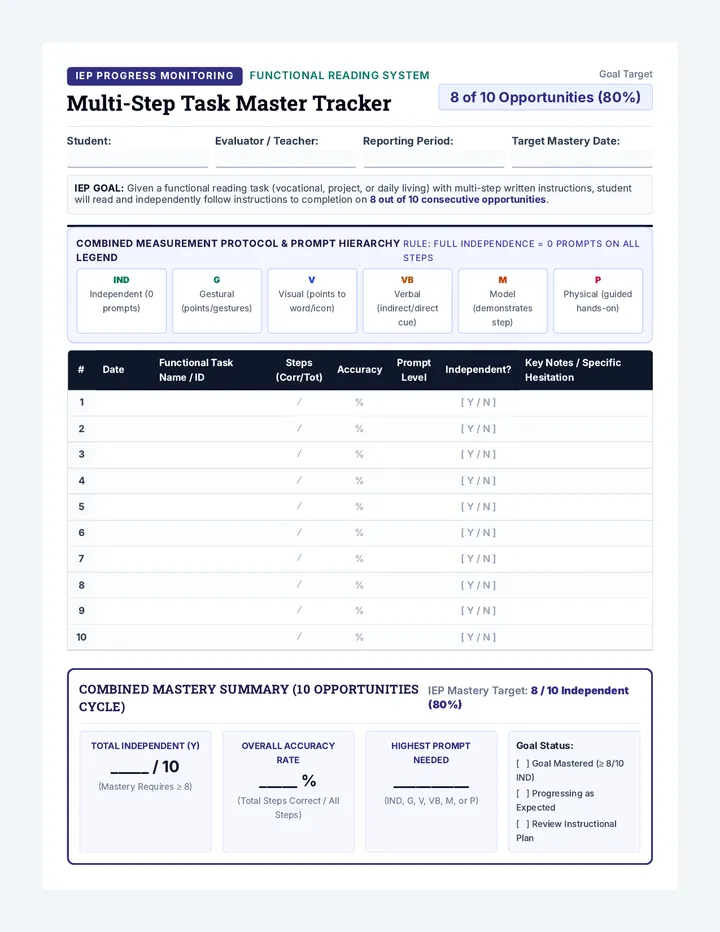
PLAAFPs
Measurable Goals
Related Services
LRE Placement
504 Requirements
Section 504 / Rehab Act
Legal Basis
Civil Rights Law: Section 504 of the Rehabilitation Act of 1973. Focuses on non-discrimination and equal access in federally funded programs.
Eligibility
Broader definition:
Physical or mental impairment.
Substantially limits one or more major life activities (e.g., learning, concentration, breathing).
CDE Oversight
CDE provides technical assistance, but primary enforcement lies with the federal Office for Civil Rights (OCR) . No state-level "ECEA" equivalent for 504.
Core Components
A concise accommodation plan focusing on:
Accommodations
Program Modifications
Auxiliary Aids
Accessibility
Comparative Nuance Table
Process Feature IEP (IDEA/ECEA) 504 Plan Funding Receives federal and state categorical funds. Unfunded mandate; no specific additional funds provided. Re-evaluations At least every 3 years (Triennial). "Periodically" (CDE recommends every 3 years). Team Members Specific required roles (Parent, Gen Ed, SpEd, Admin). "Group of persons knowledgeable about the child." Legal Remedy Due Process, State Complaints, Mediation. OCR Complaint, Grievance Procedure, Civil Lawsuit.
Reference: Colorado Department of Education (CDE) Procedural Safeguards & Section 504 Resource Guide.
© 2026 Educational Compliance Frameworks | Graduate Study Portfolio
Compliance Reference Guide Legal Reference Guide
Colorado-Specific Special Education Nuances
Purpose for Graduate Study
This reference guide serves as a technical deep-dive accompanying the Compliance Mapping Guide. It details the specific Colorado statutory language and procedural variations that differentiate state implementation from federal mandates, specifically focusing on the Exceptional Children's Educational Act (ECEA) versus Section 504.
1. The ECEA vs. Federal IDEA
State Statutory Framework
Colorado's ECEA provides the legal basis for special education. While IDEA sets the floor, ECEA dictates specific state-level definitions and procedures for 13 disability categories.
Gifted Education
Unlike many states, Colorado includes Gifted Education under the ECEA umbrella, although it does not fall under IDEA. This is a critical distinction for Colorado practitioners.
Key Differences in Transition
Colorado mandates transition services earlier than federal law:
15 Colorado Age
vs
16 Federal Age
This ensures earlier planning for post-secondary life, employment, and independent living skills.
2. Section 504 Oversight
Section 504 is a federal anti-discrimination law. In Colorado, school districts are responsible for their own 504 policies, but they often look to CDE for guidance.
Substantial Limitation: Colorado guidance aligns with the ADAAA (2008) to interpret "substantial" broadly.Mitigating Measures: Determination must be made without considering the positive effects of medication, hearing aids, etc.
Procedural Differences in Dispute
IEP Disputes CDE State Complaints / Due Process
504 Disputes OCR Regional Office (Denver)
Note: While CDE monitors IDEA compliance, they do not have jurisdiction over 504 complaints. These must go to the Office for Civil Rights (OCR).
Comparative Summary for Policy Analysis
Component
IEP (IDEA/ECEA)
504 (Rehab Act)
FAPE Standard
Must provide "meaningful educational benefit."
Must provide "comparable access" to gen-ed.
Behavior/Discipline
Manifestation Determination Review (MDR) required.
MDR required for significant change in placement.
Health Services
Can be a "Related Service" on the IEP.
Commonly managed via a 504 Health Plan.
Compliance Connection Map Colorado Compliance Map
A Graduate-Level Visual Analysis of IEP vs. 504 Frameworks
FAPE
Free Appropriate Public Education
IDEA / CO ECEA
Special Education Law
Eligibility
Requires 1 of 13 specific categories + need for SDI.
Funding
Provides supplemental federal & state (ECEA) funds.
Colorado Age 15
Transition planning must be in place by the student's 15th birthday.
Section 504
Civil Rights Law
Eligibility
Substantial limitation of a "Major Life Activity."
Funding
Unfunded mandate; responsibility of local district.
OCR Oversight
Enforced by Office for Civil Rights; no CDE state complaint process.
Shared Procedural Pillars
Child Find
LRE / Access
Notice
Evaluations
"While both frameworks provide FAPE, the IEP offers a higher level of protection through specially designed instruction (SDI) and state-monitored compliance (ECEA), whereas the 504 Plan focuses on removing barriers to access via accommodations."
Data Sourced from CDE Office of Special Education | Graduate Compliance Series
PLAAFP Quality Guide PLAAFP Quality Guide
Present Levels of Academic Achievement and Functional Performance
CDE Compliance Pillar
The Foundation of the IEP
The PLAAFP is the most critical component of the IEP. In Colorado, a legally defensible PLAAFP must provide a clear "snapshot" of the student that justifies all subsequent services, goals, and accommodations. It bridges the gap between evaluation data and the student's educational program.
1 Current Data & Baseline
Must include objective, measurable data (e.g., C-MAPP scores, DIBELS, formal assessments). Avoid vague terms like "struggles" or "doing better."
2 Strengths & Interests
Identifies what the student can do. Includes student and parent input to ensure a holistic view of the learner's capabilities and motivations.
3 Impact of Disability
Critical CDE Requirement: Describe exactly how the disability affects the student's involvement and progress in the general education curriculum.
4 Identification of Needs
Must clearly list the specific areas requiring specially designed instruction (SDI). These needs lead directly to the annual goals.
Academic vs. Functional Domains
Academic Achievement
Reading (phonics, fluency, comp)
Math (calculation, reasoning)
Written Expression
Academic state standards progress
Functional Performance
Social-Emotional skills
Executive Functioning (organization)
Activities of Daily Living (ADLs)
Behavior and Self-Regulation
The "Golden Thread" of Compliance
PLAAFP Identifies Needs
Goals Targets Needs
Services Achieves Goals
If a need is not identified in the PLAAFP, there should not be a goal for it. If there is a goal, there must be a corresponding service.
Reference: CDE IEP Procedural Guidance | 2026 Graduate Special Education Series
Related Services Roadmap Related Services Roadmap
Support Services under IDEA & Colorado ECEA
Defining "Related Services"
Under IDEA and Colorado's Exceptional Children’s Educational Act (ECEA), related services are developmental, corrective, and other supportive services required to assist a child with a disability to benefit from special education . They are not "extra" services; they are legal entitlements necessary for FAPE.
Nexus to SDI
Service must link directly to the Specially Designed Instruction (SDI).
Evaluative Data
Need must be supported by recent assessment or evaluative data.
Goal-Oriented
The service helps the student achieve specific annual IEP goals.
Common Related Services Catalog
Therapeutic & Motor
Speech-Language Pathology (SLP): Address communication disorders (articulation, language, voice).Occupational Therapy (OT): Focus on fine motor, sensory processing, and daily living activities.Physical Therapy (PT): Improve gross motor function, mobility, and physical access to school.
Counseling & Behavior
Counseling / Social Work: Address social-emotional needs and mental health barriers to learning.Psychological Services: Consultative support, assessment, and behavior plan development.Parent Counseling/Training: Helping parents support their child's IEP implementation at home.
Physical & Access
Transportation: Specialized travel required due to disability (e.g., lift bus).School Health/Nurse Services: Management of medical needs during the school day.Audiology: Hearing screenings, amplification management, and listening environment assessment.
Specialized Supports
Orientation & Mobility (O&M): Training for students with visual impairments to navigate environments safely.Interpreting Services: ASL or other communication systems for students who are deaf/hard of hearing.Assistive Technology (AT): Devices and services to increase, maintain, or improve functional capabilities.
A Note on Medical Services (IDEA/ECEA)
Medical services are related services ONLY for
Compliance Intersection Guide Compliance Intersection
Shared Foundations of IEP and 504 Frameworks
IDEA / ECEA
Section 504
Common Ground
The Mandate of FAPE
FAPE Mandate
Both laws guarantee the right to a Free Appropriate Public Education . While the "benefit" standard varies slightly in case law (Endrew F. vs. Rowley), the core obligation to provide an education at no cost to parents remains identical.
Child Find Obligations
Districts have an affirmative duty to locate, identify, and evaluate all children with disabilities within their jurisdiction, regardless of the severity of the disability or the framework they might eventually qualify for.
Team-Based Decisions
Neither an IEP nor a 504 Plan can be developed by a single individual. Both require a group of persons knowledgeable about the student, the evaluation data, and placement options.
LRE & Access
Both emphasize the Least Restrictive Environment . Students must be educated with their non-disabled peers to the maximum extent appropriate, and removal only occurs when education in regular classes cannot be achieved satisfactorily.
Procedural Safeguards
Both frameworks require districts to provide parents with procedural safeguards , including notice of meetings, the right to examine records, and an impartial hearing process to resolve disputes.
Manifestation Reviews
When a student faces a significant disciplinary change in placement (usually 10+ days), both laws require a Manifestation Determination Review (MDR) to see if the behavior was caused by the disability.
Shared Program Elements
Accommodations
Modifications
Evaluation Data
Periodic Reviews
Parent Input
CDE Compliance Integration | Graduate Special Education Law Study