Multi-sensory math manipulatives, visual problem-solving, and text annotation strategies for literacy and numeracy. Employs graphic organizers, sentence frames, and assistive technology to support memory, comprehension, and writing development.
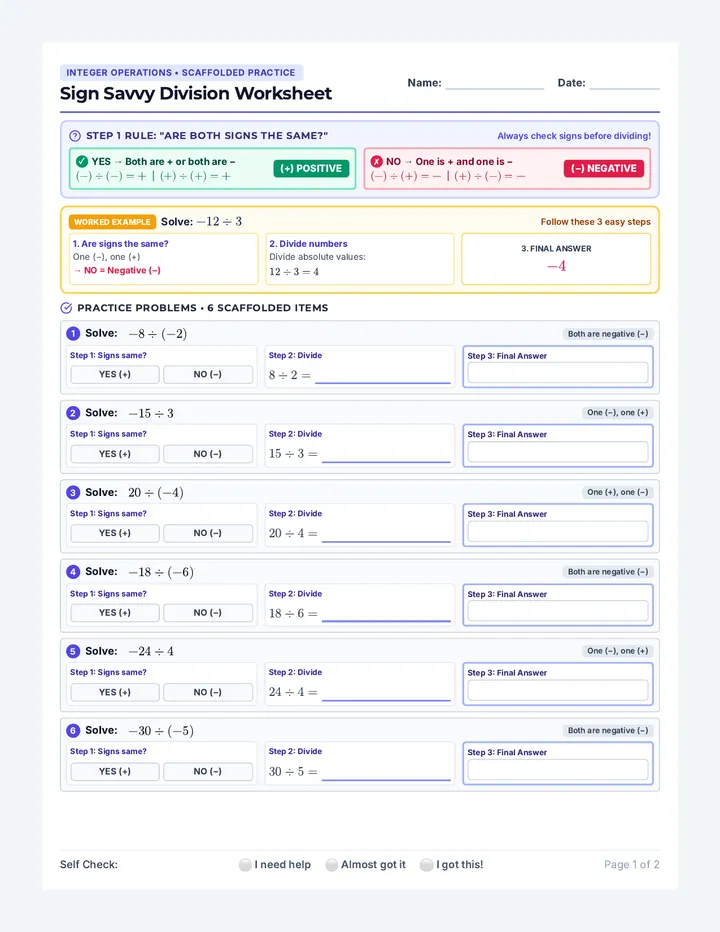
An expanded integer division worksheet for IEP students featuring 6 scaffolded problems, structured 3-step solution frames ('Are signs the same?', divide numbers, final answer), clear visual sign anchors, and a complete 6-problem answer key with teacher guidance.
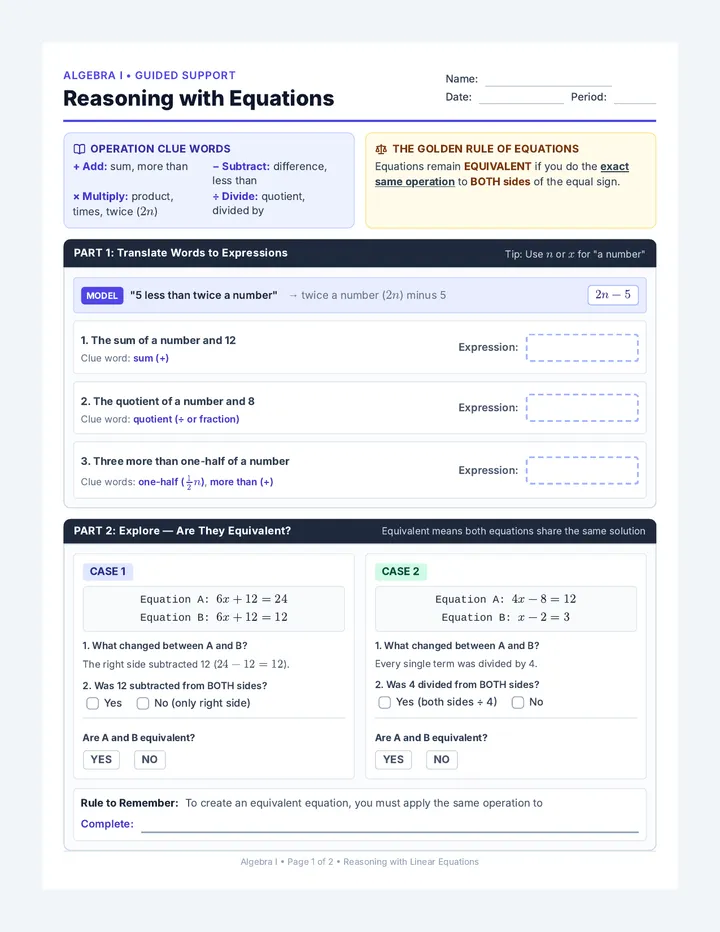
A specially modified 2-page Algebra 1 worksheet on reasoning with linear equations, translating word descriptions into algebraic expressions, and determining equation equivalence with visual organizers, scaffolded cues, and structured workspaces for special education students.
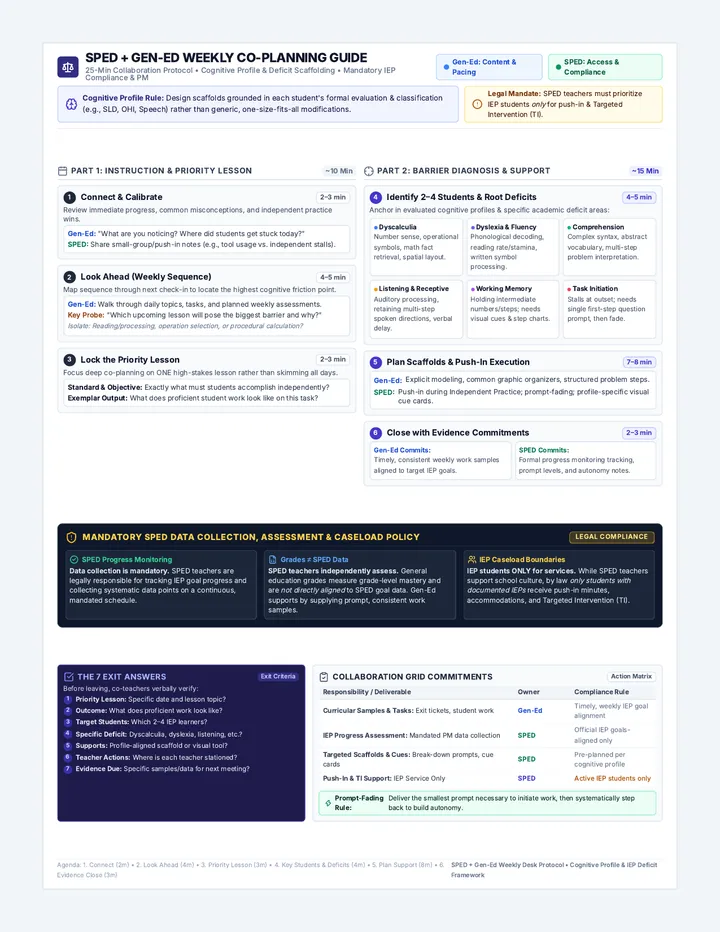
A comprehensive, high-density one-page desk reference guide for Special Education and General Education co-teachers, detailing the 20–30 minute collaboration protocol, common IEP academic deficits (dyscalculia, dyslexia, comprehension, fluency, listening), cognitive profile reminders, mandatory SPED progress monitoring rules, Gen-Ed sample submission expectations, IEP caseload legal boundaries, and a 7-point exit checklist.
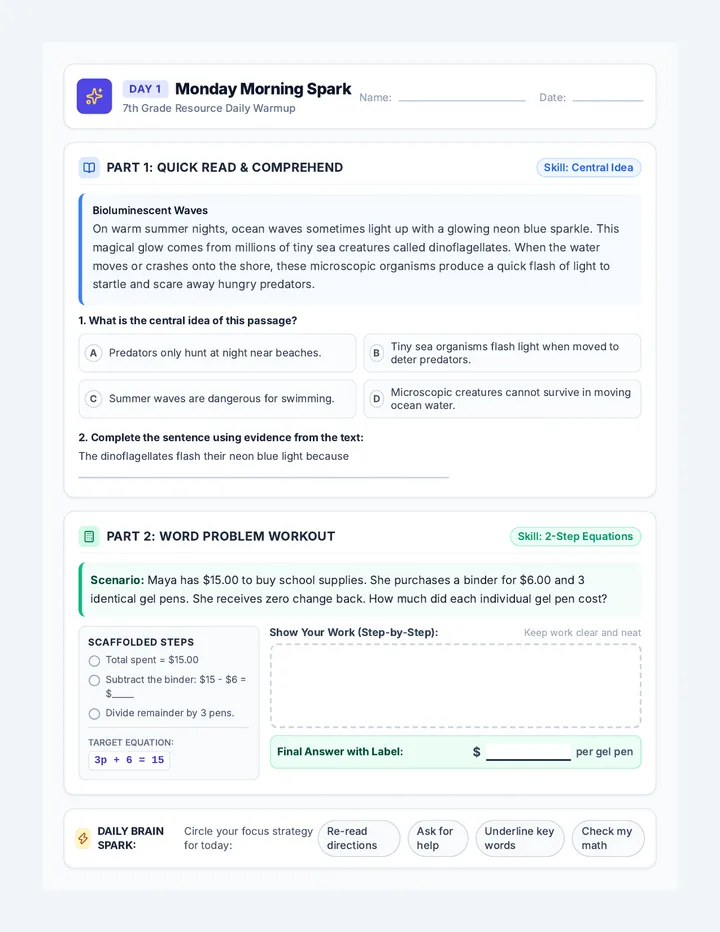
A comprehensive 5-day printable bell ringer workbook for 7th grade resource students featuring concise reading passages and scaffolded word problems. Each daily page reinforces key comprehension strategies, step-by-step math problem solving, and a quick mindset check.
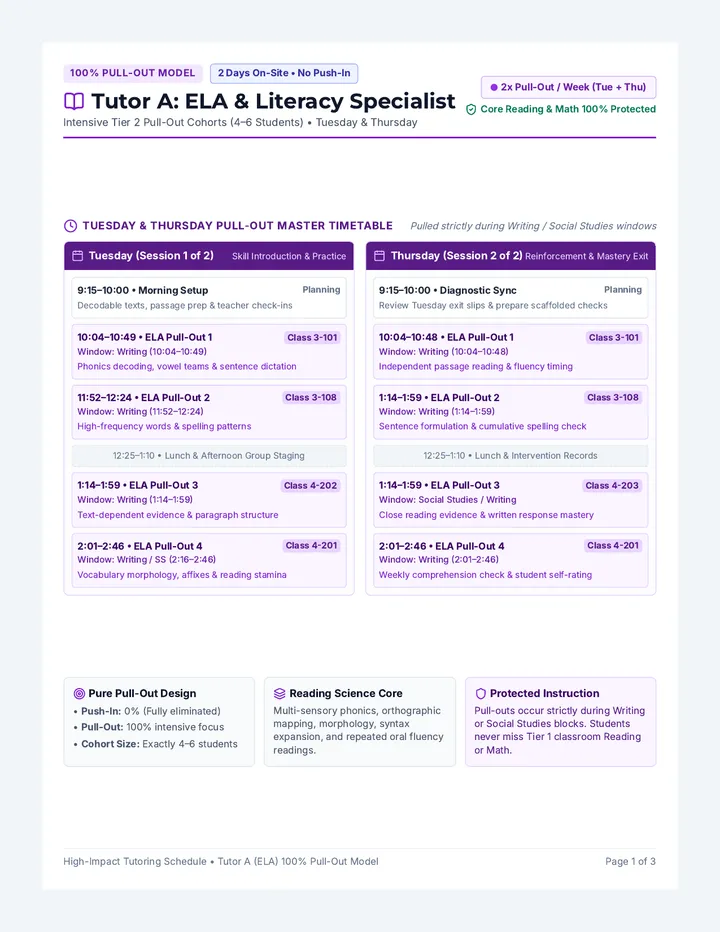
A comprehensive 3-page master weekly tutoring schedule adapted to an exclusive 100% pull-out model (no push-in) 2 days a week (Tuesday & Thursday) for two high-impact tutors (ELA and Math) across all six 3rd and 4th grade classrooms.
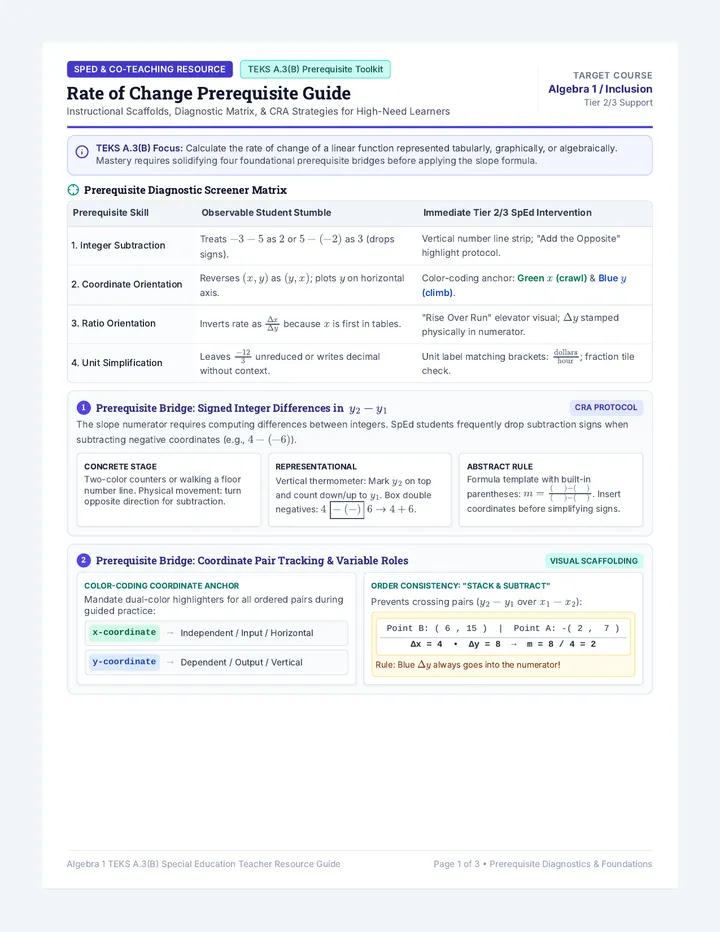
A comprehensive Special Education teacher guide detailing prerequisite instructional strategies, CRA progressions, visual scaffolds, and co-teaching protocols for calculating rate of change under TEKS A.3B.
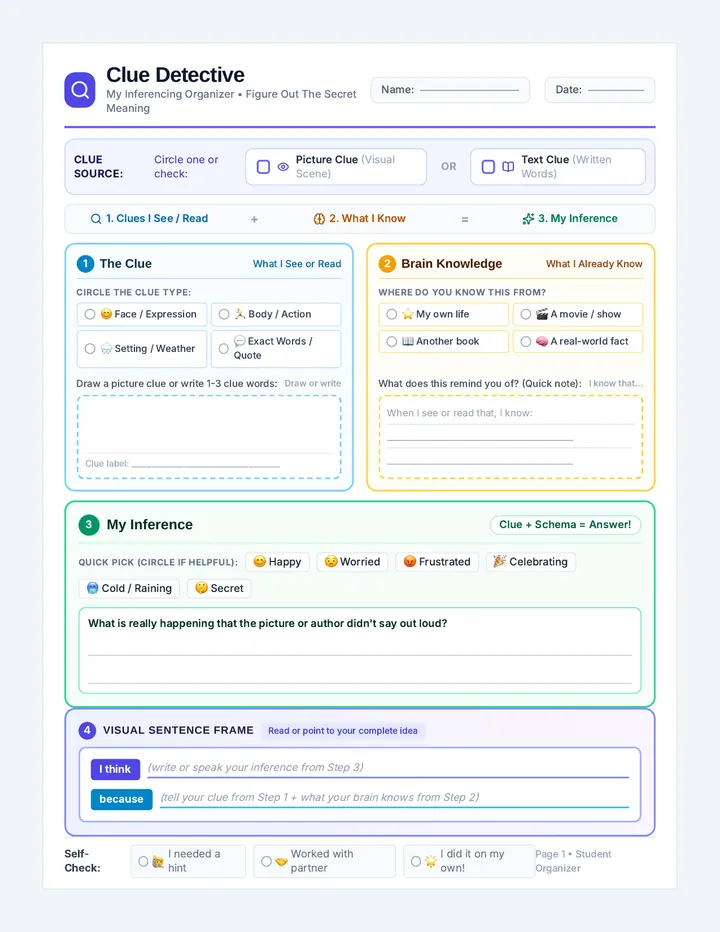
A multi-page inferencing organizer designed for 4th-grade dynamic learners with autism. It features parallel prompts for both visual scenes and written passages, minimal-writing supports with circling and drawing, visual sentence frames, a comprehensive teacher modeling and fading guide, and a visual clue and sentence builder bank.
Adaptación visual en español para la evaluación de lectura de verano, diseñada para una estudiante no lectora con apoyo de un adulto. Incluye un tablero de 3 opciones pictográficas, hojas de trabajo visuales para cada opción (carta con caritas de emociones, final alternativo antes/después, y reseña con estrellas) junto con una rúbrica adaptada.
A multi-page printable card set and game mat focused on puns and figurative ambiguity for students with ASD. Features 12 pun and idiom detective cards, an interactive Pun Patrol game tracker, and an ASD instructional guide with literal-to-figurative bridging strategies.
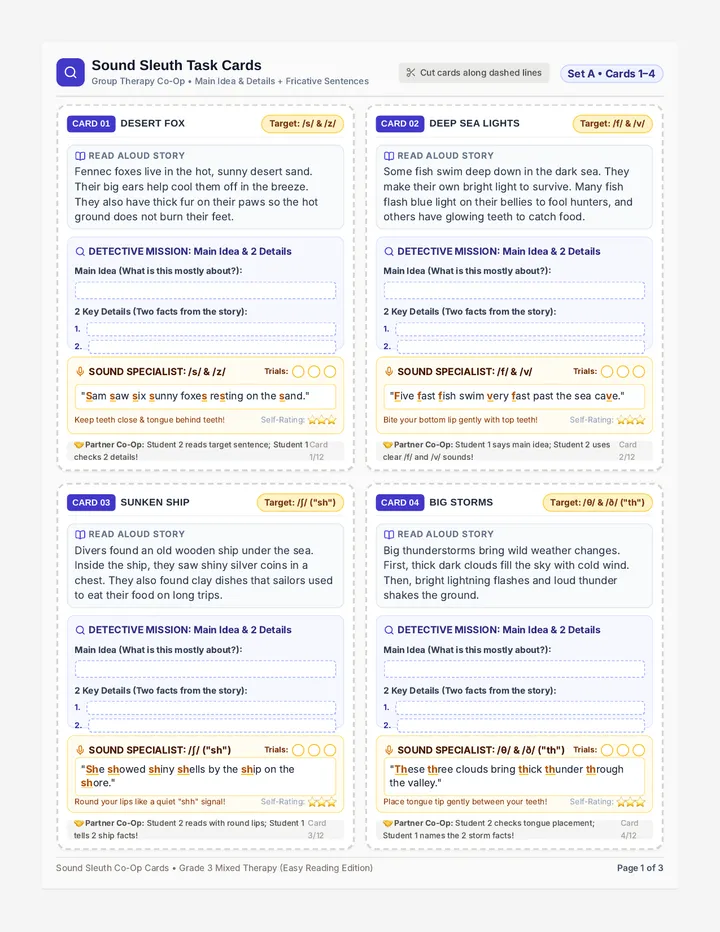
Adjusted 12-card group therapy set with an easier 2nd-3rd grade accessible reading level. Features simpler decodable vocabulary, shorter sentences, and clearer main idea and detail prompts, while maintaining full fricative phonetic density (/s, z, f, v, sh, th, zh/) for speech practice.
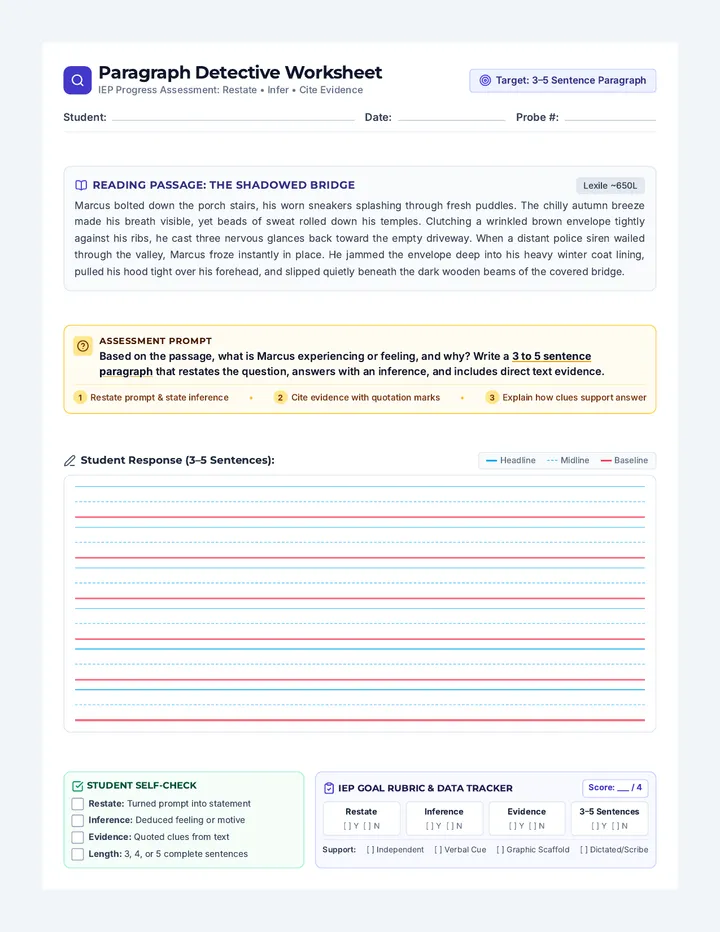
An IEP assessment worksheet for paragraph writing featuring high-interest reading passage, explicit prompt requirements, primary wide-ruled handwriting lines with headline, dashed midline, and solid baseline, student self-check, and teacher data tracking rubric.
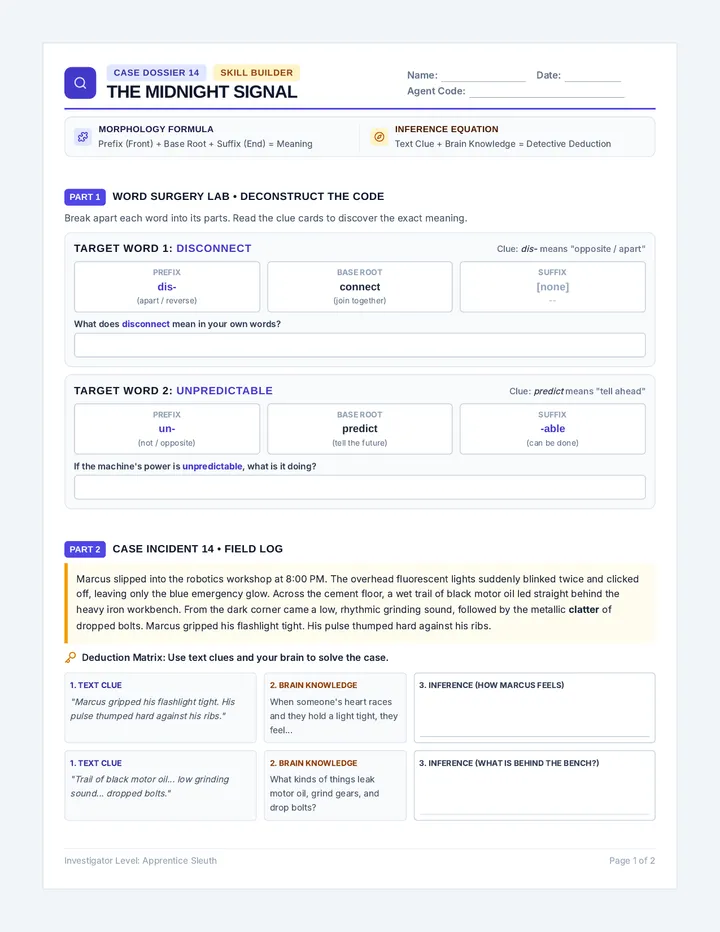
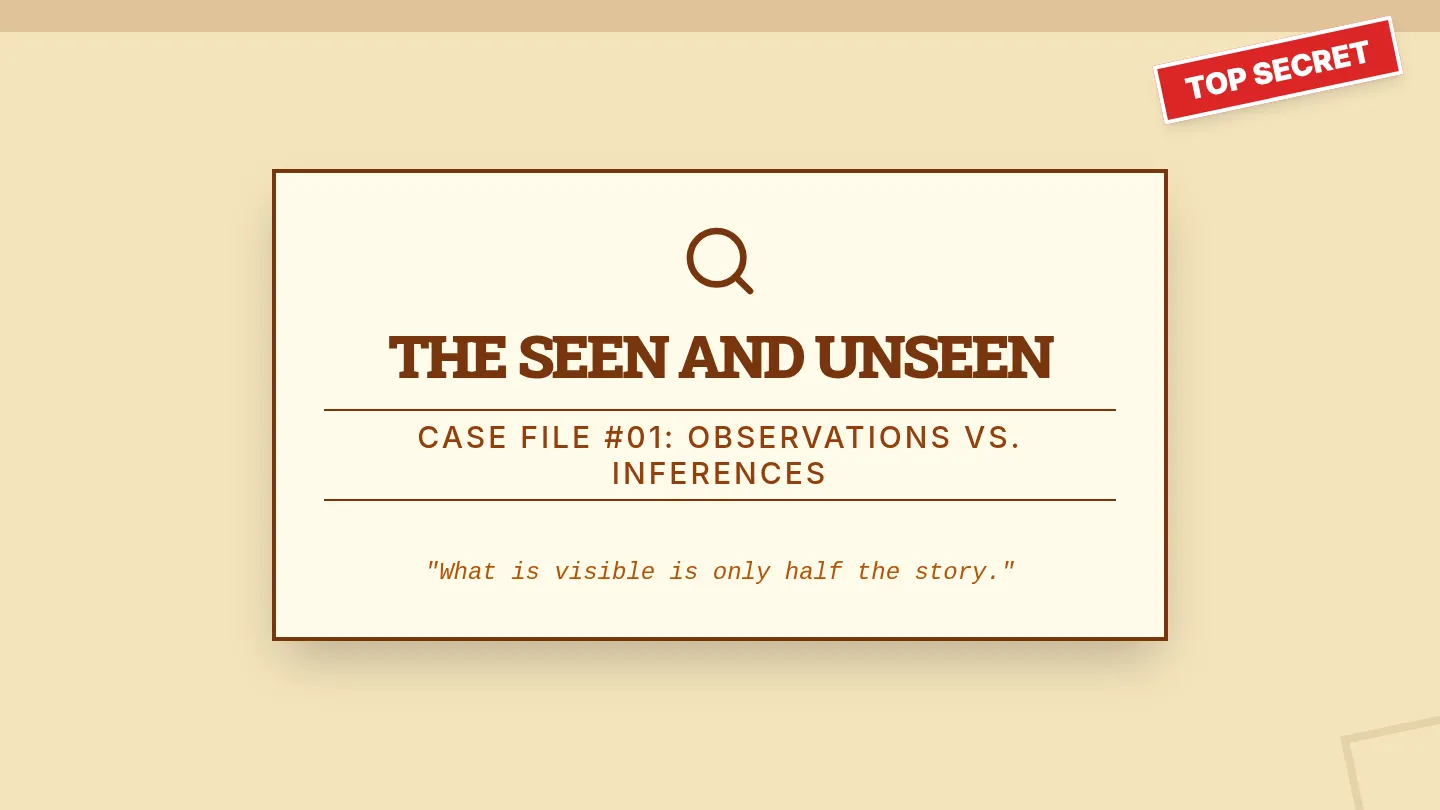
A scaffolded 2-page print-ready activity sheet targeting inferencing and morphology for an 8th-grade reader reading at 5th-6th grade decoding with 2nd-3rd grade comprehension. Features high-interest detective case file themes, visual affix equations, step-by-step inference formulas, and structured evidence matrices.
A pair of targeted 15-minute Tier 2 intervention lessons for 1st grade, focusing on foundational phonics (Short 'a' CVC words) and mental math (Number Bonds to 10).
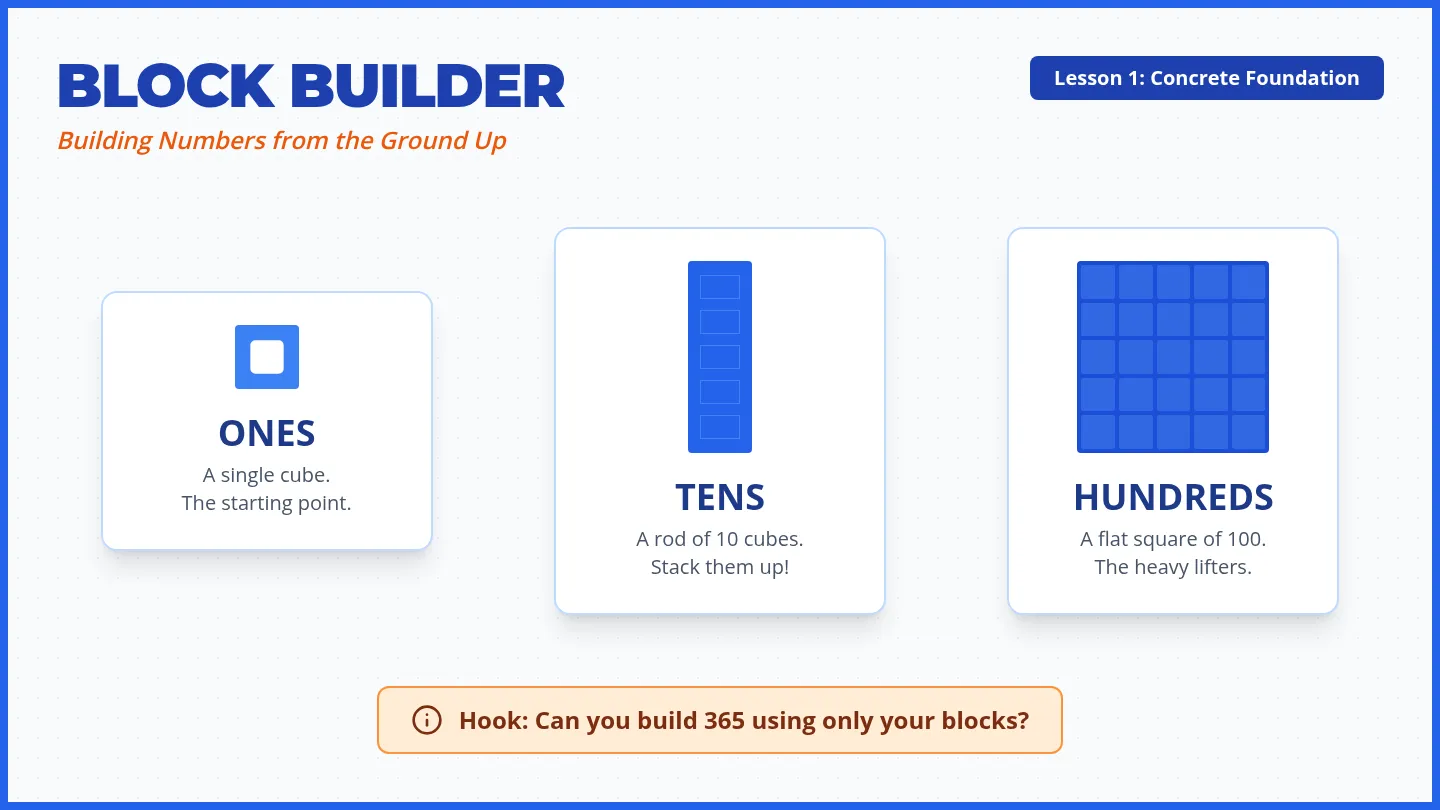
This sequence uses a Concrete-Representational-Abstract (CRA) approach to help 3rd-grade students in special education master multi-digit addition and subtraction. It moves from physical base-ten blocks to shorthand drawings and finally to the standard numeric algorithm, emphasizing the conceptual 'why' behind regrouping.
This advanced graduate sequence focuses on the design and implementation of the Concrete-Representational-Abstract (CRA) framework for learners with mathematics disabilities. Students will move from diagnostic error analysis to the creation of comprehensive, evidence-based intervention plans.
A 10th-grade special education sequence focused on the strategic use of virtual manipulatives to bridge the gap between concrete modeling and abstract algebraic reasoning. Students progress from tool exploration to independent selection and justification.
A 5-lesson sequence for 11th-grade students transitioning from physical math manipulatives to virtual tools. The curriculum emphasizes digital literacy, strategic tool selection, and self-advocacy to prepare students for post-secondary academic environments.
This sequence uses base-ten blocks to help 6th-grade students with learning disabilities visualize decimal place value and operations. By redefining the 'flat' as one whole, students tactilely explore tenths and hundredths to build a concrete foundation for addition and subtraction.
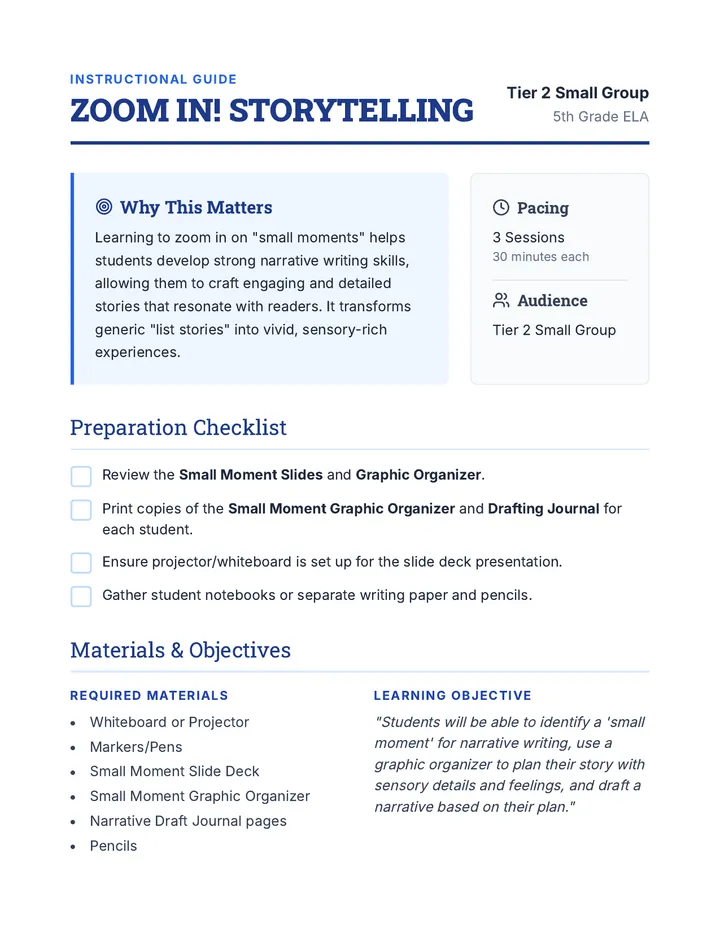
This instructional sequence provides targeted Tier 2 and Tier 3 supports for 5th-grade students, focusing on narrative writing skills and individual behavioral self-regulation strategies using a 'blueprint' thematic approach.
A 5-session comprehension program for 7th and 8th grade special education students using animated shorts to teach sequencing, inference, and perspective-taking. Students use "detective" tools and movement breaks to stay engaged and build critical thinking skills.
A specialized sequence for 6th-grade students focusing on working memory support through visual encoding. Students learn to transform auditory single-step directions into mental images and physical sketches to improve recall and task execution.
This sequence introduces 3rd-grade students to mental imagery and the 'Link Method' mnemonic device. Students progress from visualizing simple nouns to constructing complex 'mental movies' and applying these skills to retain informational text and lists of up to 10 items.
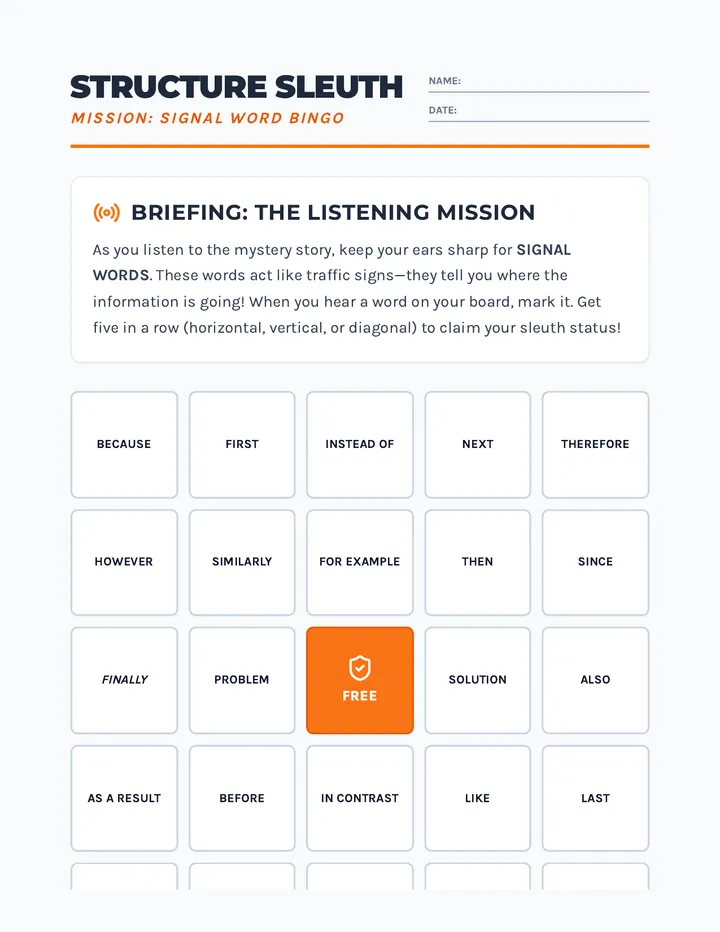
A specialized sequence for 6th-grade students with working memory challenges, focusing on transforming linear information into visual maps. Students learn to identify text structures through signal words, develop personal iconography, and master non-linear note-taking techniques to improve comprehension and recall.
A structured 5-lesson sequence for 8th-grade special education students to master inferencing. Moving from visual analysis to textual evidence, students learn to combine explicit clues with prior knowledge using the formula: Text Clues + Schema = Inference.