Ripple Effect Slides Reset & Rebuild • Lesson 1
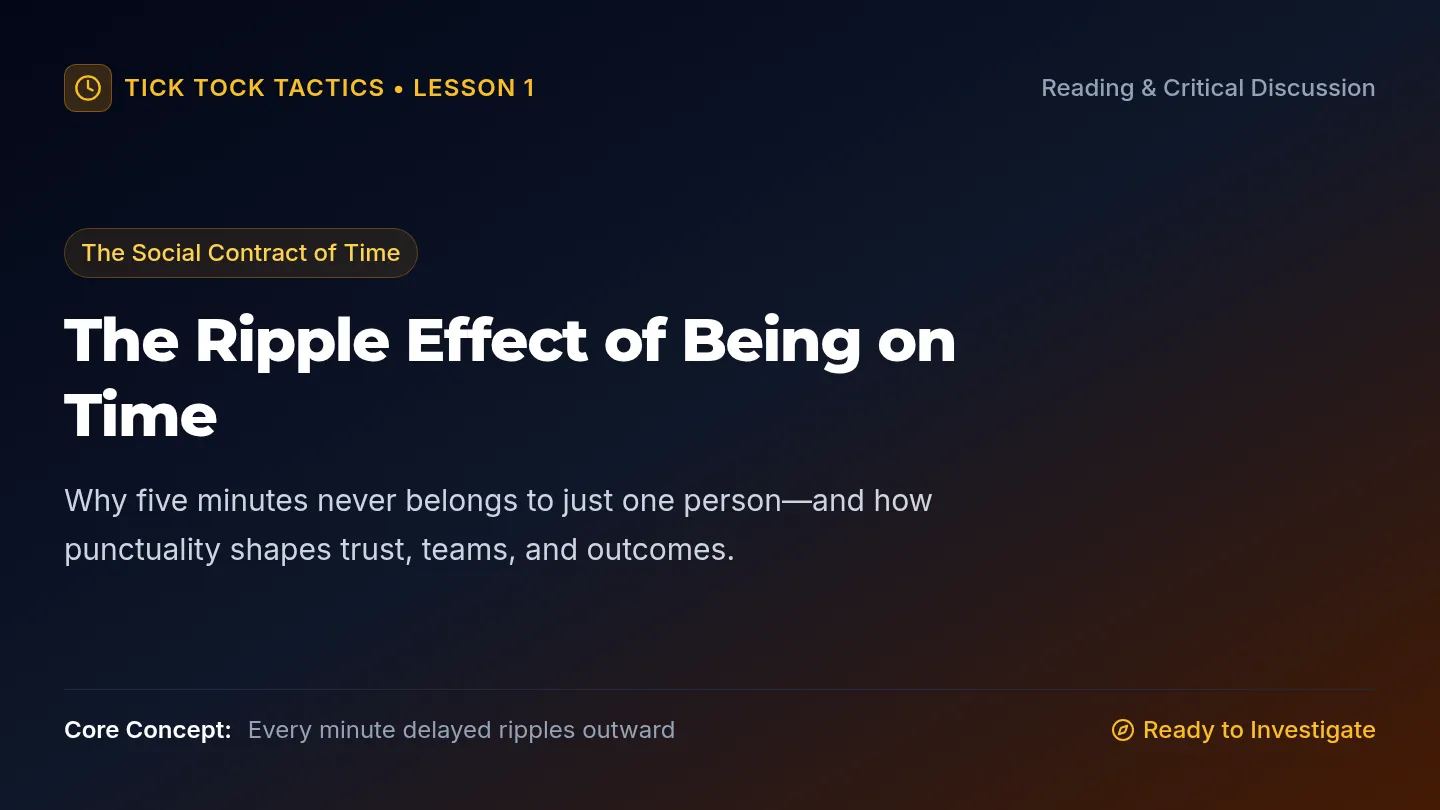
The Ripple Effect
How a single action in the classroom shapes the environment, impacts your peers' right to learn, and changes your path.
Focus: Empathy & Community Impact Slide 1 of 6
The Splash & The Waves
The Analogy
When you throw a pebble into still water, it doesn't just splash where it lands.
It creates waves that travel outwards, touching every corner of the pond.
A classroom disruption works the exact same way. It is never just "about you."
Every Choice Ripple
Your voice and actions travel further than you think.
Do your actions build up or break down the room? Slide 2 of 6
Three Distinct Ripples
Impact Map
1. Your Peers
Students lose concentration, miss critical directions, or feel anxious. Their right to learn is compromised.
2. Your Teacher
The lesson stops. Valuable preparation time is wasted. The teacher must redirect instead of inspiring.
3. Yourself
You miss core concepts, damage valuable teacher-student relationships, and build an reputation of disruption.
An interruption is never an isolated event. Slide 3 of 6
Case Study: Jordan's Interruption
Scenario
"Jordan feels bored during a complex math lesson. He decides to make a loud, sarcastic comment. The whole class erupts in laughter for 30 seconds. The teacher stops speaking, waits for quiet, and spends another minute regaining control."
Visible Impact
Class laughs; Jordan gets temporary attention; lesson halts.
Invisible Impact
Two students who finally understood fractions are now lost; teacher's rhythm is broken.
Who actually paid the price for that joke? Slide 4 of 6
The Cost of 120 Seconds
The Math
1 Disruption =
2 Minutes of Wasted Time
It takes the average class about 120 seconds to completely settle back into a focused state after a major distraction.
When we multiply those 2 minutes by 25 classmates, you have just stolen 50 total minutes of education in an instant.
50m
Total Stolen Time
Almost an entire class period's worth of learning vanishes across the room because of one split-second decision.
Respecting others means respecting their time. Slide 5 of 6
Turn the Tide
Action Steps
Building Positive Ripples
Just as disruptions steal time, positive behavior multiplies it. Your focus invites others to focus. Your respect signals a safe, predictable space to learn.
Your Next Challenge:
Acknowledge your impact on the community.
Commit to protecting the teacher's lesson flow.
Begin the worksheet to rebuild trust.
Your behavior is a wave. Let's make it a constructive one. Slide 6 of 6
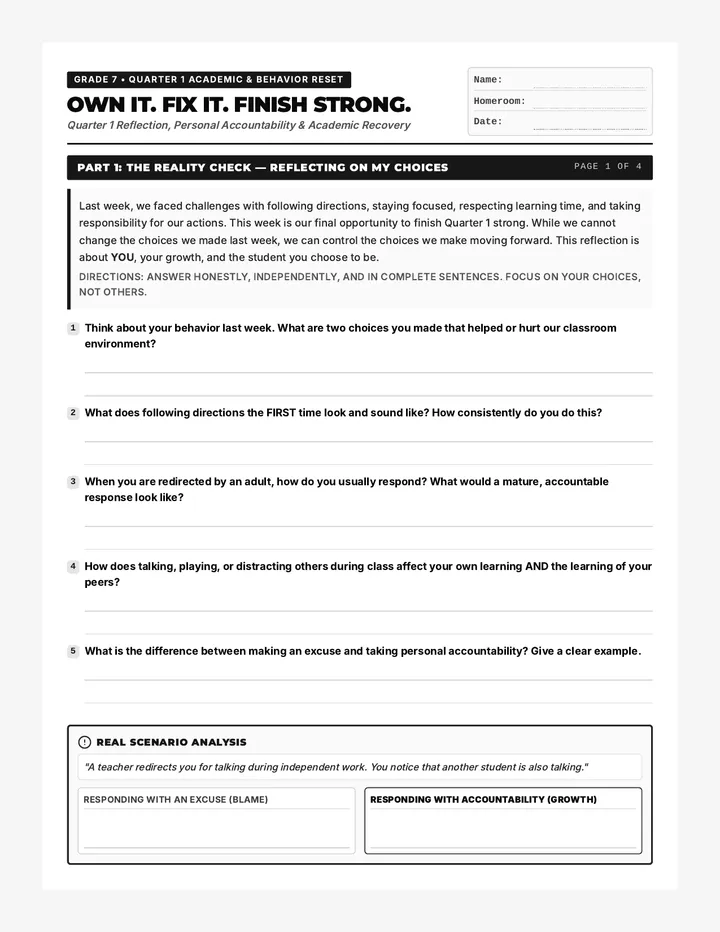
Ripple Effect Reflection The Ripple Effect
Lesson 1 • Independent Detention Reflection
Name:
Date:
Class/Period:
Supervising Admin:
Detention Instructions: This is a self-guided 20-minute reflective packet. You do not need teacher assistance. Complete both pages honestly. Write legibly and in full sentences. Your completion of this packet is required to clear your detention.
1. Self-Assessment: Classroom Focus Rating
Rate your general focus and classroom behavior over the last week. Mark the number that best fits.
1
Highly Disruptive
2
Sometimes Off-Task
3
Average / Steady
4
Mostly Engaged
5
Highly Productive
Explain why you gave yourself this rating. What specific actions are you considering?
2. Case Study: Jordan's Sarcastic Joke
Jordan felt bored during a complex math lesson. He decided to blurt out a sarcastic joke. The class erupted in laughter for 30 seconds. The teacher stopped speaking, waited for quiet, and spent another minute regaining focus. 25 students lost 2 minutes of instruction each.
Who paid the physical price for Jordan's choice? Detail the lost time:
What is the invisible impact on a student who was struggling and finally concentrating?
Reset & Rebuild • Curriculum Sequence Page 1 of 2
3. Guided Reflection: Dissecting Your Incident
Think back to the specific choice that brought you to detention today. Write detailed, honest answers.
What exact choice did you make, and what was your immediate goal (e.g., peer laughter, skipping work, releasing frustration)?
How did your choice act like a "stone thrown in water"? Trace the ripple effect to your peers and your teacher's planning labor.
Your classmates have a legal right to learn without interruption. How did your action compromise or violate that right today?
4. Rebuilding: Creating a Positive Ripple
How will you change your entry into the classroom next time? Draft a concrete strategy:
Next class, I commit to protecting our community's learning by:
Commitment of Accountability:
"I understand my behavior impacts my community. I am ready to return to class with a constructive mindset."
Student Signature
Admin Sign-Off
Pause Button Slides Reset & Rebuild • Lesson 2
The Pause Button
Mastering the vital gap between hearing/feeling something and choosing how you will react.
Focus: Impulse Control & Self-Regulation Slide 1 of 6
The Power in the Space
The Theory
"Between stimulus and response there is a space. In that space is our power to choose our response."
Most of us act like pinballs—hitting a wall and immediately bouncing off. Self-control is about catching yourself inside that tiny, critical "space."
Stimulus (Trigger)
The Space
!
Response
The "Pause Button" lives in the orange space. If you skip it, you default to chaos.
Are you in control, or is your impulse in control? Slide 2 of 6
The Two Behavior Paths
Decide Your Route
Path A: The Reflex (No Pause)
Something happens → You react instantly without processing → You make a scene, get sent out, and ruin your afternoon.
Path B: The Choice (With Pause)
Something happens → You Pause → You process your options → You choose a neutral or positive action, protecting your energy and status.
Path A is automatic. Path B takes training and courage. Slide 3 of 6
Installing Your Pause Button
The 3-Step Code
01
Physical Freeze
Keep your lips shut. Do not let your body jump forward. Take your hands off your desk or lap. Lock down your immediate movement.
02
The Reset Breath
Inhale deeply for 4 seconds, hold for 2, exhale slowly. This signals your nervous system to exit "fight or flight" mode.
03
The Smart Question
Ask: "Will what I am about to say or do help me stay in this room, or will it send me out of it?"
Practice this inside your head when you feel annoyed or bored. Slide 4 of 6
Scenario: The Snide Remark
Analysis
"Marcus is working on a social studies project. A student walking by mutters, 'Your work looks terrible' under their breath. Marcus's heart starts racing. He instantly feels an urge to leap up and shout a threat."
No Pause (Impulse Reaction)
Marcus shouts a response → Fight starts → Teacher sends Marcus to the office. The instigator gets off free.
With Pause Button
Marcus freezes → Breaths → Thinks: 'He wants me to fail.' → Ignores the remark → Finishes project. Marcus wins.
Don't hand over your personal power to anyone else's words. Slide 5 of 6
Pause Button Reflection The Pause Button
Lesson 2 • Independent Detention Reflection
Name:
Date:
Class/Period:
Supervising Admin:
Detention Instructions: This is a self-guided 20-minute reflective packet. You do not need teacher assistance. Complete both pages honestly. Write legibly and in full sentences. Your completion of this packet is required to clear your detention.
1. Impulse Trigger Identification
What makes your brain want to bypass the "Pause Button"? Check all situations that apply to you:
When I feel stuck or confused by classwork When a classmate says something annoying When I have a joke I want peers to hear When the teacher corrects or redirects me
Pick your biggest trigger above and explain what physically happens to your body (heart rate, thoughts) when it is activated:
2. Scenario: Controlling the Reaction
Recall Marcus, who chose the "Pause Button" path when a peer muttered, "Your work looks terrible." Instead of shouting, Marcus froze, breathed, and realized the student was baiting him to get him kicked out.
Why did Marcus win by doing nothing? What power did he keep?
If Marcus had screamed back, how did the instigator succeed?
Reset & Rebuild • Curriculum Sequence Page 1 of 2
3. Guided Reflection: Tracking My Autopilot
Analyze your behavior during the incident that led to your detention today.
Describe the specific moment your "autopilot" took over. What was the exact physical trigger, and what did you immediately say or do?
What would have happened if you had paused for just 5 seconds? Describe what you could have done differently in that space.
How will you install your physical "Pause Button" (freezing your body, taking a reset breath, and asking a smart question) the next time you feel a trigger activate?
4. Reclaiming Control: My Impulse Code
Create a 3-step physical rule you will use to interrupt your autopilot next time:
01. FREEZE: "The instant I feel my trigger, I will immediately close my mouth and..."
02. BREATHE & ASK: "I will take one deep belly breath and ask myself..."
Commitment of Self-Regulation:
"I am the pilot of my actions. I choose when and how I react, and I will not let triggers control me."
Student Signature
Admin Sign-Off
Hidden Cost Slides Reset & Rebuild • Lesson 3
The Hidden Cost
Understanding the invisible prep work, physical hours, and dedication that goes into every single lesson you see.
Focus: Empathy & Teacher Respect Slide 1 of 6
Behind the Curtain
Teacher Preparation
Teachers don't just stand up and talk. Every 50-minute lesson is built from hours of behind-the-scenes effort.
When you walk into a classroom, you are walking into someone else's carefully constructed work environment.
What Goes Into One Lesson?
1 - 2 Hours of Planning
Researching content, designing worksheets, and tailoring tasks.
Setup and Printing
Organizing supplies, setting up slides, and copying materials.
Your classroom is prepared for you. Do you prepare for it? Slide 2 of 6
The Sandcastle Concept
The Metaphor
Kicking it Over
Imagine someone spending three hours building an intricate sandcastle.
Now imagine someone walking by and kicking it flat in three seconds for a quick laugh.
Disruptions Kill Design
A disruption acts exactly like that kick. It is easy, instant, and completely destroys something that took care, focus, and time to build.
Respecting a teacher means respecting their work.
It takes effort to construct. It takes none to destroy. Slide 3 of 6
Case Study: Ms. Ramirez's Lab
Scenario
"Ms. Ramirez spent three hours planning a biology lab and $20 of her own money on specialized yeast. Two minutes into the lab, a student begins throwing yeast packets at friends. The lab is immediately canceled for safety."
The Real Cost
Wasted teacher money ($20); 3 hours of lost planning; 28 angry classmates who wanted to do the lab.
The Lesson
A disruption doesn't just halt talk; it cancels opportunity. The student valued 5 seconds of attention over 28 students' education.
Teachers invest in your future. Don't waste their investment. Slide 4 of 6
Respect is an Action Word
The Exchange
The Classroom Exchange
Mutual respect means acknowledging that both you and the teacher have a critical job in the room.
The teacher's job is to prepare and deliver. Your job is to receive, process, and engage. When you disrupt, you break this basic contract.
How to Value Prep Time:
Walk in and immediately read the board.
Hidden Cost Reflection The Hidden Cost
Lesson 3 • Independent Detention Reflection
Name:
Date:
Class/Period:
Supervising Admin:
Detention Instructions: This is a self-guided 20-minute reflective packet. You do not need teacher assistance. Complete both pages honestly. Write legibly and in full sentences. Your completion of this packet is required to clear your detention.
1. Estimating the Effort Behind the Scene
Many students assume lessons just "happen." Write down how many minutes of prep you think goes into each of these school events:
A Science Lab
Yeast, tubes, measurements.
Est. Prep:
A Slide Deck
Math step-by-step problems.
Est. Prep:
Art Demonstration
Clay, paints, materials.
Est. Prep:
Why do you think teachers spend so much personal time planning if a lesson can be disrupted so easily?
2. Scenario Analysis: Ruining the Lab
Ms. Ramirez spent $20 of her own cash and three hours of planning on a biology lab. A student threw yeast packets, causing the entire lab to be canceled for safety reasons.
How does this cancellation impact the other 28 students in class?
How might this affect Ms. Ramirez's energy to plan future hands-on labs?
Reset & Rebuild • Curriculum Sequence Page 1 of 2
3. Guided Reflection: Recognizing the Teacher's Work
Reflect on the class you were sent out of. Let's look at the teacher's investment.
What did your teacher have to plan, write, copy, or set up in order for today's lesson to occur? Think of the physical labor involved.
When you chose to disrupt, what message did your behavior send to the teacher about their effort and personal time?
Why is a classroom instruction period a mutual contract? What is your side of that contract when the teacher has prepared their side?
4. Restorative Focus: Acknowledging Teacher Preparation
Draft a concrete commitment of how you will show respect for lesson preparation next class:
To show I value the preparation of my classes, next class I will:
Commitment of Respect:
"I will respect the hard work and time my teacher invests in my education by coming in prepared and ready to listen."
Student Signature
Admin Sign-Off
Trigger Shield Slides Reset & Rebuild • Lesson 4
My Trigger Shield
How to spot the hidden triggers that disrupt your focus and build a mental shield to protect your choices.
Focus: Identifying Triggers & Self-Defense Slide 1 of 6
What is a Trigger?
The Concept
A trigger is a spark. It is an event, a comment, or an internal feeling that makes you want to react instantly.
Triggers are automatic, but your response is not. If you do not know your triggers, they will control you.
The Chain Reaction
Trigger → Spark → Instant Reaction (No Shield)
Sparks happen. Fires are optional. Slide 2 of 6
Two Types of Triggers
The Categories
1. Environmental (External)
• Classmates whispering or laughing
• Sitting near distracting peers
• Loud noises or chaotic transitions
• Feeling like a teacher is "staring"
2. Personal (Internal)
• Feeling confused by hard classwork
• Being physically tired or hungry
• Anxiety about failing or looking dumb
• Boredom with a quiet task
Which spark usually knocks you off course? Slide 3 of 6
How to Deploy a Shield
Defensive Moves
01
Name the Spark
Inside your head, state the trigger: "I am feeling really frustrated with this math problem right now." Acknowledging it weakens its power over you.
02
Block the Contact
Look away from the distractor. Focus directly on your paper, the floor, or the teacher. Cut physical line-of-sight with whatever is baiting you.
03
Divert the Energy
Take a slow drink of water, request to move seats, or write down your question. Transfer the physical "impulse" into a calm, constructive task.
Your shield protects your education and keeps you in class. Slide 4 of 6
Scenario: Sarah's Math Frustration
Case Study
"Sarah gets extremely stressed when she doesn't understand an assignment. To hide her confusion and avoid looking like she doesn't get it, she starts cracking jokes and walking around the room, getting the whole class laughing."
The Hidden Trigger
Sarah's real trigger is fear of looking stupid. Laughing and walking around is her way of hiding it.
The Shield Action
Sarah names the trigger: 'I'm stuck, and that's okay.' She blocks the urge to make jokes, and asks her teacher for a 1-on-1 hint.
Trigger Shield Reflection My Trigger Shield
Lesson 4 • Independent Detention Reflection
Name:
Date:
Class/Period:
Supervising Admin:
Detention Instructions: This is a self-guided 20-minute reflective packet. You do not need teacher assistance. Complete both pages honestly. Write legibly and in full sentences. Your completion of this packet is required to clear your detention.
1. Spark Spotter: Identify Your Top Triggers
Which of these specific environmental or personal triggers are hardest for you to block out? Select up to 3:
A classmate whispering or mocking me Not knowing how to start an assignment Feeling hot, tired, or extremely hungry The teacher redirecting me in front of peers
Pick one trigger you checked and describe how you can physically recognize it is about to go off:
2. Scenario: Sarah's Masking Behavior
Sarah gets extremely anxious when she doesn't understand a math problem. To hide her confusion and avoid looking "dumb" to her peers, she cracks loud jokes and walks around, getting the class laughing.
Why does Sarah use disruption as a "mask"? What is she hiding?
How could raising a "Trigger Shield" help her stay in class and get help?
Reset & Rebuild • Curriculum Sequence Page 1 of 2
3. Guided Reflection: Creating My Custom Shield
Analyze the spark that caused your disruption today, and map out your defense.
What exact "spark" (trigger comment, noise, or feeling of being stuck) set you off today? Were you using a mask to hide an underlying feeling?
How did your immediate reaction to this trigger compromise your class goals? What did you lose as a consequence?
If you deploy the 3 Shield Steps (Name it, Block it, Divert it) next time that specific trigger occurs, describe what that will look like physically:
4. Shield Mechanics: My Action Strategy
Formulate your mental defense statement. This is what you will say in your head when triggered:
When my spark fires, I will deploy my shield by repeating this to myself:
Commitment of Accountability:
"I am aware of my triggers. I commit to keeping my Shield raised to protect my choice and my focus."
Student Signature
Admin Sign-Off
Classroom Contract Slides Reset & Rebuild • Lesson 5
The Classroom Contract
Why rules aren't just handcuffs—they are a shield of mutual respect that protects your rights and potential.
Focus: Mutual Agreements & Group Respect Slide 1 of 6
Rules vs. Agreements
The Core Shift
A Contract is Shared
Rules feel like something forced on you from above.
But an Agreement is a mutual pact: "I protect your rights, and you protect mine."
When we step into a classroom, we agree to a basic social contract that makes learning possible.
Without Agreements:
Loudest person wins. Chaos rules. Nobody can hear, study, or think. Your grade and peace of mind are completely at the mercy of distractions.
Agreements don't take away freedom—they secure it. Slide 2 of 6
The Unwritten Deal
Two-Sided Commitment
The Teacher's Pact
"I will prepare engaging work, grade fairly, answer your questions, keep you safe, and treat you with human dignity."
The Student's Pact
"I will respect your preparation, allow my peers to hear instructions, and control my reactions so we can all succeed."
If one side breaks, the whole contract falls apart. Slide 3 of 6
The Elite Team Rule
Scenario
"On championship-winning athletic squads, players must sign a behavioral contract. If a star player repeatedly skips practices, argues with referees, or mocks teammates, the coach benches them. It doesn't matter how talented they are."
Why?
Because one player's bad energy or ego can rot an entire squad's culture and destroy their shot at a title.
In the Classroom
Your classroom is a squad. Disruptions rot the culture and block your peers from hitting their goals.
Are you behaving like a team player or someone toxic to the locker room? Slide 4 of 6
Your Unbreakable Rights
Contract Terms
Every human in that classroom possesses three fundamental rights that no one is allowed to take away:
1 The right to feel physically and emotionally safe.
2 The right to hear directions and understand content.
3 The right to receive the teacher's planned energy.
Your disruptions directly violate your classmates' rights. Slide 5 of 6
Renewing the Agreement
Action Steps
Your Signature Matters
It's time to stop looking at classroom expectations as a prison. It's time to negotiate and sign a contract of respect that you actually stand behind.
Classroom Contract Reflection Classroom Contract
Lesson 5 • Independent Detention Reflection
Name:
Date:
Class/Period:
Supervising Admin:
Detention Instructions: This is a self-guided 20-minute reflective packet. You do not need teacher assistance. Complete both pages honestly. Write legibly and in full sentences. Your completion of this packet is required to clear your detention.
1. Breach Evaluator: Assessing Classroom Behaviors
Determine which clause of the social contract is breached by the following actions. Classify each behavior:
Blurting Out jokes
Speaking over instructions.
Breach of Respect
Refusing to Work
Sitting with arms crossed.
Breach of Learning
Mocking a Peer
Laughing at a wrong answer.
Breach of Safety
Explain how a breach of safety (like mocking) ruins the overall contract of learning for everyone:
2. Scenario: Benched for the Team
On an elite basketball team, if a highly talented player skips practices, mocks teammates, or argues with referees, the coach benches them. The coach knows that one player's attitude can destroy the team's chances at a title.
How is a classroom of 25 students similar to an elite sports team trying to hit a goal?
Why must the teacher (like a coach) "bench" a disruptive student by sending them out?
Reset & Rebuild • Curriculum Sequence Page 1 of 2
3. Guided Reflection: Renegotiating My Pact
Consider the unwritten contract in your classroom and your actions today.
What specifically is your teacher's promise to you when they prepare a lesson? What is your promise to them in return?
How did your disruptive behavior today breach that unwritten promise? Identify the specific clause you violated.
How will you renegotiate your actions? Write the exact behavioral "clause" you commit to executing starting tomorrow:
4. Rebuilding: Renewing the Social Contract
Renewed Social Contract Agreement
"I, the undersigned student, agree to uphold my classmates' rights to hear, study, and learn in a calm classroom environment. I will respect my teacher's preparation and hold my impulses in check."
Student Graduate Signature
Admin Sign-Off / Witness
Reset & Rebuild • Curriculum Sequence Page 2 of 2
Inner Weather Slides Reset & Rebuild • Lesson 6
Inner Weather
How to track your internal emotional climate and separate your temporary mood from your classroom choices.
Focus: Emotional Awareness & Decoupling Slide 1 of 6
The Atmosphere Within
The Metaphor
You cannot control the weather outside. You can't prevent rain, extreme heat, or cold winds.
But you can control how you prepare. You pack an umbrella, or put on a jacket.
Your emotions are exactly like that weather. You can't always stop them from rolling in, but you *can* choose what you wear—and how you act.
→
Feeling Stormy ≠ Behaving Stormy
The emotion is the rain. The choice is the umbrella.
Your mood is temporary. Your behavior leaves a permanent record. Slide 2 of 6
Four Internal Climates
Self-Check
1. Sunny
Calm, energetic, engaged, and ready to listen. It is easy to make smart choices when it is sunny.
2. Cloudy
Bored, distant, unmotivated, or physically tired. Your brain feels slow and off-task.
3. Stormy
Angry, highly frustrated, defensive, or trace of attitude. Highly susceptible to immediate triggers.
4. Foggy
Confused, extremely anxious, stuck on work, or overwhelmed. Hard to seek help directly.
What is your weather pattern right now? Slide 3 of 6
Decouple Your Mood
Mood Control
Feelings ≠ Behaviors
Feeling angry is human and 100% valid. Everyone feels stormy.
But tearing down the classroom structure because you are mad is not acceptable.
We must separate the emotional "state" from the physical "action."
The Internal Check:
"I am feeling completely overwhelmed right now (weather). But I will sit down, breathe, and use my words to tell the teacher I need a minute (choice)."
Don't force your environment to pay the price for your storm. Slide 6 of 6
Scenario: Tyler's Stormy Morning
Case Study
"Tyler had a massive fight with his brother before school. He walks into first-period English feeling absolutely stormy. When Ms. Patel walks over and says, 'Please open your book to page 45,' Tyler slams the desk and shouts, 'Get out of my face!'"
The Misplaced Rain
Tyler's storm was with his brother, but he rained on Ms. Patel. Ms. Patel didn't deserve that—and now Tyler is suspended.
The Healthy Alternative
Tyler flags his weather: 'I'm stormy.' He whispers: 'Ms. Patel, I had a terrible morning. Can I sit quietly for 5 minutes before reading?'
Inner Weather Reflection Inner Weather
Lesson 6 • Independent Detention Reflection
Name:
Date:
Class/Period:
Supervising Admin:
Detention Instructions: This is a self-guided 20-minute reflective packet. You do not need teacher assistance. Complete both pages honestly. Write legibly and in full sentences. Your completion of this packet is required to clear your detention.
1. Weather Forecast: Map Your Current Climate
Take a moment to check your internal state right now. Check the climate that best describes your feelings today:
Sunny
Calm, clear, ready to engage Cloudy
Bored, tired, low-energy Stormy
Angry, defensive, attitude Foggy
Anxious, confused, stuck
Explain why you checked this weather card today. What home, school, or personal thoughts are feeding this mood?
2. Scenario: Tyler's Misplaced Storm
Tyler had a fight with his brother at home, walked into first period feeling stormy, and slammed his desk, yelling "Get out of my face!" at his teacher, Ms. Patel.
Why is Tyler's reaction "misplaced"? Who did Tyler actually owe his anger to?
Why is it completely unfair to "rain" your storm on your teacher or classmates?
Reset & Rebuild • Curriculum Sequence Page 1 of 2
3. Guided Reflection: Separating Weather from Choices
Honestly evaluate the weather you brought with you today, and how to protect your space.
What exact "Inner Weather" did you possess when you walked into class today? What was the real, underlying cause of that mood?
How did you allow that weather to influence your physical choice? Trace how your mood turned into a classroom interruption.
Feeling an emotion is 100% human. But acting it out aggressively is a choice. How can you separate the mood from your hand or mouth next time?
4. Healthy Outlets: Communicating My Storm
Draft a short, polite script or note you can hand to a teacher to ask for a quiet minute without making a scene:
"Dear Teacher, today I am feeling extremely stormy/foggy. To protect our class focus, my plan is to..."
Commitment of Emotional Control:
"I am not my weather. I will protect my classmates' rights by holding my umbrella and keeping my storm in check."
Student Signature
Admin Sign-Off
Repair Kit Slides Reset & Rebuild • Lesson 7
The Repair Kit
How to take real ownership of your mistakes, deliver a powerful apology, and rebuild the bridges you've burned.
Focus: Accountability, Repair, & Restoring Trust Slide 1 of 6
The Trust Account
Trust Mechanics
Every relationship has a "Trust Bank Account."
Doing what you say you'll do, showing respect, and working quietly are major DEPOSITS.
Disruptions, arguments, and excuses are huge WITHDRAWALS. When your account hits zero, words alone cannot fix it.
Disruption
Withdrawal
↔
Action Plan
Deposit
To rebuild trust, you must make massive deposits. Cheap excuses won't work.
Are you overdrawn with your teacher right now? Slide 2 of 6
Beware the "Fake" Apology
Excuses
What a Fake Apology Sounds Like:
• "Sorry, I guess." (Passive/Arrogant)
• "Sorry, BUT he started it!" (Deflecting blame)
• "Sorry you got so mad about it." (Blaming the teacher)
Fake apologies do not make deposits. They are actually another withdrawal because they show zero real remorse.
What a Real Apology Requires:
1. Name the exact behavior. (No dodging)
2. Own the direct impact. (No excuses)
3. Provide the fix action. (The deposit)
4. Ask for a clean slate. (Rebuilding)
This is called a Restorative Apology . It takes maturity and strength.
Excuses are the language of kids. Accountability is the language of leaders. Slide 3 of 6
The 4-Step Repair Code
The Blueprint
01
Acknowledge
State clearly what you did."I blurted out comments while you were teaching."
02
Validate
Name the impact."I wasted class time and broke your lesson flow."
03
Propose Fix
The physical action."Next class, I'll use my pause button to hold my comments."
04
Ask to Restore
Verify renewal."What can I do today to show you I am ready to return?"
Practice this. It will completely alter how teachers see you. Slide 4 of 6
Scenario: Leo's Apology
Repair Kit Reflection The Repair Kit
Lesson 7 • Independent Detention Reflection
Name:
Date:
Class/Period:
Supervising Admin:
Detention Instructions: This is a self-guided 20-minute reflective packet. You do not need teacher assistance. Complete both pages honestly. Write legibly and in full sentences. Your completion of this packet is required to clear your detention.
1. Trust Balance Audit: Reviewing Your Accounts
Rate your current trust account balances with your main teachers. Be completely honest:
English / LA
My current balance is:
Overdrawn Low
Math Class
My current balance is:
Overdrawn Solid
Science Class
My current balance is:
Overdrawn Low
Pick a class where your trust account is overdrawn or low, and explain why it reached that state:
2. Scenario: Leo's Restorative Apology
Leo was sent out for tossing a glue stick. Instead of acting defensive, he stood by Ms. Chen's desk the next day, owned his actions, named the lost learning time, and shook her hand. His slate was wiped clean.
Why did Leo's apology shock and impress Ms. Chen so much?
What did Leo gain by standing up and executing a 4-step repair instead of shrugging it off?
Reset & Rebuild • Curriculum Sequence Page 1 of 2
3. Draft Your Custom Repair Kit Script
Fill out your personalized restorative script to present to the teacher of the class you disrupted.
01. ACKNOWLEDGE (What specific choice did you make today? No excuses, no deflecting.)
"I am writing this because I made the choice to..."
02. VALIDATE (What was the real, measurable impact of your action on the teacher's flow and peers' focus?)
"I understand that my choice disrupted our classroom community because it..."
03. PROPOSE FIX (What specific tool—Pause, Shield, or Weather check—will you physically use next class?)
"Next class, to protect our community's learning time, I commit to..."
4. Restoring Wasted Trust
Words are cheap. Trust requires visible action. Write down how you will prove this apology is real:
"To show my teacher that I am serious about my return to class, I will..."
Commitment of Accountability:
"I commit to walking in tomorrow and delivering this script with eye contact and absolute maturity."
Student Signature
Admin Sign-Off
Pressure Compass Slides Reset & Rebuild • Lesson 8
Pressure Compass
How to read middle school social dynamics, resist the pull of the crowd, and keep your own bearings.
Focus: Peer Influence & Personal Standards Slide 1 of 6
The Classroom Audience
The Social Gravity
In middle school, peers exert a massive, invisible gravity.
There is a constant, subtle pressure to act out, look tough, make jokes, or follow the laugh.
But acting for an audience is a trap. You do the performance, and you pay the full price alone.
Who is the Puppet Master?
If you disrupt to get friends to laugh, they are pulling your strings.
Are you in control, or is your audience running your life? Slide 2 of 6
An Unbalanced Transaction
The Math
What You Give Away:
• Your grade and educational progress.
• Your reputation with school staff.
• Your recess, lunch, or after-school hours.
• Your parents' respect and peace.
What You Get in Return:
3 Seconds of Chuckles
Your peers snicker. Then they go home and eat snacks while you sit in detention or at the principal's desk.
This is a terrible trade. Do not accept bad deals. Slide 3 of 6
Case Study: Marcus & The Eraser
Scenario
"Marcus's friends dared him to toss a wet eraser at the chalkboard during history. Marcus did it. His friends sniggered. The teacher immediately caught Marcus and assigned him 2 days of after-school detention. His friends went home on the bus."
The Real Trade
Detained for 2 hours; zero friends came to support him; record damaged. Marcus bought a cheap show and paid full cost.
The Compass Choice
Marcus checks his target: 'I need to make the track team.' Detentions disqualify him. He ignores the dare and says, 'Nah, I'm good.'
Real friends support your goals—they don't set you up to fail. Slide 4 of 6
Defining Your True North
Self-Direction
A magnetic compass always points North, no matter how hard the storm rolls or which way the ship is turned.
Your "True North" is your long-term goal. High school graduation, making sports team, passing classes.
Check Your Compass:
Before taking any action suggested by a peer, ask:
"Will this action move me closer to my True North, or pull me off-course?"
Let your goals pull you, not your audience. Slide 5 of 6
Pressure Compass Reflection Pressure Compass
Lesson 8 • Independent Detention Reflection
Name:
Date:
Class/Period:
Supervising Admin:
Detention Instructions: This is a self-guided 20-minute reflective packet. You do not need teacher assistance. Complete both pages honestly. Write legibly and in full sentences. Your completion of this packet is required to clear your detention.
1. Audience Check: Evaluating Social Influence
Consider how much your actions in class are guided by what other students think. Check all that apply:
I have blurted a joke just to see a peer laugh. I feel embarrassed when a teacher redirects me in front of friends. I have joined in on a disruption so I wouldn't look left out. I find it hard to say "No" when friends suggest acting out.
Describe a specific time you made a choice in class only because you wanted classmates to notice you:
2. Scenario: The Wet Eraser Transaction
Marcus's friends dared him to throw a wet eraser at the board. He did. His friends snickered. Marcus got 2 days of after-school detention while his friends went home on the school bus to play games.
Who got the "free show" and who got the "bill" in this transaction?
Why is performing for a classroom audience a losing deal for your future?
Reset & Rebuild • Curriculum Sequence Page 1 of 2
3. Guided Reflection: Checking My Compass
Set your coordinates. Let's check if today's actions matched your actual long-term goals.
Was there a peer audience you were trying to impress or show off for today? Who pulled your strings, and what was the cost?
What are two major long-term "True North" targets (sports, high school, grade goals, family pride) that you are putting at risk when you act for a crowd?
The next time a classmate whispers, dares you, or tries to get you to blurt out a comment, what specific sentence will you use to decline without making a scene?
4. Reclaiming Control: Defining My Direction
Draft your non-negotiable compass target. This is what you will focus on during the next difficult lesson:
"When others act out or pull at my focus, my compass will remain locked on my goal of..."
Commitment of Self-Direction:
"I will guide my behavior by my own goals, not my friends' expectations. I hold my own compass."
Student Signature
Admin Sign-Off
Architect Focus Slides Reset & Rebuild • Lesson 9
Architect of Focus
How to physically design your classroom environment, seat, and tools to make high performance easy.
Focus: Environmental Design & Time Management Slide 1 of 6
The Environment Rule
The Theory
An architect doesn't just "hope" a building stands up. They design walls, columns, and foundations to withstand storms.
Your environment is currently shaping your behavior. If your desk, screen, and seat are chaotic, your actions will be too.
Design Over Willpower
Stop trying to "will" yourself to focus. Re-arrange your environment instead.
If you want different results, change the shape of your workspace. Slide 2 of 6
Your Seating Blueprint
Desk Anatomy
1. Cut Line of Sight
Position your chair so you are facing the teacher/board, and CANNOT easily make eye contact with classmates who trigger you.
2. Clear the Deck
Remove everything from your desk except a pencil and the paper. If a Chromebook isn't needed, close it completely.
3. Tab Lockdown
Close every single unrelated search tab on your Chromebook. Keep only the active learning page visible.
Your desk should look like a laboratory, not a junk drawer. Slide 3 of 6
Case Study: Zoe's Front-Row Move
Scenario
"Zoe used to sit in the back row next to her best friend, whispering and drawing during English class. She was failing. Her teacher moved her to the front row, directly in front of the screen. Zoe hated it at first. In 3 days, her focus doubled and she passed her essay."
The Environmental Shift
Moving closer eliminated the whispering option and removed the back-of-head visual triggers of peers.
The Takeaway
Zoe didn't miraculously get a new brain. She got a new layout that made failure hard and focus easy.
Don't rely on willpower. Build an environment that supports your goals. Slide 4 of 6
Mental Blueprints
Time Tactics
Segment Your Labor
Staring at a 50-minute task feels overwhelming. That overwhelm leads directly to acting out or giving up.
Build Time Segments:
Work intensely for exactly 10 minutes.
Take a 10-second mental reset (look at desk).
Begin the next 10-minute segment.
A large building is laid brick by brick. Focus works the same way. Slide 5 of 6
Your Focus Blueprint
Architect Focus Reflection Architect of Focus
Lesson 9 • Independent Detention Reflection
Name:
Date:
Class/Period:
Supervising Admin:
Detention Instructions: This is a self-guided 20-minute reflective packet. You do not need teacher assistance. Complete both pages honestly. Write legibly and in full sentences. Your completion of this packet is required to clear your detention.
1. Workspace Audit: Rate Your Desk Layout
Think about your typical desk arrangement in the class you disrupted today. Check any of the following focus-blockers that were present:
Unrelated papers or trash on my desk More than 3 open tabs on my Chromebook screen Doodling materials or objects I play with Sitting within reach of a highly conversational friend
How does physical clutter on your desk or computer screen lead directly to a distracted mind?
2. Scenario: Zoe's Layout Re-design
Zoe sat in the back row next to her best friend, failing history because she spent class whispering. Her teacher relocated her to the front row, directly in front of the presentation screen. In 3 days, her focus doubled and she passed her project.
Why did moving to the front row force Zoe's brain to focus?
Why is changing layout smarter than just trying to use willpower?
Reset & Rebuild • Curriculum Sequence Page 1 of 2
3. Guided Reflection: Blueprints of Concentration
Reconstruct your environment. Plan the exact changes you will make tomorrow.
What is one specific object or person in your current classroom layout that acts as a focus-blocker for you? How will you physically adjust your desk angle to block them?
Describe exactly how you will execute a "Chromebook Tab Lockdown" next time you enter class. What tabs must close?
Explain how you will divide your classwork into "10-Minute Segments" (e.g. work 10 min, 10-second hand stretch) to prevent brain fatigue and blurting out.
4. Workspace Blueprint: Custom Desk Design
Draft your ideal focus blueprint. List what is allowed to stay on your physical desk:
"When the bell rings tomorrow, I will clear my deck. The ONLY three items on my desk will be:"
Commitment of Focus Design:
"I am the designer of my focus space. I commit to clearing my desk and aligning my layout for success."
Student Signature
Admin Sign-Off
Future Self Slides Reset & Rebuild • Lesson 10
The Future Self
The Capstone: Integrating your new self-regulation tool belt and graduating into the pilot of your own classroom path.
Focus: Synthesis, Graduation, & Personal Code Slide 1 of 6
Passenger vs. Pilot
The Core Choice
Profile A: The Passenger
Driven entirely by environmental triggers, temporary moods, and the desire to impress peers. Zero long-term planning. Automatically reacts and constantly lives with the negative consequences.
Profile B: The Pilot
Seizes the impulse gap with the Pause Button. Keeps the Shield raised against distractors. Navigates by their own compass goals. Designs their desk layout for total focus. Completely in control.
Which profile matches the person you want to become? Slide 2 of 6
Your Cumulative Tool Belt
Curriculum Recap
The Ripple Effect
Understanding how your behaviors impact everyone in the classroom.
The Pause Button
Taking immediate physical control inside the stimulus gap.
The Trigger Shield
Spotting environmental spurs and building blockades.
Inner Weather
Tracking internal emotional climates and separating mood from actions.
The Repair Kit
Making Restorative apologies and rebuilding teacher trust.
Pressure Compass
Resisting the social pull. Performing only for your actual goals.
You possess the full skill set now. It's time to lock it in. Slide 3 of 6
Case Study: Devonte's Pivot
Scenario
"Devonte had been sent to the office 6 times in 2 months. He completed the 10 Reset and Rebuild lessons. Last week, a peer dared him to act out in Science. Devonte paused, raised his shield, checked his compass (track eligibility), and kept working. Devonte is now on track to graduate on stage."
The Moment of Choice
Devonte had the exact same trigger as before. The only difference was that Devonte opened his mental toolbox and selected a weapon.
The Graduation
Being a pilot means you own your steering wheel. Nobody else can force you off-road.
Devonte did it. You can do the exact same thing starting today. Slide 4 of 6
Your Personal Code of Conduct
The Rules You Own
Your Personal Laws
The ultimate mark of graduation is writing your own code of conduct.
These are three non-negotiable behavior parameters that *you* write, *you* sign, and *you* enforce on yourself. No administrators required.
Future Self Reflection The Future Self
Reset & Rebuild • Lesson 10 Reflection
Name:
Date:
Class/Period:
Teacher:
1. Tool Belt Review: Evaluate Your Mastery
Rate how confident you feel using each of the major tools you developed over this curriculum:
Pause Button
Ready to Use
Trigger Shield
Ready to Use
Inner Weather
Ready to Use
The Repair Kit
Ready to Use
Pressure Compass
Ready to Use
Focus Architect
Ready to Use
2. Scenario: Devonte's Graduation Moment
Devonte was sent out 6 times. After learning the tools, a classmate dared him to throw an eraser. Devonte paused, checked his track eligibility compass, raised his shield, and kept writing. He graduated and stayed in class.
What is the difference between letting other kids control you (passenger) versus controlling yourself (pilot)?
3. Draft Your Personal Code of Conduct
Write 3 unbreakable behavioral rules that you will enforce on yourself starting tomorrow:
1
Rule 1 (My desk layout and environment pledge):
2
Rule 2 (My impulse and blurt-out pledge):
3
Rule 3 (My response to peer pressure or distraction):
Certificate of Curriculum Completion
RECLAIMING THE WHEEL • RESET & REBUILD GRADUATE
"I have successfully completed the 10-part cognitive behavioral reset curriculum. I have learned to respect teaching prep, value peer focus, and master my reactions. I am ready to return to class as a leader."
Student Graduate Signature
Facilitator / Administrator Signature