Special Education Reference Sheet
Uncommon Schools Professional Development Reference Sheet
Teacher Desk Guide
Special Education & Inclusive Practices Quick Reference
"Fairness is when each person gets what they need."
1. Core Legal Mandates & IEP vs. 504 Comparison
Our Commitments & Legal Duties (IDEA)
- • FAPE in LRE: Free Appropriate Public Education in the Least Restrictive Environment alongside gen-ed peers.
- • Uncompromised Rigor: We never lower expectations; we provide tools, outlets, and scaffolds for access and mastery.
- • Advocacy: Educators are the students' voice and legal partners.
| 504 Plan (Rehab Act §504) | IEP (IDEA) |
|---|
| Diagnosed medical/physical condition that impacts a major life activity. | Disability formally classified by a multi-disciplinary Child Study Team (CST). |
| Accommodations only. No specialized instruction or modified curriculum. | Specialized instruction + accommodations, modifications, & related services. |
2. Placement Continuum & Service Models (Least to Most Restrictive)
1. Gen Ed (100% Core) → 2. In-Class Push-In → 3. Resource Pull-Out → 4. Resource Replacement → 5. Self-Contained / Out-of-District
◀ Least Restrictive Environment (LRE) — Highest Peer Inclusion Most Restrictive Environment ▶
Resource Push-In SpEd teacher co-teaches inside the gen-ed classroom during Math or Literacy.
Resource Pull-Out Extra skill "at-bats" delivered by a skills teacher in the skills room (supplements core).
Resource Replacement Core curriculum is replaced in skills room and heavily modified to match instructional level.
Related Services Speech (articulation/receptive), OT (fine motor), PT (gross motor), Counseling, Paraprofessionals.
3. Accommodations vs. Modifications: Changing How vs. What
ACCOMMODATION Changes HOW (Access)
Provides additional support to access the same content and master the same standard.
• Audiobooks / text-to-speech • Pre-call & sentence frames • Formula sheets & number lines • Cloze notes & printed copies • Extended time & scheduled breaks • Preferential partner seating
MODIFICATION Changes WHAT (Target)
Changes what the student is expected to learn or alters the fundamental standard/assignment.
• Reducing question count (Star System) • Lowering reading Lexile level • Shortening reading passage length • Simplified question wording • Decreasing math number sizes/steps • Level-aligned Life's Work packets
4. The Star Modification System (Daily Work & Assessments)
Applies to students with curricular modifications in IEP
Accommodates length and complexity while maximizing quality practice on high-leverage objective skills. Used across Do Nows, Independent Practice, Exit Tickets, Homework, and Quizzes/Tests.
Two Stars (**) = 50%
Completed by students with 50% and 75% modifications. Directly targets core objective, used for data response, essential for future tasks.
One Star (*) = +25%
Completed by students with 75% modifications (they complete ** and * questions). Varied question formats, IEP skills, and range of challenge.
No Stars = 100%
General education students complete all. Modified students may complete unstarred items for extra credit once starred items are finished.
Lead Lesson Planners (LLPs): Centrally star tasks; provide teacher response guides and exemplar answers.
General Education Teachers: Internalize stars; add scaffolds; Change the denominator when grading (grade only starred items).
Special Education Teachers: Teach students how to navigate stars; partner with Gen Ed to star non-aligned work and align grading.
Uncommon Schools • Intro to Special Education PD Summary Page 1 of 2
Uncommon Schools Execution, Interventions & Legal Compliance
Teacher Desk Guide
Classroom Support Strategies & MTSS/I&RS Protocols
"Creating an inclusive experience begins with awareness."
5. Common Disabilities & Classroom Support Matrix
| Disability & Primary Need | Manifestation / Challenge | Evidence-Based Classroom Teacher Moves |
|---|
| SLD (Specific Learning Disability) | Receptive/expressive language, decoding, math calculations. | First check-in during IP; graphic organizers; pre-teach with SpEd teacher. |
| ADHD (Attention Deficit Disorder) | Impulse control, motor restlessness, sustained attention. | 1-step directions; non-verbal attention cues; seat beside strong peer; printed notes. |
| CI (Communication Impairment) | Speech articulation, word retrieval, oral expression. | Pre-call with sentence frames; 1:1 CFU (understands before speaking); repeat peer answers. |
| Autism Spectrum | Social interaction, rigidity to changes, sensory sensitivities. | Visual schedule; preview routine changes; emotional constancy; sensory breaks. |
| ERI (Emotional Regulation Impairment) | Heightened anxiety/mood, conflict during unstructured transitions. | Overwhelming positivity & precise praise; structured transitions; interest-based incentives. |
| OHI (Other Health Impairment) | Medical stamina/attendance impacts (e.g., Sickle Cell, Diabetes). | Follow Nurse plan; prepared notes packet upon return; coordinate with Social Worker. |
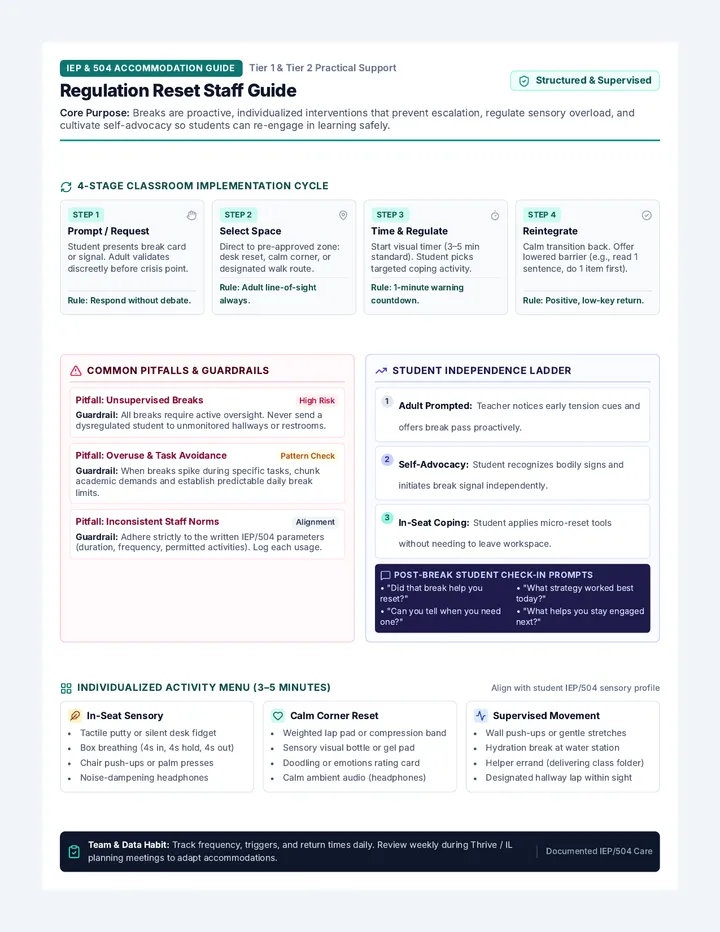
Tier 3 Behavior Formula Target Function First: Identify behavior → Hypothesize "Why" (attention vs. escape) → Link intervention to function.
Uncommon Tier 3 Behavior Toolkit
Testing Accommodations Checklist
Mandatory for Unit Tests, Interim Assessments, NJSLA & STEP:
• Extended Time • Read Aloud / TTS • Frequent Breaks • Human Scribe (per IEP) • Small Group Setting • Approved Calculator • Focusing Prompts • Distraction-reduced seat
Handout Scaffolding Best Practices
Ensure differentiated materials are posted by Friday PM:
• Definitions & Rules: Pre-print key terms in margin boxes.
• Formulas & Reference: Provide anchor steps directly on page.
• Numbered Sub-Steps: Deconstruct multi-tier prompts into bullets.
• Salient Visuals: Bold directive verbs; highlight key passage clues.
6. Supporting Students of Concern: MTSS & I&RS Referral Cycle
6-Week Data Collection Cycle
1. Try Classroom Interventions Brainstorm with co-teacher/IL; try & log documented Tier 1/2 strategies.
2. Submit Referral Email Leaders, SpEd Coordinator, & SpEd Teacher to schedule observation.
3. 6-Week Action Plan SpEd teacher observes; team creates plan; log weekly data in Google Tracker.
4. Team Review Meeting Team evaluates data to decide 1 of 3 formal next steps.
Continue Action Plan Intervention led to student success. Maintain supports without CST referral.
Revise Action Plan Initial intervention ineffective. Adjust strategies/frequency and continue tracking.
Refer to CST Evaluation Documented data shows intensive lack of progress; refer for full CST evaluation.
Campus I&RS Team: Referring Teacher, SpEd Teacher, SpEd Coordinator, Principal, Dean Child Study Team (CST): Parent, School Psychologist, LDT-C, Social Worker, SLP
7. Confidentiality, Data Storage & FOIL Compliance (Legal Mandates)
Approved Data Portals: IEP/504 data stored only in EdPlan. ELL data in Ellevation. Regional Google folders only. Never on local desktops.
FOIL Warning (All Emails): All school emails are public records under Freedom of Information Law. Anything written can be requested and inspected by outside parties.
Objective Documentation: Record only factual, observable data and evidence. Never document subjective labels, personal opinions, or frustration about students.
For guidance, reach out to your Campus Special Education Coordinator or Senior SPED Manager Page 2 of 2