Visual Vocabulary Activity
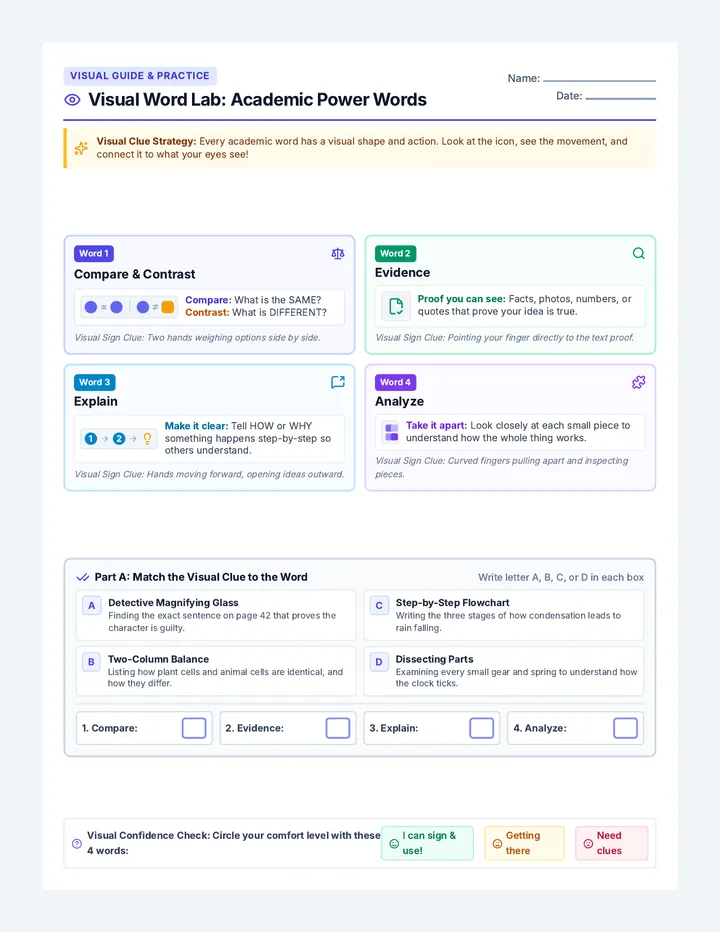
Visual Guide & Practice
Visual Word Lab: Academic Power Words
Name:
Date:
Visual Clue Strategy: Every academic word has a visual shape and action. Look at the icon, see the movement, and connect it to what your eyes see!
Word 1
Compare & Contrast
= | ≠
Compare: What is the SAME?
Contrast: What is DIFFERENT?
Visual Sign Clue: Two hands weighing options side by side.
Word 2
Evidence
Proof you can see: Facts, photos, numbers, or quotes that prove your idea is true.
Visual Sign Clue: Pointing your finger directly to the text proof.
Word 3
Explain
1 2
Make it clear: Tell HOW or WHY something happens step-by-step so others understand.
Visual Sign Clue: Hands moving forward, opening ideas outward.
Word 4
Analyze
Take it apart: Look closely at each small piece to understand how the whole thing works.
Visual Sign Clue: Curved fingers pulling apart and inspecting pieces.
Part A: Match the Visual Clue to the Word
Write letter A, B, C, or D in each box
A
Detective Magnifying Glass
Finding the exact sentence on page 42 that proves the character is guilty.
B
Two-Column Balance
Listing how plant cells and animal cells are identical, and how they differ.
C
Step-by-Step Flowchart
Writing the three stages of how condensation leads to rain falling.
D
Dissecting Parts
Examining every small gear and spring to understand how the clock ticks.
1. Compare:
2. Evidence:
3. Explain:
4. Analyze:
Visual Confidence Check: Circle your comfort level with these 4 words:
I can sign & use! Getting there Need clues
Interactive Mat
Visual Word Builder: Create & Connect
Page 2 • Student Application Mat
Part B: Visual Word Blueprint
Target Word:
Choose one target word from Page 1 (or your teacher's current unit term) and complete the visual blueprint below:
1. My Custom Icon / Symbol Sketch visual
Draw a symbol that reminds your eyes of what this word does
2. Real-World Picture Scene Sketch scene
Draw a quick scenario or science/math example showing the word
3. Visual Sentence Frame (Complete using your target word):
When I am asked to , my eyes need to look for
Part C: Visual Compare & Contrast Station
Use with any two classroom topics or pictures
Compare two items (e.g. Solid vs. Liquid, Fiction vs. Nonfiction, or Two Characters):
Concept / Topic 1
Only Item 1 has this:
Both Alike (Compare)
Shared traits:
Concept / Topic 2
Only Item 2 has this:
Visual Evidence Check: Write the page number, diagram label, or text quote that proves this:
Visual Partner Share: Show your blueprint sketch to a peer. Can they guess your word without reading it?
Peer Initial:
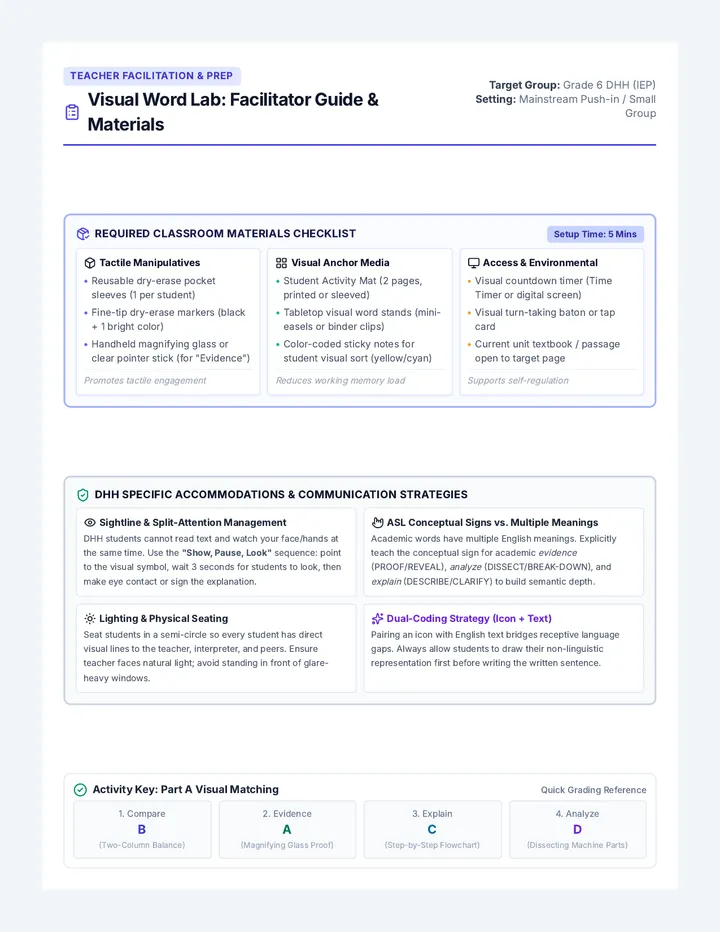
Visual Vocab Facilitator Guide
Teacher Facilitation & Prep
Visual Word Lab: Facilitator Guide & Materials
Target Group: Grade 6 DHH (IEP)
Setting: Mainstream Push-in / Small Group
Required Classroom Materials Checklist
Setup Time: 5 Mins
Tactile Manipulatives
- • Reusable dry-erase pocket sleeves (1 per student)
- • Fine-tip dry-erase markers (black + 1 bright color)
- • Handheld magnifying glass or clear pointer stick (for "Evidence")
Promotes tactile engagement
Visual Anchor Media
- • Student Activity Mat (2 pages, printed or sleeved)
- • Tabletop visual word stands (mini-easels or binder clips)
- • Color-coded sticky notes for student visual sort (yellow/cyan)
Reduces working memory load
Access & Environmental
- • Visual countdown timer (Time Timer or digital screen)
- • Visual turn-taking baton or tap card
- • Current unit textbook / passage open to target page
Supports self-regulation
DHH Specific Accommodations & Communication Strategies
Sightline & Split-Attention Management
DHH students cannot read text and watch your face/hands at the same time. Use the "Show, Pause, Look" sequence: point to the visual symbol, wait 3 seconds for students to look, then make eye contact or sign the explanation.
ASL Conceptual Signs vs. Multiple Meanings
Academic words have multiple English meanings. Explicitly teach the conceptual sign for academic evidence (PROOF/REVEAL), analyze (DISSECT/BREAK-DOWN), and explain (DESCRIBE/CLARIFY) to build semantic depth.
Lighting & Physical Seating
Seat students in a semi-circle so every student has direct visual lines to the teacher, interpreter, and peers. Ensure teacher faces natural light; avoid standing in front of glare-heavy windows.
Dual-Coding Strategy (Icon + Text)
Pairing an icon with English text bridges receptive language gaps. Always allow students to draw their non-linguistic representation first before writing the written sentence.
Activity Key: Part A Visual Matching
Quick Grading Reference
1. Compare B (Two-Column Balance)
2. Evidence A (Magnifying Glass Proof)
3. Explain C (Step-by-Step Flowchart)
4. Analyze D (Dissecting Machine Parts)
Lesson Delivery Protocol
Step-by-Step Small Group Lesson Plan
Duration: 30–35 Mins • 4 Steps
1
Visual Anchor Hook & Physical Sign Gesture (6–8 Mins)
Receptive Modeling
Display the 4 visual cards on Page 1. Model the physical hand movement for each word (e.g. cupping two hands like a scale for compare; pointing a pointer stick at text for evidence). Have students mirror the gesture before speaking or signing.
2
Independent Visual Detective Matching (8 Mins)
Guided Practice
Students place Page 1 into their dry-erase sleeve. Direct students to read the 4 scenarios in Part A, highlight the visual key clue in yellow, and write the matching letter in the answer box. Review answers visually using numbered response fingers.
3
Visual Word Blueprint & Compare Mat (12 Mins)
Dual Coding
Flip to Page 2. Select one target word (or your current unit term below). Students draw their custom symbol in Box 1, illustrate a real-world scenario in Box 2, and trace/complete the sentence frame. Then use Part C to compare two current unit concepts.
4
Peer Visual Guess & Sign Check (5 Mins)
Formative Check
Partners swap mats with target word covered by a sticky note. The partner looks at the student's custom sketch and signs which vocabulary word is being depicted. Partner initials the bottom box when verified.
Current Unit Terms: Subject-Area Adaptation Guide
Plug into Page 2 Blueprint
Science Unit
Photosynthesis / Cellular Respiration
Visual cue: Sun + leaf taking in arrows vs releasing energy bubbles.
Social Studies
Primary Source vs Secondary Source
Visual cue: Eyeball / ancient relic vs modern textbook / camera recap.
Math Unit
Ratio vs Unit Rate
Visual cue: 3 red dots : 2 blue dots compared to cost for 1 single item.
ELA Unit
Theme vs Main Idea
Visual cue: Universal heart/world umbrella vs story character plot map.
IEP Goal Progress Tracking (Checklist Rubric)
1. Non-Linguistic Concept
Student illustrates a clear, relevant symbol conveying meaning without relying on copied letters.
2. Textual Evidence Location
Student pinpoints concrete proof (page number, diagram, quote) in current unit text.
3. Expressive Signing/Writing
Student uses the academic term accurately in a complete sentence or signed communication.