Work Flow Task Cards Visual Routine Independent Work Routine
Independent Work Task Cards
Cut along dashed lines • Punch holes for binder ring
Step 1 • Setup
Clear & Prep
Clear Desk & Gather Tools
Remove extra clutter so your workspace is calm and ready.
Pencil & eraser on your dominant hand side
Assignment sheet flat in the center of desk
Goal: Workspace has ONLY required tools before starting 1 Min Max
Step 2 • Understand
Read Directions
Write Name & Read Directions
Make sure you know exactly what the task asks you to do.
Write Name & Date at the very top
Underline action words (e.g., solve, circle, explain )
Goal: Can whisper in 1 sentence what the page wants Clear Target
Step 3 • Launch
Start Fast
Start Item #1 Immediately
Do not wait or look around. Dive into the very first question.
Put pencil tip on Question 1 right away
Even if unsure, write your best first attempt
Goal: Overcome hesitation by putting mark on page within 30 sec Momentum
Independent Work Flow • Card Set 1 of 2 Steps 1 – 3 of 6
Visual Routine Independent Work Routine
Independent Work Task Cards
Cut along dashed lines • Punch holes for binder ring
Step 4 • Sustain
Focus Zone
Stay in the Zone & Problem-Solve
Work quietly until the timer ends. Use self-help strategies if stuck.
Eyes on your own page ; bodies calm in seat
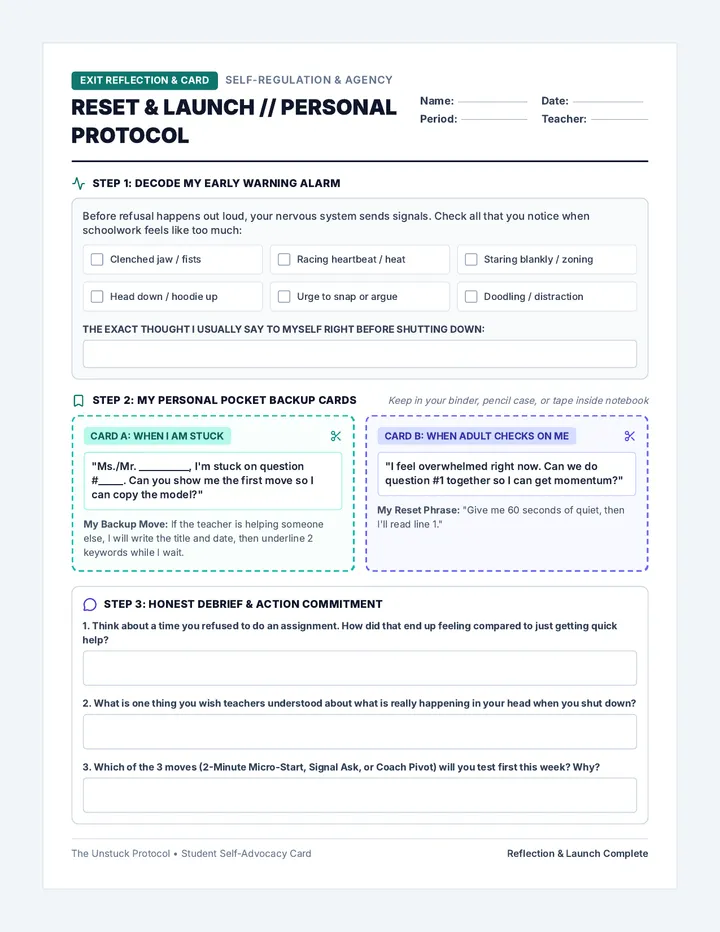
If stuck: Reread → Check Anchor Chart → Star & Skip
Strategy: Try 3 before raising hand; keep moving forward Self-Help
Step 5 • Inspect
Self-Check
Double-Check My Entire Work
Finishing first does not mean winning. Quality and accuracy matter.
Check for blanks (did I answer every single item?)
Reread 2 answers to make sure they make sense
Standard: Name is visible and handwriting is neat enough to read Quality Check
Step 6 • Closeout
Turn In & Put Away
Turn In & Put Away Supplies
Finish clean. Put work where it belongs and return tools.
Place paper face-down in the Turn-In Tray
Put supplies into pencil case or bin • Choose quiet anchor task
Done: Desk is clean, hands are empty, transition quietly Mission Complete
Independent Work Flow • Card Set 2 of 2 Steps 4 – 6 of 6
Work Routine Tracker Worksheet Self-Monitoring Independent Work Routine
Follow • Check • Reflect
Independent Work Mission Tracker
Follow each step in order from start to finish. Check the box when complete.
Name:
Date:
Task:
1 Phase 1: Starting the Task (Launch)
Get Ready • 1-2 Mins
Clear Workspace
Put extra books and items away.
Ready My Tools
Pencil & eraser ready on desk.
Name & Date on Top
Write neatly before beginning.
Read Directions
Circle key action verbs (e.g. solve, match ).
2 Phase 2: In the Work Zone (Focus & Complete)
Deep Focus • Sustain
Start Question #1 Fast
Begin first problem right away.
Eyes on Own Work
Quiet voice; stay seated calmly.
Try Before Asking
Reread clue → check model → star & move on.
Check for Blanks
Inspect all questions before turning in.
3 Phase 3: Putting Away & Wrap Up (Closeout)
Tidy Finish • 1 Min
Turn In Paper
Place flat in class turn-in bin.
Pack Tools
Pencil in case; cap on markers/glue.
Clean Desk Top
Surface completely clear; chair tucked in.
Silent Anchor Task
Read silently or start early finisher work.
My Independent Work Reflection
My Focus Today:
Super Focused Needed 1 Reset Distracted
Independence Level:
100% on My Own Asked 1 Question Needed Teacher
One step I did smoothly today:
My goal for the next work session:
Keep on your desk corner during independent work periods Work Flow Sequence Checklist
Independent Work Teacher Guide Teacher Resource Implementation & Scaffolding
Task Analysis Protocol
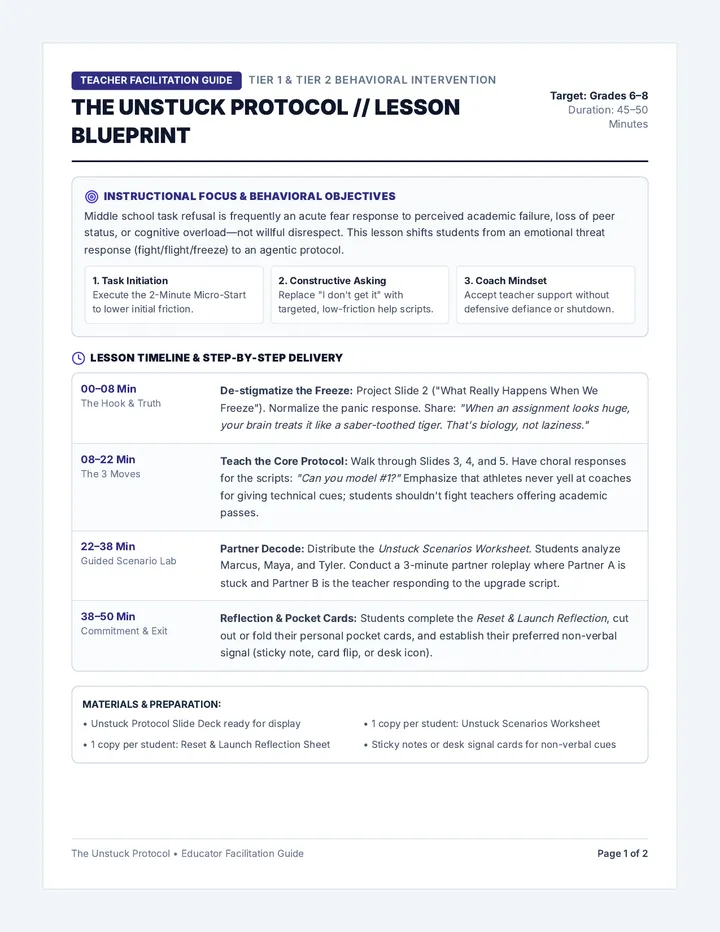
Independent Work Facilitation Guide
Instructional rollout, prompt-fading hierarchy, and executive function supports for classroom autonomy.
Instructional Purpose
Task analysis decomposes complex executive function demands into discrete, observable behaviors: Starting (overcoming task initiation freeze), Completing (sustaining attention and self-correction), and Putting Away (tidy closure and transition).
1. Three-Day Launch Routine
Day 1: Model & Non-Model (I Do)
Explicitly demonstrate Card 1 & 3. Role-play "distracted stalling" vs. "fast touch-paper start." Have students call out the differences.
Day 2: Guided Choral Check (We Do)
Use the Worksheet together. Ring a chime after 60 seconds to prompt Step 3. Students point to each step on their desk cards as they complete it.
Day 3: Independent Practice (You Do)
Students run the full routine independently with visual cue cards on desks. Teacher circulates taking observational fidelity data.
2. Prompt-Fading Ladder
1. Natural
Bell or transition phrase triggers student to open desk card and execute.
2. Visual
Teacher silently taps the specific step card on the student's desk (zero verbal).
3. Gestural
Teacher points toward the desk strip or assignment sheet from a distance.
4. Verbal
Indirect query: "What does your step card say to do next?" (Avoid direct commanding).
3. Classroom Troubleshooting Matrix
Challenge: Task Initiation Delay
Student stares at blank paper or fiddles with pencil for >2 minutes.
Intervention: Co-read Question 1, offer a 2-minute visual sand timer, or prescribe: "Just write 1 word to earn your first card check."
Challenge: Rushing & Careless Errors
Student finishes in 3 minutes with half the questions incomplete.
Intervention: Enforce Step 5 "Inspection Ticket." Require student to highlight 3 specific answers and explain them before handing in.
Challenge: Helicopter Hand-Raising
Student raises hand immediately after starting without trying.
Intervention: Issue 2 "Help Tickets" per period. Student must show proof of 2 self-help strategies (reread, model check) before redeeming.
4. Executive Function & IEP/504 Modifications
Differentiated Access
Velcro Desk Strip: Laminate cards and affix with Velcro dots. Moving cards from "To Do" to "Done" column provides tactile reinforcement for ADHD.
Chunked Work Windows: Fold assignment so only 2-3 items are visible at once to reduce visual overwhelm and working memory overload.
High-Interest Anchor Task: Define clear, desirable Step 6 anchor tasks (e.g., drawing pad, puzzle tangrams) to motivate timely task completion.
Independent Work Flow • Teacher Instructional Support Classroom Implementation Protocol