Unstuck Protocol Slides TACTICAL GUIDE
MIDDLE SCHOOL SUCCESS SERIES
ACTION OVER AVOIDANCE
Defeat the Shutdown Reflex
The Unstuck Protocol
Three powerful moves to kickstart hard assignments, get rapid backup, and protect your momentum.
1
The Micro-Start
Break inertia in 120s
2
The Signal Ask
Low-friction help scripts
3
The Coach Pivot
Accepting adult support
BEHIND THE SCENES
WHAT REALLY HAPPENS WHEN WE FREEZE
WHAT OTHERS ASSUME
"They just don't care."
• "They are being stubborn on purpose."
• "They gave up without even trying."
• "They're just trying to get out of doing work."
The Result: Tension, power struggles, and zero learning.
WHAT IS ACTUALLY HAPPENING
"My brain hit the alarm."
• Overwhelm: The task looks like a massive mountain.
• Perfection Trap: Fear of looking foolish or failing.
• Brain Threat Response: Freeze or fight kicks in first.
The Shift: Refusal is fear in disguise. We can override it.
Key Truth: You do not have to feel motivated to begin. Action creates motivation.
PROTOCOL MOVE 1: TASK INITIATION
LOWER THE INERTIA BARRIER
The 2-Minute Micro-Start Rule
Never commit to finishing the whole packet. Commit ONLY to an embarrassingly tiny first step.
A
Claim the Page
Write your name, today's date, and class period. Put the pencil down.
Time: 15 Seconds
B
Scan & Underline
Read only Question #1. Underline two keywords. Do not solve it yet.
Time: 30 Seconds
C
The First Scrawl
Write one sentence, formula, or rough guess. Once started, friction fades.
Time: 60 Seconds
Middle School Hack: Tell yourself, "I will work for exactly two minutes. If I still want to scream, I can pause." 80% of the time, you keep going.
PROTOCOL MOVE 2: ASKING FOR HELP
ZERO-EMBARRASSMENT SCRIPTS
Replace "I Don't Get It" With a Specific Ask
Saying "I can't do this" invites frustration. Specific asks get fast, pain-free answers.
The Model Request
"Can you model #1 so I can see the pattern?"
Use when you are completely blank and need an anchor to copy and follow.
The Checkpoint
"I did step 1 and 2. Can you verify if I'm on track?"
Use when you are nervous you did it all wrong and want quick reassurance.
The Reset Pass
"Brain is red-zone. May I have 60s quiet, then try #2?"
Use when rage or shutdown builds. Offers a pause with a clear return time.
Silent Help Signals: Sticky note color, signal card, or desk icon. Pro Tip: Ask BEFORE frustration spikes.
PROTOCOL MOVE 3: ACCEPTING SUPPORT
WHEN ADULTS STEP IN
Shift from Defense Mode to Coach Mode
When an adult approaches, your brain might react defensively. Flip the script to stay in power.
DEFENSE REFLEX (Traps you)
❌ Head down / Hoodie up / Refusing to look
❌ "I already know how to do it" (empty page)
❌ "This is stupid, why do we need this?"
→ Makes it longer, louder, and more stressful.
COACH PIVOT (Frees you)
✅ "I'm stuck here. Can you read question 2 with me?"
✅ "I need you to show me the first move."
✅ "Give me 30 seconds to breathe, then I'll try #1."
→ You stay in control, get answers fast, and finish early.
Pro-Athlete Mindset: Champions don't fight coaches when given guidance. They take the cue, execute the move, and win.
DECISION TREE
WHAT TO DO IN THE MOMENT
When You Feel Like Quitting: The 3-Way Fork
IF CONFUSED:
Clarify Step 1
Ask: "What is the very first verb here?" or "Can you read this prompt out loud to me?"
⚡ Action: 1 answer unlocks 3 more.
IF EXHAUSTED:
Chunk the Work
Ask: "Can I do the odd numbers first, check in, then do the rest?" Or "Can I bullet point?"
⚡ Action: Chunking shrinks giant tasks.
IF OVERWHELMED:
Contract a Reset
Ask: "I need 2 minutes of quiet, then I will complete the answer to problem #1."
⚡ Action: Breaks with commitments build trust.
Remember: Refusal burns more energy than actually doing the work.
MISSION PRACTICE
PUTTING THE PROTOCOL TO WORK
YOUR CHALLENGE TODAY
You Are in Control.
Choose Your Move.
Pick up your Unstuck Scenarios Worksheet . We are going to analyze 3 real middle-school meltdown situations and decode the winning response.
01 / IDENTIFY
Spot the refusal trap before it explodes.
02 / SCRIPT
Draft your exact phrase to get help fast.
03 / EXECUTE
Test the 2-minute micro-start today.
Middle School Instructional Support Resource Ready for Action
Unstuck Scenarios Worksheet Student Practice Executive Function & Self-Advocacy
THE UNSTUCK PROTOCOL // SCENARIO LAB
Name:
Date:
Period:
Score:
1
Micro-Start: Claim page, underline 2 words, write 1 rough thought.
2
Signal Ask: Ask for a model, check-in, or a 60s timed reset.
3
Coach Pivot: Treat the teacher like a trainer; take the first step.
Part 1: The Refusal Trap vs. The Tactical Move
CASE 01: THE 30-PROBLEM CLIFF
Marcus is handed a 30-problem algebra review. He immediately puts his head down and mutters, "I'm not doing this garbage. It's too long."
What Marcus's brain feels:
Overwhelm & helplessness disguised as defiance.
The Recommended Move:
Micro-Start Rule: Negotiate 3 odd problems only.
Write what Marcus could say instead of saying "I'm not doing this":
CASE 02: THE HOVERING ADULT
Ms. Rivera walks over to Maya's desk and asks, "How are you doing on the summary, Maya?" Maya snaps: "Leave me alone, I can do it myself!" (Her page has zero words).
The Danger Zone:
Defensive reflex creates conflict and wastes class time.
The Coach Pivot:
Acknowledge being stuck and ask for the first sentence starter.
Write Maya's Coach Pivot phrase:
CASE 03: THE BOILING POINT
Tyler has been staring at a science rubric for 10 minutes. He feels his chest tighten and balls up his worksheet ready to shove it in his backpack.
Which "Signal Ask" script should Tyler use before he destroys the worksheet?
The Unstuck Protocol • Middle School Life Skills Page 1 of 2
Applied Skill Lab
PART 2: SCRIPT WORKSHOP & PERSONAL ACTION PLAN
Student Name:
Activity A: The Upgrade Machine (Translate Refusal into Power)
Translate common middle school shutdown phrases into proactive, respectable scripts that get teachers to back you up immediately.
THE SHUTDOWN / REFUSAL PHRASE
YOUR UPGRADED UNSTUCK SCRIPT
"I don't care about this grade anyway."
"You never explained how to do this!"
"I'm taking a break and you can't make me."
Activity B: My 2-Minute Micro-Start Blueprint
Think of the ONE subject or task type that makes you want to shut down most (e.g., long writing essays, multi-step math, reading dense articles):
My High-Resistance Class / Assignment:
My Physical Reaction When Overwhelmed:
Design an "embarrassingly easy" 2-minute first step for that exact assignment:
Activity C: My Non-Verbal Help Signal Agreement
Sometimes speaking up out loud is the hardest part. Check the non-verbal signal you feel most comfortable using in class:
Sticky Note Signal
Yellow note on top corner of desk.
Pencil Pointer
Pencil placed horizontally across page top.
Direct Wave / Check-in
Catch teacher's eye with quick two-finger tap.
"I commit to testing the 2-Minute Micro-Start and using a signal ask before shutting down."
Student Signature:
The Unstuck Protocol • Middle School Life Skills Page 2 of 2
Reset And Launch Reflection Exit Reflection & Card Self-Regulation & Agency
RESET & LAUNCH // PERSONAL PROTOCOL
Name:
Date:
Period:
Teacher:
Step 1: Decode My Early Warning Alarm
Before refusal happens out loud, your nervous system sends signals. Check all that you notice when schoolwork feels like too much:
Clenched jaw / fists Racing heartbeat / heat Staring blankly / zoning Head down / hoodie up Urge to snap or argue Doodling / distraction
The exact thought I usually say to myself right before shutting down:
Step 2: My Personal Pocket Backup Cards
Keep in your binder, pencil case, or tape inside notebook
CARD A: WHEN I AM STUCK
"Ms./Mr. __________, I'm stuck on question #_____. Can you show me the first move so I can copy the model?"
My Backup Move: If the teacher is helping someone else, I will write the title and date, then underline 2 keywords while I wait.
CARD B: WHEN ADULT CHECKS ON ME
"I feel overwhelmed right now. Can we do question #1 together so I can get momentum?"
My Reset Phrase: "Give me 60 seconds of quiet, then I'll read line 1."
Step 3: Honest Debrief & Action Commitment
1. Think about a time you refused to do an assignment. How did that end up feeling compared to just getting quick help?
2. What is one thing you wish teachers understood about what is really happening in your head when you shut down?
3. Which of the 3 moves (2-Minute Micro-Start, Signal Ask, or Coach Pivot) will you test first this week? Why?
The Unstuck Protocol • Student Self-Advocacy Card Reflection & Launch Complete
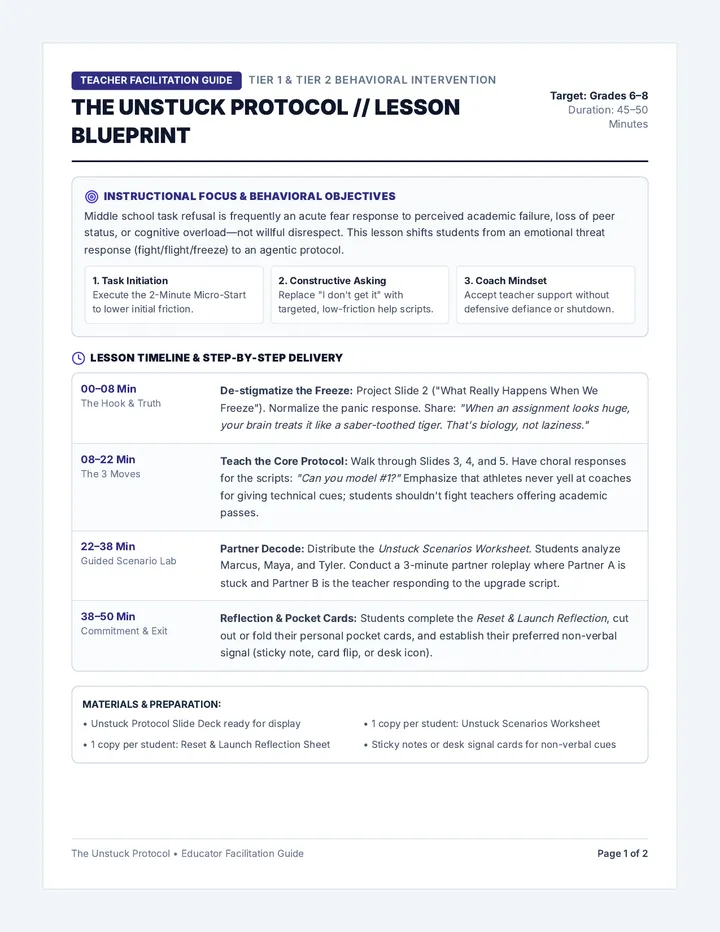
Unstuck Protocol Teacher Guide Teacher Facilitation Guide Tier 1 & Tier 2 Behavioral Intervention
THE UNSTUCK PROTOCOL // LESSON BLUEPRINT
Target: Grades 6–8
Duration: 45–50 Minutes
Instructional Focus & Behavioral Objectives
Middle school task refusal is frequently an acute fear response to perceived academic failure, loss of peer status, or cognitive overload—not willful disrespect. This lesson shifts students from an emotional threat response (fight/flight/freeze) to an agentic protocol.
1. Task Initiation Execute the 2-Minute Micro-Start to lower initial friction.
2. Constructive Asking Replace "I don't get it" with targeted, low-friction help scripts.
3. Coach Mindset Accept teacher support without defensive defiance or shutdown.
Lesson Timeline & Step-by-Step Delivery
00–08 Min
De-stigmatize the Freeze: Project Slide 2 ("What Really Happens When We Freeze"). Normalize the panic response. Share: "When an assignment looks huge, your brain treats it like a saber-toothed tiger. That's biology, not laziness."
08–22 Min
Teach the Core Protocol: Walk through Slides 3, 4, and 5. Have choral responses for the scripts: "Can you model #1?" Emphasize that athletes never yell at coaches for giving technical cues; students shouldn't fight teachers offering academic passes.
22–38 Min
Partner Decode: Distribute the Unstuck Scenarios Worksheet . Students analyze Marcus, Maya, and Tyler. Conduct a 3-minute partner roleplay where Partner A is stuck and Partner B is the teacher responding to the upgrade script.
38–50 Min
Reflection & Pocket Cards: Students complete the Reset & Launch Reflection , cut out or fold their personal pocket cards, and establish their preferred non-verbal signal (sticky note, card flip, or desk icon).
Materials & Preparation:
• Unstuck Protocol Slide Deck ready for display
• 1 copy per student: Unstuck Scenarios Worksheet
• 1 copy per student: Reset & Launch Reflection Sheet
• Sticky notes or desk signal cards for non-verbal cues
The Unstuck Protocol • Educator Facilitation Guide Page 1 of 2
Teacher Playbook
VERBAL PROTOCOLS & DE-ESCALATION RESPONSES
Adult Interaction Strategies
The Adult Approach Rule: Side-by-Side, Never Head-On
When approaching a student who has halted work, avoid towering over them, standing directly in front of their desk, or asking open-ended questions like "Why haven't you started yet?" Instead, crouch to eye level or stand slightly to the side, look at the paper together rather than locking eyes, and offer a low-stakes choice.
Classroom Confrontation Matrix (What to Say & What to Avoid)
STUDENT BEHAVIOR / PUSHBACK
AVOID (ESCALATING)
RECOMMENDED ADULT MOVE
"This is stupid / I don't care about this class."
"You need to care if you want to pass high school."
"I hear you. It feels overwhelming. Let's do #1 together, then you decide on #2."
"Leave me alone, I know how to do it!" (Blank page)
"Well you haven't written a single word yet."
"Understood. I'll give you 2 minutes of space. I'll check back when problem 1 has a draft."
Head down, hoodie tight, completely non-responsive.
Repeatedly tapping desk or demanding they sit up immediately.
Place a sticky note on the desk with: "Reset pass: 2 mins quiet. Underline 1 word when ready." Walk away.
Student Help-Seeking Growth Rubric (Track over 2–4 weeks)
Emerging (Level 1)
Shuts down, hides paper, or engages in verbal refusal when work begins. Requires repeated teacher redirection.
Developing (Level 2)
Uses non-verbal cue or accepts teacher assistance when approached without snapping or escalating.
Proficient (Level 3)
Independently executes the 2-Minute Micro-Start and uses specific verbal scripts before frustration builds.
The Unstuck Protocol • Educator Facilitation Guide Page 2 of 2