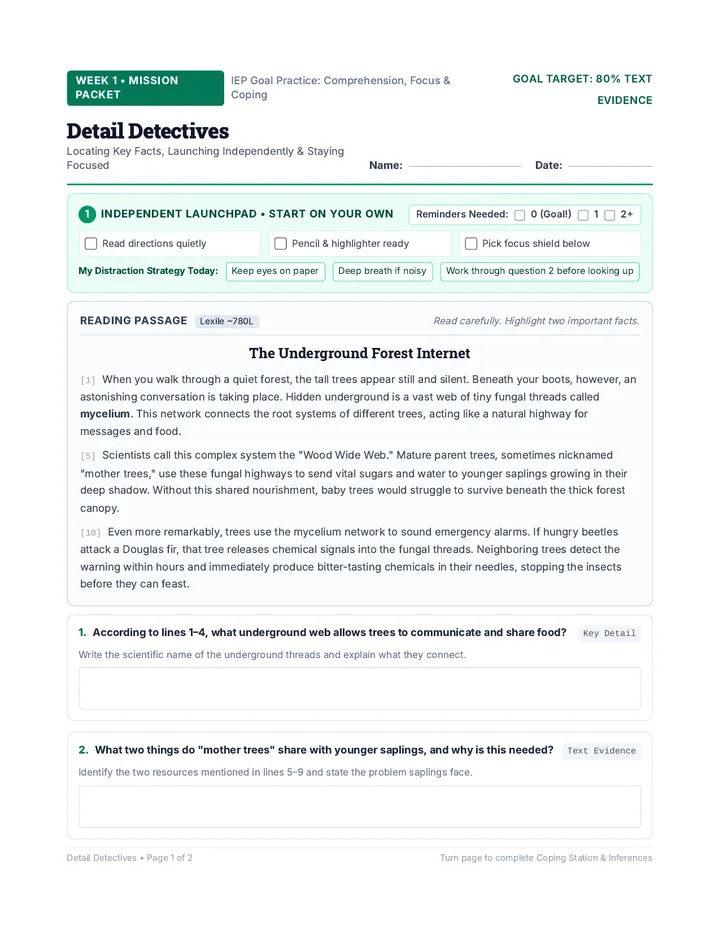
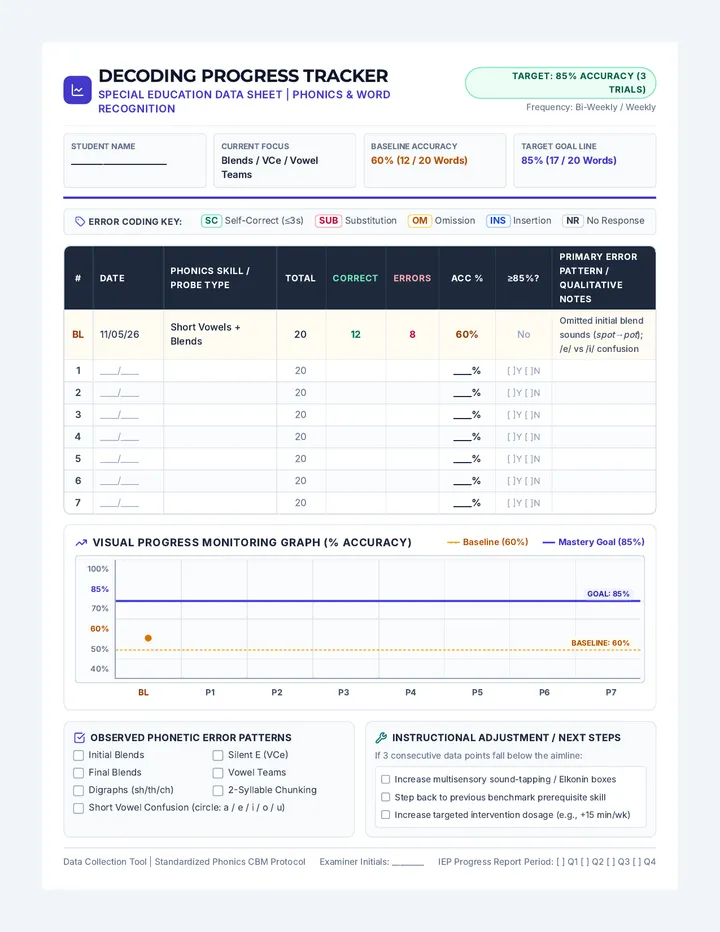
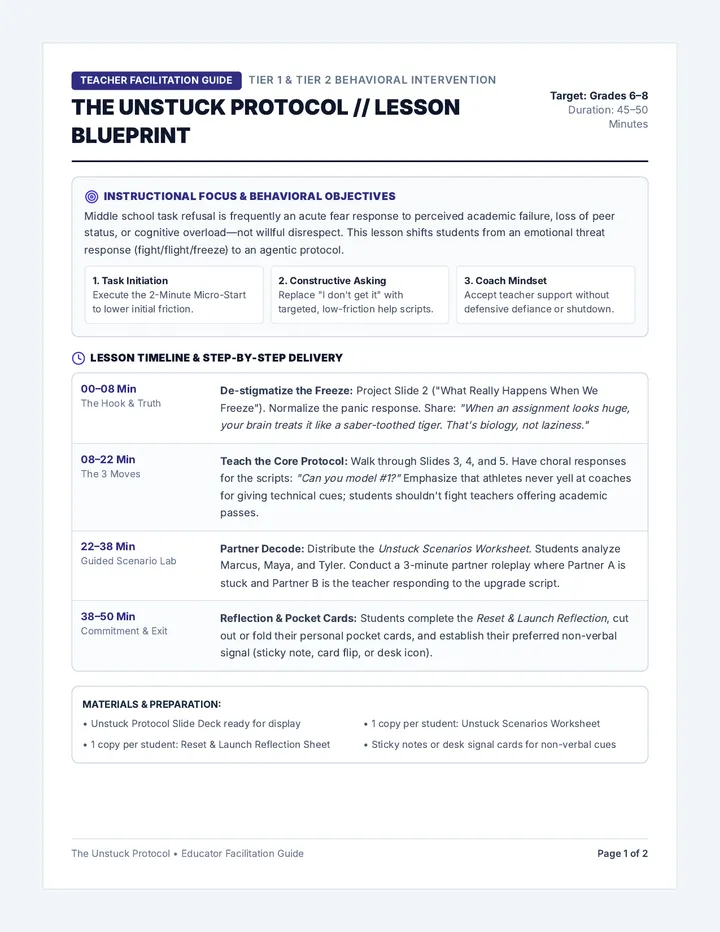
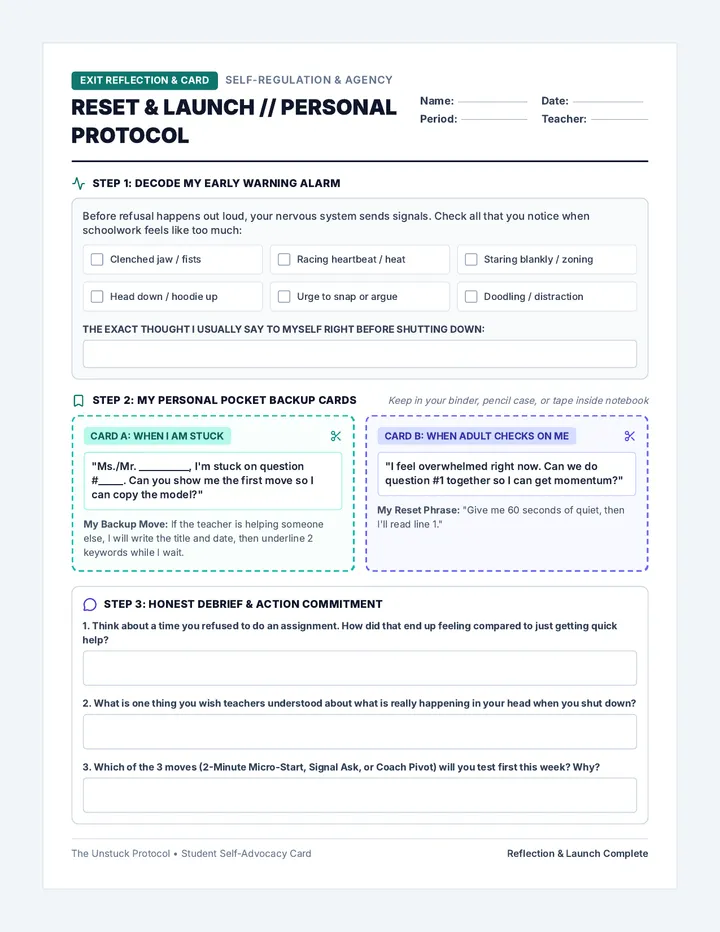
Deep Sea Investigation WorksheetWeek 1 • Mission Dossier Deep Sea Investigation Name: _______________________ Date: _____________ Start Time: ___:___ (Goal: Start within 2 minutes) Mission Directions (Check as you complete): 1. Read the passage actively (underline key facts). 2. Note any unknown words in the margin. 3. Flip to Page 2 to answer with text evidence. My Calming & Coping Tools If feeling stuck or frustrated: Box Breath 4-in, 4-hold, 4-out Positive Talk "I can take my time" 5-Min Break Request ticket Break Used? [ ] Yes [ ] No Time Out: ____ Time In: ____ Creatures of the Midnight Abyss Reading Level: 4th-6th Grade [1] Far below the ocean's sunlit surface lies a mysterious realm called the bathypelagic zone, often known as the "midnight zone." Beginning around 3,300 feet (1,000 meters) deep, sunlight is completely extinguished. The water temperature hovers just above freezing, and the water pressure is fierce enough to crush an ordinary steel tank. Despite these brutal conditions, thousands of bizarre creatures thrive in the pitch-black water. [2] Because no sunlight penetrates this deep, plants cannot grow. Food is exceptionally scarce, so animals have developed remarkable adaptations to hunt and survive. Many animals produce their own living light through a chemical process called bioluminescence. The female anglerfish, for instance, grows a fleshy spine from her snout that tips with a glowing bulb. Curious small fish swim toward the glowing beacon, straight into the anglerfish’s needle-sharp teeth. [3] Other ocean wanderers use light for self-defense rather than hunting. The firefly squid can illuminate its entire belly with brilliant sapphire light. When looking up from deeper waters, predators cannot distinguish the glowing squid from the faint dim light filtering down from above. This camouflage trick, called counter-illumination, saves the squid from being spotted by hungry sharks. [4] Marine scientists must rely on heavily reinforced robotic submersibles called ROVs to explore this extreme wilderness. Every single expedition into deep ocean trenches uncovers previously unseen species, proving that life finds ingenious ways to persevere even where warmth, daylight, and ease do not exist. Active Reading Check: Follow these 2 steps before turning the page! Action A: Circle the word in paragraph 2 that means living creatures making their own light. Action B: Underline the sentence in paragraph 3 explaining how counter-illumination protects the squid. Comprehension & Text Evidence Station Independent Focus Check: Reminders used: [ ] 0 (Solo Star) [ ] 1 [ ] 2+ A Part 1: Key Details (Identify direct facts from the text) 1. According to paragraph 1, what two environmental challenges make the midnight zone extreme? A) Boiling heat and high waves B) Freezing cold and crushing pressure C) Too much sunlight and shallow reefs D) Fast currents and thick sea plants 2. Which paragraph explains why plants cannot grow in the bathypelagic zone? Cite one key reason. Paragraph number: ________ | Key reason from text: B Part 2: Making Inferences (Combine text clues + your thinking) 3. Why do you think human divers cannot simply swim down to explore the midnight zone in scuba gear? Text Clue: Look at paragraph 1's description of water pressure and temperature. My Inference: Humans need special ROV machines because... C Part 3: Text Evidence Challenge (Citing 2 distinct pieces of evidence) 4. How do different deep-sea creatures use bioluminescence in completely opposite ways? State the two creatures and cite one sentence of evidence for each. Tip: Sentence starter — "According to the text, the anglerfish uses light to... Meanwhile, the firefly squid uses light to..." Self-Check & Mission Debrief Did I manage any frustration calmly? [ ] Yes, used coping tool [ ] Didn't feel frustrated Task Complete [ ] Yes, Finished! Teacher Sign-off Initial: ________
Ancient Codes Investigation WorksheetWeek 2 • Detective Dossier Ancient Code Breakers Name: _______________________ Date: _____________ Start Time: ___:___ (Independent launch in ≤ 2 min) Multi-Step Focus Tracker: 1. Scan paragraph numbers and title first. 2. Read closely; underline clues about the three scripts. 3. Complete Active Clue tasks before answering Page 2. Coping & Break Strategy Hub Tackle frustration: 5-4-3-2-1 Notice 5 things Reset Mindset "One step at a time" 5-Min Break Take calm reset Break Request: [ ] Used [ ] Not Needed Out: ____ In: ____ The Stone That Unlocked the Past Reading Level: 4th-6th Grade [1] For more than a thousand years, the ancient Egyptian hieroglyphic language was a complete mystery. Magnificent stone temples, tombs, and pyramids were adorned with carved symbols of birds, serpents, human figures, and boats. Yet by the Middle Ages, no person alive could read a single word. Centuries of royal histories, myths, and scientific records remained locked in silence. [2] That changed in July 1799, when soldiers in Napoleon’s army were building a military fortification near the Egyptian port town of Rashid (which Europeans called Rosetta). While digging into an ancient wall, a soldier struck a massive black granodiorite stone weighing over 1,500 pounds. The slab carved in 196 BCE contained identical decree text carved in three different scripts: ancient Egyptian hieroglyphs, Demotic (everyday Egyptian handwriting), and ancient Greek. [3] Because scholars already knew how to read ancient Greek, the Rosetta Stone offered an unprecedented decoding key. A determined French linguist named Jean-François Champollion devoted years of intense study to the stone. He carefully searched for recurring oval loops called cartouches, knowing they held the revered names of kings and queens, such as Ptolemy and Cleopatra. [4] By matching the Greek letters of royal names with the Egyptian symbols in the cartouches, Champollion made an astonishing discovery: hieroglyphs were not merely decorative pictures. They represented phonetic sounds and syllables, just like an alphabet! In 1822, Champollion published his breakthrough, allowing historians to translate thousands of ancient scrolls and hear the genuine voices of people who lived four millennia ago. Active Detective Check: Perform both actions before turning the page! Action 1: Circle the word in paragraph 3 that describes the oval loops used for royal pharaoh names. Action 2: Underline the date in paragraph 4 when Champollion officially shared his decipherment breakthrough. Comprehension & Text Evidence Station Focus Tracker: Reminders given: [ ] 0 (Independent!) [ ] 1 [ ] 2+ A Part 1: Key Details (Exact text facts) 1. What three writing scripts were carved on the Rosetta Stone according to paragraph 2? A) Latin, English, and Hieroglyphs B) Hieroglyphs, Demotic, and Ancient Greek C) Arabic, Hebrew, and Persian D) Cuneiform, Greek, and Italian 2. According to paragraph 4, what major misconception about hieroglyphs was proven wrong? Cite the detail explaining what hieroglyphs actually represented: B Part 2: Making Inferences (Reading between the lines) 3. Why was starting with royal names inside cartouches a smart strategy for Champollion? Text Clue: Scholars already knew the Greek spelling of ruler names like Ptolemy. Inference: By matching known Greek names to cartouches, he could... C Part 3: Text Evidence Challenge (Citing 2 text details) 4. Why was the discovery of the Rosetta Stone considered one of the greatest archaeological findings in history? Cite two sentences or details from the passage. Tip: Sentence starter — "First, the text notes that... Additionally, in paragraph 4, the author states that..." Self-Regulation Reflection When encountering a challenging question, I: [ ] Took a deep breath [ ] Reread the clue [ ] Used a 5-min break Task Completed [ ] Yes, Finished! Teacher Sign-off Initial: ________
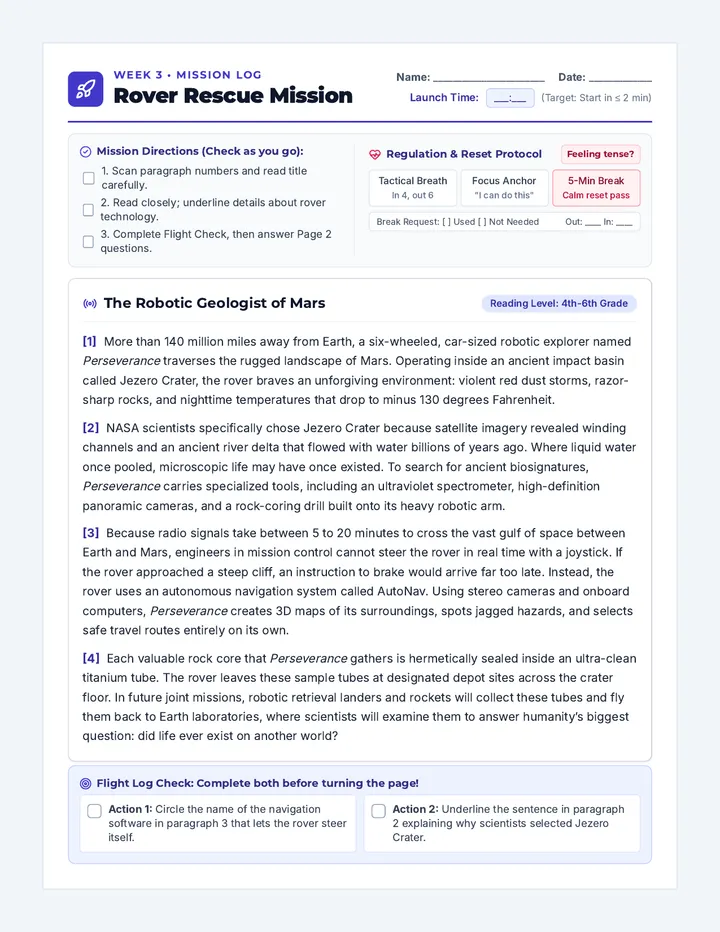
Rover Rescue Investigation WorksheetWeek 3 • Mission Log Rover Rescue Mission Name: _______________________ Date: _____________ Launch Time: ___:___ (Target: Start in ≤ 2 min) Mission Directions (Check as you go): 1. Scan paragraph numbers and read title carefully. 2. Read closely; underline details about rover technology. 3. Complete Flight Check, then answer Page 2 questions. Regulation & Reset Protocol Feeling tense? Tactical Breath In 4, out 6 Focus Anchor "I can do this" 5-Min Break Calm reset pass Break Request: [ ] Used [ ] Not Needed Out: ____ In: ____ The Robotic Geologist of Mars Reading Level: 4th-6th Grade [1] More than 140 million miles away from Earth, a six-wheeled, car-sized robotic explorer named Perseverance traverses the rugged landscape of Mars. Operating inside an ancient impact basin called Jezero Crater, the rover braves an unforgiving environment: violent red dust storms, razor-sharp rocks, and nighttime temperatures that drop to minus 130 degrees Fahrenheit. [2] NASA scientists specifically chose Jezero Crater because satellite imagery revealed winding channels and an ancient river delta that flowed with water billions of years ago. Where liquid water once pooled, microscopic life may have once existed. To search for ancient biosignatures, Perseverance carries specialized tools, including an ultraviolet spectrometer, high-definition panoramic cameras, and a rock-coring drill built onto its heavy robotic arm. [3] Because radio signals take between 5 to 20 minutes to cross the vast gulf of space between Earth and Mars, engineers in mission control cannot steer the rover in real time with a joystick. If the rover approached a steep cliff, an instruction to brake would arrive far too late. Instead, the rover uses an autonomous navigation system called AutoNav. Using stereo cameras and onboard computers, Perseverance creates 3D maps of its surroundings, spots jagged hazards, and selects safe travel routes entirely on its own. [4] Each valuable rock core that Perseverance gathers is hermetically sealed inside an ultra-clean titanium tube. The rover leaves these sample tubes at designated depot sites across the crater floor. In future joint missions, robotic retrieval landers and rockets will collect these tubes and fly them back to Earth laboratories, where scientists will examine them to answer humanity’s biggest question: did life ever exist on another world? Flight Log Check: Complete both before turning the page! Action 1: Circle the name of the navigation software in paragraph 3 that lets the rover steer itself. Action 2: Underline the sentence in paragraph 2 explaining why scientists selected Jezero Crater. Comprehension & Text Evidence Station Focus Tracker: Reminders given: [ ] 0 (Independent Master!) [ ] 1 [ ] 2+ A Part 1: Key Details (Exact facts from the reading) 1. According to paragraph 1, what harsh temperature does the rover experience at night? A) 32 degrees Fahrenheit B) Minus 130 degrees Fahrenheit C) Zero degrees Fahrenheit D) Minus 500 degrees Fahrenheit 2. What does the rover do with each collected rock core sample according to paragraph 4? Cite the detail describing where and how the rock samples are stored: B Part 2: Making Inferences (Text clues + logic) 3. Why would it be disastrous if Perseverance did not have autonomous navigation (AutoNav)? Text Clue: Radio signals take between 5 to 20 minutes to travel from Earth to Mars. Inference: If the rover faced unexpected danger, engineers on Earth... C Part 3: Text Evidence Challenge (Citing 2 distinct pieces of evidence) 4. Why do scientists believe that examining rocks from Jezero Crater might prove whether life once existed on Mars? Cite two pieces of evidence from paragraphs 2 and 4. Tip: Sentence starter — "According to paragraph 2, scientists chose Jezero Crater because... In addition, paragraph 4 states that..." 3-Week Mastery Self-Evaluation Did I manage my emotions & stay focused today? [ ] Stayed calm throughout [ ] Used coping/break tool calmly Goal Status [ ] 80%+ Accuracy Target Met Teacher Sign-off Initial: ________