A scaffolded reading comprehension lesson designed for students with extensive support needs to identify topic sentences and supporting evidence. Students explore simple passages using clear visual cues, yes/no decision points, and structured sentence frames.
Topic Detectives • Special Education / ESN Scaffolded Practice Page 2 of 2
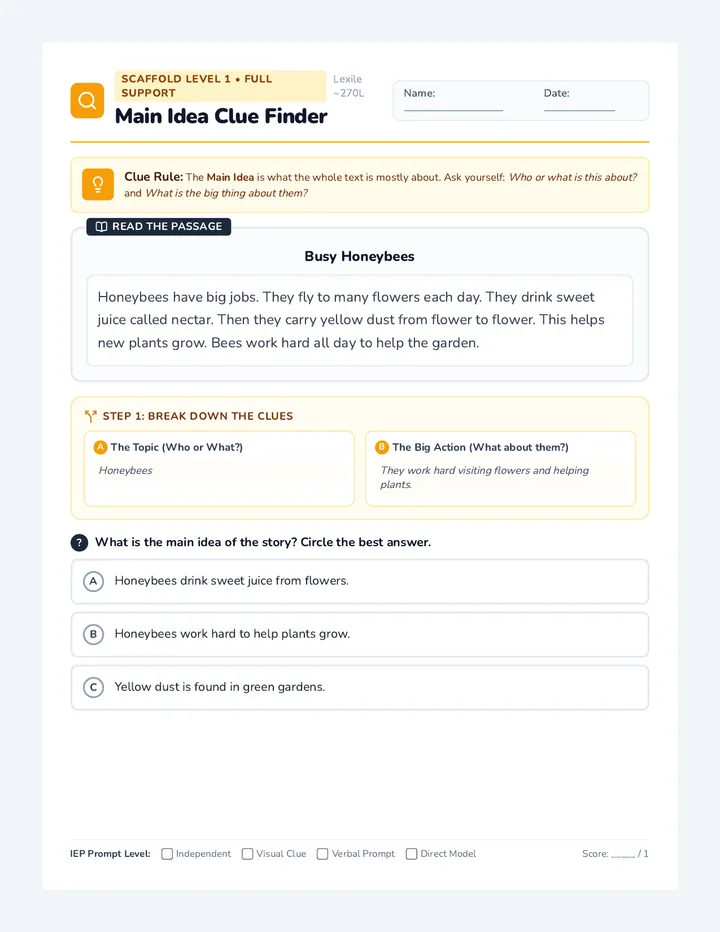
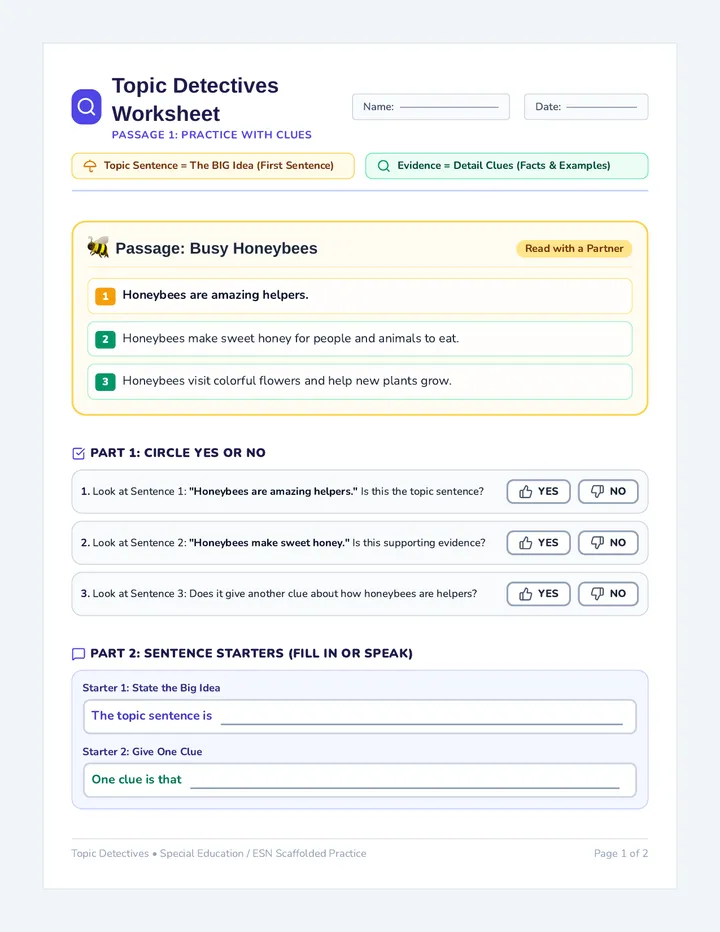
Q3 (Sentence 3 = Another clue?): YES Helping plants grow is a second supporting fact.
Starter 1 Sample:
"The topic sentence is honeybees are amazing helpers."
Starter 2 Sample:
"One clue is that they make sweet honey."
Worksheet Page 2: Apple Trees Part 1 & 2
Q1 (Sentence 1 = Topic?): YES It gives the big idea (changing in seasons).
Q2 (Sentence 2 = Evidence?): YES Spring flowers prove changes in season.
Q3 (Distractor: cars driving): NO Passage is about apple trees, not cars!
Starter 1 Sample:
"The story is mostly about apple trees change."
Starter 2 Sample:
"One clue is pink flowers blossom."
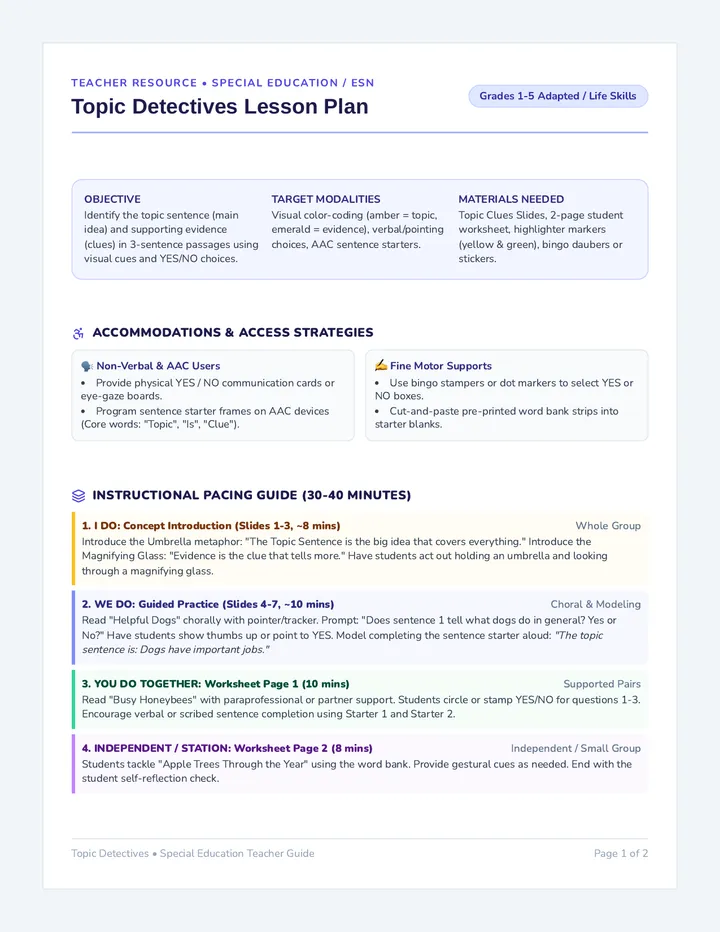
IEP Progress Monitoring Rubric
Skill / Indicator
Level 1 (Prompted)
Level 2 (Scaffolded)
Level 3 (Mastery)
Identifies Topic Sentence
Selects YES with full hand-over-hand or direct teacher point.
Identifies topic sentence with visual color cue (amber bar).
Independently points to or circles YES with 80% accuracy over 3 trials.
Identifies Clue / Evidence
Distinguishes between story clue vs non-story distractor with 1:1 aid.
Correctly selects YES for supporting detail using magnifying glass cue.
Identifies supporting evidence without prompting across 2 novel passages.
Uses Sentence Starter
Repeats or presses single AAC button to echo starter.
Fills in starter frame using pre-cut word bank strips.
Verbally, via AAC, or in writing completes frame: "The topic is..." independently.
Note for Paraprofessionals & Co-Teachers: Accept all expressive modalities (verbal speech, pointing to printed cards, signing, or AAC switch activation). Allow 5-10 seconds processing wait time between reading each sentence and asking for the YES/NO response.
Topic Detectives • Special Education Teacher Guide Page 2 of 2