Workplace Words Worksheet Vocational Skills • ESN Support
Workplace Words
Name:
Date:
Word Bank (12 Core Words)
deadline
schedule
shift
supervisor
colleague
task
meeting
break
training
equipment
request
update
1
Match the Word with its Meaning
Write letter (A-F) in the blank
1. supervisor boss / manager
2. colleague coworker
3. deadline finish time
4. shift work hours
5. task work duty
6. break rest time
A A person who manages your work.
B A person you work with at your job.
C The latest time something must be finished.
D A period of hours when you are working.
E A single piece of work you need to finish.
F A short time to stop working and rest.
2
Complete the Sentences
Choose from the word bank
schedule training equipment meeting request update
Please check the work to see what days you work.
New workers have one week of to learn the job.
Always wear safety goggles when using machines.
The entire team has a daily at 9:00 a.m. to discuss tasks.
My coworker made a written for a day off.
Please give your supervisor an about your work.
Workplace Words • Vocabulary Practice Page 1 of 2
Application & Communication
Workplace Situations
Real Job Scenarios
Read each card and choose the best word
3
What Word Fits the Situation?
Circle the best vocabulary word
Situation A
Your boss says: "This project must be finished by 4:00 PM today."
4:00 PM is your...
deadline break equipment
Situation B
You are not sure how to safely use the box cutter. You need help.
Who should you ask?
meeting supervisor task
Situation C
You work on Tuesday from 8:00 AM to 4:00 PM. That period of working time is your...
What is this period called?
shift training request
Situation D
Your coworker asks: "How is the stock room cleanup going?"
You give your coworker an...
equipment update schedule
4
Speaking & Writing Frames
Fill in the blanks with your own routine
My work or class shift usually starts at and ends at .
Helpful choices: 8:00 AM • 9:00 AM • 12:30 PM • 3:00 PM
One important task I do during the day is .
Helpful choices: organize supplies • wipe counters • sort mail • assemble boxes
I take a 15-minute break to rest at around .
Helpful choices: 10:15 AM • 12:00 PM • 1:30 PM • when finished
If I have a question, I talk to my supervisor, .
Write your supervisor, job coach, or teacher's name
Workplace Words • Vocational Application Page 2 of 2
Workplace Communication Cards Speaking & Social Skills
Workplace Communication Cards
Pair & Group Practice
Read your role out loud with a partner
Instructions: Cut or hold these cards. Practice asking and answering workplace questions.
6 Cards
Card 1 • Work Hours schedule · shift
Coworker asks:
"What time does your shift start today?"
You answer:
"My shift starts at [ 8:00 AM / 9:00 AM ] according to the schedule."
Card 2 • Asking for Help supervisor · task
You ask supervisor:
"Excuse me, can you explain this task to me?"
Supervisor answers:
"Sure! Let me show you how to complete this task safely."
Card 3 • Finish Time deadline · update
Supervisor asks:
"Can you give me an update on the deadline?"
You answer:
"Yes, I will finish everything before the [ 3:00 PM / Friday ] deadline."
Card 4 • Taking a Rest break · colleague
Colleague asks:
"Are you taking your lunch break now?"
You answer:
"Yes, I am on my [ 15-minute / lunch ] break in the breakroom."
Card 5 • Tools & Machines equipment · training
Trainer asks:
"Did you complete the safety training for this equipment?"
You answer:
"Yes, I finished training and know how to use this equipment."
Card 6 • Team Talks meeting · request
You make a request:
"I have a request to discuss our schedule during the meeting."
Supervisor answers:
"Thank you for your request. We will talk about it at 10:00."
Workplace Words • Scaffolds for Verbal & AAC Communication Cut along dashed lines or practice in pairs
Workplace Words Slides Vocational English
12 Key Job Words
Workplace Words
Essential vocabulary to understand schedules, complete tasks, and communicate with your team.
People
Time
Tasks
Talking
People at Work
Who You Work With
supervisor
The boss or manager
A person who manages and checks your work.
Example: "Ask your supervisor for help."
colleague
Your coworker
A person you work with at your job.
Example: "My colleague helped me lift the box."
Key Question: Who do you go to when you have a question? Your Supervisor!
Time & Work Hours
When You Work
schedule
A plan showing the days and times you work.
"Check the work schedule ."
shift
A set period of hours when you are working.
"My shift starts at 8:00 a.m."
break
A short time to stop working and rest.
"I take my lunch break at noon."
deadline
The latest time something must be finished.
"The report deadline is Friday."
Remember: Always arrive 10 minutes before your shift starts! Be on Time
Getting the Job Done
Tools & Tasks
task
A piece of work you need to finish.
"I have three tasks today."
equipment
Tools or machines used for work.
"Check the equipment first."
training
Learning how to do a job or task.
"New employees receive training."
Always ask for training before using new equipment!
Workplace Communication
Talking & Listening
meeting
A planned time when people talk about work.
"We have a team meeting at 10."
request
Something that someone formally asks for.
"My supervisor made a request."
update
New information about your work progress.
"Please give me a quick update."
Communication Tip: Always listen carefully and ask if you need repetition. Clear Speech
Workplace Words Teacher Guide Teacher Resource & Answer Key
Workplace Words Lesson Guide
Vocational English / ESN
Estimated Pacing: 45–60 Minutes
Lesson Objectives
Identify and define 12 essential workplace vocabulary words.
Connect vocabulary to practical job routines and tools.
Communicate basic needs using scaffolded sentence frames.
ESN Accommodations
Visual Pairings: Consistent Lucide icons for every term.Chunked Reading: Max 6 items per task with mini-banks.AAC & Verbal: Pre-built frames for low-speech learners.
Suggested Lesson Pacing
Step 1 • 10 Mins Slides & Intro
Present slides. Choral read words and review picture cues.
Step 2 • 15 Mins Matching & Fill-In
Students complete Page 1 using visual word banks.
Step 3 • 15 Mins Situations Practice
Complete Page 2 situations; personalize routine frames.
Step 4 • 10 Mins Speaking Cards
Partner role-play with structured communication cards.
Master Answer Key
Worksheet Part 1 Matching
1. supervisorA
2. colleagueB
3. deadlineC
4. shiftD
5. taskE
6. breakF
Worksheet Part 2 Sentences
1. work days:schedule
2. learn job:training
3. tools/machines:equipment
4. 9:00 am team:meeting
5. day off:request
6. progress info:update
Worksheet Part 3 Situations
Sit. A (4 PM):deadline
Sit. B (Ask help):supervisor
Sit. C (Work hours):shift
Sit. D (Progress):update
Part 4: Answers will vary based on student work/school routine.
Original 12 Word Bank Reference:
•
On the Clock Worksheet Vocational Skills • Time Management
On the Clock: Schedules & Times
Name:
Date:
1
Read the Weekly Schedule
Supermarket Stocking Department
Employee
Monday
Tuesday
Wednesday
Thursday
Friday
Alex
8 AM – 2 PM
8 AM – 2 PM
OFF
8 AM – 2 PM
8 AM – 2 PM
Jordan
OFF
10 AM – 4 PM
10 AM – 4 PM
10 AM – 4 PM
OFF
Q1. What time does Alex's shift start on Monday?
8:00 AM 10:00 AM OFF
Q2. Which day is Jordan OFF from work?
Tuesday Wednesday Monday
Q3. How many hours is Jordan's shift (10 AM to 4 PM)?
4 hours 6 hours 8 hours
2
Clock In vs Clock Out
Circle the correct action
Arriving at Work (7:55 AM)
You just walked in the door and are ready to work.
Clock In Clock Out
Leaving at End of Shift (2:00 PM)
Your shift is finished and you are going home.
Clock In Clock Out
On the Clock • Work Schedules & Timecards Page 1 of 2
Vocational Skills • Punctuality
Being on Time & Taking Breaks
Punctuality Rules
Early is on time. On time is late!
3
On Time, Early, or Late?
Your shift starts at exactly 9:00 AM
You arrive at 8:50 AM (10 minutes before your shift starts)
Early / Ready Late
You arrive at 9:00 AM (Just walking through the door at start time)
Just on Time Early
You arrive at 9:15 AM (15 minutes after start time)
On Time Late (Unexcused)
4
Break Time Management
Calculate when your break ends
15-Minute Rest Break
You start your 15-minute break at 10:30 AM .
What time must you return to work?
10:45 AM 11:00 AM
30-Minute Lunch Break
You clock out for lunch at 12:00 PM (noon) .
What time must you clock back in?
12:30 PM 1:00 PM
5
My Work Commitment Frame
To be ready for my shift, I will always arrive minutes before my shift starts.
On the Clock Teacher Guide Teacher Resource & Answer Key
On the Clock: Teacher Guide
Vocational Transition • Unit 2
Pacing: 40–50 Minutes
Core Transition Skills
Tracking scheduled days vs scheduled days off.
Operating time clocks (clock in when arriving; clock out when leaving).
Adhering strictly to designated rest and meal break durations.
Executive Functioning Supports
Highlighter Tool: Highlight employee names & active days.Visual Clocks: Pair digital numerals with clock faces.Phone Alarms: Practice setting 5-minute break warnings.
Step-by-Step Lesson Protocol
1. The "10-Minute Rule" Discussion (10 mins):
Discuss why walking into work at 9:00 AM means you aren't ready to work at 9:00 AM (putting away bags, washing hands). Teach: "Arrive 10 minutes early so you are working right on time."
2. Reading the Schedule Grid (15 mins):
Guide students to find rows (employees) and columns (days). Emphasize locating the word "OFF" and reading the start time before the end time.
3. Break Timer Simulation (15 mins):
Have students set timers on class tablets or phones for 15 minutes. Emphasize that returning late from break is a major employer concern.
Complete Worksheet Answer Key
Section 1 & 2 (Page 1) Schedules & Clocks
Q1. Alex Monday start time:8:00 AM
Q2. Jordan OFF day:Monday (also Friday)
Q3. Jordan shift length:6 hours
Action A. Arriving (7:55 AM):Clock In
Action B. Leaving (2:00 PM):Clock Out
Section 3 & 4 (Page 2) Punctuality & Breaks
Case 1. Arrive 8:50 AM (start 9:00):Early / Ready
Case 2. Arrive 9:00 AM:Just on Time
Case 3. Arrive 9:15 AM:Late (Unexcused)
15-min rest from 10:30 AM:10:45 AM
30-min lunch from 12:00 PM:12:30 PM
Section 5 commitment:10 to 15 mins
Workplace Ready Sequence • On the Clock Facilitation Instructional Key
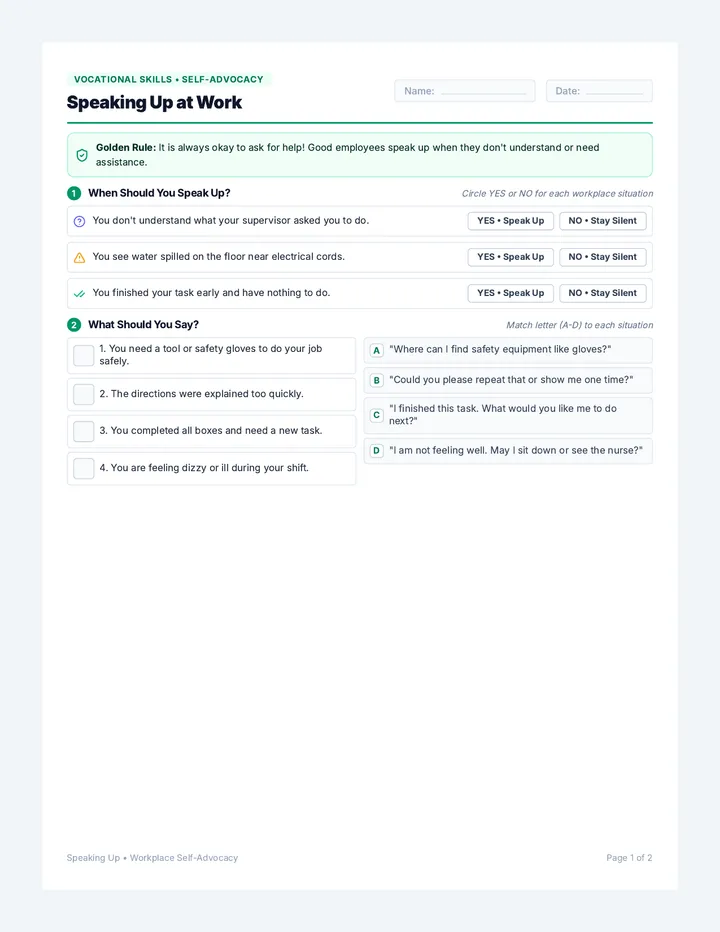
Speaking Up Worksheet Vocational Skills • Self-Advocacy
Speaking Up at Work
Name:
Date:
Golden Rule: It is always okay to ask for help! Good employees speak up when they don't understand or need assistance.
1
When Should You Speak Up?
Circle YES or NO for each workplace situation
You don't understand what your supervisor asked you to do.
YES • Speak Up NO • Stay Silent
You see water spilled on the floor near electrical cords.
YES • Speak Up NO • Stay Silent
You finished your task early and have nothing to do.
YES • Speak Up NO • Stay Silent
2
What Should You Say?
Match letter (A-D) to each situation
1. You need a tool or safety gloves to do your job safely.
2. The directions were explained too quickly.
3. You completed all boxes and need a new task.
4. You are feeling dizzy or ill during your shift.
A "Where can I find safety equipment like gloves?"
B "Could you please repeat that or show me one time?"
C "I finished this task. What would you like me to do next?"
D "I am not feeling well. May I sit down or see the nurse?"
Speaking Up • Workplace Self-Advocacy Page 1 of 2
Communication Scaffolds • Scripts
Calling Your Job: Practice Scripts
Professional Phone Calls
Always call before your shift starts!
3
Script 1: Calling in Sick
Fill in the blanks with your information
Telephone Script: Call at least 2 hours before your shift
"Hello, this is . May I please speak to my supervisor, ?"
"I am calling to let you know that I am sick today and cannot work my shift on ."
"I apologize for missing work. I expect to be back on . Thank you."
4
Script 2: Calling When Running Late
Call as soon as you know you will be delayed
Telephone Script: Bus delay, traffic, or emergency
"Hi , this is ."
"My bus is delayed. I will be about minutes late to my shift."
"I should arrive around . I will clock in right away when I get there."
Write the phone number to call when absent:
Speaking Up • Vocational Communication Protocols Page 2 of 2
Speaking Up Teacher Guide Teacher Resource & Answer Key
Speaking Up: Teacher Guide
Vocational Transition • Unit 3
Pacing: 45–55 Minutes
Instructional Priority
Many neurodivergent learners stay quiet out of fear of getting in trouble. This lesson reframes asking for clarification as a strength that employers actively value.
AAC & Non-Verbal Adaptations
Help Badges / Cards: Provide pre-printed lanyard cards.Text Templates: Save attendance scripts in mobile phones.Pair Role-Play: Practice with familiar job coaches first.
Mock Phone Call Protocol (Activity)
Materials: Use two unplugged classroom phones, walkie-talkies, or mobile props.
1. Teacher Modeling: Act as the supervisor while a confident student reads Script 1 ("Calling in Sick").
2. Partner Rehearsal: Students sit back-to-back (to simulate auditory phone calls without visual lip-reading).
3. Feedback Rubric: Did the caller state their full name? Reason? Estimated return time?
Complete Worksheet Answer Key
Worksheet Part 1 & 2 Situations & Matches
Unclear supervisor directions:YES • Speak Up
Water spilled near wires:YES • Speak Up
Finished early / no work:YES • Speak Up
1. Need gloves / equipment:A
2. Fast directions:B (Repeat/show)
3. Completed task:C (Next task)
4. Feeling ill / dizzy:D (Nurse/sit)
Worksheet Page 2 Phone Scripts
Student fill-ins will vary. Ensure each student can locate and state:
✓ Greeting & Identity: State their first & last name clearly.
✓ Specific Timeline: State how many minutes late (e.g., "15 minutes") or date of absence.
✓ Action Plan: Confirm immediate arrival or anticipated return.
Workplace Ready Sequence • Speaking Up Facilitation Instructional Key
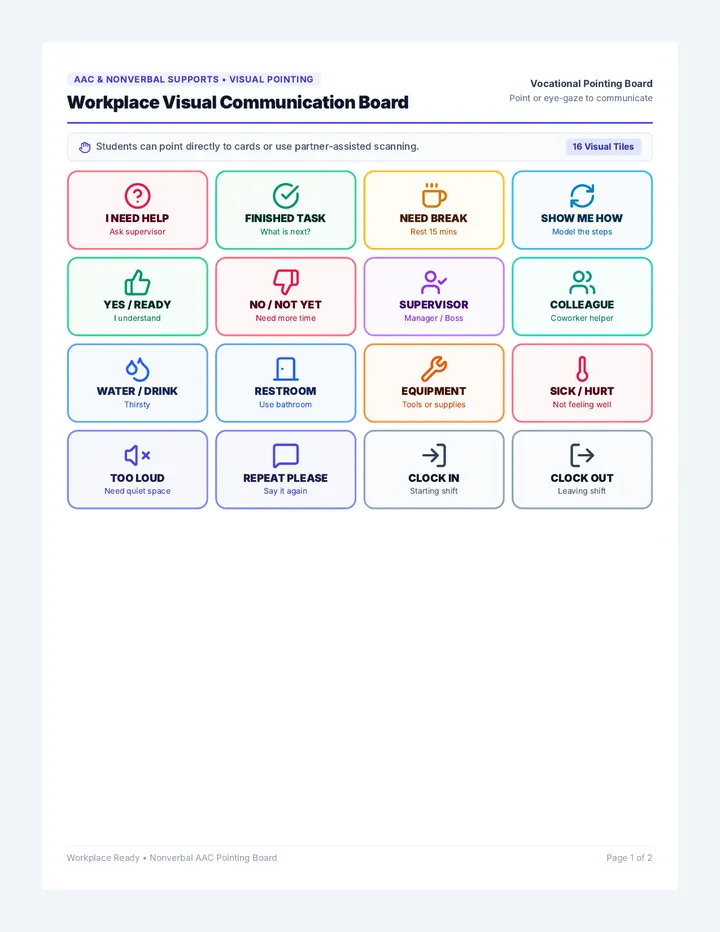
Workplace Communication Board AAC & Nonverbal Supports • Visual Pointing
Workplace Visual Communication Board
Vocational Pointing Board
Point or eye-gaze to communicate
Students can point directly to cards or use partner-assisted scanning. 16 Visual Tiles
I Need Help Ask supervisor
Finished Task What is next?
Need Break Rest 15 mins
Show Me How Model the steps
Yes / Ready I understand
No / Not Yet Need more time
Supervisor Manager / Boss
Colleague Coworker helper
Water / Drink Thirsty
Restroom Use bathroom
Equipment Tools or supplies
Sick / Hurt Not feeling well
Too Loud Need quiet space
Repeat Please Say it again
Clock In Starting shift
Clock Out Leaving shift
Workplace Ready • Nonverbal AAC Pointing Board Page 1 of 2
Wearable Job-Site Supports
Wearable Lanyard & Pocket Cards
Cut-Out Badges
Punch hole and clip to lanyard
Directions: Cut out these 6 visual badges. Laminate, hole punch at the top circle, and attach to a student lanyard or job-site belt clip.
Lanyard Card 1
I Need Help
"Please assist me with this task."
Show to Supervisor
Lanyard Card 2
I Am Finished
"Ready for my next task."
Check Work Complete
Lanyard Card 3
Break Time
"I am taking my scheduled break."
15 Minutes Rest
Lanyard Card 4
Show Me How
"Please demonstrate one time."
Visual Demonstration
Lanyard Card 5
Need Tools / PPE
"I need gloves, cleaner, or supplies."
Workplace Equipment
Lanyard Card 6
Overwhelmed
"I need 2 minutes in a quiet space."
Sensory Reset
Workplace Ready • Lanyard Communication Badges Page 2 of 2