Chaos Control Facilitator Guide Mission Control • Lesson 1 Teacher Facilitation Protocol
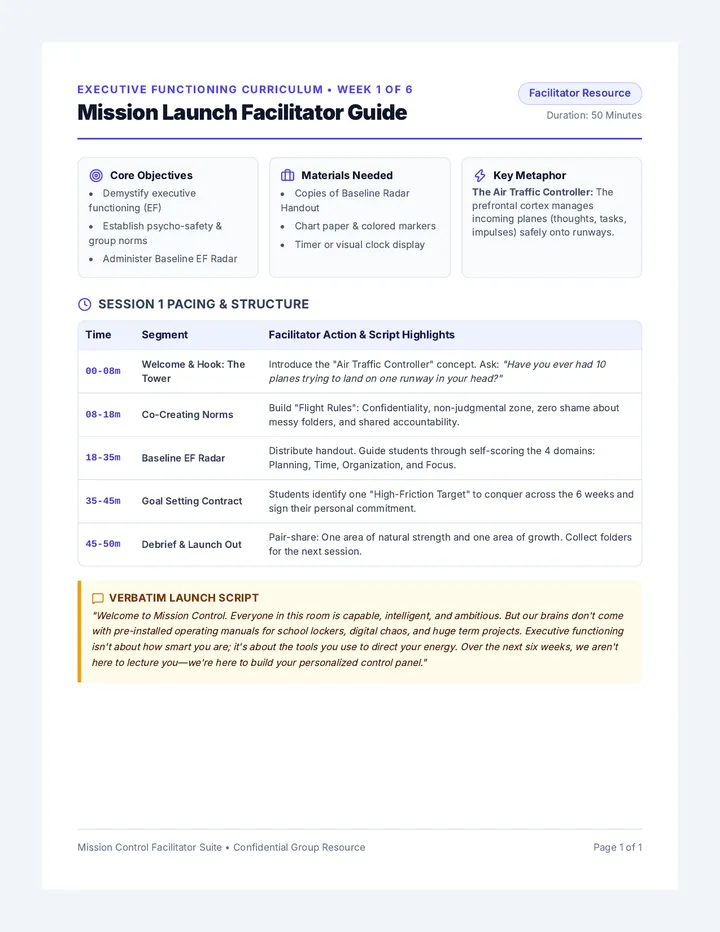
Chaos Control Facilitator Guide
Small-Group Intervention: Physical Organization & Material Systems
Format / Audience
Tier 2 Small Group (3–5 Students)
Duration: 30–35 Minutes
Executive Function Target & Rationale
Students with executive function deficits routinely experience cognitive overload caused by disorganized physical environments. This lesson replaces passive rummaging with an externalized, concrete system: the 3-Zone Material Protocol and standard Launch & Landing Checklists .
Small Group Session Pacing (35 Minutes)
5 Min
Check-In & The Cognitive Tax of Chaos
Use Slide 2. Frame disorganization not as a moral failing or "being messy," but as a working memory drain. Students complete the 60-second Backpack Audit on their blueprint.
8 Min
Direct Instruction: The 3-Zone Orbital Sorting Rule
Demonstrate with a physical prop bag. Explain Zone 1 (Daily Orbit - top accessibility), Zone 2 (Staging Base - subject folders & tools), and Zone 3 (Purge - junk, old handouts, expired food).
15 Min
Guided Practice: Live Backpack & Binder Overhaul
Students empty backpacks onto sorting mats. Coach students through triage. Use prompts: "Does this need to orbit daily, stay in your locker, or hit the recycle bin?"
7 Min
System Lock: Daily Launch & Landing Routine
Students establish their specific before-bed and end-of-school routine checklist on Page 2 of their Blueprint. Commit to a 5-day daily reset streak.
Facilitator Scripting & Verbal Prompts
When students resist discarding papers:
"If you keep everything, you find nothing. If it is already graded and not needed for a unit test, digitize it or recycle it today."
When students lose supplies repeatedly:
"Every object needs a physical home address. Where is the exact pocket your pencils live when they aren't in your hand?"
Mission Control Sequence • Lesson 1: Chaos to Control Page 1 of 2
Organization Mastery Rubric & Follow-Through
Progress Monitoring, Diagnostic Feedback & Generalization Guide
Tier 2 Monitoring
Small-Group Mastery Rubric (Weekly Progress Check)
Core Skill 1 - Emerging (Needs Support) 2 - Developing (Inconsistent) 3 - Independent (Habitual) Supply Access Speed Takes >60s to retrieve a pencil or requested notebook; frequent missing items. Locates supplies within 30s; occasionally misplaces primary folder. Instantly grabs required materials in <10s from designated pockets. Paper Routing (No Loose Sheets) Crumpled, loose worksheets loose in bottom of bag or shoved between books. Papers in binder but placed randomly without subject dividers. 100% of papers categorized into "To Do", "To Turn In", or subject tabs. Launch & Landing Ritual No evening check; relies on emergency morning packing; forgotten homework. Checks bag 2–3 times weekly with reminders; occasional missed items. Runs daily checklist independently before leaving school & before bed.
Common Roadblocks & Facilitator Remedies
Roadblock: "The Emotional Hoarder" (Keeps every doodle, scrap, and past quiz)
Intervention: Create an "Archive Box" kept at home or in a locker. Let them know they aren't destroying memories, just protecting their active bag space for today's mission.
Roadblock: "The Complex System Trap" (Too many multi-pocket dividers, color tabs)
Intervention: Simplify to an accordion folder or two primary folders: Red ("Action/Due Now") and Green ("Completed/Reference") . Low friction wins over high complexity.
Transfer Prompts for Classroom Teachers & Families
Gen-Ed Teacher Prompt
Provide 60 seconds at the end of every period: "Materials into their home address, launch folders packed." Prevent rush-bell stuffing.
Home Partnership Prompt
Designate a fixed physical "Launch Pad" near the front door. Bag stays zipped and parked on the launch pad each night before screen time.
Mission Control Sequence • Lesson 1: Chaos to Control Page 2 of 2
Launch Control Slides Mission Control Lesson 1 • Executive Functioning
Physical Logistics
Chaos to Control
Building your personal operating system for workspaces, binders, and daily school gear.
Goal: Zero lost assignments & instant supply retrieval
Small Group Strategy Session
Cognitive Science
The "Brain Tax" of Clutter
Working Memory Limit
The Unorganized Brain
Rummaging through 15 loose papers and hunting for a pen drains your limited mental fuel before instruction begins.
⚠️ Result: Fatigue, rushed panic, missed deadlines.
The Mission Control System
When every item has an exact "home address," your brain stays 100% focused on learning, creating, and problem-solving.
✨ Result: Calm focus, effortless speed, zero stress.
Core Principle: Organizing isn't about being neat—it's about protecting your brainpower.
Core Framework
The 3-Zone Orbital Sorting Rule
Sorting Triage
Zone 1
Daily Orbit
Items used every single period. Kept in top pockets or instant-access slots.
📌 Pencils, planner, active action folder, Chromebook.
Zone 2
Staging Base
Class-specific notebooks and reference units. Kept inside dedicated dividers.
📁 Subject binders, lab spiral, calculator, art tools.
Zone 3
Purge & Recycle
Old graded rubrics, duplicate handouts, scrap notes, broken utensils, wrappers.
🗑️ Trash immediately or file into home memory box.
Rule: Nothing enters your bag without an assigned Zone!
Daily Operating Routine
The 5-Minute Launch & Landing
Repeat Daily
Afternoon Landing (3 Min)
• Unpack Action Folder: Pull out homework that needs attention today.
• Toss the Trash: Empty food wrappers, receipts, and scrap paper.
• Plug In Tech: Charge Chromebook/laptop overnight.
Nighttime Launch (2 Min)
• Repack Work: Return finished homework into the Action Folder.
• Check Essentials: Pencil case filled, charged device packed.
• Stage at Launch Pad: Bag zipped and placed by the front door.
Backpack Rescue Blueprint Mission Control • Student Lab
Backpack Rescue Blueprint
Name:
Date:
Audit your physical supplies, clear working-memory clutter, and assign permanent home addresses to all school gear.
Part 1: The Pre-Flight Diagnostic (Check all that apply to you)
I have loose, crumpled worksheets floating in my bag.
I spend more than 30 seconds searching for a pen or pencil.
I have completed homework but forgot to turn it in.
I carry heavy papers or old projects from previous units.
Part 2: Today's Overhaul Triage Results
Zone 1: Daily Orbit
Must access in every class.
Zone 2: Staging Base
Subject-specific folders & tools.
Zone 3: Recycled / Purged
Trash or store at home.
Part 3: Pocket Home Address Registry
Assign each item an exact location so muscle memory takes over.
Main Large Pocket:
Small / Front Pocket:
Device / Tech Slot:
Side Water/Snack Slot:
Mission Control • Lesson 1: Chaos to Control Page 1 of 2
Daily Launch & Landing Protocols
Your step-by-step routine to end morning rushing and keep chaos from creeping back.
Afternoon Landing (3 Minutes)
Perform immediately when returning home:
Open bag and take out today's homework folder.
Recycle loose scraps, wrappers, and unneeded papers.
Plug in laptop / Chromebook to charger immediately.
Nighttime Launch (2 Minutes)
Perform before going to bed (never morning):
Pack completed assignments into your "Turn-In" pocket.
Confirm 2 working pencils/pens and charged device inside.
Zip bag completely and stage at your front-door Launch Pad.
5-Day Flight Log: Daily System Maintenance
Daily Check Mon Tue Wed Thu Fri Afternoon Landing Complete (Cleaned trash & outbox)
|
|
|
|
| Nighttime Launch Complete (Packed & staged at door) |
|
|
|
|
|
| Zero Crumpled Papers Found in Bag |
|
Focus Lab Facilitator Guide Mission Control • Lesson 2 Teacher Facilitation Protocol
Focus Lab Facilitator Guide
Small-Group Intervention: Focus, Inhibition & Impulse Regulation
Format / Target
Tier 2 Small Group (3–5 Students)
Duration: 35 Minutes
Executive Function Target & Rationale
Inhibitory control is the brain’s ability to resist quick impulses, tune out task-irrelevant sensory noise, and maintain working memory on an active task. Students build conscious metacognition by learning to recognize the physical sensation of an impulse, execute the 5-Second Brain Brake , and use an Impulse Parking Lot .
Small Group Session Pacing (35 Minutes)
5 Min
Check-In & The Dual Engine: Gas Pedal vs. Brain Brakes
Use Slide 2. Explain that smart brains have fast gas pedals (curiosity, energy, creativity), but high performance requires equally strong brakes (inhibition). Normalize distractibility without excusing it.
8 Min
Triage Training: Internal Drift vs. External Saboteurs
Use Slide 3 & Page 1 of the Student Tracker. Teach students to categorize distractions into external sensory traps (phone, peer whispers, hallway noise) vs. internal mind drift (daydreams, sudden unrelated tasks, boredom itch).
12 Min
The 7-Minute Timed Focus Sprint & Self-Monitoring Lab
Set a visible timer. Students work on an actual academic assignment. Whenever an urge to drift arises, they must not act immediately; instead, they jot it on their Impulse Parking Lot and tally a "Brake Applied" mark.
10 Min
Debrief & Personal Focus Shield Design
Students review their parking lot tallies. Facilitate reflection: "Which distraction was hardest to brake for? What physical shield (headphones, facing wall, phone put away) will you use in class tomorrow?"
Facilitator Scripting & Redirection Moves
When a student blurts or switches windows:
"Notice what just grabbed your wheel. Tap the 5-Second Brake. Park that idea on paper, and steer right back to your sentence."
When a student claims 'I can multitask':
"The human brain doesn't multitask; it task-switches. Every switch costs 20% of your processing speed and doubles careless mistakes."
Mission Control Sequence • Lesson 2: Brake and Steer Page 1 of 2
Impulse Regulation Progress & Transfer
Intervention Tracking, Impulse Roleplay Drills & Classroom Transfer
Tier 2 Monitoring
Small-Group Focus Observational Tracker (During Sprint Labs)
Brake and Steer Slides Mission Control Lesson 2 • Executive Functioning
Attention & Self-Regulation
Brake and Steer
Mastering cognitive brakes, defending against distractions, and building sustained focus endurance.
Goal: Strengthen your prefrontal brake pads against sudden urges
Small Group Strategy Session
Brain Mechanics
The Gas Pedal vs. The Brain Brakes
Neuroscience
The Gas Pedal (Impulse Engine)
Driven by curiosity, excitement, and dopamine. It wants instant rewards, answers, and rapid movements.
⚡ When unchecked: Blurting, clicking tabs, giving up when stuck.
The Brakes (Prefrontal Cortex)
Your executive steering wheel. It pauses the immediate urge, weighs long-term consequences, and stays on route.
🛡️ When trained: Calm patience, high focus, steady progress.
A fast car without brakes crashes. High intelligence requires strong brakes!
Distraction Radar
Know Your Saboteurs: Internal vs. External
Radar Scan
External Saboteurs (Outside)
Sensory stimuli in your physical environment trying to hijack your eyes and ears:
• Phone notifications & pop-up badges
• Peer whispers & hallway foot traffic
• Desktop mess & visual chaos
🛡️ Shield: Headphones, phone face down, clean desk zone.
Internal Saboteurs (Inside)
Thoughts, urges, and emotions that pull your attention away from within:
• Random unrelated ideas ("Did I text Alex?")
• The boredom itch when a task gets hard
• Daydreaming & mental wandering
📝 Shield: Impulse Parking Lot note card + deep exhale.
You cannot stop thoughts from appearing, but you can choose not to follow them!
Emergency Protocol
The 5-Second Brain Brake Routine
Step-by-Step
01
FREEZE
Catch the urge immediately. Stop hands and fingers before clicking or speaking.
02
BREATHE
Take one slow, deep nose inhale and long exhale. Reset your autonomic pulse.
03
PARK
Jot the distracting thought on your scratchpad parking lot. Get it out of your head.
04
STEER
Point eyes back to your active assignment. Complete the next single sentence.
Focus Radar Tracker Mission Control • Student Lab
Focus Radar Tracker
Name:
Date:
Scan for focus hijackers, practice your cognitive braking sequence, and defend your working attention.
Part 1: Distraction Radar Scan (Check your top 2 biggest triggers in each box)
External Saboteurs (Environment)
Classmate talking, whispering, or laughing
Phone notifications, vibration, or alerts
Hallway traffic, door opening, or window views
Messy desk with too many items on it
Internal Saboteurs (Mind Drift)
Sudden random thought ("What's for lunch?")
Urge to quit or open another tab when confused
Daydreaming about after-school plans / gaming
Feeling restless or physically bored
Part 2: The 5-Second Brain Brake Protocol
1. FREEZE
Catch the impulse in your body before moving.
2. BREATHE
One deep 3-second inhale and slow exhale.
3. PARK
Jot the urge on your parking scratchpad.
4. STEER
Re-aim eyes at the current question/line.
Part 3: Brake Simulator (Write your exact brake action)
Scenario A: You are reading a history passage. You hit a long paragraph and immediately feel the urge to click your browser bookmark bar or doodle.
My 5-Second Brake move:
Scenario B: You suddenly remember a funny video or an unfinished text while the teacher is giving instructions.
My 5-Second Brake move:
Mission Control • Lesson 2: Brake and Steer Page 1 of 2
Focus Sprint Flight Log & Shield Pledge
Live attention endurance experiment, impulse parking scratchpad, and personal defense plan.
Sprint Flight #1 7-Minute Academic Deep Work
Target Task: _______________
Brakes Applied (Tallies):
Tally each time you caught an urge & stopped it!
Total Resisted: ____
The Impulse Parking Lot (Write urges here to deal with later):
Unrelated ideas, google urges, things to tell friends, questions.
"Park it on paper so your mind doesn't have to carry it."
Sprint Debrief & Self-Assessment
What pulled my attention the most during the sprint?
How did applying the 5-Second Brake feel?
My Classroom Distraction Shield Plan (Tomorrow's Defense)
Shield 1 (Physical):
Shield 2 (Tech):
Shield 3 (Mental):
Student Signature: