Syllable Engineering Guide
Teacher Instruction Manual
Syllable Engineering Guide
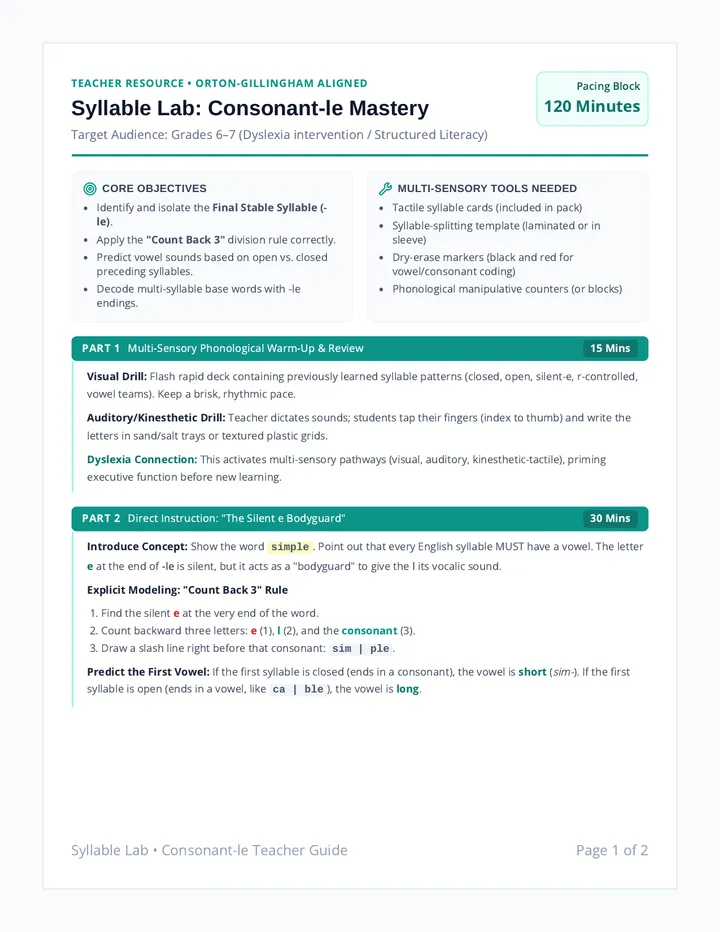
Structured Literacy Framework for Final Stable Syllables (-le)
Target Level Grades 6–7
Lesson Specs
Duration: 120 Mins (Block)
Focus: VCC-le & VC-le Division
Approach: Multi-Sensory Orton-Gillingham
Structural Rule
"A Consonant-le syllable is a Final Stable Syllable. It always appears at the end of a word. Count back three letters from the end [c - l - e] and divide. The 'e' is silent, but kept to give the consonant a vowel sound."
Blueprint Pacing Guide (120 Minutes)
20 MIN
1. Structural Stress Test (Warm-up & Review)
Review closed/open syllables. Tap out phonemes. Conduct multi-sensory blending drill using structural blocks or sandpaper card boards.
30 MIN
2. The "Count-Back-3" Engineering Rule (Direct Instruction)
Explicit modeling of VC-le (e.g., cable) vs. VCC-le (e.g., grumble). Introduce the "Count-Back-Three" blueprint rule using physical anchors and sliders.
40 MIN
3. Guided Blueprint Division & Activities (Practice)
Execute Syllable Sorting, Word Splitting, and Collaborative Task Cards. Focus on manual tactile division (drawing lines, placing division wedges).
30 MIN
4. Diagnostic Testing & Debrief (Assessment)
Administer the Blueprint Progress Assessment. Use exit tickets to diagnose automaticity. Conduct peer decoding checks with spelling-sound correlations.
Multi-Sensory Kickstart: Structural Stress Test
- Tactile Air-Writing: Have students stand. Write "l-e" in the air with full arm movements, chanting: "L-E, final stable syllable, says /əl/."
- Syllable Tap-Out: Provide physical tokens (blocks/chips). Say standard C-le words (e.g., puddle). Students slide a token for each syllable, clapping loudly on the stable "dle".
- Engineering Analogy: "Just like modern buildings need stable foundations, complex words need final stable syllables to hold them upright."
Syllable Engineering Instructional Material © 2026 Teacher Resource Booklet • Page 1 of 2
Systematic Blueprint Method
Syllable Division Architecture
The 4-Step Count-Back-Three Protocol
Instruct students to follow this precise visual and physical protocol for EVERY suspected C-le word. Do not skip steps.
01 Find "E"
Locate and box the 'e' at the end of the word.
02 Count 3
Count back 3 letters (e, l, consonant).
03 Divide
Draw a physical wedge (|) before the consonant.
04 Analyze
Determine if 1st syllable is open or closed.
Structural Specifications: Open vs. Closed Syllables
Type A: Closed Prefix (VCC-le)
Double-Consonant Splitting
If a consonant remains in the first syllable, it is closed. The vowel sound is short.
grum / ble → grum|ble (/ŭ/)
Type B: Open Prefix (VC-le)
Single-Consonant Splitting
If no consonant is left in the first syllable, it is open. The vowel sound is long.
ca / ble → ca|ble (/ā/)
Dyslexia Coaching & Troubleshooting Guide
Common Deficit: "The Ghost E"
Students often try to pronounce the final 'e' (e.g., saying "cab-lee" or "grumb-lee") or ignore it entirely, resulting in "cab-ul".
Remedy: Direct physical masking. Cover the 'e' with a finger and explain that 'e' is a silent builder holding up the 'l'.
Common Deficit: Blending Slump
Difficulty blending the consonant with the final /əl/ (e.g., struggling with /gl/ in "struggle").
Remedy: Use continuous blending. Slide your finger slowly under the onset consonant and make them vocalize a continuous stream into the /əl/.
Teacher Checklist for Interactive Slides
Project Anchor Slides Distribute Letter Tiles Prepare Decodable Text
Syllable Engineering Instructional Material © 2026 Teacher Resource Booklet • Page 2 of 2