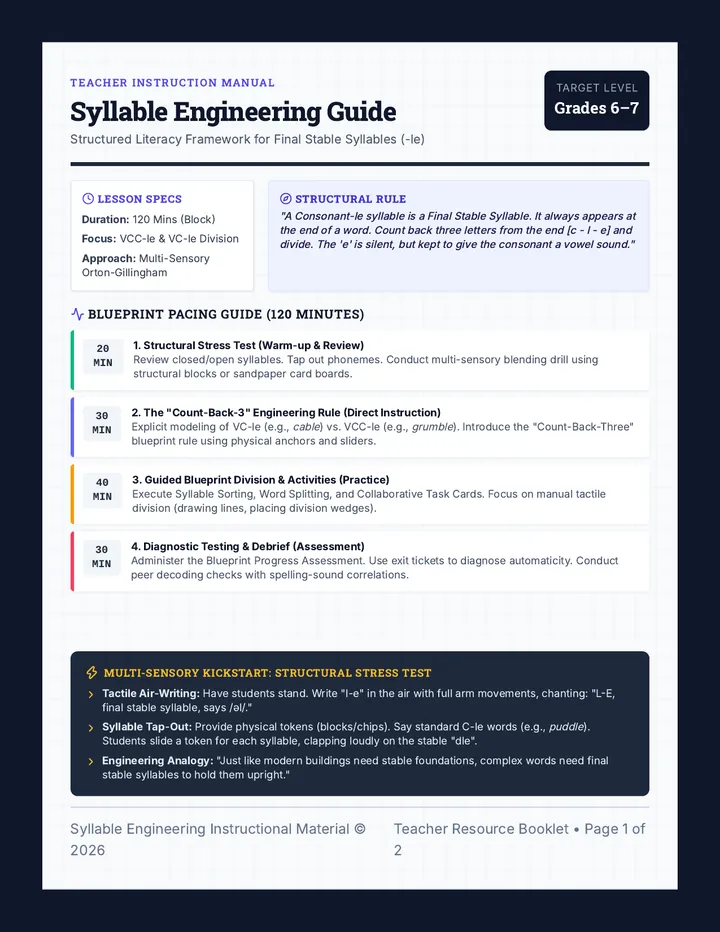
Syllable Lab Teacher Guide Teacher Resource • Orton-Gillingham Aligned
Syllable Lab: Consonant-le Mastery
Target Audience: Grades 6–7 (Dyslexia intervention / Structured Literacy)
Pacing Block 120 Minutes
Core Objectives
Identify and isolate the Final Stable Syllable (-le) .
Apply the "Count Back 3" division rule correctly.
Predict vowel sounds based on open vs. closed preceding syllables.
Decode multi-syllable base words with -le endings.
Multi-Sensory Tools Needed
Tactile syllable cards (included in pack)
Syllable-splitting template (laminated or in sleeve)
Dry-erase markers (black and red for vowel/consonant coding)
Phonological manipulative counters (or blocks)
Part 1 Multi-Sensory Phonological Warm-Up & Review 15 Mins
Visual Drill: Flash rapid deck containing previously learned syllable patterns (closed, open, silent-e, r-controlled, vowel teams). Keep a brisk, rhythmic pace.
Auditory/Kinesthetic Drill: Teacher dictates sounds; students tap their fingers (index to thumb) and write the letters in sand/salt trays or textured plastic grids.
Dyslexia Connection: This activates multi-sensory pathways (visual, auditory, kinesthetic-tactile), priming executive function before new learning.
Part 2 Direct Instruction: "The Silent e Bodyguard" 30 Mins
Introduce Concept: Show the word simple. Point out that every English syllable MUST have a vowel. The letter e at the end of -le is silent, but it acts as a "bodyguard" to give the l its vocalic sound.
Explicit Modeling: "Count Back 3" Rule
Find the silent e at the very end of the word.
Count backward three letters: e (1), l (2), and the consonant (3).
Draw a slash line right before that consonant: sim | ple.
Predict the First Vowel: If the first syllable is closed (ends in a consonant), the vowel is short (sim-). If the first syllable is open (ends in a vowel, like ca | ble), the vowel is long .
Syllable Lab • Consonant-le Teacher Guide Page 1 of 2
Teacher Resource • Orton-Gillingham Aligned
Syllable Lab: Practice & Application
Activities, Station Rotations, and Scaffolding Frameworks
Session Phase Application
Part 3 Multi-Sensory Stations & Card Sort 45 Mins
Station A: The Syllable Splitting Board (15 min)
Students use the dry-erase template to write target words. They circle the -le , count back 3, slice with red dry-erase markers, and label each syllable type (C for closed, O for open, FS for final stable).
Station B: Tactile Card Sorting Game (15 min)
Students pair onset syllable cards (e.g., scram-, trem-, han-) with the final stable cards (-ble, -dle) to form real or nonsense words. Students must physically trace the division line with a pipe cleaner or wiki stick.
Station C: Multi-Syllabic Base Work (15 min)
Introduce prefix/suffix additions: re-assemble, unscramble, bubbling, simpleton. Students identify the core stable syllable first, then dissect the affixes.
Part 4 Decodable Reading, Fluency, and Comprehension 30 Mins
Controlled Passage Routine: Focus on the customized passage "The Spectacle at Rumble Mountain".
Prep: Students scan the passage with a yellow highlighter to find and highlight all consonant-le endings before reading.Choral Read: Read aloud with students to model pacing and prosody.Partner Read: Students alternate sentences, tracking with a finger or tracking window tool.Comprehension Discussion: Ask targeted questions focusing on cause and effect and sequencing.
Dyslexia Support & Error Correction
Common Misconception:
Splitting right after the vowel (e.g., simp-le) because of phonetic chunking.
Corrective Feedback:
Have them highlight the silent-e, place 3 fingers on the last 3 letters, and slice before their index finger.
Syllable Lab • Consonant-le Teacher Guide Page 2 of 2
Syllable Lab Slides Syllable Lab
Phonics Mastery Level 2
Advanced Structure Study
Consonant-le
Final Stable Syllables
Master the secret rules to break down, pronounce, and spell multi-syllable words like a spelling scientist.
Target Concept: Count-Back-Three
Slide 1 of 6
Syllable Lab
Core Rule
What is a Final Stable Syllable?
A Final Stable Syllable is a group of letters at the end of a word that never change their sound or spelling.
The Silent-e Trick:
Every English syllable MUST have a vowel sound. The letter e is silent but stays at the end to give l its voice!
Syllable Blueprint
[C] l e
Consonant + L + Silent E
Rule Identification Slide 2 of 6
Syllable Lab
Syllable Division Method
The "Count Back 3" Method
1
Find the Silent e
Look at the very end of the word and find the silent letter e.
2
Count Back 3
Move backward three letters: e (1), l (2), [consonant] (3).
3
Slice & Split!
Draw your syllable slash right before that consonant.
Explicit Instruction Slide 3 of 6
Syllable Lab
Phonological Prediction
Closed vs. Open Base Syllables
The syllable division boundary tells you exactly how to pronounce the vowel in the first syllable!
Short Vowel Sound
Closed Base Syllables
The first syllable ends with a consonant. The vowel is blocked and short!
bub | ble
Vowel 'u' says /ŭ/ (short)
Long Vowel Sound
Open Base Syllables
The first syllable ends with a vowel. The vowel is open and long!
ca | ble
Vowel 'a' says /ā/ (long)
Vowel Sound Prediction Rules Slide 4 of 6
Syllable Lab
Advanced Level
Multisyllabic Base Challenge!
Let's level up! When we have bigger words with prefixes, suffixes , or complex roots , find the final stable syllable first, then break down the rest!
Pre + Base + -le
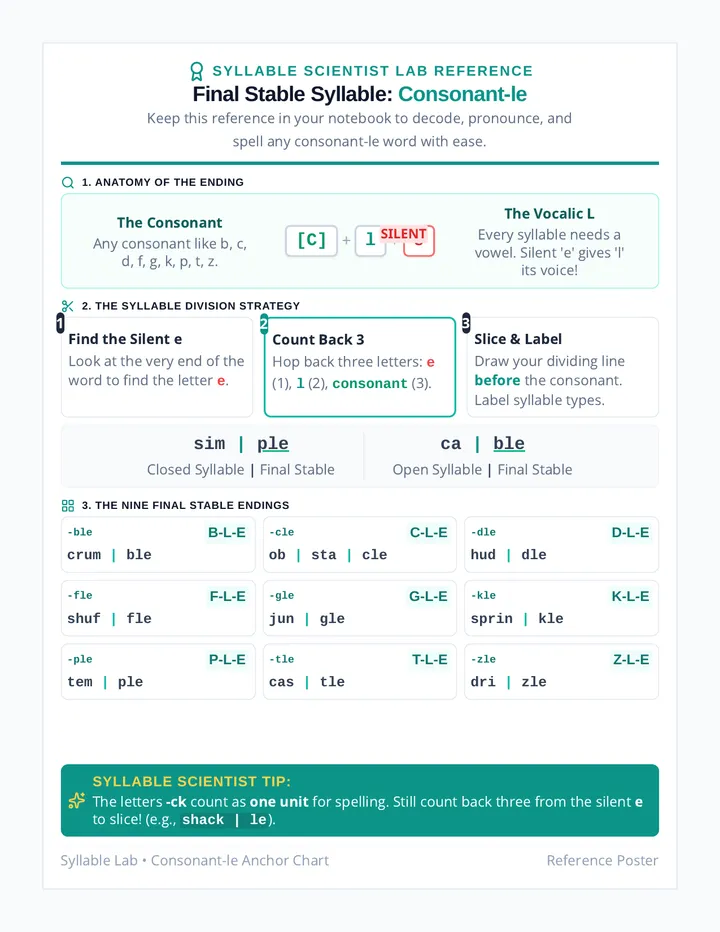
Syllable Science Anchor Chart Syllable Scientist Lab Reference
Final Stable Syllable: Consonant-le
Keep this reference in your notebook to decode, pronounce, and spell any consonant-le word with ease.
1. Anatomy of the Ending
The Consonant Any consonant like b, c, d, f, g, k, p, t, z.
[C] + l + e Silent
The Vocalic L Every syllable needs a vowel. Silent 'e' gives 'l' its voice!
2. The Syllable Division Strategy
1 Find the Silent e
Look at the very end of the word to find the letter e .
2 Count Back 3
Hop back three letters: e (1), l (2), consonant (3).
3 Slice & Label
Draw your dividing line before the consonant. Label syllable types.
sim | ple Closed Syllable | Final Stable
ca | ble Open Syllable | Final Stable
3. The Nine Final Stable Endings
-ble B-L-E
crum | ble
-cle C-L-E
ob | sta | cle
-dle D-L-E
hud | dle
-fle F-L-E
shuf | fle
-gle G-L-E
jun | gle
-kle K-L-E
sprin | kle
-ple P-L-E
tem | ple
-tle T-L-E
cas | tle
-zle Z-L-E
dri | zle
Syllable Scientist Tip:
The letters -ck count as one unit for spelling. Still count back three from the silent e to slice! (e.g., shack | le).
Syllable Lab • Consonant-le Anchor Chart Reference Poster
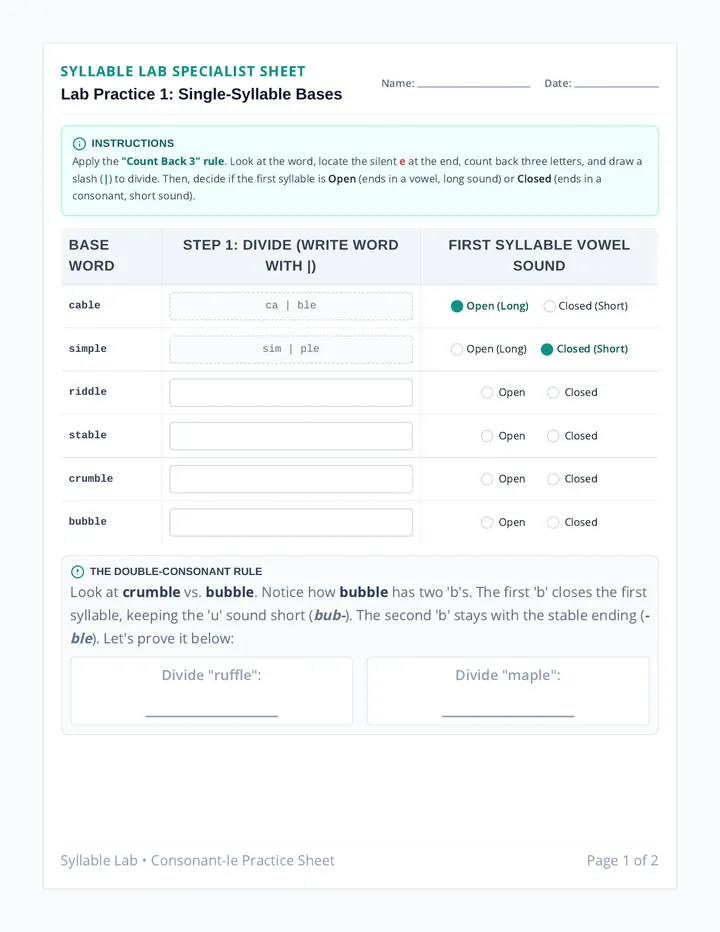
Syllable Splitters Worksheet Syllable Lab Specialist Sheet
Lab Practice 1: Single-Syllable Bases
Name:
Date:
Instructions
Apply the "Count Back 3" rule . Look at the word, locate the silent e at the end, count back three letters, and draw a slash (| ) to divide. Then, decide if the first syllable is Open (ends in a vowel, long sound) or Closed (ends in a consonant, short sound).
| Base Word | Step 1: Divide (Write Word with |) | First Syllable Vowel Sound |
| --- | --- | --- |
| cable |
ca | ble
|
Open (Long) Closed (Short)
|
| simple |
sim | ple
|
Open (Long) Closed (Short)
|
| riddle |
|
Open Closed
|
| stable |
|
Open Closed
|
| crumble |
|
Open Closed
|
| bubble |
|
Open Closed
|
The Double-Consonant Rule
Look at crumble vs. bubble . Notice how bubble has two 'b's. The first 'b' closes the first syllable, keeping the 'u' sound short (bub-). The second 'b' stays with the stable ending (-ble). Let's prove it below:
Divide "ruffle":
Divide "maple":
Syllable Lab • Consonant-le Practice Sheet Page 1 of 2
Syllable Lab Specialist Sheet
Lab Practice 2: Multisyllabic Bases & Affixes
Name:
Date:
Advanced Level Concept
Words often grow larger with prefixes (e.g., un-, dis-, re-) or suffixes (e.g., -ing, -ed, -ton). Our strategy remains: find the final stable syllable first, box it, and then split the remaining prefix or suffix chunks.
Exercise A: Dissect the Giant Words
unscrambling Prefix: un- | Base: scramble | Suffix: -ing
Divided Lab Chunks:
un | scram | bling
disassembling Prefix: dis- | Base: assemble | Suffix: -ing
Divided Lab Chunks:
reassembled Prefix: re- | Base: assemble | Suffix: -ed
Divided Lab Chunks:
simpleton Base: simple | Suffix: -ton
Divided Lab Chunks:
Exercise B: Scientific Inquiry & Analysis
Answer the analytical questions below using your knowledge of closed and open syllables.
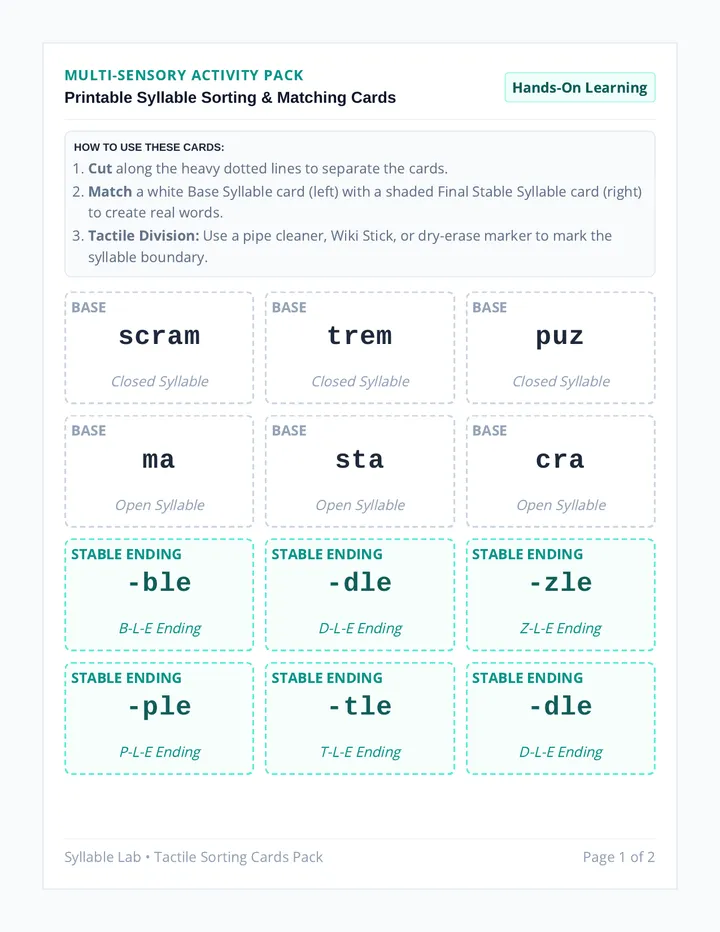
Syllable Sorting Cards Multi-Sensory Activity Pack
Printable Syllable Sorting & Matching Cards
Hands-On Learning
How to Use These Cards:
Cut along the heavy dotted lines to separate the cards.Match a white Base Syllable card (left) with a shaded Final Stable Syllable card (right) to create real words.Tactile Division: Use a pipe cleaner, Wiki Stick, or dry-erase marker to mark the syllable boundary.
Base
scram
Closed Syllable
Base
trem
Closed Syllable
Base
puz
Closed Syllable
Base
ma
Open Syllable
Base
sta
Open Syllable
Base
cra
Open Syllable
Stable Ending
-ble
B-L-E Ending
Stable Ending
-dle
D-L-E Ending
Stable Ending
-zle
Z-L-E Ending
Stable Ending
-ple
P-L-E Ending
Stable Ending
-tle
T-L-E Ending
Stable Ending
-dle
D-L-E Ending
Syllable Lab • Tactile Sorting Cards Pack Page 1 of 2
Syllable Lab Specialist Sheet
Lab Record: Real vs. Nonsense Word Maker
Name:
Date:
Word Laboratory Directions
Combine your Base Syllable cards with different Final Stable Syllable cards . Read the combined words aloud. If the word is a real English word, write it in the Real Words column. If it is silly or imaginary, write it in the Nonsense Words column. Be sure to draw a slash (| ) dividing your syllables!
Real Words Column
Ex.
scram | ble
Nonsense Words Column
Ex.
ma | zle
Lab Conclusion Question: Choose one of your nonsense words . Can you explain what you think this silly word might mean? Be creative!
Syllable Lab • Tactile Sorting Cards Pack Page 2 of 2
Rumble Mountain Passage Syllable Lab Reading Passages
Decodable Study: Level 2 Phonics
Name:
Pre-Reading Mission:
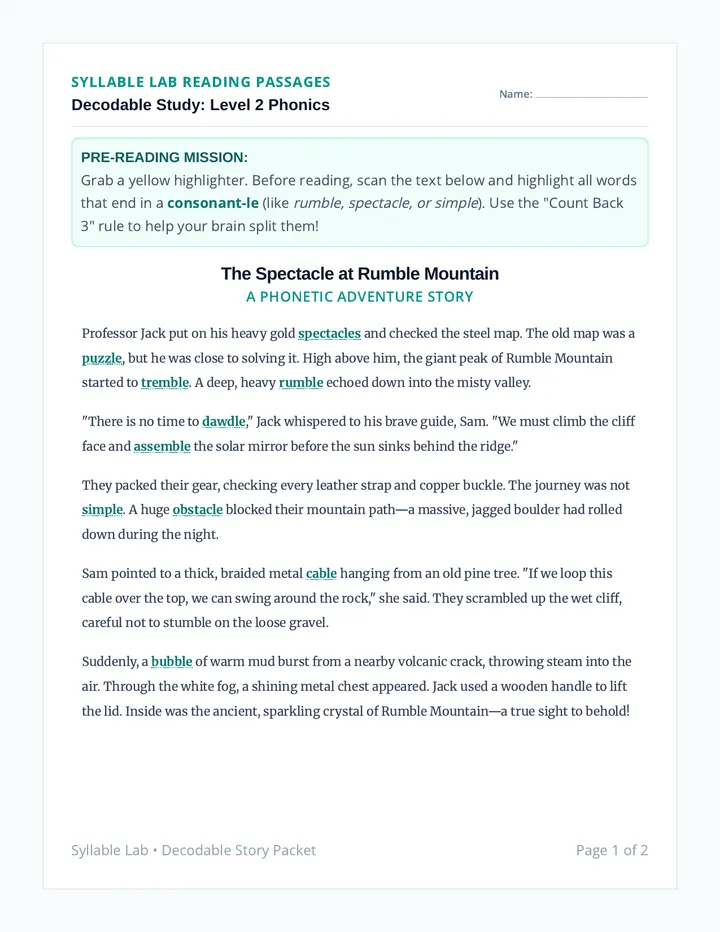
Grab a yellow highlighter. Before reading, scan the text below and highlight all words that end in a consonant-le (like rumble, spectacle, or simple ). Use the "Count Back 3" rule to help your brain split them!
The Spectacle at Rumble Mountain
A Phonetic Adventure Story
Professor Jack put on his heavy gold spectacles and checked the steel map. The old map was a puzzle , but he was close to solving it. High above him, the giant peak of Rumble Mountain started to tremble . A deep, heavy rumble echoed down into the misty valley.
"There is no time to dawdle ," Jack whispered to his brave guide, Sam. "We must climb the cliff face and assemble the solar mirror before the sun sinks behind the ridge."
They packed their gear, checking every leather strap and copper buckle. The journey was not simple . A huge obstacle blocked their mountain path—a massive, jagged boulder had rolled down during the night.
Sam pointed to a thick, braided metal cable hanging from an old pine tree. "If we loop this cable over the top, we can swing around the rock," she said. They scrambled up the wet cliff, careful not to stumble on the loose gravel.
Suddenly, a bubble of warm mud burst from a nearby volcanic crack, throwing steam into the air. Through the white fog, a shining metal chest appeared. Jack used a wooden handle to lift the lid. Inside was the ancient, sparkling crystal of Rumble Mountain—a true sight to behold!
Syllable Lab • Decodable Story Packet Page 1 of 2
Syllable Lab Reading Passages
Lab Practice: Reading Comprehension & Analysis
Name:
Date:
Part A: Syllable Hunt Review
Find and list three consonant-le words from the story that have a closed preceding syllable (short vowel sound), and two words with an open preceding syllable (long vowel sound).
Closed / Short Sound Words
1. _______________________________
2. _______________________________
3. _______________________________
Open / Long Sound Words
1. _______________________________
2. _______________________________
Part B: Comprehension Questions