Feelings Detective Story Packet 1st Grade Communication & Literacy Visual Reading Packet
Feelings Detective: Leo's Ice Cream
Student A:
Student B:
1. Feelings Anchor Board (Face & Body Clues)
Match body clues to find the feeling!
😊 HAPPY
Yellow Zone ☀️
😄 Big smile
👏 Clapping hands
😭 SAD
Blue Zone 🌧️
☹️ Frowning mouth
😢 Falling tears
😡 MAD
Red Zone 🔥
😠 Eyebrows down
🦶 Stomping feet
😨 SCARED
Purple Zone ⚡
😳 Wide open eyes
🫣 Hiding body
2. Read-Along Story: Leo's Sweet Treat
👉 Finger-Point Reading
1
Leo holds a cold, sweet ice cream cone at the park. 🍦
2
Uh-oh! The ice cream drops on the ground with a loud splat! 🍦💥
3
Leo's mouth makes a big, downward frown. ☹️
4
Big, wet tears roll down his cheeks. 😭
5
Leo feels very sad. 😢
6
Miss Ana gives Leo a soft napkin and a brand new ice cream! 🍦❤️
7
Leo wipes his tears, smiles big, and claps his hands! 👏
8
Leo feels happy again! 😊
3. Clue Detective Chain: Event ➔ Physical Clue ➔ Feeling
Cause & Effect Map
Step 1: Event
🍦💥
Ice cream drops on ground
Clue
Step 2: Physical Clues
☹️ + 😭
Frowning mouth & wet tears
Therefore: Leo feels SAD 😢 (Blue Zone)
👉 Point to the tears in the story!
Comprehension & Reciprocal Talk
Detective Questions & Partner Talk
🎤 Pass the Talking Token!
4. Comprehension Questions (Color or Check ◯)
Read clues carefully before choosing
1. Direct Recall: What happened to Leo's ice cream at the park? 🍦
It dropped on the ground. 🍦💥
A big puppy ate it. 🐶
Leo put it in his pocket. 👖
2. Infer Feeling: Leo had a frown ☹️ and big tears 😭. How did Leo feel?
Leo felt mad. 😡
Leo felt sad. 😢
Leo felt scared. 😨
3. Cause & Feeling: Why did Leo feel happy at the end of the story? 😊
He got a new ice cream. 🍦👏
He went down the slide. 🛝
He played with blocks. 🧱
5. Partner Turn-Taking Script (Student A & Student B)
Pass token after each turn 🎤
Student A 🎤
Asks: "How did Leo feel when his ice cream dropped? 🍦"
Student B 👂
Answers: "Leo felt sad 😢 because his ice cream fell on the ground."
🔄 Pass the Token to Student B!
Student B 🎤
Asks: "What made Leo feel happy again? 😊"
Student A 👂
Answers: "Leo felt happy 😊 when Miss Ana gave him a new ice cream! 🍦"
SLP & Educator Implementation Quick-Tips
1. Physical Clue Mapping
Explicitly pair concrete observations with feelings (Tears = Sad 😢, Smile = Happy 😊) before asking for abstract emotion labels.
2. Visual Prompt Hierarchy
Allow 5s wait time $\rightarrow$ Point to physical clue in story $\rightarrow$ Gesture to feeling card $\rightarrow$ Model sentence frame.
3. Concrete Turn Prop
Use a physical object (plush mic or token) passed hand-to-hand to make conversational reciprocity tangible and visible.
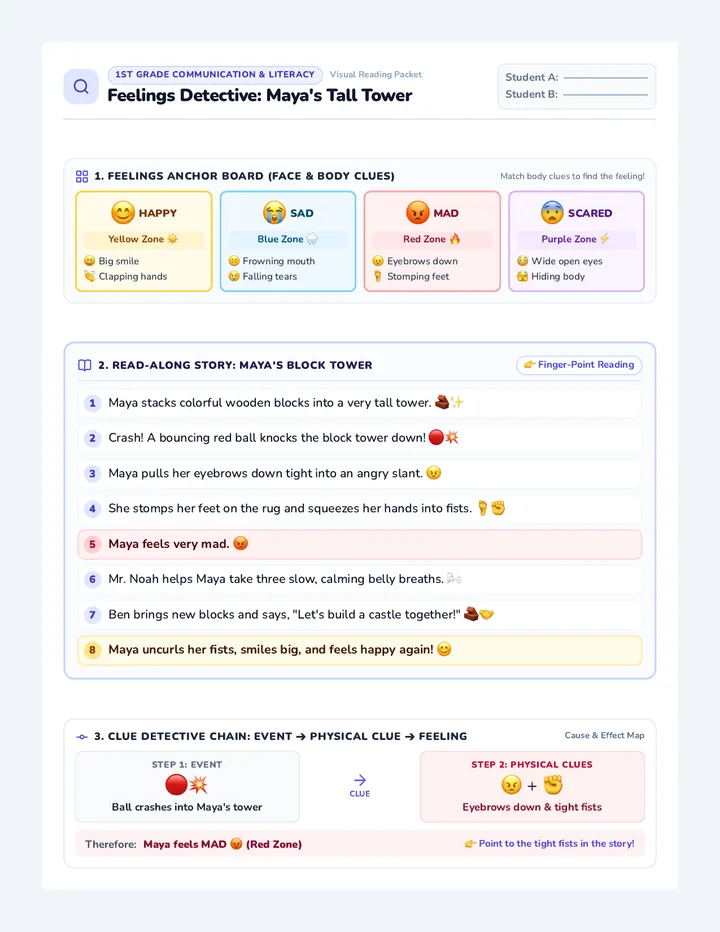
Tower Trouble Story Packet 1st Grade Communication & Literacy Visual Reading Packet
Feelings Detective: Maya's Tall Tower
Student A:
Student B:
1. Feelings Anchor Board (Face & Body Clues)
Match body clues to find the feeling!
😊 HAPPY
Yellow Zone ☀️
😄 Big smile
👏 Clapping hands
😭 SAD
Blue Zone 🌧️
☹️ Frowning mouth
😢 Falling tears
😡 MAD
Red Zone 🔥
😠 Eyebrows down
🦶 Stomping feet
😨 SCARED
Purple Zone ⚡
😳 Wide open eyes
🫣 Hiding body
2. Read-Along Story: Maya's Block Tower
👉 Finger-Point Reading
1
Maya stacks colorful wooden blocks into a very tall tower. 🧱✨
2
Crash! A bouncing red ball knocks the block tower down! 🔴💥
3
Maya pulls her eyebrows down tight into an angry slant. 😠
4
She stomps her feet on the rug and squeezes her hands into fists. 🦶✊
5
Maya feels very mad. 😡
6
Mr. Noah helps Maya take three slow, calming belly breaths. 🌬️
7
Ben brings new blocks and says, "Let's build a castle together!" 🧱🤝
8
Maya uncurls her fists, smiles big, and feels happy again! 😊
3. Clue Detective Chain: Event ➔ Physical Clue ➔ Feeling
Cause & Effect Map
Step 1: Event
🔴💥
Ball crashes into Maya's tower
Clue
Step 2: Physical Clues
😠 + ✊
Eyebrows down & tight fists
Therefore: Maya feels MAD 😡 (Red Zone)
👉 Point to the tight fists in the story!
Comprehension & Reciprocal Talk
Detective Questions & Partner Talk
🎤 Pass the Talking Token!
4. Comprehension Questions (Color or Check ◯)
Read clues carefully before choosing
1. Direct Recall: What knocked down Maya's block tower? 🧱
A bouncing red ball. 🔴💥
A loud green fan. 🍃
A fluffy puppy dog. 🐶
2. Infer Feeling: Maya had eyebrows down 😠 and tight fists ✊. How did Maya feel?
Maya felt mad. 😡
Maya felt scared. 😨
Maya felt happy. 😊
3. Cause & Feeling: Why did Maya feel happy at the end of the story? 😊
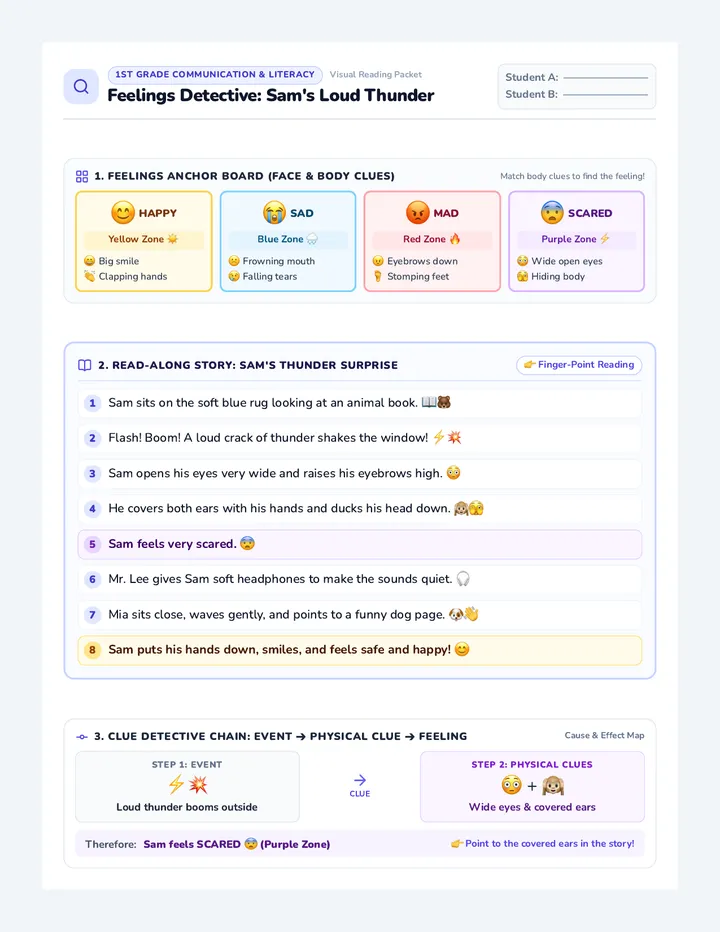
Loud Thunder Story Packet 1st Grade Communication & Literacy Visual Reading Packet
Feelings Detective: Sam's Loud Thunder
Student A:
Student B:
1. Feelings Anchor Board (Face & Body Clues)
Match body clues to find the feeling!
😊 HAPPY
Yellow Zone ☀️
😄 Big smile
👏 Clapping hands
😭 SAD
Blue Zone 🌧️
☹️ Frowning mouth
😢 Falling tears
😡 MAD
Red Zone 🔥
😠 Eyebrows down
🦶 Stomping feet
😨 SCARED
Purple Zone ⚡
😳 Wide open eyes
🫣 Hiding body
2. Read-Along Story: Sam's Thunder Surprise
👉 Finger-Point Reading
1
Sam sits on the soft blue rug looking at an animal book. 📖🐻
2
Flash! Boom! A loud crack of thunder shakes the window! ⚡💥
3
Sam opens his eyes very wide and raises his eyebrows high. 😳
4
He covers both ears with his hands and ducks his head down. 🙉🫣
5
Sam feels very scared. 😨
6
Mr. Lee gives Sam soft headphones to make the sounds quiet. 🎧
7
Mia sits close, waves gently, and points to a funny dog page. 🐶👋
8
Sam puts his hands down, smiles, and feels safe and happy! 😊
3. Clue Detective Chain: Event ➔ Physical Clue ➔ Feeling
Cause & Effect Map
Step 1: Event
⚡💥
Loud thunder booms outside
Clue
Step 2: Physical Clues
😳 + 🙉
Wide eyes & covered ears
Therefore: Sam feels SCARED 😨 (Purple Zone)
👉 Point to the covered ears in the story!
Comprehension & Reciprocal Talk
Detective Questions & Partner Talk
🎤 Pass the Talking Token!
4. Comprehension Questions (Color or Check ◯)
Read clues carefully before choosing
1. Direct Recall: What loud sound did Sam hear during reading time? ⚡
A loud crack of thunder. ⚡💥
A squeaky toy duck. 🦆
A ringing school bell. 🔔
2. Infer Feeling: Sam opened eyes wide 😳 and covered ears 🙉. How did Sam feel?
Sam felt hungry. 🍎
Sam felt scared. 😨
Sam felt happy. 😊
3. Cause & Feeling: Why did Sam feel happy at the end of the story? 😊