Classroom Synergy Slides
Staff Professional Development • 30-Minute Workshop
Actionable Classroom Inclusion
Moving Beyond "One Teaches, One Watches"
Classroom Synergy: Maximizing Every Adult in the Room
Defining active, choreographed roles for General Educators, Special Educators, and Paraprofessionals to accelerate student independence.
Role Precision
Gen Ed, SpEd & Para roles
4 Active Models
Zero spectator time
Action Sprint
10-min co-planning protocol
The Mindset Shift
Eradicating the Spectator Trap
Minutes 04 – 08
The Passive Default (Avoid)
One Teaches, One Drifts
Co-teacher hovers in the back, checking emails or managing pencils.
The "Velcro" Paraprofessional
Adult glued to one student, answering questions for them and stifling autonomy.
Single-Teacher Ownership
Students view one adult as the "real" teacher and others as visitors.
The Active Standard (Target)
Dual Instructional Voice
Both teachers actively facilitate, prompt thinking, and guide content delivery.
Strategic Independence Coaching
Paraprofessionals cue strategies, collect goal data, and intentionally fade support.
Shared Parity & Authority
Both names on the syllabus, both lead circles, equal classroom respect.
Core Principle: If a visitor cannot tell who the general educator or special educator is, you have achieved parity. 100% Active Engagement
Professional Parity Matrix
General Educator vs. Special Educator Roles
Minutes 08 – 12
General Educator (Curriculum Lead)
Curriculum & Pacing: Master of grade-level standards, course sequence, and core content scope.
Tier-1 Instruction: Designs foundational learning targets and initial core unit assessments.
Shared Environment: Manages classroom culture alongside co-teacher with equal authority.
Key Question: "What core standards must every student master?"
Special Educator (Access Specialist)
Specially Designed Instruction: Embeds IEP accommodations, scaffolds, and multi-modal access.
Barrier Diagnosis: Identifies cognitive or processing roadblocks before lessons launch.
Targeted Co-Delivery: Co-leads whole-class instruction and directs small-group mastery.
Key Question: "How do we remove barriers so every student accesses it?"
Both Grade Student Work Both Communicate with Families Both Command Class Respect
Unlocking Support Staff
The Paraprofessional: Facilitating Autonomy
Minutes 12 – 16
High-Impact Paraprofessional Practices
Prompting Self-Advocacy
Uses visual cue cards and wait time instead of supplying immediate answers.
Objective Data Logging
Tallies on-task duration, prompt levels, and goal tracker charts in real time.
Reinforcing Teacher-Designed Practice
Facilitates practice stations using materials prepared by certified teachers.
Pitfalls to Protect Against
The "Velcro" Hover
Sitting right next to one student for 60 minutes isolates them socially from peers.
Unplanned Primary Instruction
Paras must never be tasked with introducing new content or planning lessons.
Waiting in the Dark
Arriving with no briefing on daily goals or specific role expectations.
The Golden Rule of Support: "The ultimate measure of success is when the student no longer needs you." Promote Autonomy
Video Exemplar Analysis
Decoding Effective Co-Teaching in Action
Minutes 16 – 20
The 3-Lens Observation Protocol
1
Voice & Instructional Parity
Do both certified teachers speak, clarify student ideas, and issue directions, or does one dominate?
2
Choreographed Adult Movement
Are adults strategically distributed across the room? Is anyone standing idle while another works?
3
The Paraprofessional's "Fade" Technique
Does the paraprofessional provide a prompt, step back 3 paces, and observe before stepping back in?
Observation Focus
Target Scenario:
Examining simultaneous instructional delivery and adult positioning in active classrooms.
Turn & Discuss Questions:
How do the adults balance room presence without talking over each other?
What specific signals or cues trigger transitions between groups?
See live video exemplars on next slide!
Observation Target: Identify the exact verbal hand-off cues between both certified teachers. Active Inquiry Lens
Instructional Architecture & Video Exemplars
4 High-Impact Co-Teaching Models
Minutes 20 – 25
Video
Station Teaching
Students rotate through mini-stations. Each teacher runs an active station.
Embedded media
High engagement & low adult ratio.
Video
Parallel Teaching
Class is divided in half. Both teachers simultaneously teach identical content.
Embedded media
Doubles student voice & talk time.
Video
Alternative Teaching
One leads core group; co-teacher runs targeted pre-teach/extension.
Embedded media
Targeted intervention without stigma.
Video
Team Teaching
Both co-deliver seamlessly, modeling dual dialogue and strategy debate.
Embedded media
Dynamic dialogue & dual perspectives.
The 80/20 Rule: "One Teach, One Assist" should occupy less than 20% of your co-taught week.
4 Live Exemplars: Watch & Analyze Synergy in Action
Reflective Practice • Connecting to Slide 6 Models
What Do I Do When Not at the Front?
Minutes 25 – 29
The Core Breakthrough: In high-impact co-teaching, neither adult is ever an audience member.
Active Co-Pilot Standard
1. Station Teaching
No "Front" Exists
You lead a small-group inquiry station with students. Partner leads another; Para proctors the independent station.
Active Move: Rapid student questioning & feedback.
2. Parallel Teaching
Lead Your Own Half
You are the primary teacher for half the classroom. Deliver identical content directly to your cluster at their pace.
Active Move: Doubles talk time for all students.
3. Alternative Teaching
Small Strategy Group
While partner introduces main concept, pull a few students for intensive vocabulary practice or extension scaffolds.
Active Move: Instant Tier-2 support in the room.
4. Team Teaching
The Active Co-Pilot
When partner speaks, you chart anchor notes on board, ask student-advocate questions, and prompt silent cues.
Active Move: Interject dialogue within 90 seconds.
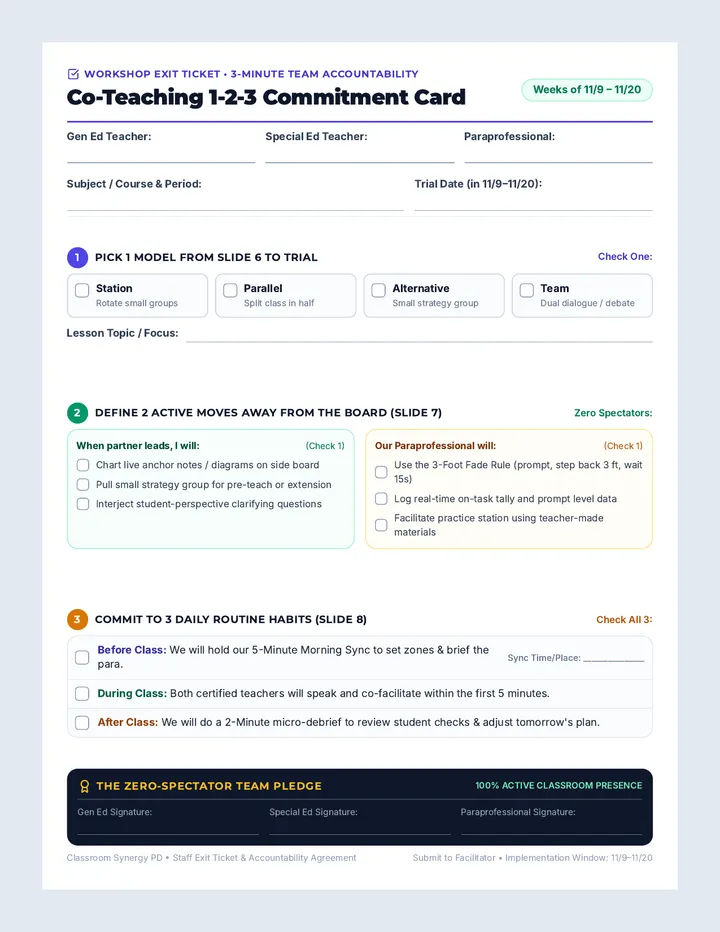
Turn & Reflect: "Which of these 4 moves will you use during 11/9–11/20 when your partner is speaking?" 100% Purposeful Presence
The Daily Co-Teaching Routine
Weeks of 11/9 – 11/20: Before, During & After Class
Minutes 29 – 30
1. Before Class
The 5-Minute Morning Sync
Select model of the day from Slide 6.
Assign student rosters & physical zones.
Brief para on the plan & go over any data that needs to be collected.
Never enter a period without assigned zones.
2. During Class
Choreographed Execution
Both teachers speak within first 5 mins.
Off-stage teacher charts notes or leads small strategy group.
3-Foot Fade: Prompt, step back 3 ft, and wait 15s to build autonomy.
Zero spectators: 100% active presence.
3. After Class
The 2-Minute Quick Debrief
Did our adult transitions eliminate downtime?
Review para data tracker on student checks.
Pivot upcoming models based on mastery.
Daily micro-adjustments build lasting synergy.
Our Shared Standard: Choreograph Every Minute You Share
Transforming co-taught classrooms from solitary islands into collaborative powerhouses.
Ready for 11/9 – 11/20