Anxiety Armor Slides Self-Advocacy & Coping Lesson 1
Anxiety Armor
Building your personal toolkit to face learning challenges, handle anxiety, and advocate for what you need to succeed.
17-Year-Old Transition & Coping Skillset
Press space or arrow keys to advance
Meet the "Roadblock"
01 // Understanding Anxiety
Anxiety isn't a failure—it is a physical signal from your nervous system. In high school, anxiety often shows up as a Roadblock when a task feels too large or environment feels overwhelming.
Recognizing the signal early is your queue to activate your armor.
How to Spot a Roadblock:
→ Physical: Racing heart, tight chest, shallow breathing, or fidgeting.
→ Cognitive: Foggy brain, "freezing" when looking at an assignment, or negative loop-thinking.
→ Urge: Wanting to shutdown, put your head down, or leave the room.
Anxiety Armor Training Slide 2 of 8
The Four Shield Skills
02 // Coping Options
Self-Talk
Reframing negative thoughts inside your head using positive, realistic self-talk.
Shield 01 - Internal
Journaling
Writing or brain-dumping worries onto paper to clear mental bandwidth and plan next steps.
Shield 02 - Cognitive
Active Break
Taking a regulated walk or sensory pause to physically lower adrenaline levels.
Shield 03 - Physical
Self-Advocacy
Speaking up to ask a teacher or trusted adult for support using a simple script.
Shield 04 - Social
Anxiety Armor Training Slide 3 of 8
Shields 1 & 2: Self-Talk & Journaling
03 // Internal Processing
Shield 1: Thought Reframing
When the panic brain says: "I can't do this, I'm going to fail."
Reframe it with realistic self-talk:
"This feels really heavy right now, but I have a system. I can do one step at a time."
Shield 2: The Brain Dump
When your thoughts are spinning too fast to sort out, put them on paper to make them static and manageable.
Step 1 Write everything out without filtering.
Step 2 Underline the one active problem.
Anxiety Armor Training Slide 4 of 8
Shield 3: The Regulated Break
04 // Physical Reset
Sitting at your desk while experiencing high anxiety is like keeping your foot on the gas pedal in neutral. You need movement to burn off adrenaline.
The Rules of a Regulated Break:
Time-Boxed: Exactly 3–5 minutes. Use a visual timer.
Purposeful Path: Walk a specific route (e.g., water fountain).
Self-Regulation Check
The "3-2-1" Walk
While walking, mentally note:
3 Things you can see 👁️
2 Things you can physically touch ✋
1 Sound you can hear 👂
Anxiety Armor Training Slide 5 of 8
Shield 4: Speak Up (Self-Advocacy Scripts)
05 // Professional Communication
Asking a teacher for help isn't interrupting—it is advocating . High school teachers respect students who communicate their needs professionally.
The Golden Rule:
"Name the barrier + State the action you are taking + Request what you need."
Script A: When stuck on a task
"I'm feeling blocked on step 3. I want to finish this, but I need to take a 3-minute walk to clear my head first. Can I check in when I get back?"
Script B: When sensory/environment is too loud
"It is hard for me to focus in this spot today. Can I work at the back table or use my noise-canceling headphones for this task?"
Anxiety Armor Training Slide 6 of 8
Put It Into Action: Scenario Challenge
06 // Real-World Practice
Live Scenario Practice
The Task Roadblock:
You are given a 3-page research assignment in History. Looking at the rubric makes your throat feel tight. You instantly feel the urge to shut your computer and give up.
1. Detect
Notice the tight throat and urge to shut the laptop. Say: "This is my nervous system reacting."
2. Choose Shield
Decide to use Active Break + Self-Advocacy to clear the immediate freeze.
3. Execute Script
Walk up to the teacher or write a brief note: "I am overwhelmed by the options. Can I take a 3-minute water break?"
Anxiety Armor Training Slide 7 of 8
Your Superpower Conclusion
Self-Advocacy is Independence
"Every time I speak up for what I need, I take charge of my own path."
You are in control. Use your pocket planner and prompt cards to navigate any roadblock class throws at you. You've got this!
End of Presentation ANXIETY ARMOR APPROVED
Anxiety Armor Pocket Guide Student Toolkit
Name: ______________________ Date: _________
Anxiety Armor Pocket Guide
Cut out these four cards, fold them, and keep them in your wallet, pencil case, or phone pocket. Use them as physical reminders or hand them directly to a trusted teacher when you encounter an anxiety roadblock.
CARD 01 // PASS
Regulatory Break Pass
"I am currently facing an anxiety roadblock. To prevent shutting down, I am taking a planned 3-minute walk to reset. I will return to work directly."
Time Out: ______________ Time In: ______________
ANXIETY ARMOR INDEPENDENCE PASS
CARD 02 // SCRIPT
Task Breakdown Request
"I want to finish this work, but I am stuck. Can we look at the requirements together and break them down into smaller steps when you are free?"
• Select 1 small step to complete first.
• Ask for feedback on just that step.
ANXIETY ARMOR ADVOCACY SCRIPT
CARD 03 // SCRIPT
Sensory Adjust Request
"The noise level in here is making it hard for me to focus. May I work in the quiet zone / back table, or use my noise-canceling headphones for this task?"
• Headphone agreement: Only for focus music.
• Keep volume at a respectful level.
ANXIETY ARMOR ADVOCACY SCRIPT
CARD 04 // ANCHOR
Mental Grounding Card
If your heart is racing, focus on this visual sequence. Take one deep breath for each step.
3 SEE Identify 3 objects
2 TOUCH Feel 2 textures
1 LISTEN Hear 1 sound
ANXIETY ARMOR GROUNDING TOOLS
CUT OUT ALONG THE DASHED LINES ABOVE FOR WALLET CARDS
Personalized Guide My Action Plan
Anxiety Armor Action Planner
My Common Roadblocks & Triggers
Which events make you feel the roadblock (anxiety freeze)? Check the ones that apply, and write your own.
Unannounced Quizzes / Tests
Unfamiliar Academic Tasks (Projects)
Noisy / Loud Environments
Speaking / Presenting in Class
My Custom Trigger: Write here...
My Chosen Shields (Pick 2-3 to focus on)
Which strategies are you most comfortable using when you encounter a roadblock? Select and customize your tools.
✔ Cognitive: Journaling
Write details down to empty your head. Keep your "Armor Journal" in your bag.
✔ Internal: Self-Talk
Reframe critical panic thoughts into steady task steps ("One step at a time").
Anxiety Armor Strategy Journal Mental Reset Tool
Name: ______________________ Date: _________
Anxiety Armor Strategy Journal
When an unannounced event or complex task causes an anxiety freeze, open this page. Write down the chaos in your mind first, isolate the roadblock, and then select an active strategy.
Step 1: The Rapid Brain Dump
Write everything you are thinking and feeling right now. Don't worry about spelling or making sense. Just get it onto the page.
Step 2: Isolating the Roadblock
Look at your brain dump above. What is the single biggest barrier blocking you from completing your work right now? Pinpoint it and write it below.
The core barrier is:
Step 3: Thought Reframing
Reframe the critical panic thought (e.g., "I can't do this") into a realistic statement. Use positive, action-focused self-talk.
My positive, realistic self-talk statement for today is:
ANXIETY ARMOR JOURNAL SYSTEM FOCUS FIRST, PROCESS ALWAYS
Academic Success
Name: ______________________ Date: _________
Anxiety Armor Task Deconstruction
When an assignment feels too massive or overwhelming, do not try to finish it all at once. Break it down into micro-steps. Focus only on completing Step 1.
The Daunting Assignment
Write down the name of the big task, project, or paper that is causing anxiety:
Deconstruction: Three Tiny Steps
Break the massive task down into three small, concrete actions that can be done in 10 minutes or less.
1
Step 1 (The easiest, smallest step - e.g., open document, write title):
2
Step 2 (The next small milestone - e.g., draft 2 bullet points):
3
Step 3 (A minor goal - e.g., complete the introductory sentence):
My Self-Advocacy Fail-Safe
If I get stuck on Step 1, what is my pocket script or who is my trusted adult I will show my pass to?
ANXIETY ARMOR DECONSTRUCTION SYSTEM ONE STEP IS ENOUGH
Anxiety Armor Educator Kit Educator Resource
Student: ______________________ School Year: 2026-2027
Anxiety Armor Educator Kit
Official IEP Goal Target Reference
"Build self-advocacy by developing and implementing coping strategies (journaling, positive self-talk, seeking support, taking a walk/break) when presented with natural or contrived instances of anxiety, with at least 80% accuracy in 4 out of 5 instances (1 instance = scenario; 80% mastery) with no more than 1 verbal or visual prompt ."
Prompt Hierarchy & Scoring Guide
Independent (I) Student recognizes roadblock & initiates coping action autonomously. (Mastery Met)
1 Prompt (P-1) Student requires exactly 1 verbal statement or visual check-in to use tools. (Mastery Met)
2+ Prompts (P-2+) Student requires multiple prompts or physical redirection. (Not Mastered)
IEP Data Logging (5-Instance Sweep)
Record each instance of task-related anxiety or sensory roadblock. Mark prompt levels and whether accuracy criteria was met.
Date/Staff Trigger Scenario Selected Shield Prompt Level Accurate? (Y/N) ___/___ by ____ Natural / Contrived: ________________ Self-Talk / Journal / Walk / Ask I P-1 P-2+ Yes / No ___/___ by ____ Natural / Contrived: ________________ Self-Talk / Journal / Walk / Ask I P-1 P-2+ Yes / No ___/___ by ____ Natural / Contrived: ________________ Self-Talk / Journal / Walk / Ask I P-1 P-2+ Yes / No ___/___ by ____ Natural / Contrived: ________________ Self-Talk / Journal / Walk / Ask I P-1 P-2+ Yes / No ___/___ by ____ Natural / Contrived: ________________ Self-Talk / Journal / Walk / Ask I P-1 P-2+ Yes / No
Qualitative Observations & Next Steps
CONFIDENTIAL IEP DOCUMENT IEP TARGET: 4/5 INSTANCES ACCURACY
Staff Prompts Practice Tools
Anxiety Scenario Cards
Use these scenario cards to facilitate contrived roleplay sessions or to guide you during actual classroom "roadblock" moments. Each card defines the situation, lists symptoms, and provides the exact wording for Prompt 1.
Self Talk Showdown Worksheet Session 2 // Cognitive Armor
Name: ______________________ Date: _________
Self-Talk Showdown
When faced with school roadblocks, your brain immediately tells a story. "Panic Talk" is automatic and negative. "Self-Talk" is intentional, realistic, and action-focused. Use this guide to rewrite your story.
The Core Concept:
Positive self-talk isn't pretending everything is perfect. It is identifying the facts over feelings so you don't freeze up.
The Reframing Grid
🚫 Automatic Panic Talk
🛡️ Balanced Self-Talk Reframe
"I can't do this research project. I'm going to fail this whole class." "This is a major project, but I don't have to finish it today. I can write down Step 1."
"Everyone is looking at me. They think I'm stupid for being stuck." "Everyone is focused on their own worksheets. It's okay to ask for help when stuck."
"The classroom is too loud. I have to get out of here right now." "It's loud, but I have a tool. I will put on my noise-canceling headphones to reset."
Your Personal Showdown Reframe
Think of a real classroom roadblock that makes you anxious. Write the automatic Panic Talk below, then write your customized balanced Self-Talk reframe. Keep boxes completely blank inside for clean handwriting.
🚫 My Panic Talk (The automatic loop):
🛡️ My Shield Reframe (Fact over feeling):
© SHIELD AND SPEAK SYSTEM // SESSION 2 30-MINUTE COPING PRACTICE
Declutter Diary Worksheet Session 3 // The Brain Dump
Name: ______________________ Date: _________
The Declutter Diary
When thoughts spin too fast, your brain gets full. This leaves no mental capacity to actually complete assignments. "Brain dumping" is a way to physically empty your thoughts onto paper so you can isolate task-based barriers.
The Strategy:
Write down everything in your head—even non-school things. Once it is on the page, the worry loses its momentum. You can then identify the actual problem.
The Declutter Area
Spend exactly 3 minutes writing out every single thought. Do not edit, judge, or erase. Leave this box completely white for handwriting.
Isolating the Action
Look back at your writing above. Underline or circle the most dominant or distracting thought. Let's process it below:
1. What is the single biggest stressor in that dump?
2. What is 1 tiny, actionable step to address it?
© SHIELD AND SPEAK SYSTEM // SESSION 3 30-MINUTE JOURNAL PRACTICE
Strategic Pause Tracker Session 4 // Physical Regulation
Name: ______________________ Date: _________
Strategic Pause Tracker
Remaining at your desk while experiencing high-adrenaline anxiety keeps your nervous system in a "fight or flight" loop. Taking a brief, structured, 3-minute walk acts as a physical reset. Use this log to track your regulatory progress.
The Pause Rules:
Keep it strictly under 3–5 minutes. Use a visual timer. Walk along a predetermined, designated path (e.g., to the drinking fountain and back). Focus on your sensory surroundings, not your worries.
Active 3-2-1 Sensory Grounding Walk
As you walk, mentally locate or notice these elements to anchor your mind to the physical environment:
👁️ 3 Visuals Locate 3 red things, square objects, or texts.
✋ 2 Textures Touch a cool metal rail, a smooth wall, or a pocket zip.
👂 1 Sound Listen for the hum of air conditioning, writing, or steps.
My Active Break Journal Log
Complete one row for each strategic walk you take. Hand your break card to your teacher before checking out.
Date Reason for Break (Triggers) Timer Run (3m) Calmness Index (1-5) ___/___ e.g., Assignment overwhelm [ ] Yes Before: ___ → After: ___ ___/___ [ ] Yes Before: ___ → After: ___ ___/___ [ ] Yes Before: ___ → After: ___
© SHIELD AND SPEAK SYSTEM // SESSION 4 30-MINUTE MOVEMENT REGULATION
Script Architect Worksheet Session 5 // Social Advocacy
Name: ______________________ Date: _________
The Script Architect
Asking for help or academic modifications in high school is a form of communication leadership. Using the "Barrier-Action-Request" formula, you can draft exact scripts to request support from teachers with confidence.
The Advocacy Formula
1. BARRIER Name the physical or academic roadblock.
2. ACTION State what coping skill you are initiating.
3. REQUEST Ask for the specific accommodation.
Architectural Drafting Practice
Read this pre-drafted script and dissect how it perfectly utilizes the formula:
"I'm feeling blocked on step 3 [BARRIER]. I am going to write in my journal for 2 minutes to clear my brain [ACTION]. May I show you my draft once I'm done [REQUEST]?"
BARRIER: Task Block ACTION: Journaling REQUEST: Step Feedback
Build Your Custom Advocacy Script
Formulate your own script for a real-life school roadblock (e.g., noisy room, tough math homework, etc.). Keep the boxes completely blank for handwriting.
1. My BARRIER (What is getting in my way?):
2. My ACTION & REQUEST (What coping strategy am I using, and what do I need from the teacher?):
© SHIELD AND SPEAK SYSTEM // SESSION 5 30-MINUTE ADVOCACY BUILDER
Task Deconstruction Blueprint Session 6 // Task Management
Name: ______________________ Date: _________
Task Deconstruction Blueprint
When an academic project or homework assignment feels massive, your brain enters "task freeze" and perceives the work as a threat. The best way to overcome task anxiety is to deconstruct the assignment into micro-milestones.
The Micro-Step Rule:
A micro-step is an action so small it takes less than 5 minutes and is almost impossible to fail at (e.g., opening a document, putting your name on the paper, or reading just one paragraph).
Task Breakdown Exemplar
🚨 Massive Goal Write a 3-Page History Report
🏁 Micro-Step 1 Open Google Doc & write the title
🏁 Micro-Step 2 Write 3 bullet points for paragraph 1
🏁 Micro-Step 3 Draft the opening 2 sentences
Deconstruct Your Own Roadblock Assignment
Take an actual assignment causing you stress right now. Fill in the boxes below to break it down. Keep input boxes completely blank inside for handwriting.
The Big, Overwhelming Task is:
🏁 Step 1 (Super Small):
🏁 Step 2 (What's next?):
🏁 Step 3 (The minor win):
© SHIELD AND SPEAK SYSTEM // SESSION 6 30-MINUTE ACADEMIC DECONSTRUCTION
Sensory Audit Map Session 7 // Environmental Coping
Name: ______________________ Date: _________
Sensory Audit Map
Our environment can directly amplify our internal anxiety. High school classrooms are busy sensory spaces. By mapping out your sensory triggers, you can plan accommodations—like noise-canceling headphones or spatial transitions—before overload hits.
The Sensory Rule:
Advocating for a sensory adjustment (like moving to a quiet desk or wearing ear protection) is a professional, mature way to keep yourself focused and calm.
Classroom Sensory Audit
Which sensory elements make it hardest for you to focus or complete assigned tasks? Check all that apply.
Loud group discussions / chatter
Flickering / bright overhead lights
Unexpected bells or sudden buzzers
Sitting close to high-traffic doors
My Sensory Navigation Action Plan
Customize your responses below. Decide exactly how you will advocate for your sensory needs when they occur. Keep boxes completely blank for handwriting.
1. When the classroom environment gets too loud or distracting, my immediate coping action is:
2. My specific self-advocacy script to ask my teacher for noise-canceling headphones or a back-row move is:
© SHIELD AND SPEAK SYSTEM // SESSION 7 30-MINUTE SENSORY REGULATION PLAN
Quiz Freeze Plan Session 8 // Stress Response
Name: ______________________ Date: _________
Quiz Freeze Plan
Unannounced quizzes or sudden changes to the school routine are prime triggers for task freeze. When surprised, your amygdala reacts before your rational brain can catch up. Use this step-by-step protocol to unlock your brain.
The Surprise Protocol:
Do not instantly pick up your pencil. Put both feet flat on the floor, rest your hands on your lap, and take a 5-second breath. Recognize that the panic is temporary.
Melt the Freeze Checklist
1
Acknowledge the Signal: Mentally say: "My heart is racing because of this surprise. It is just a physical reaction, not a sign of failure."
2
Scan for the Easiest Question: Do not read the quiz in order. Flip through and find the easiest question first. Answer just that one to build confidence.
3
Use Your Option: If completely frozen, slide your "Regulatory Break" or "Task Clarification" card to the teacher's desk.
My Surprise Scenario Blueprint
Formulate your response plan for the next surprise academic event. Keep boxes completely blank inside for handwriting.
1. When a surprise quiz is handed out, my custom Positive Self-Talk statement is:
2. If my brain freezes during the quiz, I will advocate for myself by saying or writing:
© SHIELD AND SPEAK SYSTEM // SESSION 8 30-MINUTE ADAPTIVE REGULATION
Presentation Ally Worksheet Session 9 // Performance Anxiety
Name: ______________________ Date: _________
The Presentation Ally
Speaking or presenting in front of an entire class is one of the most intense anxiety triggers in high school. Public speaking anxiety is real, but you have options. Self-advocacy allows you to negotiate alternative, highly professional presentation methods.
The Negotiation Mindset:
Alternative presentation methods are not "skipping the work." They are professional accommodations that allow you to demonstrate your knowledge without triggering a panic roadblock.
Alternative Presentation Options
Review these typical accommodations you can proactively request from your teachers before project day.
Option A: Private Delivery Present your slides privately to the teacher during office hours, lunch, or after school.
Option B: Small Group Present to a small circle of 2-3 selected, trusted classmates instead of the whole room.
Option C: Pre-Recorded Record a video of your presentation at home and submit the MP4 or Google Drive link.
Draft Your Speech Advocacy Script
Pick one presentation option above (A, B, or C) that you want to use. Draft your exact script to request it from your teacher. Keep boxes completely blank inside for clean handwriting.
1. My preferred alternative presentation option is:
2. My specific Barrier-Action-Request script to ask my teacher for this option is:
© SHIELD AND SPEAK SYSTEM // SESSION 9 30-MINUTE PERFORMANCE ACCOMMODATION PLAN
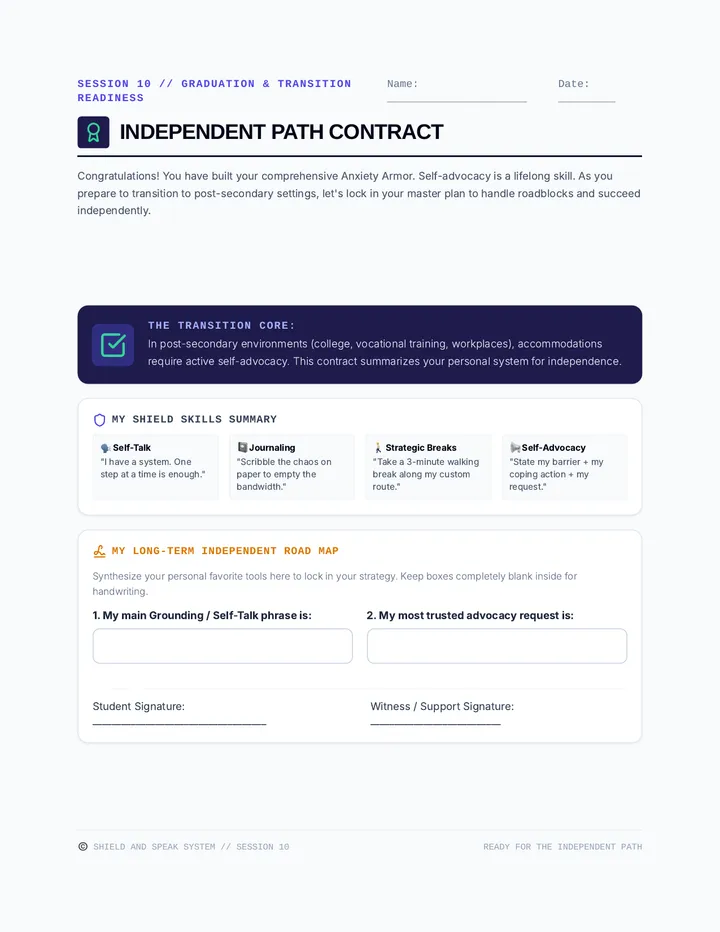
Independent Path Contract Session 10 // Graduation & Transition Readiness
Name: ______________________ Date: _________
Independent Path Contract
Congratulations! You have built your comprehensive Anxiety Armor. Self-advocacy is a lifelong skill. As you prepare to transition to post-secondary settings, let's lock in your master plan to handle roadblocks and succeed independently.
The Transition Core:
In post-secondary environments (college, vocational training, workplaces), accommodations require active self-advocacy. This contract summarizes your personal system for independence.
My Shield Skills Summary
🗣️ Self-Talk "I have a system. One step at a time is enough."
📓 Journaling "Scribble the chaos on paper to empty the bandwidth."
🚶 Strategic Breaks "Take a 3-minute walking break along my custom route."
📢 Self-Advocacy "State my barrier + my coping action + my request."
My Long-Term Independent Road Map
Synthesize your personal favorite tools here to lock in your strategy. Keep boxes completely blank inside for handwriting.
1. My main Grounding / Self-Talk phrase is:
2. My most trusted advocacy request is:
Student Signature: ____________________________________
Witness / Support Signature: ___________________________
© SHIELD AND SPEAK SYSTEM // SESSION 10 READY FOR THE INDEPENDENT PATH