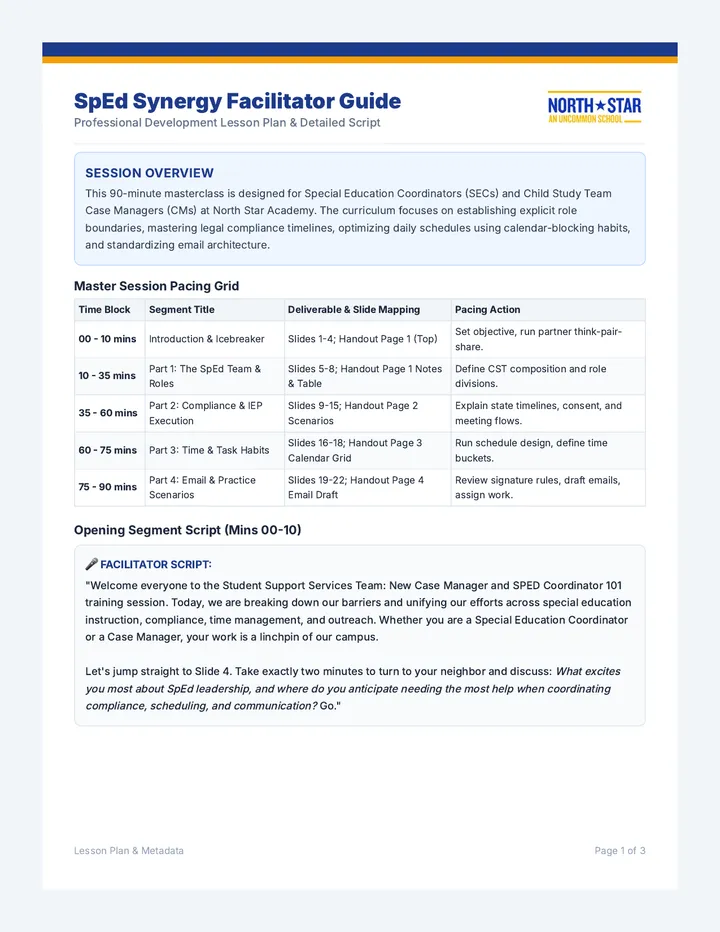
Student Support Services Team: New Case Manager and SPED Coordinator 101

PROFESSIONAL DEVELOPMENT
Student Support Services Team
New Case Manager and SPED Coordinator 101
Aligning Compliance, Time Management, and Communication
Time: 90 Minutes Slide 1 of 22
Today's Objectives
1
Establish Explicit Partnerships
Clearly define and separate the day-to-day responsibilities of Case Managers and Special Education Coordinators.
2
Master Compliance & Timelines
Commit state-mandated timelines, consent rules, and meeting procedures to habit to protect legal standards.
3
Optimize Time & Task Habits
Adopt specific schedule-blocking and email structures that reduce coordination overhead and protect deep work.
Introduction Slide 2 of 22
Today's Agenda
90-Minute Session Mapping
PART 1: THE SPED TEAM & ROLES
Partnership & Composition
Aligning the Child Study Team, Regional Contacts, and parent communication channels. (25 mins)
PART 2: COMPLIANCE & TIMELINES
Timelines & IEP Running
Decoding state rules, parental consent triggers, and running effective, collaborative IEP meetings. (25 mins)
PART 3: TIME & TASK HABITS
Calendar & Focus Blocking
Structuring the "Big Rocks," planning "Hunker Down" work, and mapping out a standard week. (20 mins)
PART 4: STREAMLINED COMMUNICATION
Email & Case Management Practice
Writing high-leverage emails, managing task trackers, and walking through real-world scenarios. (20 mins)
Introduction Slide 3 of 22
Think, Pair, Share
Opening Reflection
Discuss the following with your partner:
What excites or interests you most about Case Management or Special Education leadership?
What do you anticipate needing the most support with when merging compliance duties, schedules, and communication?
Time Block: 5 Minutes Slide 4 of 22
SECTION 01 OF 04
Part 1
The SpEd Team & Distinct Partnerships
Understanding Child Study Team (CST) structures, campus lines of support, and the division of work between Special Education Coordinators (SECs) and Case Managers (CMs).
Focus: Aligning Our Roles Slide 5 of 22
Special Education Team Landscape
Child Study Team (CST) Roles
School Psychologist
Conducts psychological evals, assesses cognitive/emotional development, consults on social-emotional interventions.
LDT-C
Evaluates academic achievement, identifies learning styles, provides explicit instructional recommendations.
School Social Worker
Conducts social history evaluations, assesses family/community factors, coordinates outside supports.
Speech-Language
Assesses and treats student communication disorders (integrated when communication needs are identified).
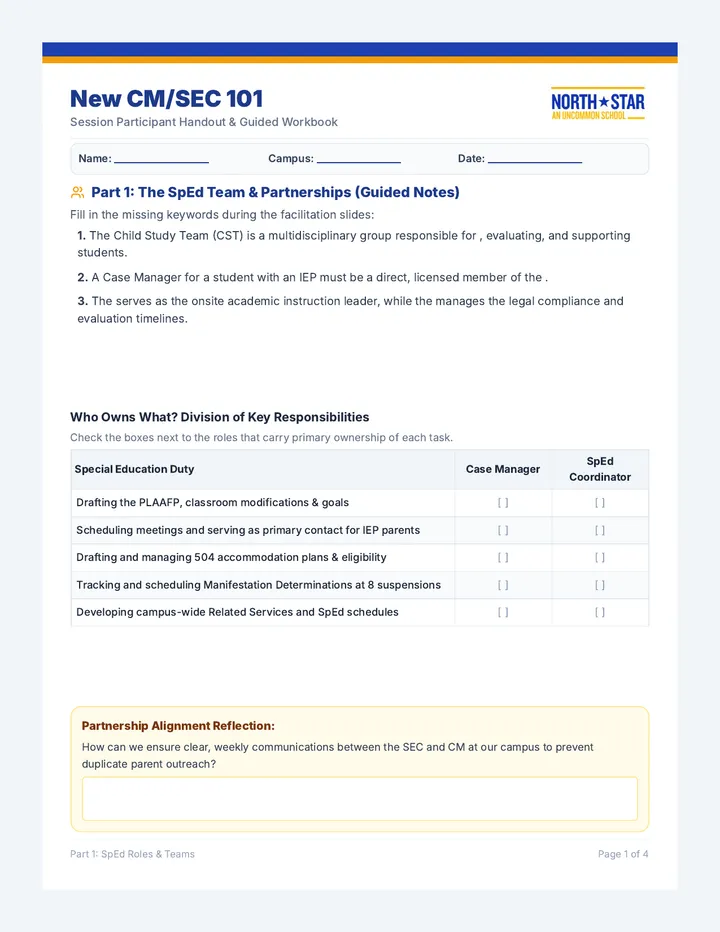
Rule of Team Membership: A Case Manager for a student with an IEP must be a direct, licensed member of the Child Study Team.
Part 1: Team Landscape Slide 6 of 22
CST Case Manager (CM) Role
Primary Focus: Compliance & Parents
Scheduling & Parent Contact
Schedules and invites parents to all IEP-related meetings. Serves as parent point-of-contact.
Evaluation & Draft Planning
Drafts the Evaluation Planning form and Eligibility Report in EdPlan at least 48 hours prior to meetings.
SEMI Logs & Consent
Logs counseling / IEP meeting services daily/weekly. Gathers and uploads parent SEMI consent.
Suspensions & Manifestation Determinations
Collaborates with Deans before a suspension is issued to ensure looping. Tracks suspensions and triggers a Manifestation Determination Meeting when a student hits 8 suspensions (and every suspension after).
Ensure a Dean who can speak directly to the infractions is always present.
Part 1: Role of CM Slide 7 of 22
SpEd Coordinator (SEC) Role
Primary Focus: Instruction & Schedules
Special Education Instruction
Serves as a Special Education Teacher. Coordinates with grade levels, collects student progress, and drafts student PLAAFP, goals, and modifications.
MTSS & 504 Case Manager
Manages MTSS action plans, coaches intervention teachers, drafts 504 accommodation plans, and updates 504 eligibility every 3 years.
Schedules & Related Services
Creates and manages the Related Services schedules, SpEd services schedule, and coordinates ELL needs and testing rooms.
Key Distinctions from Case Manager:
- ✔ SEC writes modifications, whereas CM evaluates eligibility.
- ✔ SEC manages day-to-day services and MTSS process.
- ✔ SEC coordinates with DOO & Principal on campus service models.
SEC acts as the onsite academic leader; CM handles legal, evaluation, and compliance coordination.
Part 1: Role of SEC Slide 8 of 22
SECTION 02 OF 04
Part 2
Compliance, Timelines & IEP Execution
Navigating state mandated timelines, consent requirements, and establishing clinical habits for pre-meeting alignment and in-meeting execution.
Focus: Flawless Legal Timelines Slide 9 of 22
State Mandated Timelines
Critical Deadlines
20 Days
Parental Evaluation Request
Time from written request receipt to holding the ID meeting. (Coordinate with CST and invite parents within 10 days of request.)
90 Days
Initial Evaluation Cycle
Max days allowed from date of signed consent to evaluate to holding the eligibility and IEP meetings. Reports sent 75 days post-meeting.
60 Days
Re-Evaluation Cycle
Max days allowed from date of consent to evaluate to eligibility meeting. Re-evaluations must occur every 3 years.
15 Days Prior: Send parent invitation and formal Written Notice for annual reviews.
10 Days Prior: Send parent invitation and formal Written Notice for eligibility meetings.
Annually: Minimum frequency to hold IEP reviews. Plan by the actual ending IEP date!
Part 2: Timelines Slide 10 of 22
Consent Rules: When is it Required?
Legal Benchmarks
Obtain Signed Parental Consent BEFORE:
- Evaluating a student for the first time.
- Beginning a student's special education program for the first time.
- Testing as part of a re-evaluation (unless several attempts documented).
- Excusing a mandated member of the IEP team.
Consent NOT Required / Automatic Effect:
- If parent does not provide consent 15 days after an annual review / reevaluation, the proposed IEP automatically goes into effect.
- Eligibility Determination itself (does not require parent signature to finalize).
- 504 documents automatically go into effect 15 days post-meeting.
Part 2: Consent Rules Slide 11 of 22
Pop Quiz!
Compliance Speed Round
Question 1:
How often are IEP meetings held (at a minimum)?
Question 2:
A parent requests an evaluation in writing. Deadline to meet?
Question 3:
Days to send Written Notice / parent invitation prior to an IEP?
Question 4:
How many days does the CST have to review all reports for an INITIAL evaluation?
Pacing: Think about your answers... Slide 12 of 22
Pop Quiz Answers!
Compliance Verified
Question 1:
How often are IEP meetings held (at a minimum)?
Annually
Question 2:
A parent requests an evaluation in writing. Deadline to meet?
20 Days
Question 3:
Days to send Written Notice / parent invitation prior to an IEP?
15 Days
Question 4:
How many days does the CST have to review all reports for an INITIAL evaluation?
90 Days
Verification: Protect your timelines Slide 13 of 22
IEP Meetings: Before & Starting
Pacing & Structure
Before the Meeting: Alignment
- Collaborative Outlook: Align on basic plans while fully prioritizing parent participation.
- Time for Debate: Meet internally 15 minutes before parent joins.
- Check Data: Ensure all evaluations and service logs are completed and on EdPlan.
- Draft goals and PLAAFP 48 hours prior.
Starting: The First 5 Minutes
- Punctuality: Start exactly on time to respect all schedules.
- Introductions: State names, explicit titles, and the designated note taker (CM).
- Student Centered: Lead by sharing a positive, personal strength of the child.
- Clarify Purpose: Outline exactly what decisions will be made.
Part 2: IEP Facilitation Slide 14 of 22
IEP Meetings: During & Post
The Collaboration Framework
DURING: Roles Breakdown
Case Manager (Note Taker) • Facilitates flow, documents parent concerns, reviews eligibility, and captures formal meeting minutes.
SPED Coordinator (SEC) • Presents present levels (PLAAFP), shares classroom progress, discusses goals/accommodations, and reviews SpEd services.
POST: Execution & Signatures
1
Proposed Version: CM drafts and sends proposed version to parent via DocuSign by end of day (EOD).
2
DocuSign Sweep: Follow up immediately; secure all attendee and parent signatures.
3
EdPlan Upload: Upload fully signed document to EdPlan and update SpEd tracker within 15 days.
Part 2: IEP Execution Slide 15 of 22
SECTION 03 OF 04
Part 3
Time & Task Management (TTM)
Overcoming schedule fragmentation. Applying the "Big Rocks" scheduling framework, color-coding Outlook, and designing standard weeks to protect deep work.
Focus: Calendar and Productivity Slide 16 of 22
Big Rocks Come First
Managing Time Buckets
Your Six Time Buckets:
- 1 Direct Teaching: Core intervention instruction.
- 2 IEP & 504 Meetings: Annuals, eligibility, initials.
- 3 Regional Meetings: Weekly check-ins with SSM.
- 4 Lesson Planning: Curriculating SpEd services.
- 5 Staff Collaboration: Check-ins with deans, teachers.
- 6 Email & Calls: Regulating communication intake.
The "Big Rocks" Theory
If you fill your jar with sand (emails, drop-ins, tiny administrative tasks) first, you will not have space for the big rocks (teaching, deep-work planning, parent meetings).
Calendar Habit: Schedule your big, immovable rocks (Teaching blocks, IEP meetings) on Outlook first, then nest work time, and finally fill the gaps with sand.
No day is normal in SpEd leadership. You must explicitly build flex-time into your schedule.
Part 3: Time Buckets Slide 17 of 22
Structuring a Balanced Week
Daily Pacing Priorities
1. Instruction & Mtgs
4-5 Hours / Day
The bulk of your day. Core SpEd teaching blocks, annual IEP/504 meetings, and mandatory staff collaborations. Non-negotiable priorities.
2. Deep Work Blocks
2-3 Hours / Day
For writing IEPs, drafting evaluation plans, compiling MTSS student reports, and prepping complex educational plans. Keep your door closed.
3. Email & Phone
< 1 Hour / Day
Regulated to 2-3 specific times daily. Avoid keeping email open in background. Turn off desktop notifications to prevent focus fragmentation.
Calendar Habit: Schedule "hunker down" work on Outlook. Weekly Habit: Spend Friday afternoon planning next week's layout.
Part 3: Daily Pacing Slide 18 of 22
SECTION 04 OF 04
Part 4
Streamlined Communication & Systems
Driving execution through specific email architecture, recipient targeting, tracker ownership, and walking through real-world scenario coordination.
Focus: High-Leverage Outreach Slide 19 of 22
SpEd Email Architecture
Writing High-Leverage Outreach
1
Clear Subject Headers
Provide direct context and actionable deadlines. Include student initials.
Bad: "Quick Question"
Good: "Action Req 3/10: PT input for ST"
2
Disciplined Recipient Fields
To: Only individuals from whom you expect immediate action/response.
CC: Key partners who need information, but no direct response (e.g., Regional Contact, school leaders).
Email Signature Requirements
Your email signature must follow NSA guidelines and explicitly include the Parental Rights in Special Education (PRISE) link and the confidentiality statement.
PRISE Link (Parental Rights in Special Education)
CONFIDENTIALITY STATEMENT: This email and files transmitted are confidential and intended solely for recipient...
Part 4: Email Structure Slide 20 of 22
Next Steps & Deliverables
Immediate Action Required
- By Friday 8/23: Review the three EdPlan navigation, caseload setup, and SEMI logging training videos.
- By Friday 8/23: Log into EdPlan and set up your case management caseload tracker. Send self-introduction letters.
- By Thursday 8/29: Schedule your weekly ongoing SpEd check-ins with your regional coordinator (SSM).
Ongoing Tracker Ownership
- Case Manager: Owns and updates the Meetings Log, OSS Discipline/Removal tab, and SEMI consents/logs daily.
- SpEd Coordinator: Owns and updates the Student Roster, snapshots, Related Services tracker, and MTSS logs weekly.
- Regional Contact: Audits IEP timelines weekly and reviews notes.
Part 4: Deliverables Slide 21 of 22
THANK YOU
Thank You for Your Leadership!
"With better communication, we make better use of our time."
Let's work together to protect compliance, maximize student instruction, and build strong professional partnerships across our classrooms.
Case Manager & SPED Coordinator 101 Slide 22 of 22