Circle Stars Teacher Guide Lesson 1: Arrival & Circle
Circle Time Stars
Unit: Ready Set School Teacher Guide: Day 1-5
Pacing
Arrival: 20 mins
Setting
K-5 Self-Contained
Key Targets
Visual Schedule
Instructional Objectives
1
Arrival Routine Mastery: Students will enter the classroom, hang up backpacks, and transition to the circle rug with visual/verbal prompt levels reduced by 25% by Day 5.
2
Schedule Interaction: Students will participate in manipulating a personalized visual schedule or checking-in on the main routine board during circle time.
3
Engagement & Communication: Students will respond to their names during greeting time using their preferred communication mode (verbal, AAC, sign, or touch/eye-gaze).
Environmental Setup & Adaptations
Visual Boundaries
Define the Circle Rug area using colored taped borders, visual sit-spots, or individual carpets. Use carpet markers with students' names or photos to prevent space disputes.
Sensory Adjustments
Have wiggle cushions, weighted lap pads, and noise-canceling headphones readily accessible next to the circle time rug. Transition lights to warm/dim settings 2 minutes prior.
Arrival Sequence (First Week Strategy)
Step 1
The Greeting Threshold
Meet students at the door. Hand them their visual check-in icon immediately. Avoid sensory overload: keep your voice warm but calm and direct. Prompt student to hand backpack to designated hook.
Step 2
Cubby & Check-In
Guide student to cubby using "First Cubby, Then Circle" visual card. Use hand-over-hand physical guidance or gesture prompts. Student places backpack in cubby, takes off outerwear, and proceeds to circle board.
Step 3
First-Then Rug Sit-Spot
Provide immediate positive reinforcement (high-five, edible, highly preferred toy) as soon as the student sits on their designated carpet spot. Keep wait times extremely short with "wait-time containers" (pop-tubes, sensory bottles).
Ready Set School Unit • Lesson 1 Page 1 of 2
Lesson 1: Routine Breakdown
Morning Circle Routine
Day 1-5 Scaffold Circle Flow & IEP Planning
Daily 15-Minute Circle Sequence
Routine Segment Teacher Action & Verbal Scripts Student Response / Adaptation 1. Hello Song (3 minutes) Sing greeting song (e.g., "Hello [Name], how are you?"). Use a physical greeting board where students place their photo in the "Here" box. Wave, tap hello card, say "hello", or activate a BIGmack switch with custom greeting message. 2. Schedule Check (3 minutes) Point to schedule cards. "Today we have: Circle, then Play, then Snack." Guide student helper to move the "Now" arrow indicator. Look at schedules, repeat simple key words, point to matching individual visual strips. 3. Weather / Clothing (4 minutes) Sing weather song. Look out window. Use multi-sensory items (mister for rain, yellow ball for sun, real wool scarf for cold). Touch sensory items, choose between two visual choice symbols (e.g., sunny vs. rainy). 4. Movement Song (3 minutes) Play highly visual gross motor song (e.g., "Freeze Dance", "If You're Happy and You Know It"). Model physical actions exaggeratedly. Imitate physical motions. Stand up, jump, clap, or wiggle in seat. High engagement. 5. Transition Out (2 minutes) Use a transition chime. "Circle is ALL DONE." (Perform "All Done" manual sign). Direct individuals to visual schedule boards. Make "All Done" sign, stand up, take transitional item to next area (e.g., puzzle piece).
IEP Data Targets during Circle
Receptive Communication Target
"Following visual/verbal instructions to transition to circle within 60 seconds with 1 or fewer physical prompts."
Expressive / Social Interaction Target
"Responding to peer/teacher greeting by making eye contact, waving, or touching symbol, on 4 out of 5 daily trials."
Teacher Pro-Tips: Keeping the Circle Calm
During week 1, do not worry about academic content (days of the week, calendar numbers). Focus entirely on the physical and visual structure of sitting together, looking at the speaker, and interacting. If a student stands up, gently guide them back without verbal scolding, or offer an alternative "active-sit" cushion. Always use low-arousal vocal tones.
Ready Set School Unit • Lesson 1 Page 2 of 2
Morning Circle Visuals Classroom Daily Visuals
Directions: Print, cut along dashed lines, laminate, and apply rough Velcro on the back.
Printable Visuals
Routine Card 1
Circle Time
Hello Song & Calendar
Velcro Dot
Routine Card 2
Centers
Toys, Blocks, & Puzzles
Velcro Dot
Routine Card 3
Snack
Eating & Cleaning Up
Velcro Dot
Routine Card 4
Playground
Outdoor Play & Running
Velcro Dot
Routine Card 5
Bathroom
Wash Hands with Soap
Velcro Dot
Routine Card 6
Pack Up
Backpack & Going Home
Velcro Dot
Ready Set School Unit • Circle Time Stars Page 1 of 2
Interactive Circle Interactive Boards
Cut-outs for your weather chart and peer-greeting check-in sequence.
Weather & Welcome
Class Greeting Board
Attach the student's photo card here when they arrive!
[ Photo Spot ]
[ Photo Spot ]
[ Photo Spot ]
[ Photo Spot ]
Printable Weather Cards (Cut Out)
Weather 1
Sunny
Weather 2
Rainy
Weather 3
Cloudy
Weather 4
Snowy
Pro-Tip for Communication: Give emerging verbal learners a choice of two weather cards (e.g. Sunny and Rainy) instead of asking the open question, "What is the weather today?" Handing you the physical card serves as an active communicative response.
Ready Set School Unit • Circle Time Stars Page 2 of 2
Circle Star Slides Morning Circle
Good Morning,
School Stars!
It is time to sit together, sing, and look at our daily plan.
Teacher Cue: Play greeting chime and guide students to their designated sit-spots.
Today's School Plan
Let's look at what we are doing today!
First
Circle Time
Then
Centers
Next
Snack
"First we do Circle Time, then we play in Centers!"
Who is at School?
Let's wave and say Hello to our friends!
Hello Song Time
"Hello [Student Name], we are happy you are here today!"
Wave Hello
Smile
Say Hello
Prompt: Point to the student's name/photo on the smartboard, encourage peers to look and wave.
What is the Weather?
Let's look out the window together!
Sunny
Rainy
Cloudy
Snowy
"Is it sunny or rainy today? Point and tell!"
Circle is ALL DONE!
It is time for center playtime.
1
Stand up calmly
2
Check visual schedule
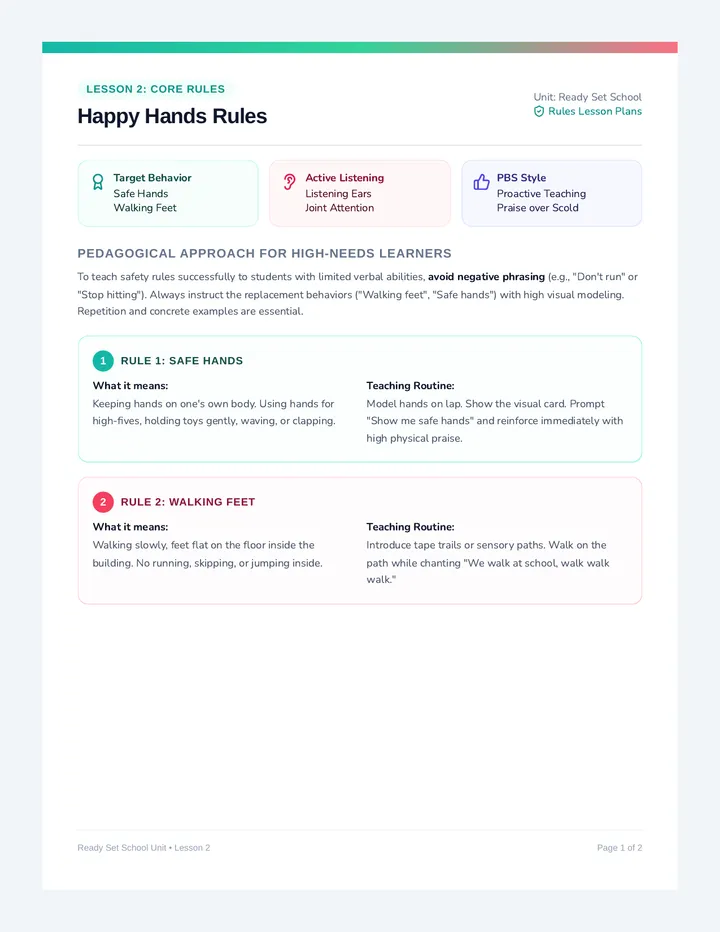
Happy Rules Teacher Guide Lesson 2: Core Rules
Happy Hands Rules
Unit: Ready Set School Rules Lesson Plans
Target Behavior
Safe Hands
Active Listening
Listening Ears
PBS Style
Proactive Teaching
Pedagogical Approach for High-Needs Learners
To teach safety rules successfully to students with limited verbal abilities, avoid negative phrasing (e.g., "Don't run" or "Stop hitting"). Always instruct the replacement behaviors ("Walking feet", "Safe hands") with high visual modeling. Repetition and concrete examples are essential.
1
Rule 1: Safe Hands
What it means:
Keeping hands on one's own body. Using hands for high-fives, holding toys gently, waving, or clapping.
Teaching Routine:
Model hands on lap. Show the visual card. Prompt "Show me safe hands" and reinforce immediately with high physical praise.
2
Rule 2: Walking Feet
What it means:
Walking slowly, feet flat on the floor inside the building. No running, skipping, or jumping inside.
Teaching Routine:
Introduce tape trails or sensory paths. Walk on the path while chanting "We walk at school, walk walk walk."
Ready Set School Unit • Lesson 2 Page 1 of 2
Lesson 2: Behavior Guide
Positive Reinforcement
Classroom Routines Rules Implementation
3
Rule 3: Listening Ears
What it means:
Looking towards the teacher when called, quiet voice when others are talking, and pointing to ears to show attention.
Teaching Routine:
Play sound-recognition games. Whisper instructions. Touch ears together while saying "Ears are ready to listen!"
Daily 5-Minute Modeling Drills
Run these drills daily right after Circle Time. Pick one rule per day to practice directly through role-play.
Drill: "Safe Hands Helper"
Provide two students with a soft beanbag or visual token. Instruct: "Keep your safe hands holding the beanbag." Practice walking side-by-side gently. High praise: "Your hands are safe!"
Drill: "Red Light, Green Light Walkers"
Using the Walking Feet visual card. Play a game where green means slow, calm walking, and red means "Freeze!" Explicitly praise slow movements: "Look at those walking feet!"
SpEd Behavior Intervention Strategy
If a student demonstrates unsafe hands (hitting, throwing),
Happy Rules Adapted Book My School Rules Adapted Book
Teacher Note: Laminate pages, cut out matching symbol cards on Page 2, and place Velcro on squares.
Interactive Book
Book Cover
I Can Follow Rules!
An interactive book about our safe and happy classroom.
Name: ________________________
Date: ___________
Page 1
My Safe Hands
At school, I use my hands gently. I keep my hands on my own body. I wave, I clap, and I high-five. My hands are safe.
Place Velcro
Match Safe Hands
"I keep my hands safe."
Ready Set School Unit • Happy Hands Rules Page 1 of 2
My School Rules Adapted Book (Cont.)
Cut out matching symbols at the bottom and use for pages 1, 2, and 3.
Matching Pieces
Page 2
My Walking Feet
Inside our school, I walk slowly. I walk with my feet on the flat floor. Walking keeps me safe and happy.
Place Velcro
Match Walking Feet
"I use my walking feet."
Laminate & Cut Out Matching Pieces
Piece 1
Safe Hands
Piece 2
Walking Feet
Piece 3
Listening Ears
Ready Set School Unit • Happy Hands Rules Page 2 of 2
Happy Rules Cue Cards Paraprofessional Lanyard Visuals
Directions: Cut along dashed lines, laminate, punch a hole in the circle, and clip to school lanyards.
Lanyard Prompts
o
Safe Hands
Keep hands on your own body.
Happy Hands SpEd
o
Walking Feet
Walk slowly in school.
Happy Hands SpEd
o
Listening Ears
Look and listen to teacher.
Happy Hands SpEd
o
Quiet Voice
Use your inside voice.
Happy Hands SpEd
o
Sit Spot
Sit on your spot calmly.
Happy Hands SpEd
o
All Done
Clean up; activity is finished.
Happy Hands SpEd
Ready Set School Unit • Happy Hands Rules Page 1 of 2
Individual Desk & Table Visuals
Printable desk strips and visual token boards for real-time rule reinforcement.
Desk Prompts
Desk Rules Strip (Print & Cut)
Safe Hands Keep hands to yourself
Walking Feet Walk slowly in school
Listening Ears Look at the teacher
My Rule Star Board
Provide tokens when you spot the student following rules. Short-loop success!
ID: PBS-TB3
I am working for:
[ Velcro Reward ]
Token 1
Token 2
Token 3
Goal: Fill all 3 stars to earn your reward! Keep positive momentum going!
Ready Set School Unit • Happy Hands Rules Page 2 of 2
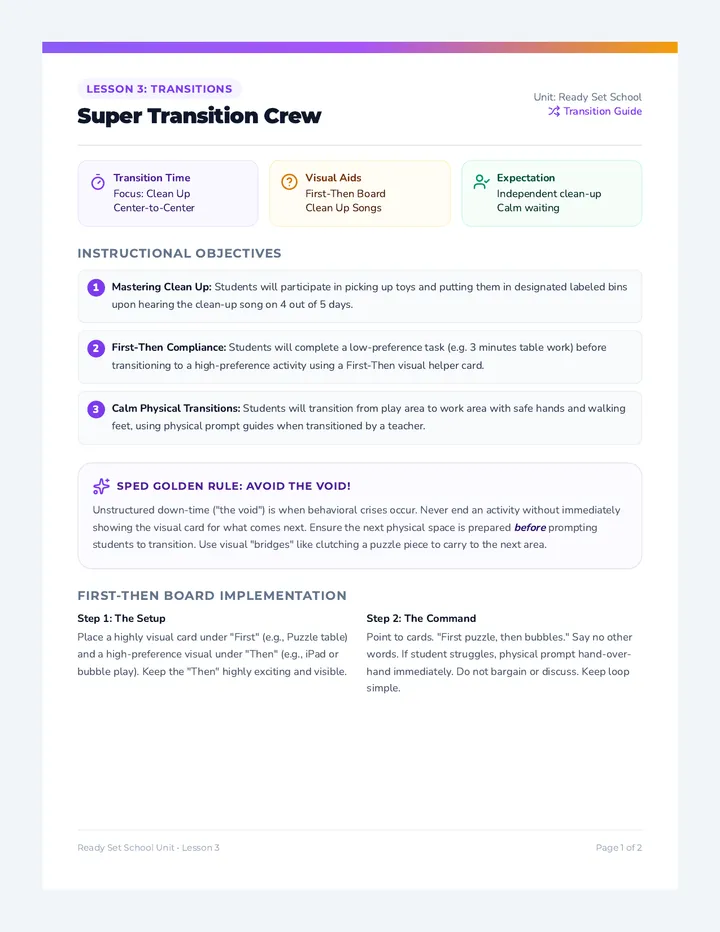
Super Transition Teacher Guide Lesson 3: Transitions
Super Transition Crew
Unit: Ready Set School Transition Guide
Transition Time
Focus: Clean Up
Visual Aids
First-Then Board
Expectation
Independent clean-up
Instructional Objectives
1
Mastering Clean Up: Students will participate in picking up toys and putting them in designated labeled bins upon hearing the clean-up song on 4 out of 5 days.
2
First-Then Compliance: Students will complete a low-preference task (e.g. 3 minutes table work) before transitioning to a high-preference activity using a First-Then visual helper card.
3
Calm Physical Transitions: Students will transition from play area to work area with safe hands and walking feet, using physical prompt guides when transitioned by a teacher.
SpEd Golden Rule: Avoid the Void!
Unstructured down-time ("the void") is when behavioral crises occur. Never end an activity without immediately showing the visual card for what comes next. Ensure the next physical space is prepared before prompting students to transition. Use visual "bridges" like clutching a puzzle piece to carry to the next area.
First-Then Board Implementation
Step 1: The Setup
Place a highly visual card under "First" (e.g., Puzzle table) and a high-preference visual under "Then" (e.g., iPad or bubble play). Keep the "Then" highly exciting and visible.
Step 2: The Command
Point to cards. "First puzzle, then bubbles." Say no other words. If student struggles, physical prompt hand-over-hand immediately. Do not bargain or discuss. Keep loop simple.
Ready Set School Unit • Lesson 3 Page 1 of 2
Lesson 3: Centers Protocol
Centers & Clean Up Sequence
Classroom Rotines Daily Transition Guide
Mastering the Clean-Up Transition (Daily Flow)
Time/Trigger Teacher/Staff Action & Strategy Student Support Required 2 Min Warning Visual Timer Show visual countdown sand-timer or digital red timer. Whisper: "2 minutes left, then we clean up." Maintain quiet vocal space. Look at timer. Make transitioning statement/acknowledgment where possible.
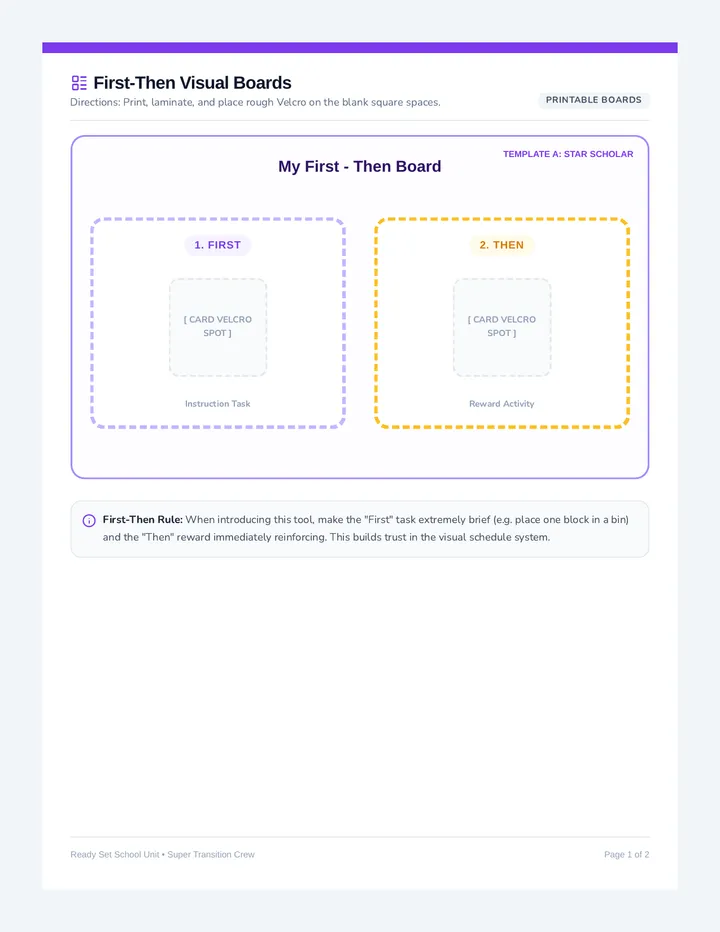
Transition Boards Visuals First-Then Visual Boards
Directions: Print, laminate, and place rough Velcro on the blank square spaces.
Printable Boards
Template A: Star Scholar
My First - Then Board
1. FIRST
[ Card Velcro Spot ]
Instruction Task
2. THEN
[ Card Velcro Spot ]
Reward Activity
First-Then Rule: When introducing this tool, make the "First" task extremely brief (e.g. place one block in a bin) and the "Then" reward immediately reinforcing. This builds trust in the visual schedule system.
Ready Set School Unit • Super Transition Crew Page 1 of 2
First-Then Visual Cards
Directions: Cut along dashed lines, laminate, and attach soft Velcro on the backs.
Cut-out Cards
Task Card 1
Clean Up
Task Card 2
Table Work
Task Card 3
Puzzle
Task Card 4
Wash Hands
Reward Card 1
Tablet
Reward Card 2
Sensory Play
Reward Card 3
Bubbles
Reward Card 4
Blocks
Ready Set School Unit • Super Transition Crew Page 2 of 2
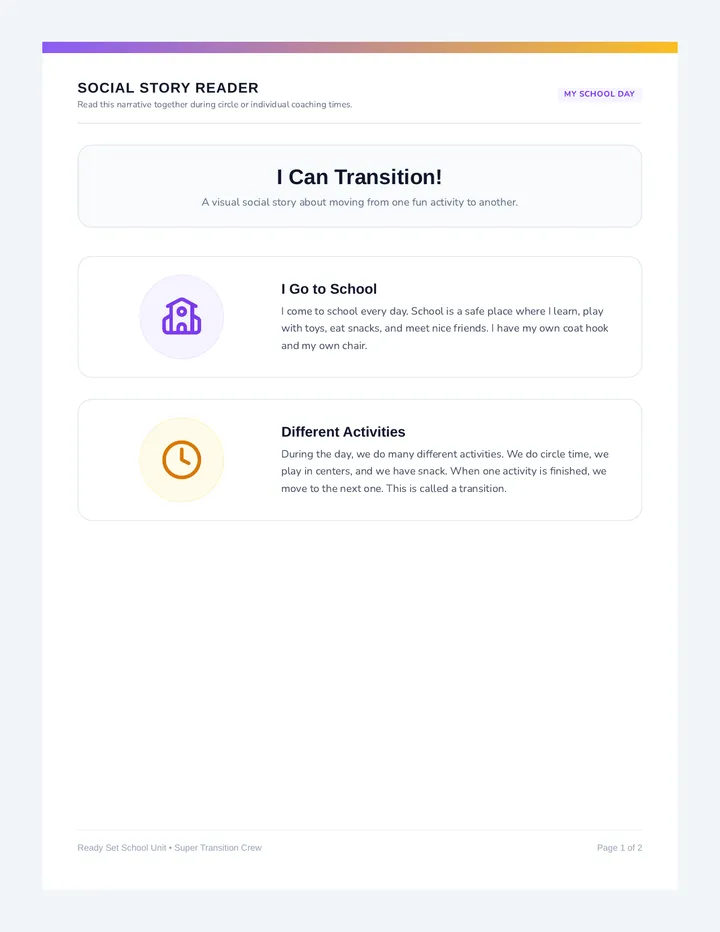
My School Transition Story Social Story Reader
Read this narrative together during circle or individual coaching times.
My School Day
I Can Transition!
A visual social story about moving from one fun activity to another.
I Go to School
I come to school every day. School is a safe place where I learn, play with toys, eat snacks, and meet nice friends. I have my own coat hook and my own chair.
Different Activities
During the day, we do many different activities. We do circle time, we play in centers, and we have snack. When one activity is finished, we move to the next one. This is called a transition.
Ready Set School Unit • Super Transition Crew Page 1 of 2
Social Story Reader (Cont.)
Read this narrative together during circle or individual coaching times.
My School Day
The Clean-Up Song
When center play is finished, I will hear the "Clean-Up Song". Hearing this song means it is time to put toys away. I can pick up blocks and cars and slide them into our labeled bins.
I am a Transition Superstar!
Moving to new places is easy when I check my visual board. I look at my "First-Then" schedule to see what is next. Following the plan keeps everyone happy, and I get stars on my board!
Talk about the story:
What is the name of our school? ________________________
What do we hear when play is finished? ________________________
Where do the toys go during Clean Up? ________________________
Ready Set School Unit • Super Transition Crew Page 2 of 2