Brain Squad Facilitator Guide Brain Squad Mastery
Unit Facilitator Guide: A 4-Week Social Skills Curriculum
Upper Elementary Neurodiversity Affirming 8 Lessons
Unit Philosophy
The Core Message
"We aren't 'fixing' behavior; we are teaching students to understand their biological alarm system and providing the tools to help their Smart Brain (PFC) regain control."
The Squad Metaphor
By personifying the brain parts as Sparky and Professor PFC , we remove shame from emotional reactivity and create a common language for self-regulation.
The 4-Week Roadmap
Week Lesson A (Intro/Concept) Lesson B (Activity) WEEK 1 1: Brain Squad Basics Meet Sparky vs. Professor PFC 2: Inside the HQ Anatomy & Brain Parts Puzzle WEEK 2 3: The Autism Switch The "Stuck" Brain biology 4: Trigger Detectives Identifying personal alerts WEEK 3 5: The Flipped Lid The hand model of regulation 6: The Smart Roadmap Flowcharts for responding WEEK 4 7: Scenario Showdown Skits and Game Day 8: Hobby Power Outlets & Mastery Quiz
W1
Week 1: Identity & Anatomy
Lesson 1: Brain Squad Basics
Introductory
Key Discussion Question:
"What is a choice you made today that was FAST? What is a choice that was SLOW?"
Practice Activity: Freeze Frame Reactions. Teacher calls out a scenario (e.g., "Someone bumped you"). Students freeze in a "Sparky" pose (arms up/shock) then a "Professor" pose (rubbing chin/thinking).
Instructional Flow: Intro Character Slides -> Character Comparison Handout -> Freeze Frame Game -> T-Chart Reflection.
Lesson 2: Inside the HQ
Biological Focus
Key Discussion Question:
"If the Amygdala is our alarm, why do we need the Hippocampus 'library' to talk to it?"
Practice Activity: 3D Brain Model. Build a model with 4 distinct colors. Stress that the Prefrontal Cortex (Blue) is at the front, furthest from the reactive Stem.
Instructional Flow: HQ Anatomy Slides -> Brain Parts Definition Guide -> Brain HQ Puzzle Cut-out -> STEM Model Activity.
W2
Week 2: Autism & Triggers
Lesson 3: The Autism Switch
Key Discussion Question:
"Does your 'Smart Switch' ever feel stuck? Like a video game that is loading very slowly?"
Practice Activity: The High-Speed Highway vs. The Bridge. Draw two roads. Road A (Neurotypical) is clear. Road B (Autistic) has sensory barriers (lights/sounds). Explain that Sparky has to wait longer for the Professor's help on Road B.
Instructional Flow: Autism Connection Teacher Guide -> "The Switch" Video/Discussion -> Road Drawing Activity -> Body Awareness Check.
Lesson 4: Trigger Detectives
Key Discussion Question:
"What is a trigger that is 'invisible' to others? How can we tell Professor PFC about it?"
Practice Activity: Trigger Detective Scavenger Hunt. Walk around the classroom/hallway. Find 3 things that might wake Sparky up (loud fan, bright window, itchy rug).
Instructional Flow: Trigger Checklist -> Individual "Top 3" list -> Scavenger Hunt -> Body Signal Reflection.
W3
Week 3: Visual Tools
Lesson 5: The Flipped Lid
Key Discussion Question:
"When your lid is flipped, can Professor PFC give Sparky a high-five? Why not?"
Practice Activity: The Hand Model Drill. All students practice "Flipping" (fingers up) and "Connecting" (fingers down). Brainstorm "Lid Glue" (deep breaths, cold water, count to 10).
Instructional Flow: Flipped Lid Slides -> Hand Model Demo -> "Glue Action" Brainstorm -> Role Play "Flipping" (No acting out behavior, just the hand motion).
Lesson 6: The Smart Roadmap
Key Discussion Question:
"Why is Step 3 (The 5-Second Pause) the most powerful part of the whole roadmap?"
Practice Activity: The Pause Relay. Students stand in a circle. Teacher gives a trigger. Each student must do a 5-second pause (e.g., finger breathing) before passing the "Smart Choice" to the next student.
Instructional Flow: Roadmap Flowchart Review -> The 5-Second Pause Skill Training -> Roadmap Group Navigation -> Personal Response Guide.
W4
Week 4: Celebration & Mastery
Lesson 7: Scenario Showdown
Key Discussion Question:
"In Scenario 1, Sparky wanted to scream. How did Professor PFC change that into a winning choice?"
Practice Activity: The Director's Cut Skits. Students perform the provided skits. After the first performance, the teacher yells "Director's Cut!" and students must redo the ending using a DIFFERENT smart choice.
Instructional Flow: Scenario Game Slides -> Skit Group Planning -> Performance Showcase -> Peer "Smart Choice" Shout-outs.
Lesson 8: Hobby Power
Key Discussion Question:
"What is your 'Super Hobby'? How does it help Professor PFC stay strong?"
Practice Activity: Brain Master Badge Design. Students complete their quiz, then design a badge that features their favorite hobby as a "shield" for their brain squad.
Instructional Flow: Hobby Map Worksheet -> Personal Power-Up reflection -> Mastery Quiz -> Brain Master Graduation.
Facilitator Success Tips
1. Respect the Physiology If a student is currently "Flipped," these lessons will not reach them. Wait for their lid to come down before revisiting the concepts. Self-regulation is a biological process, not a moral failing.
2. Narrate Your Own Brain Be a model! "Class, my Sparky is waking up because the internet is slow. I am going to use Step 3 of my Roadmap and take a 5-second pause."
3. Visual Non-Verbals Use the hand model gestures silently throughout the day. If you see a student getting triggered, simply point to your own tucked thumb or folded fingers as a quiet reminder.
4. Interest-Led Squads Allow students to rename Sparky or the Professor based on their interests (e.g., Charizard vs. Alakazam) to increase emotional buy-in.
Brain Squad Progress Tracker Unit Progress Tracker
Monitoring: Brain Squad Mastery
10 Student Max
| Student Name | L1
Scoring Key (0-3)
3 (Mastery): Independent / Explains the "why".
2 (Proficient): Needs 1 verbal prompt.
1 (Emerging): Needs heavy visual support.
0 (Not Evident): Not yet introduced.
General Unit Observations Brain Squad Basics Slides Meet the Brain Squad
Smart Thinking vs. Reactive Feeling
SPARKY Emotional Brain
PROF. PFC Smart Brain
Meet Sparky
"I'm FAST!"
Protects you from Danger .
Fights, Flies, or Freezes.
Reacts in a split second.
🌋
Emotional Explosion!
Meet Professor PFC
💡
Smart Thinking!
"I'm SMART!"
Helps you Stop and Think .
Remembers the Rules .
Solves problems fairly.
Reacting vs. Thinking
Reacting
Feelings only
"I'm so mad, I'm going to YELL!"
Thinking
Pause for 5 seconds
"I'm mad, but I will breathe first."
Brain Parts Slides Inside the Headquarters
Exploring the anatomy of your Brain Squad!
Amygdala PFC Hippo
The Amygdala
This is Sparky's House. It's an almond-shaped alarm!
The Job:
It scans for Threats . It starts big feelings like Fear and Anger to keep you safe.
🌋
Reaction Center
The Sensitive Alarm
In Autism Brains:
Sparky (Amygdala) is extra sensitive .
Loud sounds can feel like a real alarm .
It's harder to hear the Smart Brain logic.
Sparky is LOUD
Prof. PFC is QUIET
Volume is turned UP!
Prefrontal Cortex
💡
Smart Center
This is Professor PFC's Office, right behind your forehead.
The Job:
It's your Smart Manager . It helps you focus, plan, and choose Problem-Solving Actions .
The Hippocampus
This is the Brain's Library . It's tucked deep inside!
The Job:
It stores all your Memories . It remembers social rules and what helped you last time.
📚
Memory HQ
The Brain Stem
⚡
Automatic HQ
This is the Autopilot . It connects your brain to your body.
The Job:
It handles Breathing and your Heartbeat without you even trying!
The Whole Squad
Alarm
Thinking
Library
Autopilot
When we know how our headquarters works, we can help Professor PFC stay in charge!
Build a Brain Activity Brain HQ Puzzle
Lesson 2 Activity
Inside the Headquarters
Assembly Mission:
Color the parts, cut them out, and glue them onto the Brain Base on the next page!
PFC: BLUE
Amygdala: ORANGE
Hippo: GREEN
Stem: GREY
The Cut-Out Lab
Prefrontal Cortex
Amygdala
Hippocampus
Brain Stem
Prefrontal Cortex
The Smart Brain office. I solve problems and help you follow rules.
Amygdala
The Alarm center. I scan for danger and start big feelings like anger.
Hippocampus
The Brain's Library. I keep memories and rules safe for the Professor.
Brain Stem
The Autopilot. I connect the brain to the body and handle breathing.
The Brain Base
Assemble your Brain Headquarters here!
PFC Area
Amygdala
Hippocampus
Brain Stem
Paste your name labels and definitions below your model!
Brain STEM Challenge Guide STEM Brain Challenge
Building the Brain Squad HQ
The Mission:
Create a 3D model of the brain using everyday materials. Your model must show the 4 key parts of the Brain Squad HQ!
Materials
Playdough (4 colors)
Sponges (easily cut)
Pipe Cleaners
Toothpicks & Tape
Color Key
Blue = PFC (Smart Office)
Orange = Amygdala (Alarm)
Green = Hippo (Library)
Grey = Stem (Autopilot)
Building Steps
1
Start with the Grey Brain Stem as your base cable.
2
Wrap the Green Hippocampus around the top of the stem.
3
Tuck the small Orange Amygdala next to the Library.
4
Place the large Blue PFC on the front of the model.
5
Make little paper flags to label each part of your masterpiece!
STEM Reflection
"If the Amygdala (The Alarm) was bigger than the Prefrontal Cortex, how would your brain act during a fire drill? Why?"
The Autism Connection Guide The Autism Connection
Teacher Reference & Discussion Guide
Brain Squad Mastery
Lesson 2
Why is the "Switch" harder for students with Autism?
For neurotypical students, the connection between the Amygdala (Sparky) and the Prefrontal Cortex (Professor PFC) acts like a high-speed highway. For students with Autism, this connection can feel more like a "stuck switch" or a bridge under construction.
1. Sensory Overload
Loud noises, bright lights, or itchy clothes are processed as threats by Sparky. When Sparky senses danger, he shuts down the road to Professor PFC immediately to focus on survival.
"It's not just a loud noise; it's a physical pain signal to their brain."
2. Executive Function Delay
Professor PFC is responsible for "Executive Functions" (planning, shifting attention). In Autism, these functions may take longer to "load." By the time the Smart Brain has a solution, Sparky has already reacted.
"Imagine a computer trying to run a heavy app with a slow internet connection."
3. Cognitive Rigidity
Changing plans or routines can feel like a "system error." Sparky hates surprises! When things don't go as expected, Sparky goes into Emergency Mode before Professor PFC can explain that it's okay.
"Predictability is the 'safety signal' for their emotional brain."
4. Social Processing
Understanding social cues is a "heavy lift" for Professor PFC. When a student is confused by a peer's joke or tone, Sparky fills that confusion with anxiety , leading to a defensive reaction.
"Confusion is often felt as a threat to their safety."
Discussion Prompts for Students
1
"Does it ever feel like Sparky is louder than Professor PFC in your brain? When does that happen?"
2
"When we get 'stuck' on a change, is that Sparky trying to protect us from a surprise?"
Teaching Tip:
Avoid asking "Why did you do that?" during a Sparky reaction. Sparky can't talk! Wait for Professor PFC to come back online (calm down) before discussing the behavior.
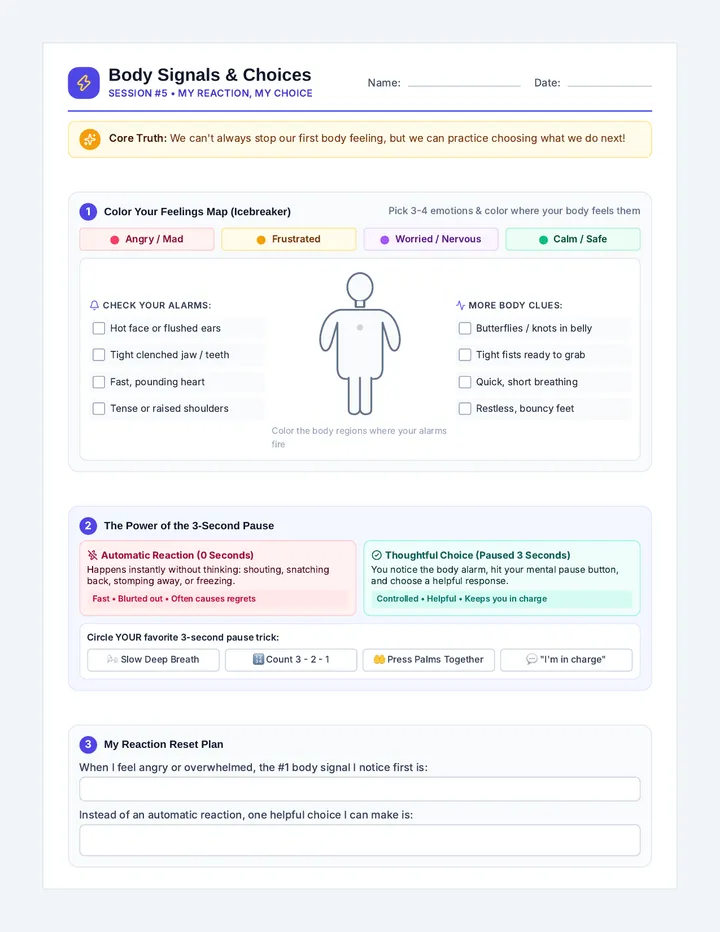
Trigger Detective Worksheet Name: ____________________________________
Date: __________________
Trigger Detective
What is a Trigger?
A trigger is something that happens that wakes up Sparky (Your Emotional Brain) . When a trigger happens, Sparky wants to react quickly!
Step 1: Common Trigger Checklist
Check the things that make your "Sparky" brain wake up:
Loud Noises
Unexpected Changes
Bright Lights
Being told "No"
Strong Smells
Losing a Game
Itchy Clothes
People touching my stuff
Step 2: My Big Three
Write or draw your three biggest triggers below:
Trigger #1
Trigger #2
Trigger #3
Step 3: Body Warnings
When Sparky is about to take over, how does your body feel? (Circle all that apply)
Fast Heartbeat Tight Fists Hot Face Tummy Ache Sweaty Hands Clenched Teeth Shaky Legs
My Control Plan
When I feel these signals, the first thing I will do is:
Flipped Lid Slides The Flipped Lid
Understanding what happens during a Meltdown
Brain Squad Series
Your Hand is a Brain!
1
The Thumb
This is the Amygdala (Sparky) . He stays tucked inside the safety of the fist.
2
The Fingers
These are the PFC (Professor) . They fold over Sparky to keep things calm.
✊
Lid Down = Thinking
Flipping the Lid
🤚
Lid Flipped!
The Disconnect:
When big feelings take over, the fingers Pop Up . The Professor can no longer talk to Sparky!
"I'm not being bad... my Professor PFC is just disconnected right now!"
The Lid Glue Strategy
Breathe
Slowly breathe in like a balloon, and out like a straw.
10 Rounds
Cool Down
Drink cold water or wash your face to reset the system.
Cold Water
Move
Push against a wall or take a 1-minute power walk.
Action reset
Smart Brain Roadmap Flowchart The Smart Brain Roadmap
From Reacting (Sparky) to Thinking (Professor PFC)
1. THE TRIGGER
Something happens that makes Sparky wake up!
2. BODY SIGNAL
My body feels hot or tight. This is the "warning."
3. The 5-Second Pause
Stop! Breathe and count 1-2-3-4-5.
Breathe Count Wait
4. PROF. PFC ACTIVATES
Ask: "What is a smart choice for me right now?"
5. SMART RESPONSE
I act using my smart brain. I feel proud!
Sparky: "I want to react right now! My big feelings are loud!"
Prof. PFC: "Wait. Let's look at the rules and find a safe solution."
Scenario Showdown Slides 🎮
Scenario Showdown
Sparky vs. Professor PFC
🕹️ How to Play
1
Identify Trigger
2
Spot Reacting
3
Choose Thinking
Scenario #1: The Alarm
🚨
The fire alarm goes off unexpectedly! It is very loud.
SPARKY:
"SCREAM and RUN for the door right now!"
PROF. PFC:
"Pause. Walk to the door with the line."
Scenario #2: Time's Up
💻
Teacher says: "Turn off the computer and start math."
SPARKY:
"Ignore them and keep playing! No math!"
PROF. PFC:
"Finish. Close the lid. I can play again later."
Scenario #3: The Accident
🧱
Someone accidentally knocks over your tower.
SPARKY:
"Push them back! They ruined everything!"
PROF. PFC:
"Pause. It was an accident. I can rebuild."
Scenario #4: The Joke
😂
A friend makes a joke you don't understand.
SPARKY:
"Are you making fun of me? Go away!"
PROF. PFC:
"Pause. Ask: 'What do you mean by that?'"
Scenario #5: The Wait
⏳
You are so hungry, but the line is very long.
SPARKY:
"Cut the line! I need food right NOW!"
PROF. PFC:
"Wait. Think about something fun. Almost there."
🤔
Your Turn!
Create your own scenario! What happens? What would Sparky and the Professor do?
Scenario #6: Student Choice
Sparky?
Prof. PFC?
Brain Squad Skit Scripts Handout Brain Squad Skit Scripts
Practice Making the Smart Choice!
Brain Squad Mastery
Lesson 6 Handout
Student 1: Sparky . Student 2: Prof. PFC . Student 3: The Student (Final Choice).
Skit #1: The Wrong Snack
The Trigger:
You wanted goldfish, but you got a cheese stick.
Sparky Reacts:
"Throw it on the floor! Tell the teacher you HATE cheese!"
Prof. PFC Thinks:
"Wait. It's safe to eat. Let's just say thank you anyway."
Student Choice:
Skit #2: The Bumpy Hallway
The Trigger:
The hallway is crowded. Someone accidentally bumps you.
Sparky Reacts:
"They did that on purpose! Push them back right now!"
Prof. PFC Thinks:
"Pause. It was an accident. Just keep walking."
Student Choice:
Skit #3: Hard Math
The Trigger:
You see a math problem you don't know how to solve.
Sparky Reacts:
"This is too hard! I'm not doing it! Rip up the paper!"
Prof. PFC Thinks:
"It's okay to be stuck. Let's raise our hand for help."
Student Choice:
Skit #4: Game Over
The Trigger:
Your friend wins the game and you come in second.
Sparky Reacts:
"I hate this game! It's not fair! I'm never playing again!"
Prof. PFC Thinks:
"Take a breath. Say 'Good game'. You did your best."
Student Choice:
Skit #5: The Smelly Lunch
The Trigger:
The cafeteria smells like tuna fish today.
Sparky Reacts:
"EW! IT STINKS! I'M LEAVING! Everyone is gross!"
Prof. PFC Thinks:
"Breathe through your mouth. Ask to sit at the end."
Student Choice:
The DIY Skit Zone
The Trigger:
Sparky's Reaction:
Professor's Thought:
The Student's Choice:
Use your best teamwork to perform this for the class!
Brain Squad Scenario Practice Sheet The Big Scenario Pack
Unit-Wide Social Skills Practice
Student: ___________________
Part 1: Brain Identification
Select Sparky or Professor for each reaction:
1
You lose a game and say, "I'm done! This is stupid!"
Sparky
Prof
2
Waiting in a long line without pushing or yelling.
Sparky
Prof
3
A surprise loud noise happens; you take a deep breath.
Sparky
Prof
4
Someone touches your stuff and you scream "NO!" instantly.
Sparky
Prof
5
Asking for help when a math problem gets too difficult.
Sparky
Prof
Create Your Own Challenge
Scenario:
Sparky
Professor
Part 2: Roadmap Challenges
Plan your Smart Brain response for these triggers:
1. Trigger: A noisy cafeteria making it hard to think.
My Roadmap Action (Step 3 or 4):
2. Trigger: Someone sitting in 'your' chair by mistake.
My Roadmap Action (Step 3 or 4):
3. Trigger: A favorite app is crashing and won't open.
My Roadmap Action (Step 3 or 4):
4. Trigger: It's time to stop your iPad and start work.
My Roadmap Action (Step 3 or 4):
5. Trigger: You rolled a 1 and the game is over for you.
My Roadmap Action (Step 3 or 4):
Personal Roadmap Creation
The Surprise Trigger:
My Roadmap Smart Action:
Hobby Power Map Worksheet Hobby Power Map
Name: ____________________________________
My Personal Regulation Map
Calm-Down Hobbies
Draw or write what helps when you feel ANGRY or LOUD:
Space #1
Space #2
Power-Up Hobbies
Draw or write what helps when you feel SAD or STUCK:
Space #1
Space #2
Prof. PFC Strategy
"When Sparky is loud, use a hobby for 10 minutes to help your Smart Brain take the wheel!"
Mastery Challenge Quiz Brain Squad Mastery Challenge
Unit Final Quiz
Brain Squad Mastery
Lesson 8
Part 1: Meet the Squad
Draw a line to match the character to their job:
Sparky
Professor PFC
I help you STOP and THINK . I solve problems fairly.
I am FAST and REACTIVE . I want to keep you safe.
Part 2: Multiple Choice
1. What is a "Trigger"?
A. Type of brain food
B. Something wakes Sparky up
C. Button on a game
D. Special kind of shoe
2. In Autism, why can the "Smart Switch" be slow?
A. Sensory stuff feels scary
B. Brain takes longer to "load"
C. Both A and B are correct
D. The switch is broken
3. What should you do in a "5-Second Pause"?
A. Scream loudly
B. Breathe and count to 5
C. Run away fast
D. Throw your pencil
Part 3: Final Reflection
Write or draw about a time you used your Smart Brain:
What is your favorite "Hobby Power" to help Sparky?
BRAIN MASTER!
Mastery Challenge Answer Key Guide Teacher Answer Key
Brain Squad Mastery Challenge Quiz
Part 1: Character Match
Sparky:
Matches with: "I am FAST and REACTIVE. I want to keep you safe using big feelings."
Professor PFC:
Matches with: "I help you STOP and THINK. I solve problems and help you follow the rules."
Part 2: Multiple Choice
1
Question: What is a "Trigger"?
Correct Answer: B (Something that wakes Sparky up)
2
Question: In Autism, why can the "Smart Switch" be slow?
Correct Answer: C (Both A and B are correct)
3
Question: What should you do during the "5-Second Pause"?
Correct Answer: B (Breathe and count to five)
Part 3: Reflection Guide
Grading Open-Ended Questions:
Personal Experience: Award credit if the student describes any self-regulation strategy (deep breaths, walking away, counting) that led to a positive outcome.Hobby Power: Ensure the hobby mentioned is one that aligns with their regulation needs (calm vs. energizing).