Executive Blueprint Guidebook
Administrative Leadership Playbook Elementary Tier 1 & 2 Framework
THE EXECUTIVE BLUEPRINT
A Systemic Framework for School Leaders to Build Executive Functioning Scaffolds in Elementary Classrooms.
The Principal as Executive Director
In elementary school, the prefrontal cortex—the seat of executive functioning (EF)—is undergoing its most rapid development. For students facing EF deficits, traditional classroom environments can feel like a chaotic series of barriers. When a student cannot organize their desk, follow multi-step instructions, or start a task independently, it is rarely a defiance issue; it is a developmental scaffolding deficit.
As a school leader, your role is to shift the campus paradigm from "Why won't they do it?" to "How have we scaffolded it?" This guide provides a concrete, systemic blueprint to audit, design, and lead classroom interventions that make invisible cognitive tasks highly visible, predictable, and manageable.
Key Leadership Imperatives:
- • Environmental Uniformity: Reduce cognitive fatigue by standardizing organization tools across grades.
- • Proactive Routines: Build transitions directly into instructional pacing, treating them as academic skills.
- • Invisible Supports: Ensure every classroom has structured tools ready for immediate student use.
Framework Pillars
Four Pillars of EF Support
1. Organization & Time
Desk mapping, color-coded systems, and standardized time indicators.
2. Working Memory
Externalized memory anchors, visual step paths, and three-prompt rules.
3. Planning & Task Start
The 5-Minute Launch protocol, dynamic chunking visual tools.
4. Self-Regulation
De-escalation pathways, tactile timers, and flexibility visual triggers.
"Structure in the environment creates space in the mind."
Framework Author: Principal Leadership Network Page 1 of 4
The Executive Blueprint PILLAR 1: ORGANIZATION & TIME
Operationalizing Order
Physical Environments & Time Scaffolds
Establishing sensory-neutral, self-explanatory structural spaces to minimize transition friction.
Desk & Storage Architecture
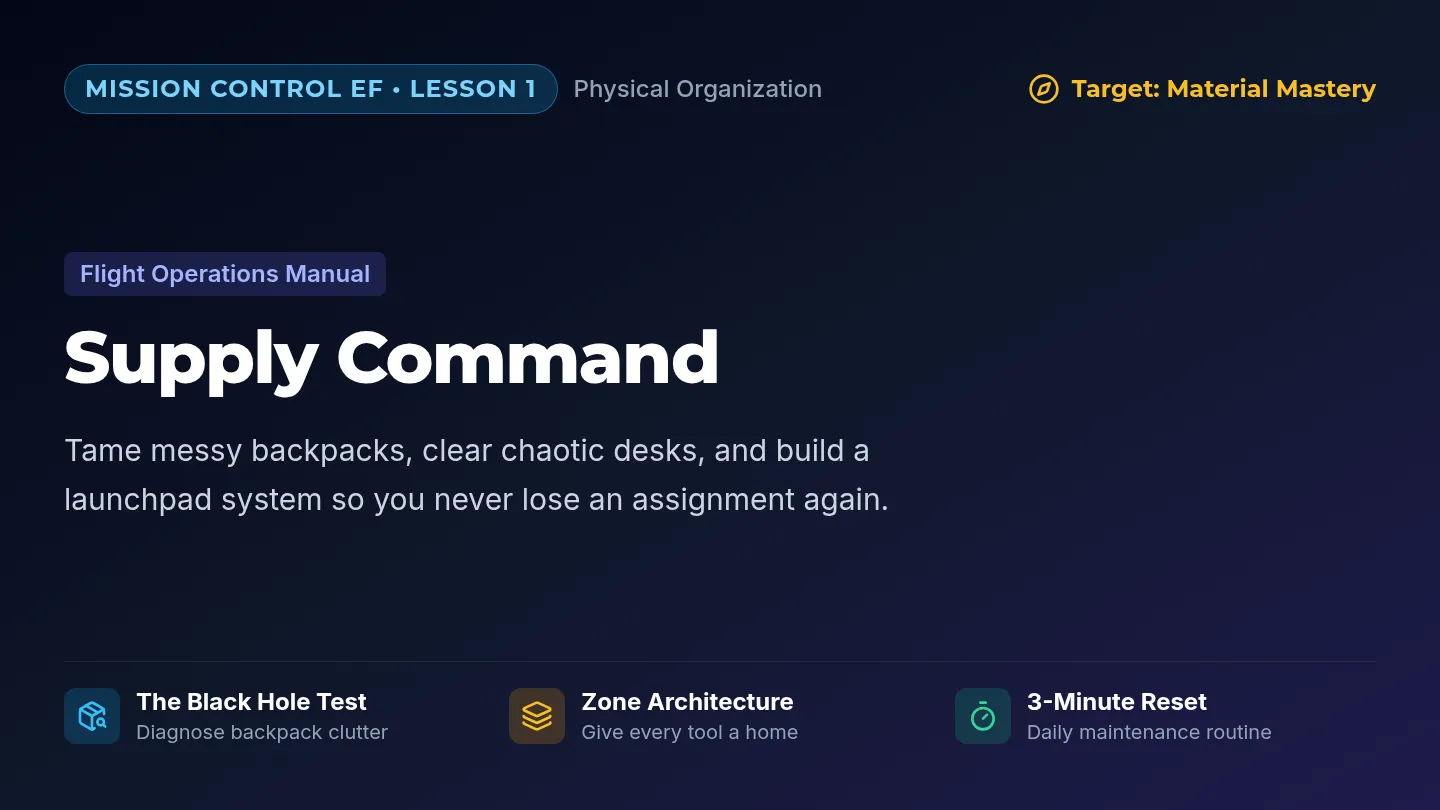
Cluttered desks directly contribute to cognitive overload. When materials are out of sight, students with EF challenges struggle with object permanence ("out of sight, out of mind").
The "Two-Pocket" Binder System
Standardize a single color-coded binder school-wide. Left Pocket = "To Do Today" (Hot), Right Pocket = "Home/File" (Cold). No loose papers allowed.
The Visual Desk Map
A small visual sticker on the top corner of each desk showing exactly where the pencil box, notebook, and folder should reside.
Environmental Checklist
No open wire-mesh bins
Labeled shelf zones
Clear desk expectations
Low-sensory focus desks
Systemic Transition Protocols
Unstructured transitions waste up to 25% of instructional time and trigger anxiety. High-EF classrooms treat transitions as physical drills.
The "Three-Minute Pivot"
- Minute 1: "Clear" — Sweep all current materials into desk zones.
- Minute 2: "Retrieve" — Gather resources for the next lesson.
- Minute 3: "Ready" — Sit silently in the "launch stance."
Dual-Clock Visual Scheduling
Provide both an analog visual timer (e.g., Time Timer showing elapsed red disk) and a digital countdown. Pair this with a step-by-step visual schedule that moves downward vertically.
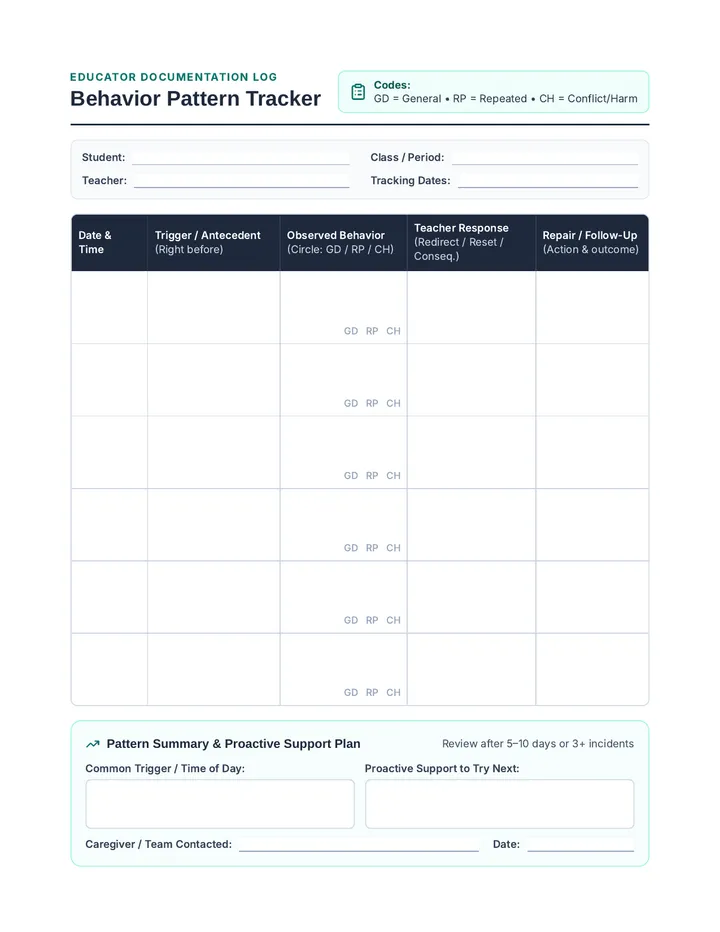
Leader's Observation Tool: Count the steps required for a student to turn in homework. If it exceeds three physical touches/movements, redesign the central bin system immediately to limit friction points.
Leadership "Look-Fors" during Audits
Are materials structured consistently across different grade-level classrooms to prevent adaptive fatigue?
Suggested Timeline Pre-Year Classroom Setup Audit
Framework Author: Principal Leadership Network Page 2 of 4
The Executive Blueprint PILLARS 2 & 4: MEMORY & INITIATION
Scaffolding Cognitive Drive
Working Memory Shields & Task Initiation Catalysts
Ensuring directions are retained and reducing task paralysis through systemic instructional launches.
Working Memory Externalization
Students with low working memory capacity can hold only 1-2 steps in their head before cognitive drift. When a teacher says, "Get your math book, open page 42, do problem 3," steps are instantly lost.
The "Three-Prompt Rule"
Never deliver more than three instructions verbally at one time. Every verbal instruction sequence must be accompanied by a numbered list on the board containing matching symbols.
Instruction Playback Protocol
Instead of asking "Does everyone understand?", use structured pair-share: "Partner A, tell Partner B the first thing you are doing. Partner B, tell Partner A how we submit it."
Memory Shield: Have desk-sized templates with dry-erase slots for students to jot down their immediate 3 target steps.
The 5-Minute Launch Framework
"Task paralysis" occurs when a student is overwhelmed by the scope of an assignment. Breaking down tasks into micro-deliverables is essential.
The "First Five Minutes" (FFM) Protocol
Upon starting independent work, the student only aims to finish step 1 (e.g., "Write title and name"). This lowers the hurdle for immediate momentum.
The "Chunking Template"
For projects, teachers must provide a rubric shaped as a staircase, not a table. Each step is exactly one day of work with a concrete visual checklist.
Leader's Observation Look-For: Note how long it takes for the lowest-performing student to put pencil to paper after the release to independent work. Goal: under 90 seconds.
Standard Scaffolding Sequence for Classrooms
1. Verbal Release
Concise, action-oriented directives only.
2. Visual Anchor
Steps mapped clearly on board.
3. Peer Verification
Re-explain the immediate step to peer.
4. Micro-Launch
Immediate 90-second focus point.
Framework Author: Principal Leadership Network Page 3 of 4
The Executive Blueprint PILLAR 3 & IMPLEMENTATION
Systemic Leadership Action Plan
Emotional Regulation & School-Wide Scaling
Establishing sensory strategies and a concrete timeline for sustainable school-wide leadership.
Co-Regulation & Cognitive Flexibility
Emotional self-regulation is the ultimate tier of executive functioning. When a child undergoes sensory overload or task anxiety, active logical processes shut down, resulting in "fight, flight, or freeze."
The "Calm-Down Sandbox" Concept
Ensure every classroom has a designated physical calming corner with non-verbal tools (sand timers, stress squeeze balls, deep-breathing visual cards). It must not be styled as a play area; it is a clinical self-soothing work area.
The "Change-of-Plan" Visual Shield
Cognitive rigidity causes outbursts when timetables change unexpectedly. Teachers display an explicit yellow "Change Card" next to the visual schedule to telegraph upcoming sequence adjustments early.
Leader's Co-Regulation Guide:
Train teachers to drop their tone octave and speak in declarative, steady sentences rather than asking questions. E.g., instead of "Why are you throwing paper?" say, "We are sitting calmly."
Administrative Roadmap
Three-Phase Principal Plan
Phase 1: Environment Audit
Perform walkthroughs with an objective checklist for visual clutter, uniform desk spaces, and standard binders.
Phase 2: Capacity Building
Execute a 45-minute PD on the "Three-Prompt Rule" and "First 5-Minute" launches. Provide visual kits to staff.
Phase 3: Coaching Iterations
Direct assistant principals to track independent task start time during informal walk-through sessions.
Key Performance Metric
Classroom EF Uniformity Goal: 90%
School-Wide Implementation Rubric
| Core Focus |
Emerging |
Optimized (Target) |
| Visual Schedules |
Inconsistent formats across classrooms. |
Standard vertical schedules in all classrooms. |
| Task Releases |
High student paralysis; waiting on instruction. |
Every kid starts within 90s using micro-launch. |
Framework Author: Principal Leadership Network Page 4 of 4