Fraction Jump Scaffold Student Reference Guide
Fraction Jump Scaffold
Using a number line to subtract fractions with the same denominator
Name: ________________________
Two Ways to Find a Difference: Example \(1\frac{2}{5} - \frac{4}{5}\)
Strategy 1: Jump Back (Take Away) \(1\frac{2}{5} - \frac{4}{5} = \frac{3}{5}\)
Start at \(1\frac{2}{5}\). Break \(\frac{4}{5}\) into \(\frac{2}{5} + \frac{2}{5}\) so you can land on the whole number \(1\) first, then jump back the rest.
0 3/5 1 1 2/5 2 − 2/5 − 2/5
Strategy 2: Jump Forward (Find the Unknown Addend) \(\frac{4}{5} + \frac{3}{5} = 1\frac{2}{5}\)
Start at \(\frac{4}{5}\) and count up to \(1\frac{2}{5}\). Jump to \(1\) first, then jump to \(1\frac{2}{5}\). Add your jumps: \(\frac{1}{5} + \frac{2}{5} = \frac{3}{5}\).
0 4/5 1 1 2/5 2 + 1/5 + 2/5
Mental Equivalence & Decomposing Tips
1. Name the Whole
\(1 = \frac{5}{5} = \frac{10}{10} = \frac{4}{4}\). Use the same denominator as your problem!
2. Rewrite Mixed Numbers
\(1\frac{2}{5} = \frac{5}{5} + \frac{2}{5} = \frac{7}{5}\). This helps when you need to subtract across \(1\).
3. Land on a Benchmark
Split your jump so you land on \(1\) or \(2\) first, then jump the remaining fraction.
Explain & Connect Your Thinking (Sentence Starters)
CLAIM
"The difference between ______ and ______ is ______." • "I can represent this problem with the equation ______."
MODEL
"On my number line, I partitioned each whole into ______ equal parts." • "I started at ______ and jumped [back / forward] ______ to land on ______."
EXPLAIN
"My jumps prove my answer is ______ because ______." • "In the story problem, my jump of ______ represents ______ and my final answer means ______."
Fraction Proof Graphic Organizer Graphic Organizer
Fraction Explanation Graphic Organizer
Name: ________________________
Date: ________________
Problem or Story Context Write the equation or story problem you are solving.
1. CLAIM
Your Equation & Numerical Answer
State your subtraction (or unknown-addend) equation and final answer.
2. MODEL
Number Line Diagram
Partition into equal parts, label key fractions & wholes, and draw labeled jumps.
3. EXPLANATION
Connect Answer, Model & Story Context
Explain how your jumps prove your answer & what they mean in the story.
Proof Check: ☐ Clear equation & answer ☐ Equal parts & labeled jumps ☐ Answer connected to model/story
Guided Fraction Organizer Fraction Explanation Organizer
Name: _______________________
Date: _______________
My Problem:
Step 1: My Claim (Answer)
My equation is: ____________________________________________________
The difference is ______________________ .
Step 2: My Model (Number Line)
Cut each whole into equal parts. Draw and label your jumps.
Step 3: My Explanation
Fill in the blanks. Circle back or forward .
Each whole on my number line has __________ equal parts.
I started at ____________ and jumped ( back / forward ) ____________ .
I landed on ____________ , which proves my answer is ____________ .
In the story problem, my answer means ____________________________
Guided Addition Organizer Fraction Addition Organizer
Name: _______________________
Date: _______________
My Problem:
Step 1: My Claim (Answer)
My equation is: ____________________________________________________
The sum is __________________________ .
Step 2: My Model
Check one strategy, then show your model below.
☐ Fraction tiles ☐ Drawing diagrams ☐ Equivalent fractions ☐ Number line
Step 3: My Explanation
Fill in the blanks to explain your thinking.
I chose to use __________________________ to model my problem.
First, I started with ____________ and added ____________ .
My model shows the total is ____________because _______________________________________ .
(In the story problem, my answer means ____________________________)
Guided Subtraction Organizer Fraction Subtraction Organizer
Name: _______________________
Date: _______________
My Problem:
Step 1: My Claim (Answer)
My equation is: ____________________________________________________
The difference is ______________________ .
Step 2: My Model
Check one strategy, then show your model below.
☐ Fraction tiles ☐ Drawing diagrams ☐ Equivalent fractions ☐ Number line
Step 3: My Explanation
Fill in the blanks to explain your thinking.
I chose to use __________________________ to model my problem.
First, I started with ____________ and subtracted ____________ .
My model shows the difference is ____________ because_________________________________.
(In the story problem, my answer means ____________________________)
Complete Explanation Checklist Student Self-Check
Complete Explanation Checklist
Use this checklist whether you explain with numbers , a diagram , or words .
Name: ___________________
Date: _____________
☐
1. Check for Your Answer
Did I clearly state my final numerical answer and equation so anyone can find it?
Sentence Stem "My equation is __________________ and my final answer is __________________ ."
☐
2. Check for All of Your Steps
Did I show every step I took from start to finish (using numbers, a diagram, or words) without skipping anything?
Sentence Stems for Your Steps
• First, I started with ____________ and I chose to ____________ .
• Next, I ____________ (broke apart / made equivalent fractions / jumped ____) .
• Then, I ____________ to get ____________ .
• Finally, I landed on / ended with ____________ .
☐
3. Connect Your Answer to Your Diagram or Story
Did I explain why my answer makes sense using my visual model or the story problem?
Connect to Your Diagram / Model "My model proves my answer is __________ because ______________________________ ."
Connect to the Story Problem "In the story problem, my answer of __________ means __________________________ ."
Ready to Share? ☐ My steps are in order ☐ My model matches my numbers ☐ I included units (if a story)
Streamlined Explanation Checklist Explanation Checklist
Numbers, diagrams, or words
Name: ________________________
☐
1. My Answer
Equation & final answer are clear.
"My equation is ______ and my answer is ______."
☐
2. All of My Steps
Show every step from start to finish.
First, I started with ________.
Next, I ________________.
Then, I ________________.
Finally, I got ____________.
☐
3. Connect It
Link your answer to your model or story.
"My diagram shows ______ because ______."
"In the story, my answer means ______."
☐ Steps are in order
☐ Model matches my numbers
☐ Units included (if a story)
Explanation Checklist
Numbers, diagrams, or words
Name: ________________________
☐
1. My Answer
Equation & final answer are clear.
"My equation is ______ and my answer is ______."
☐
2. All of My Steps
Show every step from start to finish.
First, I started with ________.
Next, I ________________.
Then, I ________________.
Finally, I got ____________.
☐
3. Connect It
Link your answer to your model or story.
"My diagram shows ______ because ______."
"In the story, my answer means ______."
☐ Steps are in order
☐ Model matches my numbers
☐ Units included (if a story)
Workbook Explanation Sheet Show & Explain Your Thinking
Solve the problem below, then fill in the stems to explain your steps and answer.
Name: ___________________
Problem #: ______ Date: __________
1. My Work & Model
☐ Equation & final answer ☐ Model (number line, diagram, or numbers)
2. My Explanation
Complete the sentence stems below.
☐ Stated my final answer ☐ Explained all of my steps in order ☐ Connected answer to model or story
My equation is __________________ and my answer is __________________ .
First, I started with ________________________________________________ .
Next, I ____________________________________________________________ .
Then, I ____________________________________________________________ .
Finally, I got _______________________________________________________ .
My diagram shows ___________________ because ________________________
(In the story, my answer means ______________________________________ .)
Final Check: ☐ Steps are in order ☐ Model matches numbers ☐ Units included (if a story)
IM Inquiry Lesson Template Teacher Planning Template
IM Accommodation Planning Template
Embedding Support for Students with Communication & Executive functioning needs into Illustrative Mathematics (Grade 4, Unit 3)
Lesson #: ______ Section: A / B / C
Goal Focus: ________________________
Explicit Pre-Teaching & Anchor Chart Content (5 min review)
Vocabulary & Foundational Skill
Key Academic Vocabulary to Pre-Teach (2–3 terms)
e.g., unit fraction, mixed number, equivalent, tenths/hundredths
Foundational Procedural Skill Warm-Up
e.g., partitioning a whole into equal parts, naming \(1 = \frac{n}{n}\)
Deliberate Scaffolding & Modeling
Activity Launch & Think-Aloud
Teacher Think-Aloud Model (I Do / We Do) Quickly note the problem, representation, & Claim-Model-Explanation
UDL Access & Choices
☐ Fraction tiles / manipulatives
☐ Pre-partitioned number line
☐ Worked example & stem card
Target Sentence Stems (MLR8)
Structured Peer Collaboration (During IM Activities)
Defined Roles & Turn-Taking
Partner A Role & Prompt
Partner B Role & Prompt
Metacognitive Prompting (Synthesis & Cool-Down)
Self-Monitoring & Error Reflection
Mid-Lesson Checklist / Self-Check Question
Cool-Down Reflection / Common Error to Watch For
Unit 3 Lesson Goal Alignment Guide (Lessons 1–20)
Plug-and-play vocabulary, models, collaboration roles, and metacognitive checks for each section.
Section A: Equal Groups of Fractions (Lessons 1–6)
Multiplication of Whole Numbers & Fractions
1. Pre-Teach, Create & Reference Anchor Chart: equal groups, unit fraction, product, equivalent expressions ; skip-counting by unit fractions (\(\frac{1}{4}, \frac{2}{4}, \frac{3}{4}\)).
2. Model with sentence stem or Anchor Chart: Think-aloud connecting equal-group diagrams (tape/area) to \(n \times \frac{a}{b} = \frac{n \times a}{b}\) and equivalence (\(4 \times \frac{2}{3} = 8 \times \frac{1}{3}\)).
3. Peer Roles: Builder draws equal groups; Expression Writer writes \(n \times \frac{a}{b}\) and checks that both match.
4. Metacognition: "Does my product match the total shaded parts? How can I rewrite it using a unit fraction?"
Section B: Addition & Subtraction of Fractions (Lessons 7–14)
Decomposing, Mixed Numbers & Line Plots
1. Pre-Teach, Create & Reference Anchor Chart: decompose, mixed number, difference, line plot, benchmark whole ; rewriting \(1 = \frac{d}{d}\) and mixed numbers as sums.
2. Model with sentence stem or Anchor Chart: Think-aloud comparing Jump Back vs. Jump Forward on a number line (L9–12) and plotting \(\frac{1}{2}, \frac{1}{4}, \frac{1}{8}\) on line plots (L13).
3. Peer Roles: Strategist decides whether decomposing across \(1\) helps (L12); Verifier checks number-line jumps & line-plot X's.
4. Metacognition: "Did I need to decompose a whole? Does my number line or line plot answer the story question?"
Section C: Addition of Tenths & Hundredths (Lessons 15–20)
Equivalent Fractions, Multi-Step & Design
1. Pre-Teach, Create & Reference Anchor Chart: tenths, hundredths, equivalent fraction, greater/less than 1 ; converting \(\frac{a}{10} = \frac{10a}{100}\) using 10×10 grids.
2. Model with sentence stem or Anchor Chart: Think-aloud converting tenths to hundredths before adding 2 or 3+ addends (L16–18), and benchmarking sums to \(1\) (L17).
3. Peer Roles: Converter rewrites tenths as hundredths; Estimator/Checker justifies whether the sum is \(< 1\), \(= 1\), or \(> 1\) (and asks info-gap questions in L20).
4. Metacognition: "Did I convert to the same denominator before adding? Does my multi-step answer fit the constraints?"
Companion Student Templates in This Lesson Set
• Practice Vocab and Skill with sentence stem: Use at the beginning of a lesson to provide review/practice.
• Structured Partner Inquiry Mat: Use during partner Activities in IM Lessons.
• Guided Addition / Subtraction Organizers: Support Claim-Model-Explanation.
• Explanation Checklists & Workbook Sheet: Self-monitoring & assessment.
Pre-Teach Vocab & Skill Template Inquiry Launch Warm-Up
Get Ready to Explore!
Today's Goal: ____________________________________________________________________
Name: ___________________
Lesson #: ______ Date: ________
1. Key Math Words We Need Today
Write the word, what it means in your own words, and a quick picture or example.
Math Word
What It Means
Picture or Example
2. Today's Practice Problem
Show your thinking with a model and an equation.
3. Today's Sentence Stem to Explain the Solution
Use today's stem to explain how your model proves your answer.
Ready for Inquiry? ☐ I can explain today's key words ☐ I solved the practice problem ☐ I used the sentence stem
Structured Partner Inquiry Mat Partner Inquiry Protocol
Structured Partner Inquiry Mat
Partner A: ___________________
Partner B: ___________________
Partner A: Builder & Explainer
Build the model, explain your steps out loud, and share your equation.
• "First, I started with ______ because ______."
• "My model shows ______."
• "Our equation is ______ and our answer is ______."
Partner B: Questioner & Checker
Ask a clarifying question, check the math, and connect to the story.
• "Why did you choose to ______?"
• "How does your model prove ______?"
• "I agree because ______ / Let's check ______."
Our Shared Model & Equation
Draw your diagram, number line, or equal groups, and write your equation.
Team Check-In & Reflection
☐ Both partners shared ☐ Model matches equation ☐ Checked for errors
One thing we fixed, noticed, or learned together: ______________________________________
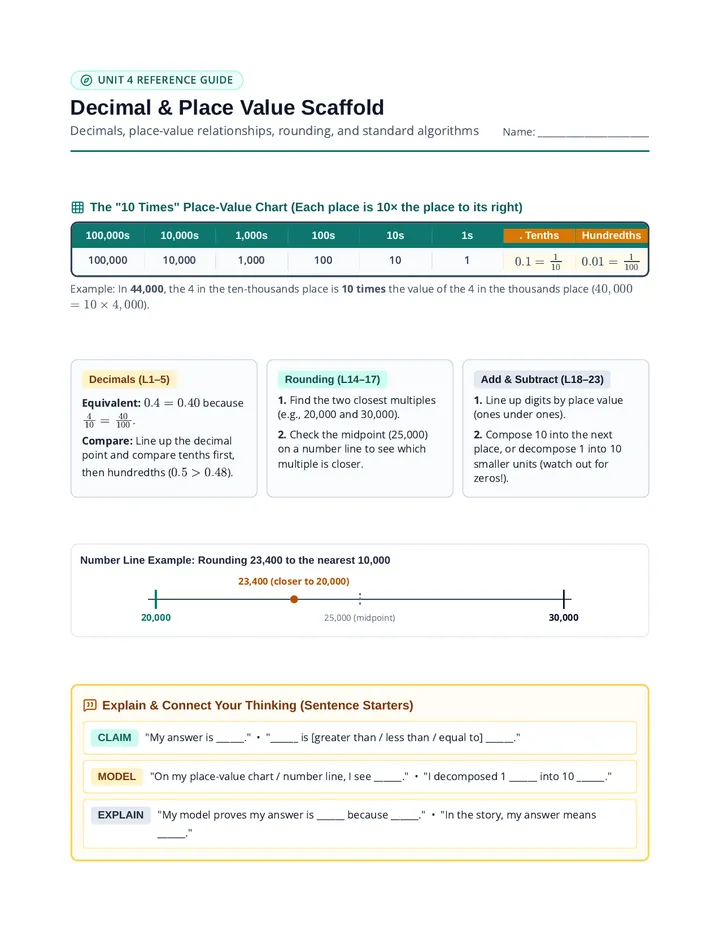
Decimal & Place Value Scaffold Unit 4 Reference Guide
Decimal & Place Value Scaffold
Decimals, place-value relationships, rounding, and standard algorithms
Name: ________________________
The "10 Times" Place-Value Chart (Each place is 10× the place to its right)
100,000s
10,000s
1,000s
100s
10s
1s
. Tenths
Hundredths
100,000
10,000
1,000
100
10
1
\(0.1 = \frac{1}{10}\)
\(0.01 = \frac{1}{100}\)
Example: In 44,000 , the 4 in the ten-thousands place is 10 times the value of the 4 in the thousands place (\(40,000 = 10 \times 4,000\)).
Decimals (L1–5)
Equivalent: \(0.4 = 0.40\) because \(\frac{4}{10} = \frac{40}{100}\).
Compare: Line up the decimal point and compare tenths first, then hundredths (\(0.5 > 0.48\)).
Rounding (L14–17)
1. Find the two closest multiples (e.g., 20,000 and 30,000).
2. Check the midpoint (25,000) on a number line to see which multiple is closer.
Add & Subtract (L18–23)
1. Line up digits by place value (ones under ones).
2. Compose 10 into the next place, or decompose 1 into 10 smaller units (watch out for zeros!).
Number Line Example: Rounding 23,400 to the nearest 10,000
20,000 25,000 (midpoint) 30,000 23,400 (closer to 20,000)
Explain & Connect Your Thinking (Sentence Starters)
CLAIM
"My answer is ______." • "______ is [greater than / less than / equal to] ______."
MODEL
"On my place-value chart / number line, I see ______." • "I decomposed 1 ______ into 10 ______."
EXPLAIN
"My model proves my answer is ______ because ______." • "In the story, my answer means ______."
Unit 4 Accommodation Template Teacher Planning Template
IM Accommodation Planning Template
Embedding Support for Students with Communication & Executive functioning needs into Illustrative Mathematics (Grade 4, Unit 4)
Lesson #: ______ Section: A / B / C / D
Goal Focus: ________________________
Explicit Pre-Teaching & Anchor Chart Content (5 min review)
Vocabulary & Foundational Skill
Key Academic Vocabulary to Pre-Teach (2–3 terms)
e.g., decimal notation, ten-thousands, standard algorithm
Foundational Procedural Skill Warm-Up
e.g., reading a place-value chart, finding midpoints on a number line
Deliberate Scaffolding & Modeling
Activity Launch & Think-Aloud
Teacher Think-Aloud Model (I Do / We Do) Quickly note the problem, representation, & Claim-Model-Explanation
UDL Access & Choices
☐ Base-ten blocks / 10×10 grids
☐ Place-value chart / number line
☐ Worked example & stem card
Target Sentence Stems (MLR8)
Structured Peer Collaboration (During IM Activities)
Defined Roles & Turn-Taking
Partner A Role & Prompt
Partner B Role & Prompt
Metacognitive Prompting (Synthesis & Cool-Down)
Self-Monitoring & Error Reflection
Mid-Lesson Checklist / Self-Check Question
Cool-Down Reflection / Common Error to Watch For
Unit 4 Lesson Goal Alignment Guide (Lessons 1–23)
Plug-and-play vocabulary, models, collaboration roles, and metacognitive checks for each section.
Section A: Decimals with Tenths & Hundredths (Lessons 1–5)
Decimal Notation, Equivalence & Comparing
1. Pre-Teach, Create & Reference Anchor Chart: decimal notation, tenths, hundredths, equivalent ; matching \(\frac{4}{10} = 0.4 = 0.40\) on 10×10 grids.
2. Model with sentence stem or Anchor Chart: Comparing tenths first, then hundredths using \(>, <, =\) and ordering decimals on a number line.
3. Peer Roles: Grid Builder shades 10×10 grids; Comparator writes the comparison (\(>, <, =\)) and explains why.
4. Metacognition: "Did I compare the tenths place before the hundredths place? (Watch out for \(0.12 > 0.4\) error!)"
Section B: Place-Value Relationships through 1,000,000 (Lessons 6–11)
5- & 6-Digit Numbers & "Ten Times" Rule
1. Pre-Teach, Create & Reference Anchor Chart: ten-thousands, hundred-thousands, expanded form, ten times ; reading 5- and 6-digit numerals and words.
2. Model with sentence stem or Anchor Chart: Writing equations for the 10× rule (\(40,000 = 10 \times 4,000\)) and estimating locations on a number line (L11).
3. Peer Roles: Representer shows the number with base-ten diagrams/expanded form; Value Checker explains the 10× relationship.
4. Metacognition: "Does my equation match the place-value chart? How many times greater is the digit on the left?"
Section C: Compare, Order, and Round (Lessons 12–17)
Multiples of 1,000 / 10,000 / 100,000
1. Pre-Teach, Create & Reference Anchor Chart: nearest multiple, midpoint, round, reasonable ; identifying bounding multiples on a number line.
2. Model with sentence stem or Anchor Chart: Plotting a number relative to the midpoint to round (L14–16) and discussing when rounding helps/hinders (L17).
3. Peer Roles: Number-Line Plotter marks the two multiples & midpoint; Rounding Explainer justifies which multiple is closer.
4. Metacognition: "Did I round to the right place value? Does rounding make sense for this real-world problem?"
Section D: Add and Subtract Multi-Digit Numbers (Lessons 18–23)
Standard Algorithm & Across Zeros
1. Pre-Teach, Create & Reference Anchor Chart: standard algorithm, compose, decompose, minuend ; lining up place values vertically.
2. Model with sentence stem or Anchor Chart: Recording composed/decomposed units (L19), spotting algorithm errors (L20), and subtracting across zeros (L21).
3. Peer Roles: Solver works the standard algorithm step-by-step; Error Detective checks each column's regrouping & zeros.
4. Metacognition: "Did I decompose across zeros correctly? Is my answer reasonable compared to my rounded estimate?"
Companion Student Templates in This Lesson Set
• Unit 4 Pre-Teach Practice Sheet: Use at the start of a lesson for vocab & stem practice.
• Unit 4 Partner Inquiry Mat: Use during partner Activities in IM Lessons.
• Guided Place Value Organizer: Support Claim-Model-Explanation.
• Unit 4 Workbook Sheet: Self-monitoring & assessment insert.
Unit 4 Pre-Teach Practice Sheet Unit 4 Warm-Up & Review
Get Ready to Explore!
Today's Goal: ____________________________________________________________________
Name: ___________________
Lesson #: ______ Date: ________
1. Key Math Words We Need Today
Write the word, what it means in your own words, and a quick picture or example.
Math Word
What It Means
Picture or Example
2. Today's Practice Problem
Show your thinking with a chart, grid, number line, or equation.
3. Today's Sentence Stem to Explain the Solution
Use today's stem to explain how your model proves your answer.
Ready for Inquiry? ☐ I can explain today's key words ☐ I solved the practice problem ☐ I used the sentence stem
Unit 4 Partner Inquiry Mat Unit 4 Partner Inquiry Protocol
Structured Partner Inquiry Mat
Partner A: ___________________
Partner B: ___________________
Partner A: Builder & Explainer
Build the model (grid, chart, number line, or algorithm) and explain your steps.
• "First, I lined up / started with ______."
• "My chart / number line shows ______."
• "My equation or comparison is ______."
Partner B: Questioner & Checker
Ask a clarifying question, check place values or regrouping, and verify.
• "How does the value of ______ compare to ______?"
• "Did we compose / decompose across zeros?"
• "I agree because ______ / Let's check ______."
Our Shared Model & Equation
Show your 10×10 grid, place-value chart, number line, or standard algorithm.
Team Check-In & Reflection
☐ Both partners shared ☐ Place values aligned ☐ Checked for errors
One thing we fixed, noticed, or learned together: ______________________________________
Guided Place Value Organizer Place Value & Decimal Organizer
Name: _______________________
Date: _______________
My Problem:
Step 1: My Claim (Answer)
My equation / comparison is: ___________________________________________
My answer is __________________________ .
Step 2: My Model
Check one strategy, then show your model below.
☐ 10×10 grid / blocks ☐ Place-value chart ☐ Number line ☐ Standard algorithm
Step 3: My Explanation
Fill in the blanks to explain your thinking.
I chose to use __________________________ to model my problem.
First, I started with ____________ and then I ______________________ .
My model shows my answer is ____________ because ______________________ .
(In the story problem, my answer means ______________________________)
Unit 4 Workbook Sheet Show & Explain Your Thinking
Solve the problem below, then fill in the stems to explain your steps and answer.
Name: ___________________
Problem #: ______ Date: __________
1. My Work & Model
☐ Equation / comparison & answer ☐ Model (grid, chart, number line, or algorithm)
2. My Explanation
Complete the sentence stems below.
☐ Stated my final answer ☐ Explained all of my steps in order ☐ Connected answer to model or story
My equation / comparison is _______________ and my answer is _______________ .
First, I started with ________________________________________________ .
Next, I ____________________________________________________________ .
Then, I ____________________________________________________________ .
Finally, I got _______________________________________________________ .
My model shows _____________________ because ________________________
(In the story, my answer means ______________________________________ .)
Final Check: ☐ Steps are in order ☐ Place values aligned / model matches ☐ Units included (if a story)