Active Brain Moves Poster
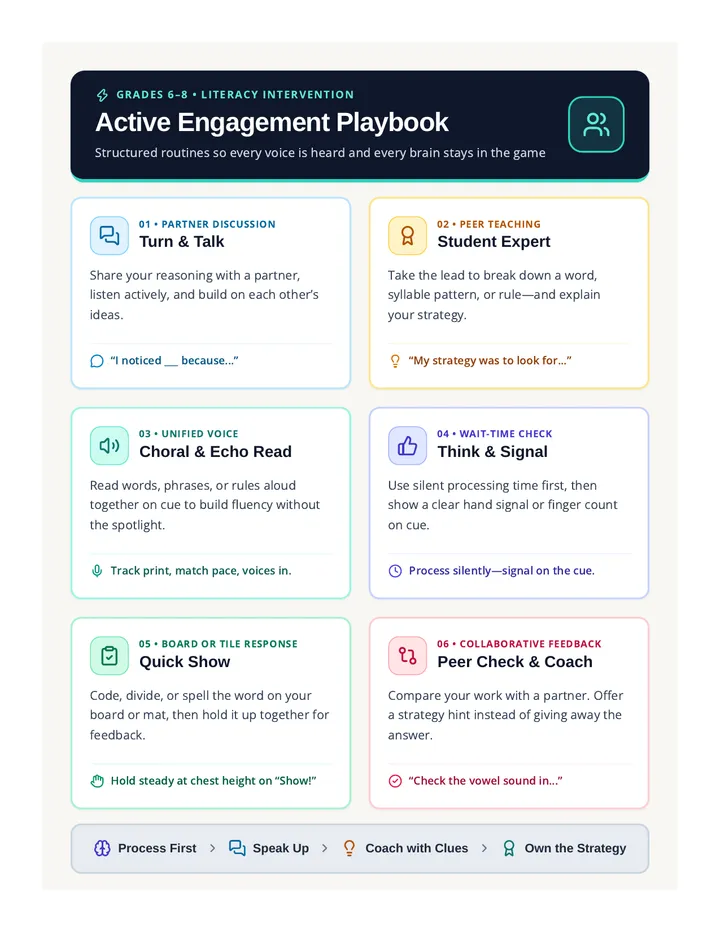
Grades 6–8 • Literacy Intervention
Active Engagement Playbook
Structured routines so every voice is heard and every brain stays in the game
01 • Partner Discussion
Turn & Talk
Share your reasoning with a partner, listen actively, and build on each other’s ideas.
“I noticed ___ because...”
02 • Peer Teaching
Student Expert
Take the lead to break down a word, syllable pattern, or rule—and explain your strategy.
“My strategy was to look for...”
03 • Unified Voice
Choral & Echo Read
Read words, phrases, or rules aloud together on cue to build fluency without the spotlight.
Track print, match pace, voices in.
04 • Wait-Time Check
Think & Signal
Use silent processing time first, then show a clear hand signal or finger count on cue.
Process silently—signal on the cue.
05 • Board or Tile Response
Quick Show
Code, divide, or spell the word on your board or mat, then hold it up together for feedback.
Hold steady at chest height on “Show!”
06 • Collaborative Feedback
Peer Check & Coach
Compare your work with a partner. Offer a strategy hint instead of giving away the answer.
“Check the vowel sound in...”
Process First
Speak Up
Coach with Clues
Own the Strategy
Active Engagement Teacher Guide
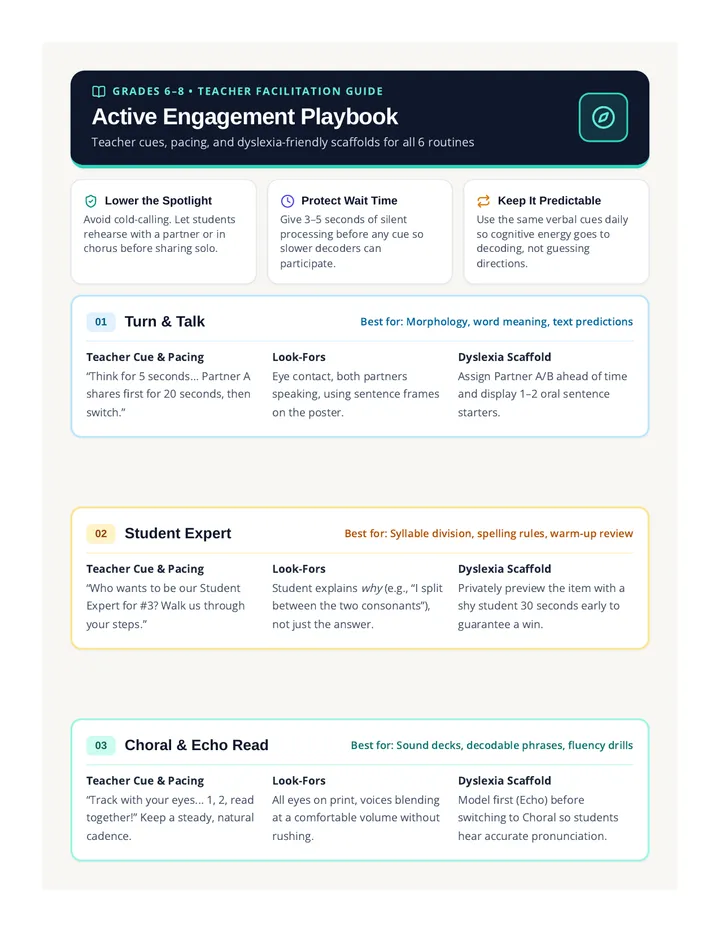
Grades 6–8 • Teacher Facilitation Guide
Active Engagement Playbook
Teacher cues, pacing, and dyslexia-friendly scaffolds for all 6 routines
Lower the Spotlight
Avoid cold-calling. Let students rehearse with a partner or in chorus before sharing solo.
Protect Wait Time
Give 3–5 seconds of silent processing before any cue so slower decoders can participate.
Keep It Predictable
Use the same verbal cues daily so cognitive energy goes to decoding, not guessing directions.
01
Turn & Talk
Best for: Morphology, word meaning, text predictions
Teacher Cue & Pacing
“Think for 5 seconds... Partner A shares first for 20 seconds, then switch.”
Look-Fors
Eye contact, both partners speaking, using sentence frames on the poster.
Dyslexia Scaffold
Assign Partner A/B ahead of time and display 1–2 oral sentence starters.
02
Student Expert
Best for: Syllable division, spelling rules, warm-up review
Teacher Cue & Pacing
“Who wants to be our Student Expert for #3? Walk us through your steps.”
Look-Fors
Student explains why (e.g., “I split between the two consonants”), not just the answer.
Dyslexia Scaffold
Privately preview the item with a shy student 30 seconds early to guarantee a win.
03
Choral & Echo Read
Best for: Sound decks, decodable phrases, fluency drills
Teacher Cue & Pacing
“Track with your eyes... 1, 2, read together!” Keep a steady, natural cadence.
Look-Fors
All eyes on print, voices blending at a comfortable volume without rushing.
Dyslexia Scaffold
Model first (Echo) before switching to Choral so students hear accurate pronunciation.
Active Engagement Playbook — Teacher Guide
Grades 6–8 • Page 2
04
Think & Signal
Best for: Syllable count, vowel type, yes/no checks
Teacher Cue & Pacing
“Count the syllables silently. Keep your hand down... Ready, show!”
Look-Fors
Simultaneous signals at chest height—no peeking around before the cue.
Dyslexia Scaffold
Keep signals discrete (close to chest) to reduce peer comparison and anxiety.
05
Quick Show
Best for: Dictation, word building, morpheme sorting
Teacher Cue & Pacing
“Tap it, spell it, check it. Boards up in 3, 2, 1—show!”
Look-Fors
Quick scan for common error patterns (e.g., vowel teams, doubling rules) before erasing.
Dyslexia Scaffold
Always prompt “Check your vowels” before holding up so students self-monitor.
06
Peer Check & Coach
Best for: Independent practice, word lists, sentence editing
Teacher Cue & Pacing
“Compare #1–3 with your partner. If they differ, coach with a clue—no spoilers!”
Look-Fors
Partners pointing to specific word parts and asking guiding questions.
Dyslexia Scaffold
Model “clue vs. spoiler” first so coaching feels respectful, not corrective.
Middle School Troubleshooting Quick-Fix
| If You Notice... |
Try This Teacher Move |
| Reluctance to speak aloud |
Start with Think & Signal or Turn & Talk first; frame participation as “testing ideas together.” |
| Fast finishers blurting out |
Use a clear silent signal (“Hand flat on desk when ready”) and hold the cue for the full 5 seconds. |
| One partner taking over |
Time each turn (20 sec each) and ask Partner B to summarize Partner A’s idea before adding on. |