Behavior Reset Teacher Guide
Teacher Reference Guide
Behavior Reset & Logical Consequences
Moving from punitive reactions to accountability, repair, and consistent support.
1. Why Logical Consequences Replace Punishments
Traditional Punishment
- ×Unrelated to the behavior (e.g., taking away recess for talking).
- ×Focuses on compliance through fear or embarrassment.
- ×Often escalates power struggles and damages trust.
Logical & Restorative Response
- ✓Related, Respectful, Reasonable: Directly connected to the action.
- ✓Teaches the replacement skill and repairs any harm caused.
- ✓Preserves student dignity while holding clear boundaries.
2. General Classroom Behavior: Consistent 3-Step Response
Use calm, neutral body language and brief, private cues to keep instruction flowing.
Step 1: Quiet Redirect (Off-task, chatting, minor rule slip) Goal: Re-engage fast
Action: Proximity, non-verbal cue, or brief 5-second private whisper: “Eyes on your draft, thank you.” Praise neighboring students meeting expectations. Avoid public call-outs.
Step 2: Reset & Choice (Continued disruption after redirect) Goal: Pause & regulate
Action: Offer two acceptable choices quietly: “You can work quietly at your desk, or take 3 minutes at the reset table to refocus. Which works best right now?”
Step 3: Logical Consequence & Reflection (Persisting or unsafe) Goal: Accountability
Action: Apply a directly related consequence (e.g., “You break it, you fix it”; loss of privilege to use lab tools safely; completing missed work during independent time) + assign the Repair & Reset Reflection form.
Golden Rule of Delivery: Speak slower, lower your volume, and keep your face neutral. Emotion escalates behavior; calm structure de-escalates it.
Conflict Repair & Ongoing Behavior Patterns
Page 2 • Protocols
3. Conflict or Harm: Restorative Repair Protocol
When a student hurts someone’s feelings, damages property, or disrupts the community, a traditional punishment leaves the harm unaddressed. Follow this 3-part restorative sequence once both parties are calm:
1. Hear Both Sides
Use the Repair & Reset Reflection first so students cool down and organize facts without interrupting each other.
2. Guided Conversation
Ask: “What happened?”, “Who was affected?”, and “What needs to happen to make things right?”
3. Concrete Repair
Follow through on a real action: fixing/cleaning items, a sincere apology note, or a check-in agreement.
Examples of Meaningful Repair Actions:
• Replacing or cleaning damaged supplies • Writing a specific apology (naming the impact, not just “sorry”) • Helping a peer catch up on missed work • Practicing the respectful wording with the teacher.
4. Repeated Behavior: Planning Consistent Supports
If the same behavior happens 3+ times in a week, consequences alone are not working—the behavior is meeting a need (escape, attention, sensory, or skill gap). Shift to pattern tracking and proactive support:
| Phase |
Teacher Action & Consistency Plan |
| A. Track the Pattern |
Use the Behavior Pattern Tracker for 5–10 school days. Note the Antecedent (what happened right before: transitions, independent reading, peer conflict) to spot triggers. |
| B. Adjust Proactive Supports |
Pre-correct before the trigger: give a 2-minute transition warning, chunk assignments, offer a quiet workspace, or establish a secret check-in signal. |
| C. Keep Responses Predictable |
Use the exact same script every time so the student knows what to expect. Avoid changing the rules day-to-day based on frustration. |
| D. Partner & Escalate |
Share tracker data with caregivers and support staff (counselor/admin) after 2 weeks of documented supports without improvement to build an individualized behavior plan. |
Safety Note: If a behavior involves physical danger, severe verbal abuse, or immediate safety risk, skip Steps 1–2, ensure classroom safety first, request support per school protocol, and complete restorative follow-up only after everyone is safe and regulated.
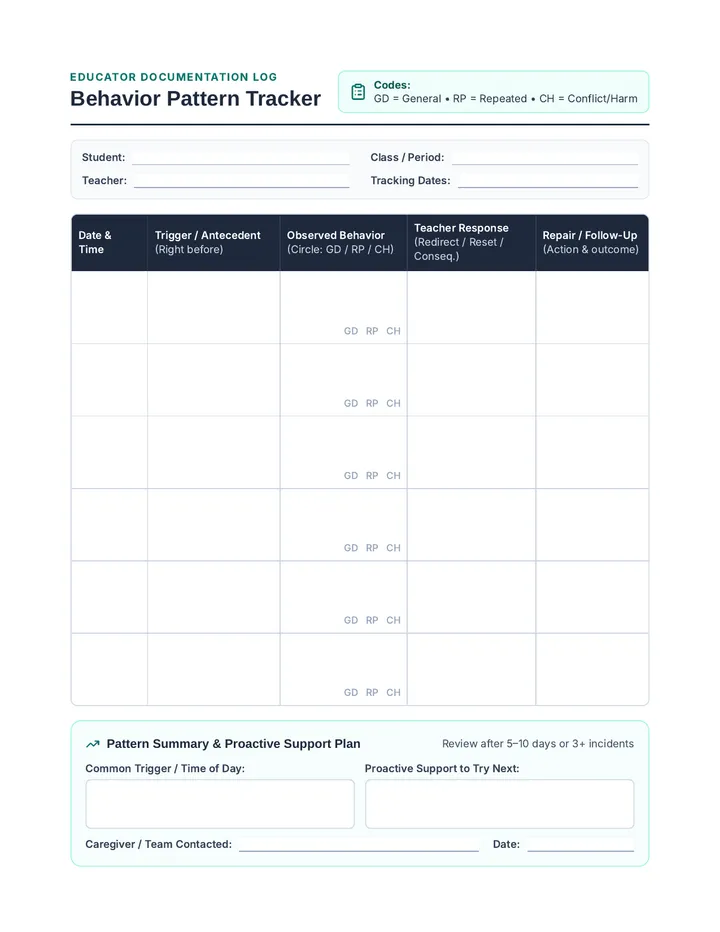
Behavior Pattern Tracker
Educator Documentation Log
Behavior Pattern Tracker
Codes: GD = General • RP = Repeated • CH = Conflict/Harm
Student:
Class / Period:
Teacher:
Tracking Dates:
| Date & Time | Trigger / Antecedent
(Right before) | Observed Behavior
(Circle: GD / RP / CH) | Teacher Response
(Redirect / Reset / Conseq.) | Repair / Follow-Up
(Action & outcome) |
| --- | --- | --- | --- | --- |
| | | GD RP CH | | |
| | | GD RP CH | | |
| | | GD RP CH | | |
| | | GD RP CH | | |
| | | GD RP CH | | |
| | | GD RP CH | | |
Pattern Summary & Proactive Support Plan
Review after 5–10 days or 3+ incidents
Common Trigger / Time of Day:
Proactive Support to Try Next:
Caregiver / Team Contacted:
Date:
Repair Reset Reflection
Student Reflection & Accountability
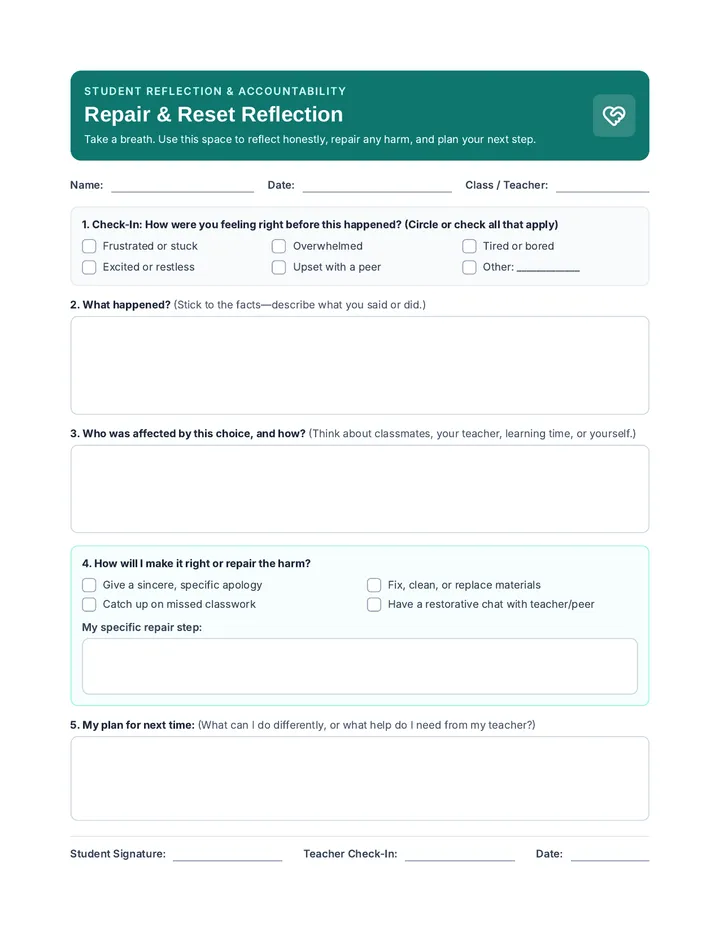
Repair & Reset Reflection
Take a breath. Use this space to reflect honestly, repair any harm, and plan your next step.
Name:
Date:
Class / Teacher:
1. Check-In: How were you feeling right before this happened? (Circle or check all that apply)
Frustrated or stuck
Overwhelmed
Tired or bored
Excited or restless
Upset with a peer
Other: _____________
2. What happened? (Stick to the facts—describe what you said or did.)
3. Who was affected by this choice, and how? (Think about classmates, your teacher, learning time, or yourself.)
4. How will I make it right or repair the harm?
Give a sincere, specific apology
Fix, clean, or replace materials
Catch up on missed classwork
Have a restorative chat with teacher/peer
My specific repair step:
5. My plan for next time: (What can I do differently, or what help do I need from my teacher?)
Student Signature:
Teacher Check-In:
Date: