Ready to Learn Reflection Worksheet
Early Childhood Management Ages 5–6 • Kindergarten / 1st Grade
Ready to Learn Reflection
Setting clear, developmentally appropriate expectations before starting instruction
Name:
Date:
Period:
Focus Prompt
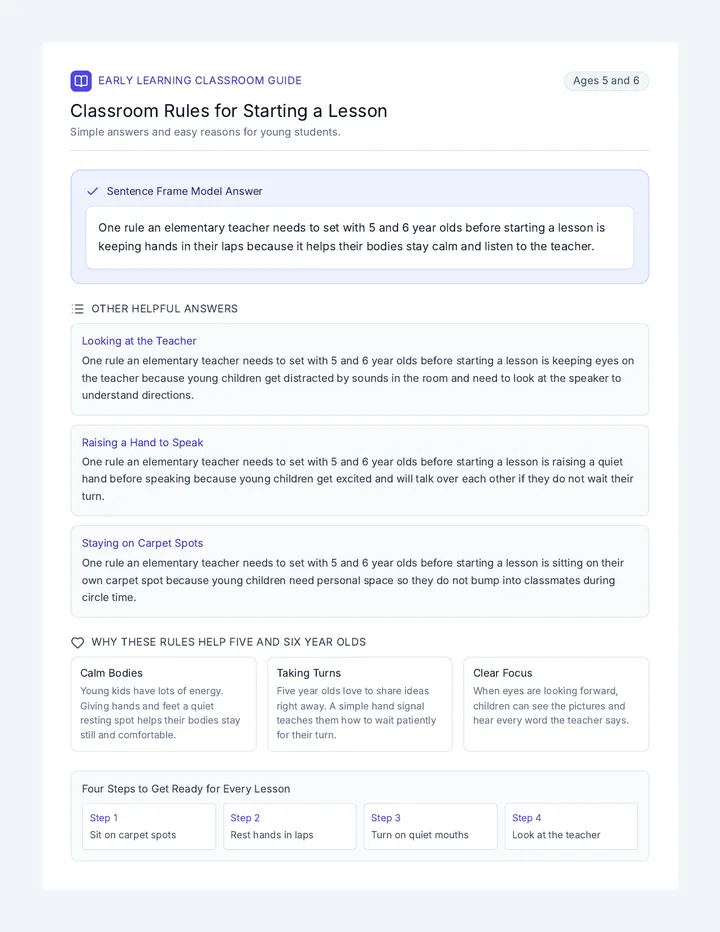
What is one rule or expectation an elementary teacher needs to set with 5 and 6 year olds before starting a lesson?
Sentence Frame Assist
“One rule an elementary teacher needs to set with 5 and 6 year olds before starting a lesson is [insert rule/expectation] because [insert reason].”
Expectation & Idea Bank (Developmental Norms for 5–6 Year Olds) Select one target rule to analyze
Eyes & Attention
Tracking the teacher, "Whole Body Listening", facing forward on carpet dots to reduce visual distractions.
Voice & Turn Taking
"Catching a bubble" (quiet mouth), raising hands to speak, waiting for peer response signals.
Body Control
"Criss-cross applesauce", hands resting in laps ("quiet hands"), keeping personal space on the rug.
Part 1: Your Structured Response (Use Frame Above) Write neatly in complete sentences
Part 2A: Developmental Rationale
Why is this expectation essential for 5–6 year olds? (e.g., attention span, impulse control, safety)
Part 2B: Proactive Teaching Move
How will you explicitly teach or cue this rule? (e.g., call-and-response, chime, visual icon, modeling)
Response Checklist:
Used Sentence Frame Specific Rule Stated Age 5–6 Rationale Concrete Teaching Move
Ready to Learn Answer Key
Exemplar & Answer Key 9th Grade Child Development / Foundations of Education
Ready to Learn Model Responses
Sample responses, developmental explanations, and proactive classroom routines
Grade 9 Benchmark Level
Primary Model Answer (Using Sentence Frame)
Rule: Active Attention
“c.”
Why this works: It clearly names an observable behavior and explains the direct consequence on student learning.
Alternative High-Quality Student Responses
Option 2: Raising Hands Turn Taking
“One rule an elementary teacher needs to set with 5 and 6 year olds before starting a lesson is raising hands before speaking because at this age kids get super excited and blurt out, which makes it hard for anyone else to hear.”
Option 3: Personal Space Body Boundaries
“One rule an elementary teacher needs to set with 5 and 6 year olds before starting a lesson is keeping hands and feet in their own carpet square because little kids accidentally bump or distract peers when they don't have clear personal boundaries.”
Part 2 Exemplar Breakdown (9th-Grade Voice)
Part 2A: Developmental Rationale
Kindergarteners have attention spans of only 5 to 10 minutes, and their impulse control is still forming. If teachers start talking before establishing focus, the students won't process the steps and will get frustrated during independent work.
Part 2B: Proactive Teaching Move
The teacher can use a quick call-and-response like “Flat tire—shhhhh” or tell students to “catch a bubble” in their mouth. This reminds them to be quiet without having to shout or stop the lesson.
Grading Criteria (Full Credit Checklist)
✔ Sentence Frame: Filled in both brackets accurately.
✔ Targeted Rule: Clear, observable action (eyes, hands, voice).
✔ Logical Reason: Mentions distractibility or developmental needs.
Resource: Pre-Lesson Expectations Key Instructional Focus: Age-Appropriate Scaffolding