PLAAFP Blueprint Templates
IEP Writer's Toolkit
PLAAFP Blueprint Templates
IDEA Compliant
The 4-Part PLAAFP Anatomy
1. Strengths & Input Student interests, parental concerns, and what the student does well.
2. Baseline Data Measurable, quantitative start points (CBMs, rubrics, trial data).
3. Impact Statement How the disability affects involvement in general education.
4. Target Needs Specific skill deficits requiring accommodations or goals.
Template 1: Functional Academics
Focuses on real-world reading, consumer math, or functional writing skills.
Use this structured template to document present levels for students working on life-skills literacy, functional reading, budget calculations, or real-world vocational writing.
Template Text
[Student Name] is a highly motivated student who possesses strong strengths in [identify strengths, e.g., verbal participation, digital navigation, peer collaboration]. Parent input gathered on [Date] indicates that the parents' primary concern is [Parent input/concerns, e.g., independent community safety, managing small bills].
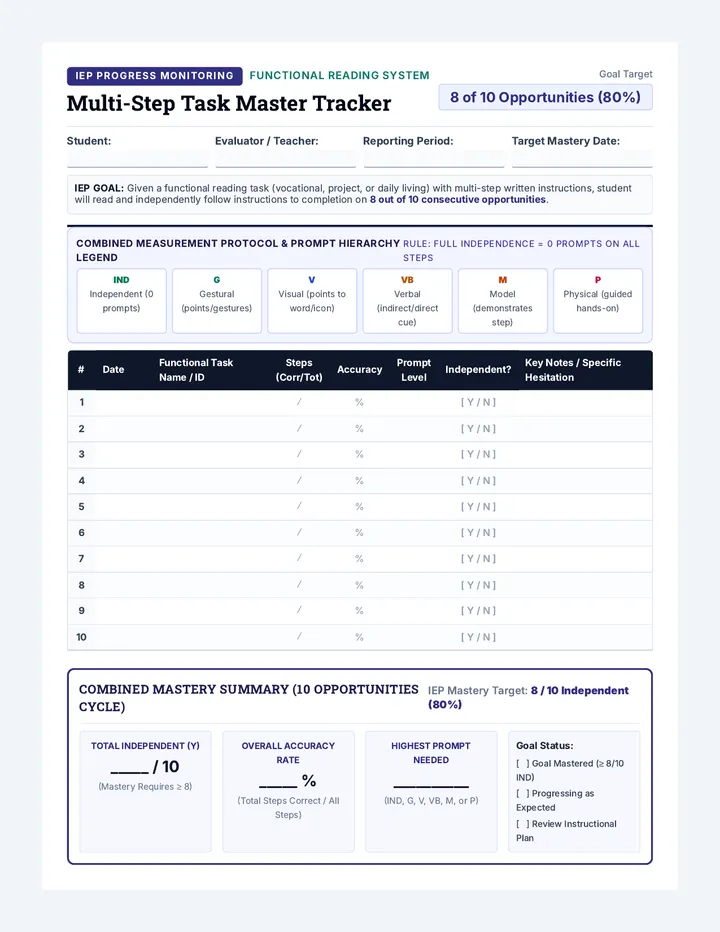
In the area of functional academics, current baseline data collected on [Date] via [Data Source/Assessment, e.g., Functional Math Inventory, consumer budgeting checklist] indicates that [Student Name] can currently [skill student CAN do, e.g., identify coin values, read simple safety signs] with [X]% accuracy. However, [Student Name] struggles with [skill deficit, e.g., calculating change for purchases, reading multi-step community recipes]. Specifically, when presented with [specific scenario/task], [Student Name] performs at a baseline of [measurable rate, e.g., 2 out of 5 trials, 40% accuracy].
This deficit in functional academics directly impacts [Student Name]'s involvement and progress in the general education curriculum because it limits their ability to independently [impact statement, e.g., participate in standard math applications, navigate vocational work sites] without direct adult support. To address these deficits and access the curriculum, [Student Name] requires specialized instruction focused on [targeted skill need, e.g., decimal operations in currency, high-frequency community print vocabulary].
PLAAFP Blueprint Toolkit & Templates Page 1 of 3
IEP Writer's Toolkit
PLAAFP Blueprint Templates
Part 2 of 3
Template 2: Social-Emotional & Behavior
Focuses on self-regulation, social interactions, or coping strategies.
Designed to capture social-emotional baselines, triggers, self-regulation frequency, and peer-to-peer interaction challenges.
Template Text
At school, [Student Name] demonstrates strengths in [strengths, e.g., forming positive relations with select teachers, offering to help clean the room]. Input from parents and teachers indicates [Student Name] is most successful when [support, e.g., provided a structured cool-down space, given a visual checklist].
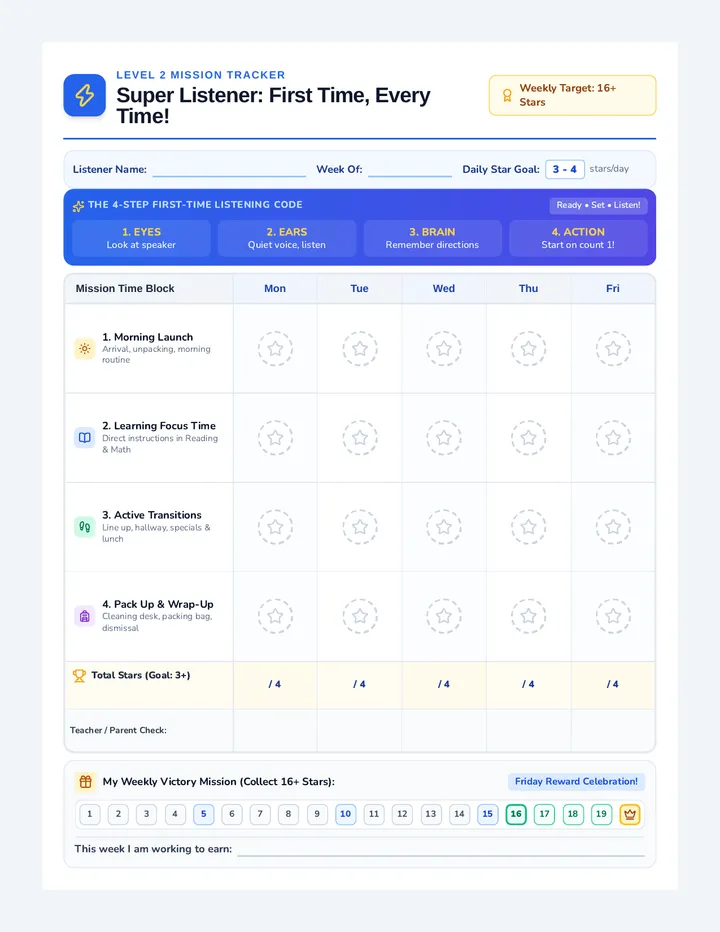
According to classroom behavioral data and incident tracking collected from [Date Range], when faced with triggers such as [triggers, e.g., non-preferred academic tasks, peer disagreement], [Student Name] exhibits [behavior, e.g., task refusal, verbal outbursts, walking away from area]. This behavior occurs at an average frequency of [X] times per week/day and typically lasts for [duration, e.g., 15 minutes]. Currently, [Student Name] utilizes coping strategies [independently / with visual prompts / with direct verbal direction] in [Y]% of observed opportunities.
These self-regulation challenges affect [Student Name]'s progress in the general education setting by decreasing their active instructional time by [Z] minutes/hours per week, and occasionally disrupting the learning environment. To address these needs, [Student Name] requires specialized instruction in [targeted skill, e.g., identifying emotional escalation, using deep-breathing independently].
Template 3: Executive Functioning
Focuses on organization, task initiation, time management, or self-advocacy.
Perfect for students who struggle to get started on tasks, organize physical or digital materials, or self-advocate when confused.
Template Text
[Student Name] is cooperative and demonstrates strong work ethic in preferred classes like [Subject]. They respond positively to visual schedules and [preference].
In executive functioning skills, observational data collected over [number] weeks shows that [Student Name] struggles with task initiation. When presented with a multi-step project or independent assignment, [Student Name] initiates work within a standard time frame of [X] minutes in only [Y]% of opportunities, requiring an average of [Z] verbal reminders to begin. Regarding organization, a recent physical desk/binder inspection revealed that materials are organized in [A out of B] trials, which leads to [consequence, e.g., lost assignments, late work].
These executive functioning deficits impede [Student Name]'s performance in general curriculum classes because they cannot independently complete classwork within block periods or consistently locate assignments. They require targeted specialized instruction in [targeted skill, e.g., breaking projects into prioritized sub-tasks, self-monitoring checklist use].
PLAAFP Blueprint Toolkit & Templates Page 2 of 3
IEP Writer's Toolkit
PLAAFP Blueprint Templates
Part 3 of 3
Template 4: Transition & Life Skills
Focuses on independent living, post-secondary transition, or vocational readiness.
Use this template for older students transitioning to adult services, vocational environments, or post-secondary independent settings.
Template Text
According to [Transition Assessment Name] administered on [Date], [Student Name] expresses a post-secondary goal to work in [Vocational Area] and live [independent living plan]. Their strengths include [skills, e.g., reliable attendance, enthusiasm for assignments].
In the area of vocational and independent transition skills, baseline data from [source, e.g., school job site evaluations] shows [Student Name] can perform [task student CAN do] with [X]% accuracy/independence. However, when required to [deficit skill, e.g., follow multi-step written task cards, ask for supervisor help], they require [type/number of supports] to complete the job. Currently, they complete independent transitional routines in [Y]% of observed scenarios.
This deficit in transition-ready skills directly impacts their ability to progress toward post-secondary outcomes of competitive or supported employment. To achieve self-sufficiency, [Student Name] requires specialized instruction focused on [targeted skill, e.g., step-by-step task execution, asking work-related questions].
PLAAFP Quality & Compliance Checklist
✓
Current, Fresh Data Are observations and assessments less than 1 year old?
✓
Quantifiable Baselines Does it have a percentage, count, trial rate, or frequency?
✓
Clear Impact Statement Does it clearly say: "This deficit impacts their progress by..."?
✓
Direct Link to IEP Goals Does the final sentence lead directly to a measurable goal?
PLAAFP Blueprint Toolkit & Templates Page 3 of 3