Green Finders Teacher Guide
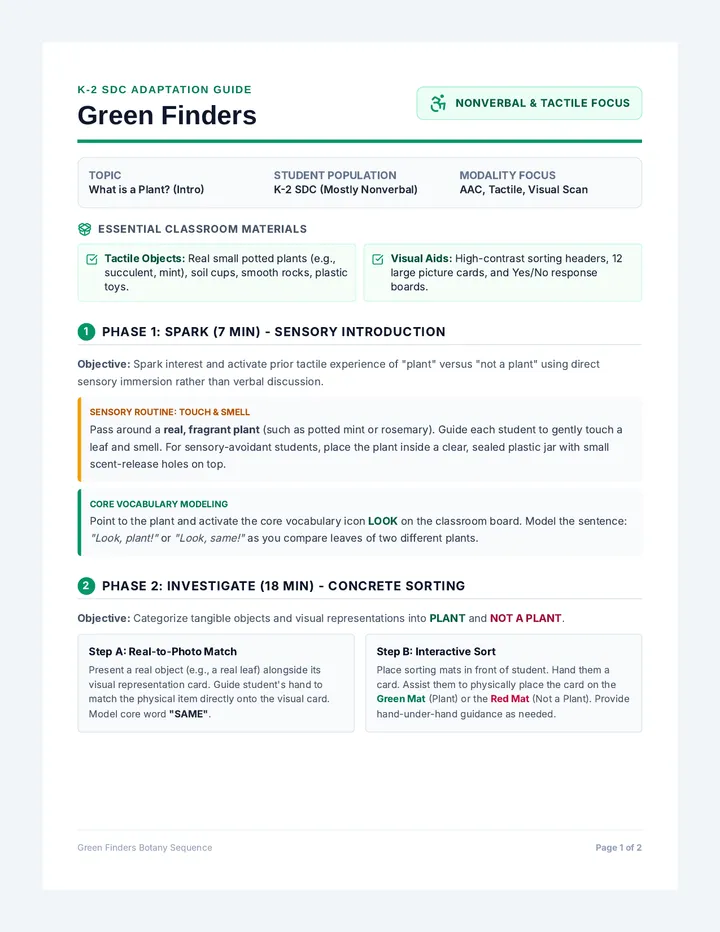
K-2 SDC Adaptation Guide
Green Finders
Nonverbal & Tactile Focus
Topic What is a Plant? (Intro)
Student Population K-2 SDC (Mostly Nonverbal)
Modality Focus AAC, Tactile, Visual Scan
Essential Classroom Materials
Tactile Objects: Real small potted plants (e.g., succulent, mint), soil cups, smooth rocks, plastic toys.
Visual Aids: High-contrast sorting headers, 12 large picture cards, and Yes/No response boards.
1 Phase 1: Spark (7 Min) - Sensory Introduction
Objective: Spark interest and activate prior tactile experience of "plant" versus "not a plant" using direct sensory immersion rather than verbal discussion.
Sensory Routine: Touch & Smell
Pass around a real, fragrant plant (such as potted mint or rosemary). Guide each student to gently touch a leaf and smell. For sensory-avoidant students, place the plant inside a clear, sealed plastic jar with small scent-release holes on top.
Core Vocabulary Modeling
Point to the plant and activate the core vocabulary icon LOOK on the classroom board. Model the sentence: "Look, plant!" or "Look, same!" as you compare leaves of two different plants.
2 Phase 2: Investigate (18 Min) - Concrete Sorting
Objective: Categorize tangible objects and visual representations into PLANT and NOT A PLANT.
Step A: Real-to-Photo Match
Present a real object (e.g., a real leaf) alongside its visual representation card. Guide student's hand to match the physical item directly onto the visual card. Model core word "SAME".
Step B: Interactive Sort
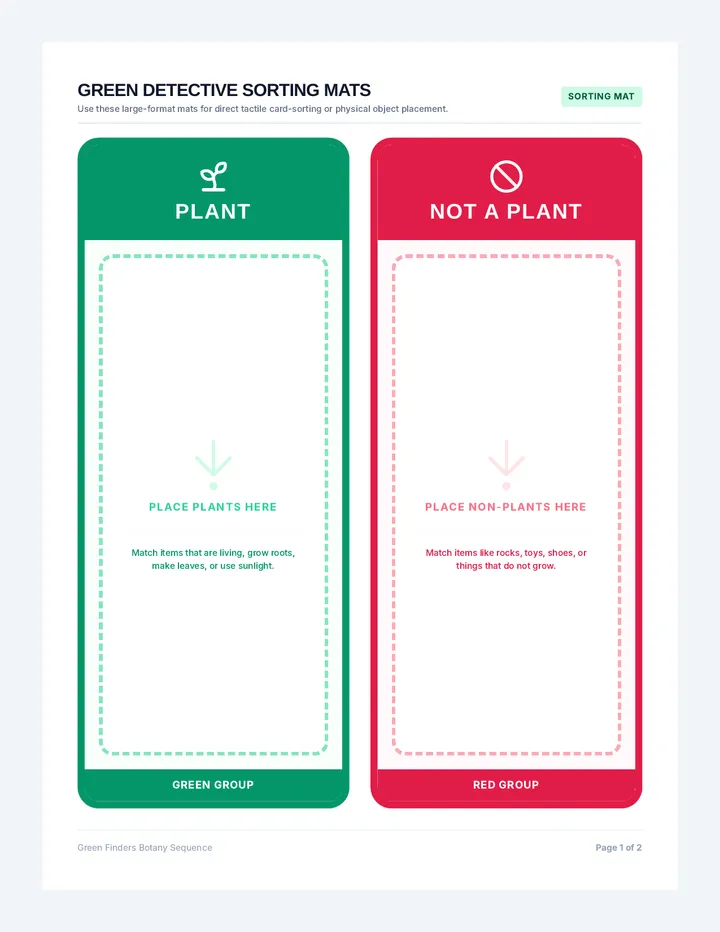
Place sorting mats in front of student. Hand them a card. Assist them to physically place the card on the Green Mat (Plant) or the Red Mat (Not a Plant). Provide hand-under-hand guidance as needed.
Green Finders Botany Sequence Page 1 of 2
K-2 SDC Adaptation Guide
Green Finders
Teacher Facilitation
3 Phases 3 & 4: Report & Reflect (13 Min)
Objective: Share answers and consolidate learning using low-tech AAC strategies.
A
Yes/No Verification Routine
Hold up a sorted card (e.g., the Toy Block card placed in "Plant"). Ask: "Is this a plant?" Prompt student to use their color-coded Yes (Green) or No (Red) selection card to respond. Use a high-contrast physical layout to support scanning.
B
Eye-Gaze / Spaced-Out Selection
For students with limited motor control, present two cards (one plant, one non-plant) spaced 12 inches apart on an eye-gaze board. Ask: "Look at the plant." Honor their gaze choice instantly by picking up and naming the item.
Low-Tech AAC Integration Guide
| Target Core Word | Teacher Prompt / Cue | Expected Student Action |
|---|
| LOOK | "Look at the leaf. Touch 'LOOK'." | Points to card, looks at target plant. |
| SAME | "This leaf matches this plant. It is 'SAME'." | Touches 'SAME' card to verify match. |
| NOT | "Is a rock a plant? No, it is 'NOT' a plant!" | Points to 'NOT' symbol or selects red card. |
Accommodations Matrix
Motor Accommodations
Use visual velcro strips on cards to make grip/release easy. Affix large wooden knobs or thick craft foam to the back of cards for easier pick-up.
Visual Accommodations
High-contrast yellow-on-black background cards. Space targets at least 8 inches apart. Use a black felt cloth board to block visual background noise.
Sensory Accommodations
Provide sensory brush routines before tactile work. Keep headphones nearby for students sensitive to rustling leaf or crinkly soil sounds.
Green Finders Botany Sequence Page 2 of 2
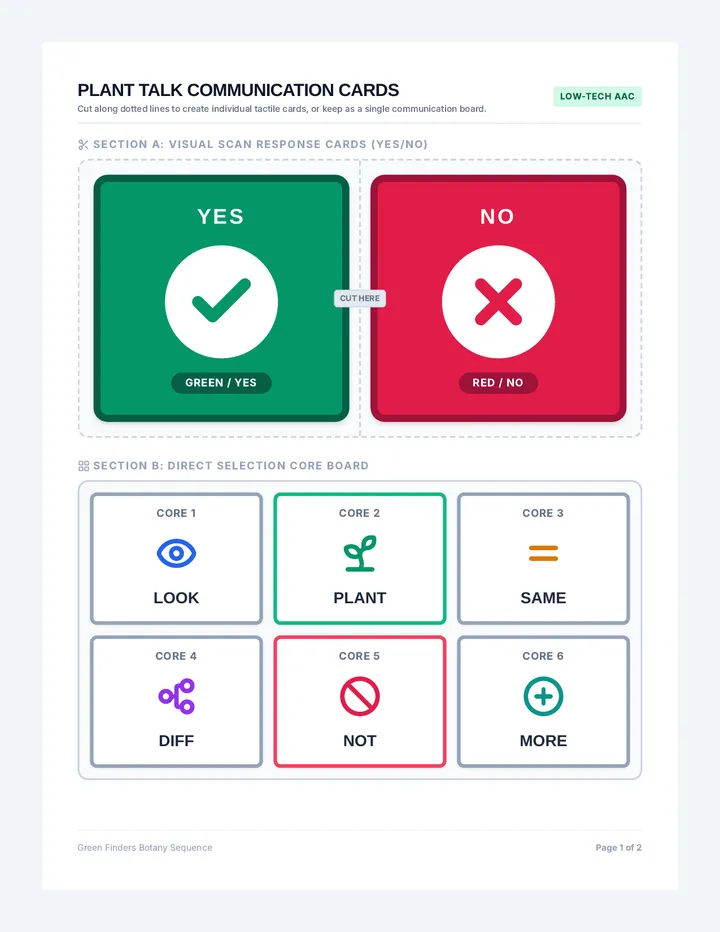
Plant Talk Communication Cards
Plant Talk Communication Cards
Cut along dotted lines to create individual tactile cards, or keep as a single communication board.
Low-Tech AAC
Section A: Visual Scan Response Cards (Yes/No)
YES
GREEN / YES
NO
RED / NO
CUT HERE
Section B: Direct Selection Core Board
Core 1 LOOK
Core 2 PLANT
Core 3 SAME
Core 4 DIFF
Core 5 NOT
Core 6 MORE
Green Finders Botany Sequence Page 1 of 2
Spaced-Out Pointing / Eye-Gaze Board
Position board 12-18 inches from student's face. Observe primary eye fixation or reach.
Direct Select
Teacher Tip: Direct student gaze to the yellow star in the center first to "reset" tracking. Then, present your target question: "Where is the plant?" or "Which one is not a plant?" and watch which quadrant they focus on.
A - Plant PLANT
B - Leaf LEAF
C - Rock ROCK
D - Toy TOY
Green Finders Botany Sequence Page 2 of 2
Green Detective Sorting Cards
Green Detective Sorting Mats
Use these large-format mats for direct tactile card-sorting or physical object placement.
Sorting Mat
PLANT
Place Plants Here
Match items that are living, grow roots, make leaves, or use sunlight.
Green Group
NOT A PLANT
Place Non-Plants Here
Match items like rocks, toys, shoes, or things that do not grow.
Red Group
Green Finders Botany Sequence Page 1 of 2
Green Detective Sorting Cards
Cut along the dotted guidelines. Cards are styled with identical backing frames to prevent visual bias.
Tactile Cards
Item 1
FLOWER Living Plant
Item 2
ROCK Not a Plant
Item 3
TREE Living Plant
Item 4
TOY CAR Not a Plant
Item 5
LEAF Living Plant
Item 6
BLOCK Not a Plant
Item 7
GRASS Living Plant
Item 8
SPOON Not a Plant
Item 9
CACTUS Living Plant
Item 10
SHOE Not a Plant
Item 11
POTTED Living Plant
Item 12
BOOK Not a Plant
Green Finders Botany Sequence Page 2 of 2