Quest Board Slides CODE QUEST
The Success Pathway Race
How to Play
1
Reach the Checkpoint before moving to the next block of code.
2
Get a "Ding!" to confirm your syntax is 100% correct.
3
Race against your own best time, not the clock!
Motto:
"Slow is smooth, and smooth is fast."
Checkpoint 01
Open and Prep
Open the assignment.
Clear your workspace.
Get your code board ready.
Checkpoint 02
Logic Check
The Challenge:
"Explain the task in your own words. What are we building today?"
Checkpoint 03
Syntax Scan
Micro-Step Mode:
Type ONE small part. A single line or one single function. Stop there!
Checkpoint 04
The Admin Check
Double-check the details:
Spelling
Admin
Not "Abmin"
Spaces
() { }
Check the gaps!
Checkpoint 05
The Show-Off
Ready for Verification?
Show your code block to the Proctor. Wait for the green light!
Checkpoint 06
DING!
The Final DING
Block complete! Save your work and prepare for the next micro-quest.
Quest Comms: Use Your Scripts
If you're stuck:
"Can you show me an example?"
If instructions are messy:
"Can you explain it in simpler steps?"
Asking for a micro-step is part of the game!
Victory Reflection
Quest Complete!
Post-Game Question:
"What is ONE thing you are proud of today?"
Quest Master Guide Quest Master Guide
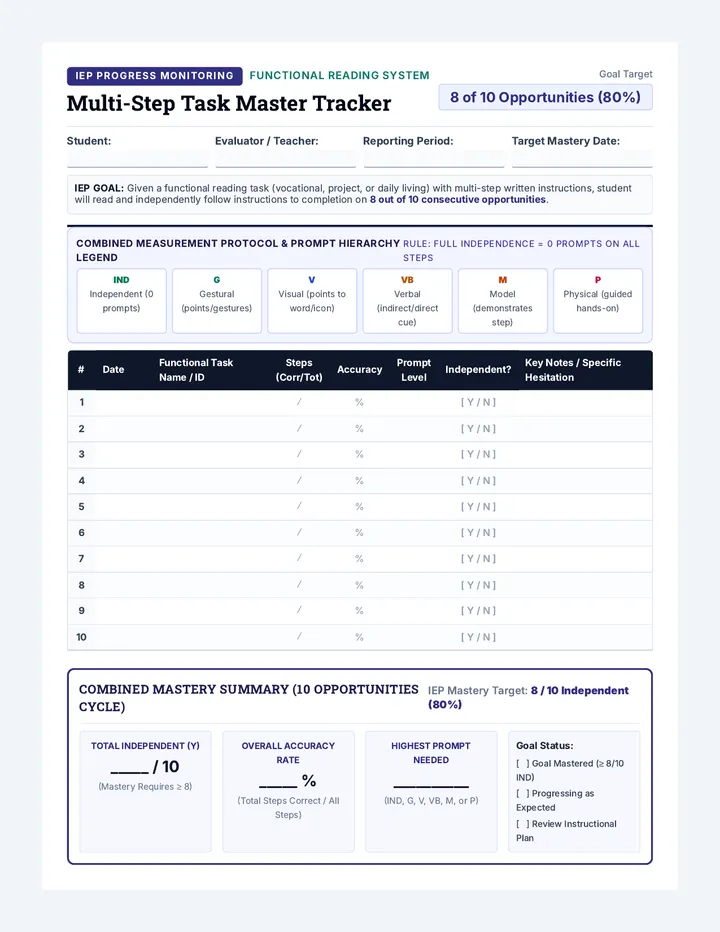
Supporting Processing & Memory in Coding
Facilitator Protocol
Leverage Numbers
The student shows strength in numerical logic. Frame coding as a sequence of numerical values . When explaining variables, focus on the number being "stored" rather than the word describing it.
Memory Anchors
To combat memory loss, use physical anchors . Have the student point to the card, say the step name out loud, and check it off a physical log. Repeat the current "Quest Step" number every 5 minutes.
Numerical Quest Protocol
01: Clear Space
Goal: Minimize visual processing load.
Close all browser tabs except the IDE. Ensure the physical workspace has only the "current number" reference card visible.
02: Logic Match
Goal: Bypass word comprehension barriers.
Instead of asking "Read this line," ask: "If the number is 10, does the computer take the emerald path or the rose path?" Use color/visual logic.
03: Symbol Scan
Goal: Precise pattern matching.
Have the student use the "Pencil Point" strategy. Check for symbol inversions or missing numbers. Avoid long verbal instructions; use "Check Step 3."
04: Quest Save (Ding!)
Goal: Reinforce memory & closure.
Provide an immediate auditory "Ding!" Use a physical tally mark. Ask the student: "What step number did we just finish?" to build retention.
Processing Scripts
Instruction Support
When instructions are too complex:
"Step 1: Write the number. Step 2: Stop."
"Find the equals sign. What number comes after it?"
"Point to the start. Move your pencil to the end."
Memory Recovery
When the student forgets the current task:
"Check your Quest Log. What number is next?"
"Let's reset. Say the Step 2 rule out loud."
"Look at your Card 1. Does your code match the picture?"
Growth Metrics
Student transitions between numerical steps without a prompt.
Student uses the "Show me the next number" help script.
Student correctly matches a 3-part code pattern (Number-Symbol-Number).
Quest Knowledge Check Quiz Quest Knowledge Check
Level 1: Success Pathway Basics
Player Name
Show what you know about the Code Quest rules! Complete these tasks to unlock your first quest.
1 Checkpoint Match-Up
Draw a line from the Checkpoint Name to its correct Action .
Logic Check
Syntax Scan
The Show-Off
The Ding
Type just ONE small part of the code and stop.
The final noise that means the block is done!
Explain the task in your own words.
Show your work to the teacher for a thumbs up.
2 The Script Choice
You are stuck at a checkpoint. Which script do you use to ask for help?
"I can't do this, it's too hard for me."
"Can you show me an example of this step?"
"Someone else already finished the whole thing."
3 The Admin Scan
Circle the Impostors (the words spelled wrong) below.
Admin
Abmin
Admin
Admin
Adminn
Admin
Admn
Admin
Admin
Next Level: First Quest!
Ready for DING!
Syntax Scout Worksheet Syntax Scout Mission
Phase 3: The Syntax Scan
Player Name
A Syntax Scan means looking at every single character—letters, spaces, and symbols. Even one missing dot can break the code!
1 Spot the Impostor
Look at the target code. Circle the Impostor in each row that has a mistake.
Target Code
print()
print()
print()
primt()
Target Code
Admin
Abmin
Admin
Admin
Target Code
count = 5
count = 5
count == 5
count = 5
2 The Missing Piece
One vital character is missing from each code block. Draw it in the empty box.
Need a Semicolon
runCode
Need a Parenthesis
start(
Need a Bracket
class Code {
Need an Equals Sign
score 10
3 The Slow Scan Challenge
Copy this line of code exactly. Use the dots below to check every character one-by-one.
function startQuest() {
Letters
Symbols
Spaces
Success Pathway | Code Quest
Goal: Level 5 Independence
Syntax Decoder Card Syntax Decoder Card
Visual Reference for the Code Quest
Use this card during your Syntax Scan . If you aren't sure what a symbol is, find it here!
( )
Parentheses
"The Backpacks"
They hold **info** or **actions** that a function needs to work.
{ }
Curly Braces
"The Room Walls"
They wrap around a **whole block** of code to keep it together.
;
Semicolon
"The Stop Sign"
Put this at the **end of a line** to tell the computer "Finished!"
=
Equals Sign
"The Storage Label"
It puts a **value** inside a variable (like putting a toy in a box).
The "Pencil Point" Strategy
To catch every syntax error, follow these 3 steps:
1
Touch your pencil tip to the **first character** on the screen or board.
2
Move slowly character by character. **Say the name** of each symbol out loud.
3
Check: Does your paper match the board **exactly**? Check the spaces too!
"One space is like one breath. Don't forget to let your code breathe!"
Syntax Reference Cards Printable Teacher Tip: Print this page on cardstock and laminate for durable handheld reference cards!
( )
Parentheses
"The Backpacks"
They hold info or actions that a function needs to work.
Syntax Scout Level 1
{ }
Curly Braces
"The Room Walls"
They wrap around a whole block of code to keep it together.
Syntax Scout Level 1
;
Semicolon
"The Stop Sign"
Put this at the end of a line to tell the computer "Finished!"
Syntax Scout Level 1
=
Equals Sign
"The Storage Label"
It puts a value inside a variable (like a label on a toy box).
Syntax Scout Level 1
Pencil Scan
Strategy Card
1. Point to the 1st character.
2. Move slow, say it out loud.
3. Match the board exactly!
Syntax Scout Level 1
Help Script
Quest Comms
"Can you show me an example of this micro-step?"
Syntax Scout Level 1
Cut along the edges • Code Quest Success Pathway
Syntax Reference Cards Printable Revised Teacher Tip: Print this page on cardstock and laminate. These 6 cards are designed for handheld use during coding.
( )
Parentheses
"The Backpacks"
They hold info or actions that a function needs to work.
Code Quest
{ }
Curly Braces
"The Room Walls"
They wrap around a whole block of code to keep it together.
Code Quest
;
Semicolon
"The Stop Sign"
Put this at the end of a line to tell the computer "Finished!"
Code Quest
=
Equals Sign
"The Label"
It puts a value inside a variable (like a label on a toy box).
Code Quest
Pencil Scan
Strategy Card
Point pencil at the 1st letter.
Move slow, say it out loud.
Match the board exactly!
Quest Ready
Help Script
Self-Advocacy
"Can you show me an example of this micro-step?"
Quest Comms
Cut along edges • Code Quest Success Pathway
Logic Reference Cards Printable Teacher Tip: Set 2 of reference cards. Print on cardstock and laminate to expand the student's toolkit.
print()
The Shout
Action Command
It tells the computer to show a message on the screen for the player to see.
Code Quest
x = 10
Magic Boxes
Variables
Give a box a name and put a value inside. You can use it later!
Code Quest
if (...)
The Decision
Control Flow
If the condition is TRUE , the computer follows the path. Otherwise, it skips it!
Code Quest
else:
Backup Plan
Control Flow
This is what happens when the first choice (the if ) was FALSE .
Code Quest
The Breath
Indentation
Coding blocks need space (4 spaces or 1 tab) to show they belong together. Don't squish them!
Structural Rule
Name Rule
Naming Strategy
1. Use one word.
Quest Ready
Set 2: Logic & Structure • Code Quest Pathway
Logic Reference Cards Printable Revised Teacher Tip: Updated Set 2 with concrete examples. Print on cardstock and laminate.
The Shout
Command: print()
Example:
print("Go!")
The computer shouts the message inside the quotes onto the screen.
Logic Quest
Magic Boxes
Variables
Example:
score = 5
The name (score ) is the label on the box. The number (5 ) is what is inside.
Logic Quest
The Gate
Statement: if
Example:
if score > 10:
The computer asks a question. IF the answer is YES, it opens the gate to the next lines.
Logic Quest
Plan B
Statement: else
Example:
else:
The else is the backup path. It only happens if the if gate was CLOSED.
Logic Quest
The Gap
Indentation
if coins == 5:
print("Bonus!")
↑ This gap is 4 spaces!
The gap tells the computer: "This line belongs to the gate above it!"
Logic Quest
Naming
Variable Rules
GOOD
my_score
BAD
my score
Names must be one word . Use an underscore ( _ ) instead of a space!
Logic Quest
Logic & Structure • Code Quest Pathway
Logic Quest Guide Sheet Logic Quest Guide
Visual Explanations for Coding Decisions
Student Reference
coins = 10
Variable
1. The Loot Box (Variables)
Think of a Variable like a loot box in a game. The Name (coins) is the label on the outside of the box. The Value (10) is what you put inside. When you want to know how many coins you have, you just call the name of the box!
YES NO
Logic Gate
2. The Fork in the Road (If/Else)
An If Statement is a fork in the road. The computer checks a condition: if coins > 5:
Gate opens...
Action 1
Action 2
Indentation
3. Stepping into the Room (Spacing)
When a gate (like an If ) opens, the actions inside must be indented. Think of it like stepping into a room . The space (the gap) tells the computer: "These actions only happen inside this specific room!" If you don't indent, the computer gets lost and doesn't know where the room ends.
The Full Quest Script
health = 20
if health > 0:
print("You are still in the quest!")
else:
print("Game Over. Try again?")
• The Variable saves your status.
• The If/Else chooses the path.
Quest Answer Keys Teacher Resource Answer Key
For Teacher/Quest Master Use Only
KEY
Quest Knowledge Check Quiz
1. Checkpoint Match-Up
Logic Check → Explain the task in your own words.Syntax Scan → Type just ONE small part of the code and stop.The Show-Off → Show your work to the teacher for a thumbs up.The Ding → The final noise that means the block is done!
2. Script Select
"Can you show me an example of this step?"
3. Admin Scan Impostors
Abmin, Adminn, Admn
Syntax Scout Worksheet
1. Spot the Impostor
Row A: primt()
Row B: Abmin
Row C: count == 5 (Note: explain that while valid in some contexts, it doesn't match the target count = 5)
2. Missing Pieces
Item 1: ; (Semicolon)
Item 2: ) (Closing Parenthesis)
Item 3: } (Closing Brace)
Item 4: = (Equals Sign)
Proctor Scoring Tip
For students with dyslexia, focus on the effort of scanning rather than absolute perfection. If they identify an impostor but struggle with the spelling themselves, that is still a win for visual discrimination!
Quest Board Slides Revised NUMBER QUEST
Coding by the Steps
Memory Rule: Check & Record
1
Look at the Number on your card first.
2
Say the Step Name out loud to help you remember.
3
Put a mark in your Quest Log after every "Ding!"
Numerical Logic:
"Follow the numbers, find the code."
01
Clear Space
Close extra windows. Only ONE task on screen.
02
Logic Match
Point to the code. Tell me:"What happens next?"
03
Symbol Scan
Check the numbers. Check the dots.
04
DING!
QUEST SAVE
Save your work. Mark your log. You did it!
HELP SCRIPTS
"Show me the next number."
"What is the symbol for this?"
Asking for a Number Step helps your brain!
Syntax Scout Worksheet Revised Syntax Pattern Scan
Mission: Match the Numbers and Symbols
Player Name
Memory Tip: Say the numbers and symbols out loud while you scan.
1 Number Pattern Match
Circle the code block that matches the Target Pattern exactly.
Target Pattern
score = 100
score = 10
score = 100
Target Pattern
if health < 5:
if health > 5:
if health < 5:
2 Symbol Decoder
Look at the code below. One symbol is missing. Draw it in the box.
End of Line
print("Win!")
;
Logic Stop
if coins == 0
:
3 Step-by-Step Memory Copy
Say each number and symbol as you write it!
player_id = 459;
Correct Numbers
Correct Symbols
Correct Order
Code Quest Success Pathway
Numerical Focus | Session 1
Quest Memory Log Sheet Quest Memory Log
Level 1: The Number Path
Total Dings 0
Memory Rule: Every time you finish a number, color in the circle! This helps your brain remember where you are.
01
Clear Space
Close extra windows. Only 1 task on screen.
02
Logic Match
Explain: "What happens next?"
03
Symbol Scan
Check every number and dot on the screen.
04
Quest Save
Save work. Get your "DING!"
End of Quest Check
Circle your feeling:
1
Hard
2
Okay
3
Success!