Lenny.com
Explore
Create
ActivitiesNewMathEnglish Language ArtsScience & EngineeringSocial StudiesGlobal LanguagesHealth & Physical EducationSpecial EducationCounseling & Life SkillsArts & CreativityESL
Lenny.com
Lenny.com
Explore
Create
ActivitiesNewMathEnglish Language ArtsScience & EngineeringSocial StudiesGlobal LanguagesHealth & Physical EducationSpecial EducationCounseling & Life SkillsArts & CreativityESL
Lenny.com
Lenny.com

Solutions

Lenny for EducatorsLenny for SchoolsLenny for Districts

Product

ExploreSign inCreateSupportAbout

Resources

Getting startedMTSS Acceleration Program

© 2026 Lenny Learning Inc.

TermsPrivacyAccessibility
LinkedInInstagramX
Lenny

Math Manipulative Use

Integrates base-ten blocks, counters, and virtual tools to scaffold the Concrete-Representational-Abstract (CRA) sequence. Targets conceptual understanding of arithmetic, place value, and fractions for students with learning disabilities.

Special EducationSensory Processing & RegulationSensory Preferences IdentificationSensory Tool UseCommunicating Sensory NeedsSensory Overload RecognitionDeep Breathing PracticeMovement Break UtilizationIndependent Calming Strategy UsePersonalized Calming RoutinePersonal Sensory Diet CreationProactive Sensory BreaksEmotion Intensity RecognitionDysregulation RecoveryPositive Behavior SupportUnderstanding Social StoriesPersonal Social Story CreationEmotional Regulation FrameworksPersonal Trigger IdentificationSelecting Regulation StrategiesReinforcement System ResponseSelf-Monitoring & RewardsLearning Positive AlternativesCross-Setting Skill GeneralizationSocial CommunicationEye Contact & Personal SpaceContext-Appropriate GreetingsAppropriate Volume & ToneConversation Turn-TakingTopic Maintenance in DiscussionEffective Help-SeekingBody Language InterpretationFacial Expression RecognitionIdioms & Figurative LanguageSocial Problem IdentificationSocial Solution GenerationSocial Decision EvaluationTask ManagementMinimal Prompting Task StartSelf-Talk for StartingStarter Strategies for Difficult TasksAge-Appropriate Task PersistenceStrategic Break ManagementSmooth Task TransitionsAdapting to Plan ChangesObstacle Problem-SolvingMulti-Day Project CompletionPlanning & OrganizationPhysical Material OrganizationVisual Schedule & Timer UseSequential Task BreakingTime Estimation SkillsTask PrioritizationDigital & Physical Workspace ManagementPersonalized Organization StrategiesDetailed Project PlanningMultiple Commitment BalancingAcademic Support StrategiesMath Manipulative UseVisual Math Problem RepresentationComplex Math Problem BreakdownText Highlighting & AnnotationVisualization While ReadingPredictions & Inferences from TextText Structure Graphic OrganizersWriting Graphic OrganizersSentence Frames & TemplatesStudy Guide CreationSpaced Repetition for MemoryAssistive Writing TechnologyWorking Memory SupportSingle-Step Direction FocusMulti-Step Direction FollowingInformation Chunking PracticeVisual Support Memory AidsMnemonic Device ApplicationEfficient Note-Taking SystemsGraphic Organizer Note-TakingNote Review & OrganizationSustained Complex Task AttentionAssistive TechnologySymbol-Word CommunicationAAC Device NavigationSpeech Recognition DictationDictation Text EditingText-to-Speech for ReadingDigital Calendar UseKeyboard Shortcuts NavigationProductivity App ManagementSelf-Advocacy SkillsCommunicating Learning NeedsRequesting AccommodationsAdvocating for Appropriate SupportsIEP & Student RightsUnderstanding IEP ComponentsMeaningful IEP Meeting ParticipationIDEA & Section 504 RightsProgress MonitoringTracking IEP Goal ProgressReflecting on AchievementData-Informed Instructional AdjustmentTransition PlanningCareer & Vocational Goal SettingExploring Post-Secondary OptionsIndependent Living Skills Planning

Materials

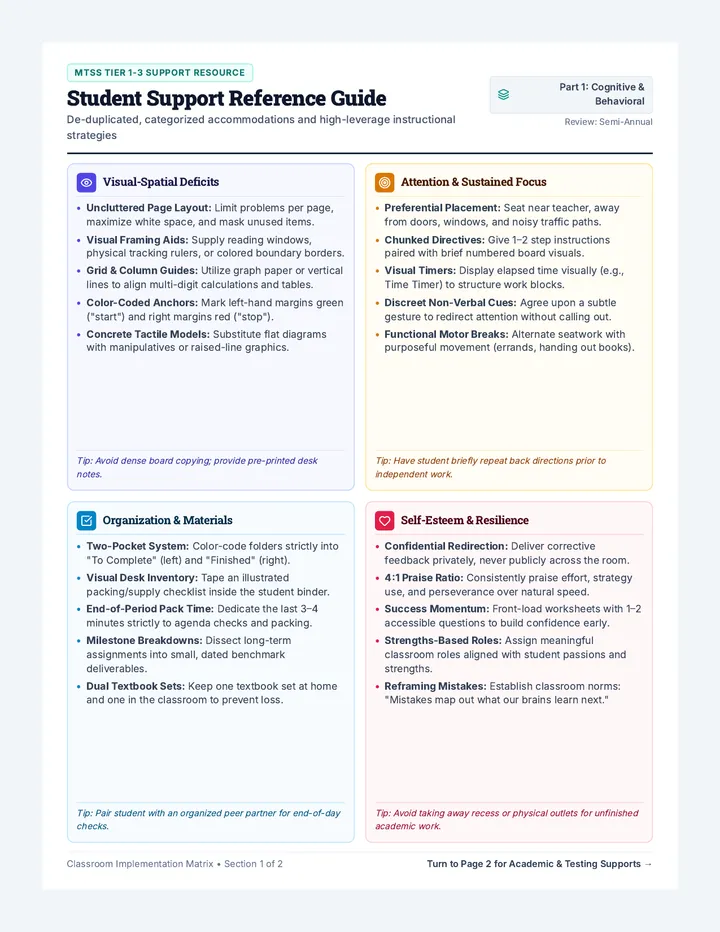
Student Support Reference Guide

Student Support Reference Guide

A comprehensive, de-duplicated reference guide for educators organizing evidence-based accommodations across seven core domains: visual-spatial deficits, attention, organization, self-esteem, writing, math, and testing/environmental accommodations.

CL

Christina Lorenzoni

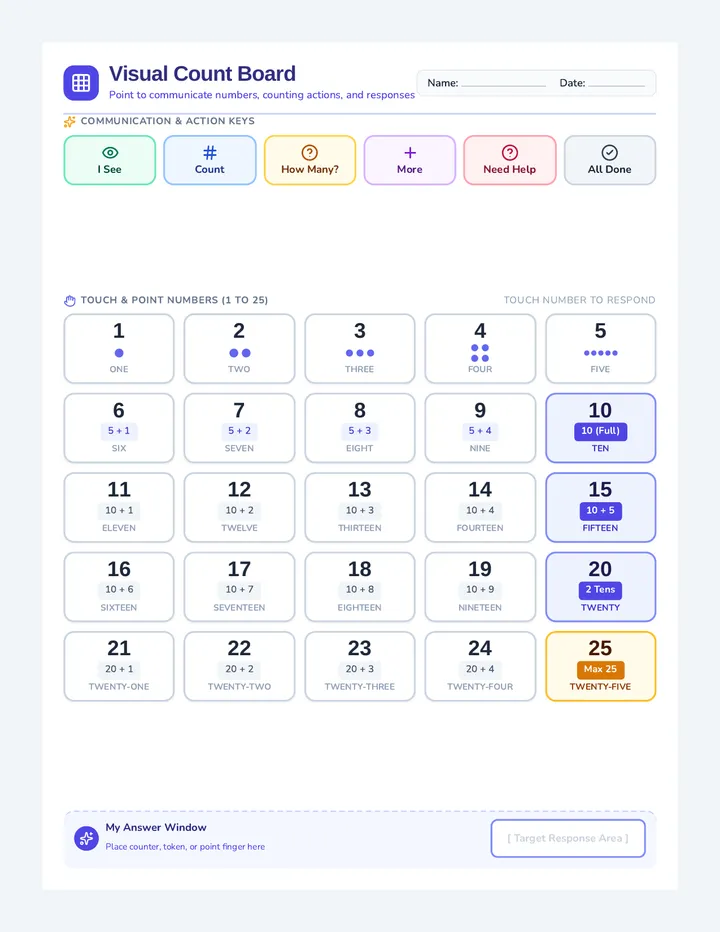
Visual Count Kit Document

Visual Count Kit Document

A comprehensive 5-page visual counting packet designed for non-verbal learners featuring an AAC-style communication and number pointing board up to 25, touch-point counting cards, ten-frame visual sets, and hands-on matching activities.

CP

Christian Page

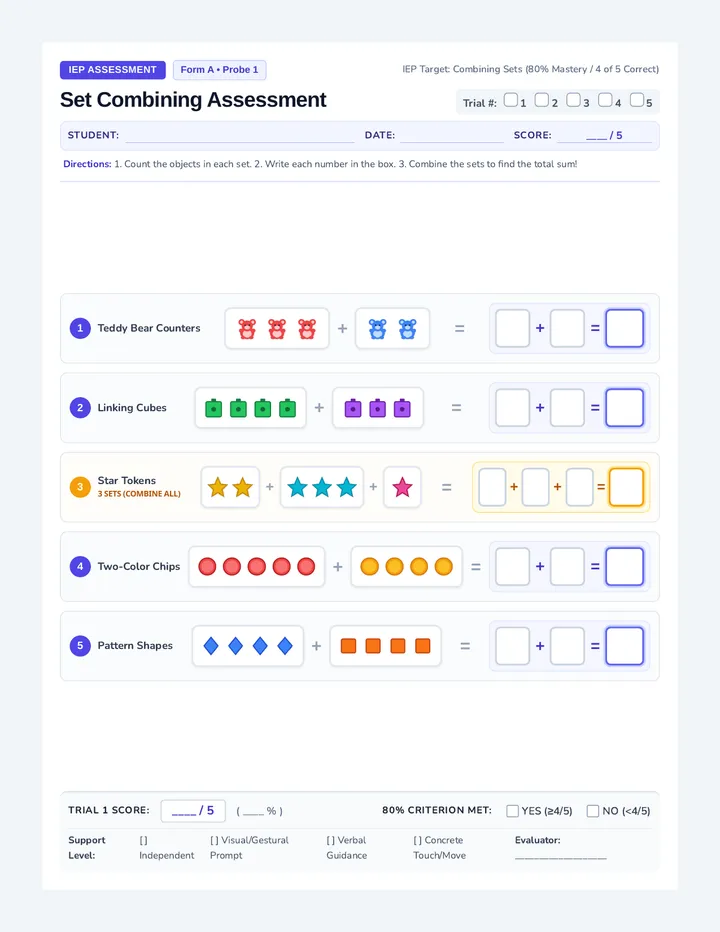
Set Combining Assessment Worksheet

Set Combining Assessment Worksheet

A 2-page print-ready IEP assessment worksheet designed to evaluate addition by combining two or more sets of concrete manipulatives. Features Form A and Form B with diverse visual sets, clear write-in equation frames, and a 5-trial progress monitoring data tracking rubric.

EB

Emily Brown

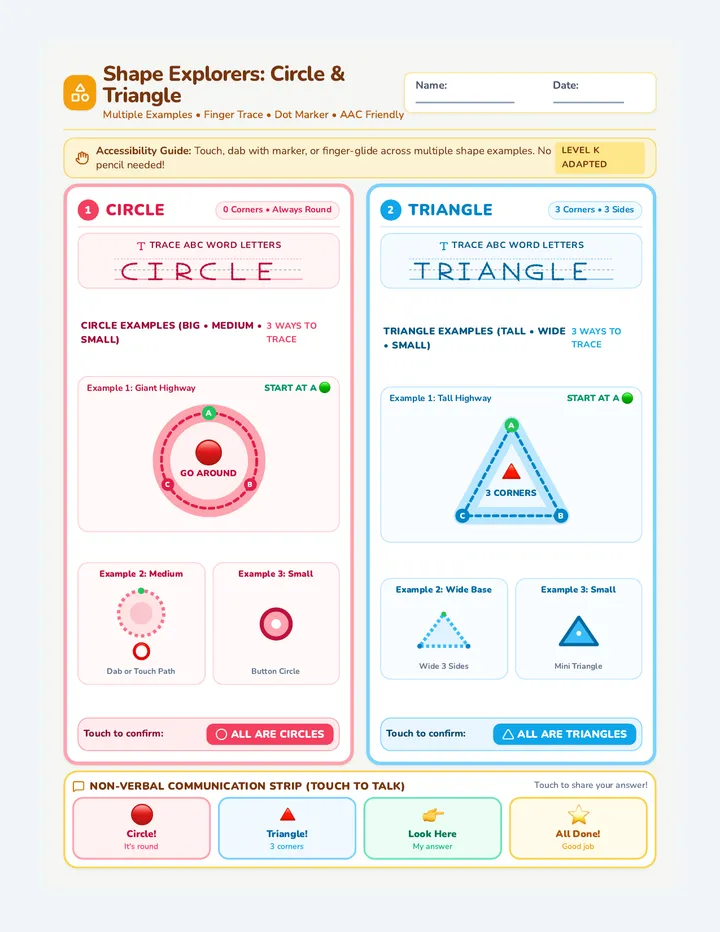
Shape Explorers Adapted Worksheet

Shape Explorers Adapted Worksheet

A 2-page adapted kindergarten worksheet for students learning circles and triangles with physical and communication impairments. Real-world pictures on Page 2 now feature high-contrast dashed tracing outlines with A-B-C guide dots so students can finger-trace or dab the shape directly on each familiar picture, alongside touch choice buttons and AAC supports.

J

janet.laureano

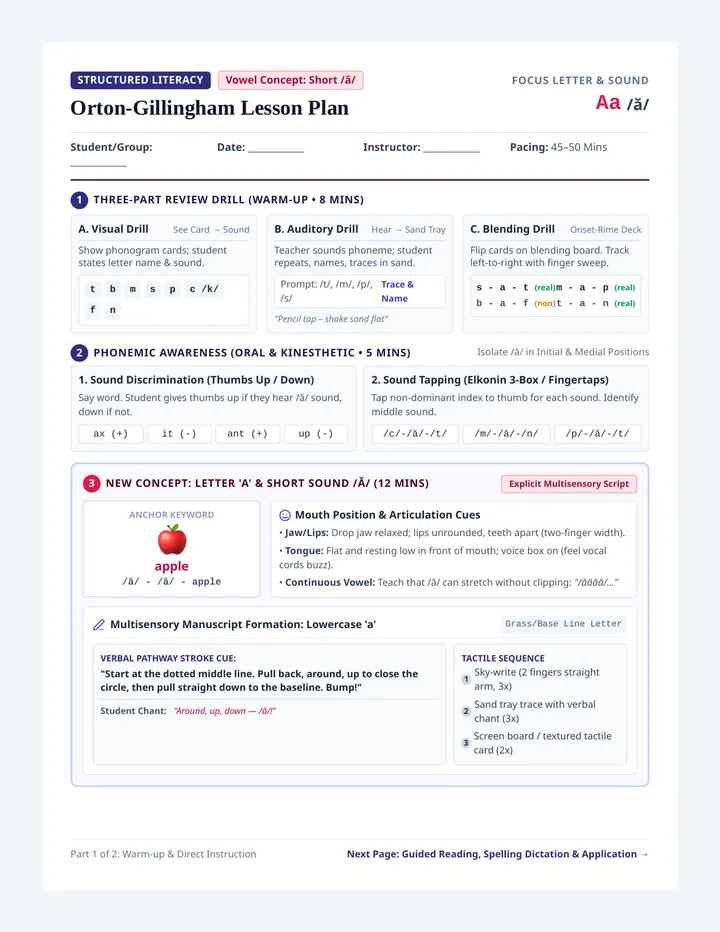
Short A OG Lesson Plan

Short A OG Lesson Plan

A comprehensive Orton-Gillingham lesson plan for introducing and reviewing the short vowel sound /ă/ and manuscript letter formation. Features structured drills, multisensory routines, decodable word lists, dictation scripts, and decodable text.

MF

Melissa Fletcher

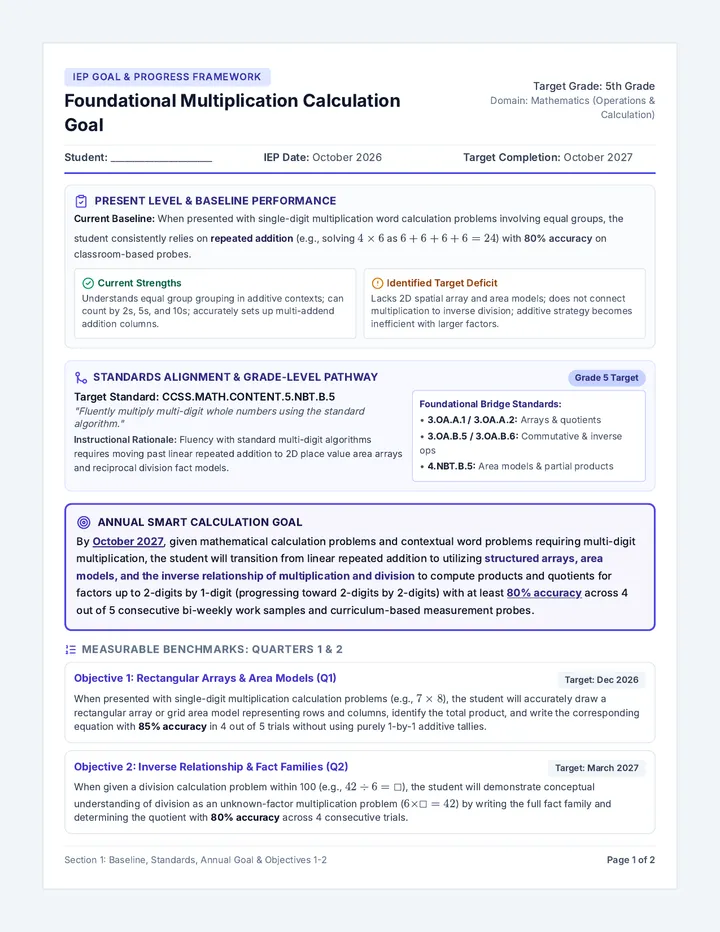
Math Calculation Goal Sheet

Math Calculation Goal Sheet

A comprehensive IEP math calculation goal document for a 5th grade student transitioning from repeated addition to foundational multiplication concepts, complete with baseline data, standards alignment, measurable objectives, and progress monitoring tools.

L

lwalker

Sequences

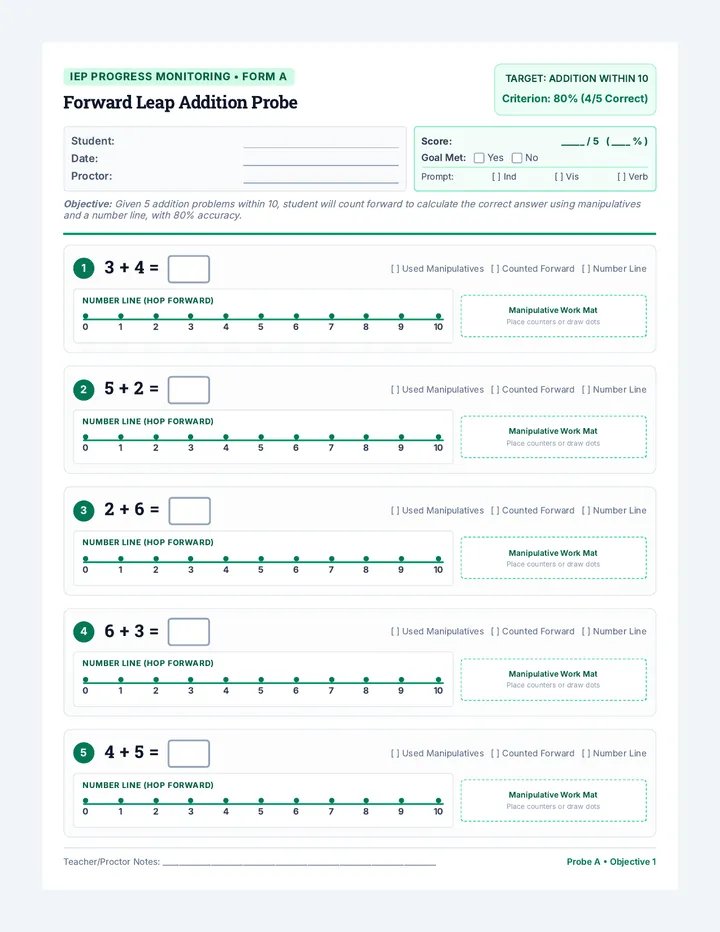
Forward Leap Probe A Worksheet

Step By Step Counters

A comprehensive progress monitoring collection designed for special education and tier intervention math goals. The sequence contains targeted assessment probes aligned to specific counting strategies on number lines and visual supports within 10 and 20.

DG

Doris Gutierrez

14
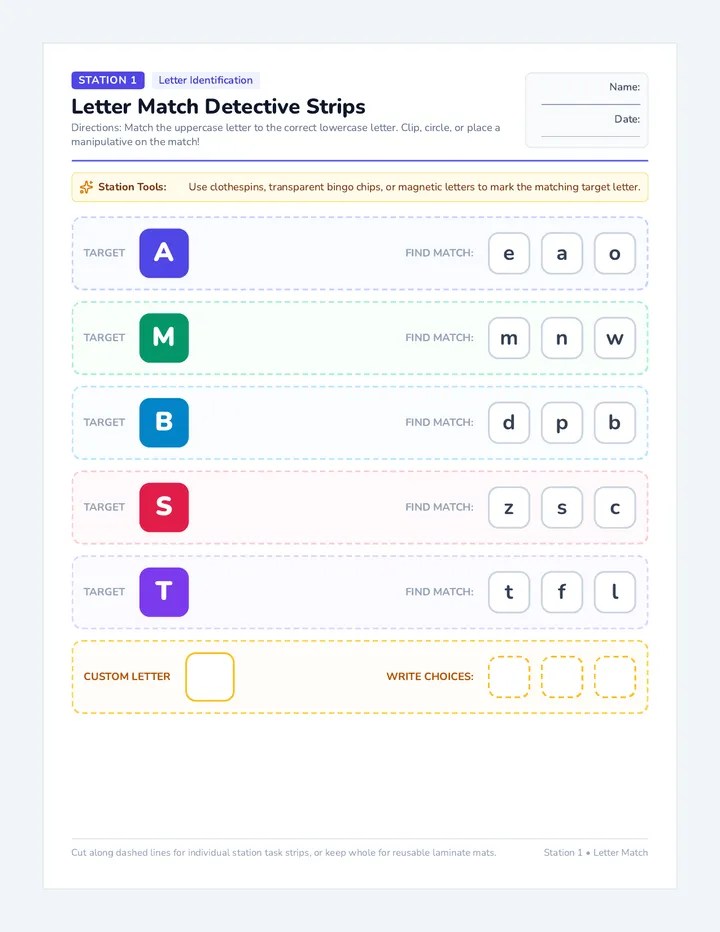
Letter Match Station Cards

Word Builders Lab

A multi-day station rotation sequence designed for essential skills classrooms, targeting letter identification, sound correspondence, word building with tiles, and sight word recognition through hands-on, multi-sensory activities.

SC

Samantha Carmer

7
Number Detective Script

Make Ten Solve Big

A 12-session Tier 2 intervention series focusing on making ten and decomposing strategies for addition and subtraction word problems within 20 and 200. Designed for students with learning and intellectual disabilities using direct instruction and hands-on practice.

K

kurtzm

28
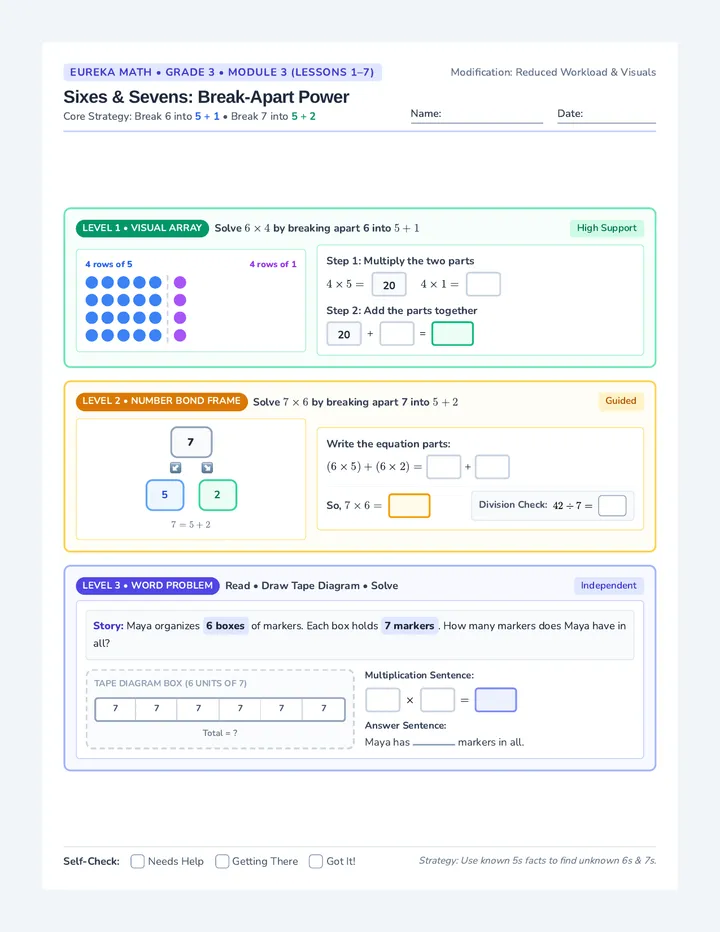
Sixes Sevens Tiered Worksheet

Module Three Math Modifications

A comprehensive instructional sequence providing differentiated, reduced-workload, and visually scaffolded modifications for Eureka Math Grade 3 Module 3. Covers all 21 lessons organized across four focused mastery clusters with multi-tiered student practice and teacher modification guides.

ML

Michelle Low

8
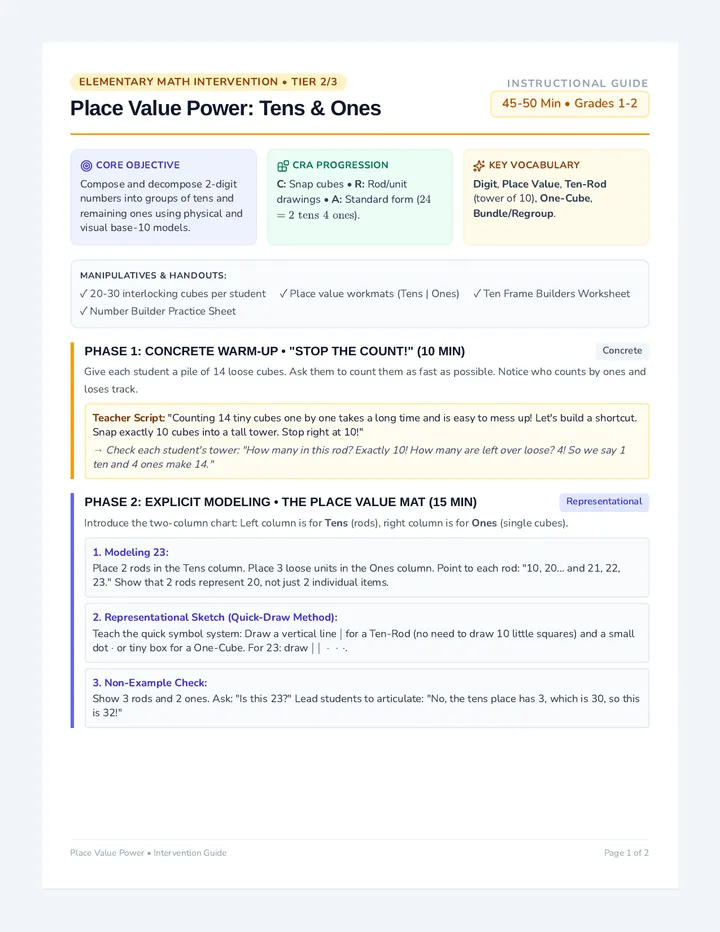
Place Value Power Teacher Guide

Foundational Skills Boost

A targeted intervention sequence providing structured multi-sensory support in foundational numeracy and reading comprehension. Built for elementary learners needing visual scaffolding, chunked tasks, and explicit strategy routines.

LF

Lindsey Flores

8
Short A Lesson Plan

Small Group Power Up

A pair of targeted 15-minute Tier 2 intervention lessons for 1st grade, focusing on foundational phonics (Short 'a' CVC words) and mental math (Number Bonds to 10).
RC

Rebekah Chon

6