IEP Masterclass Note Taker
Participant Handout & Note-Taker
IEP WRITING & PROGRESS REPORTS
Uncommon Schools • K-12 Regional Special Education Team
Educator Name
Date
Meeting Norms
- Stay Engaged & Participate Fully
- Computers Closed (except during workshop)
- Ask Questions & Drive Equity
PD Road Map
• IEP Writing Best Practices
• Writing Strong PLAAFPs
• Formulating SMART Goals
• Progress Report Ownership
• Hands-On IEP Drafting Workshop
Part 1
IEP Writing Best Practices
1. Grounding the Work: Compliance vs. Equity
"Compliance is the floor, not the ceiling." How do we ensure our IEPs go beyond simple checkbox legalities to actively drive equity?
Reflection / Key Takeaways:
2. Present Levels (PLAAFPs) Essentials
What are the core attributes of a robust PLAAFP narrative? Focus on balancing strengths and needs using multiple data points.
Data-Based (No Guesses)
Balanced (Strengths + Needs)
Clear, Objective Narratives
Actionable for Goal Writing
CORE IDEA
"A clear picture of a scholar's strengths is the foundation for meaningful IEPs — it tells us where to start, not just what's missing."
DID YOU KNOW?
Every annual goal must include at least one aligned objective to map out the instructional pathway to mastery.
PD Spotlight: Roles & Team Responsibilities
| Case Manager | SpEd Coordinators (SECs) | Special Education Teachers |
|---|
| • SEL & Counseling PLAAFPs/Goals | • Academic/Behavior PLAAFPs & Goals | • Academic PLAAFPs & Goals (all service students) |
| • LRE & Placement Justification | • State & District Assessment planning | • Accommodations & Modifications execution |
| • Parent Response & Notices | • Comprehensive audits of drafts | • Class modifications with SEC guidance |
Uncommon Schools K-12 Regional Special Ed PD Handout Page 1 of 5
Section 1: PLAAFP Framework
STRENGTHS & PARENT CONCERNS
Uncommon Schools PD Handout
The 3 Pillars of an EdPlan PLAAFP
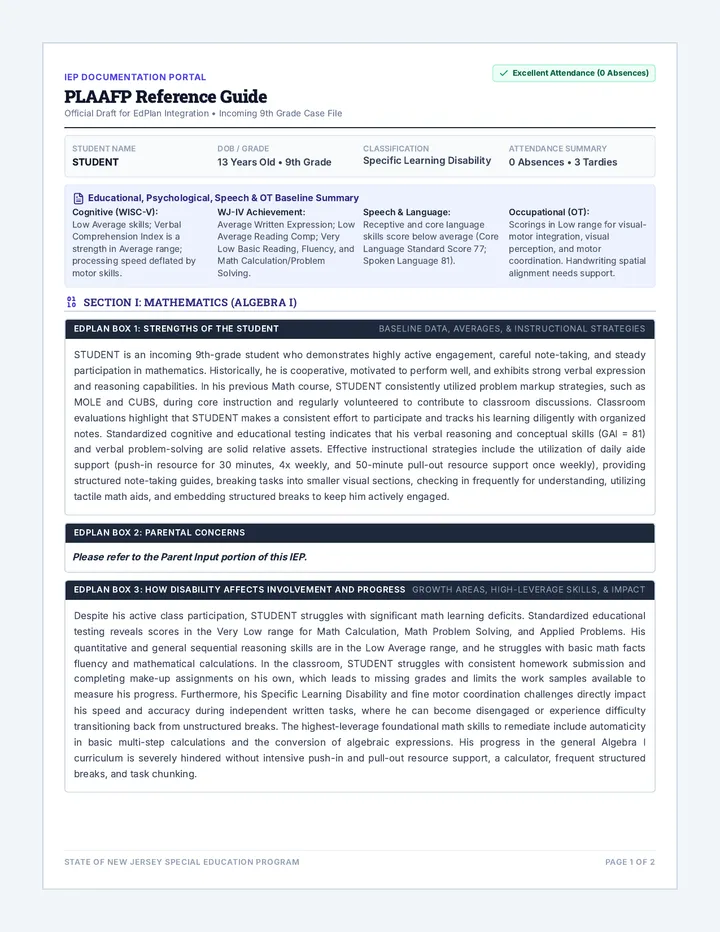
To ensure complete compliance and quality in EdPlan, every single area of need must independently document: (1) Scholar Strengths, (2) Parent/Guardian Concerns, and (3) Adverse Impact.
Critical Rule No copy-pasting across different sections!
1 Component 1: Scholar Strength Statements
Must be: Data-Based • Specific • Instructionally Useful
WEAK
"Janelle is a sweet scholar who tries her best in reading. She needs to improve her comprehension."
Why: Extremely vague, no assessment data cited.
Impact: Gives teachers zero instruction baseline.
STRONG
"Janelle uses context clues effectively to determine vocabulary. Fall DIBELS indicates instructional level of 2.8. In class, she identifies main idea/details when read aloud..."
References standard tests (DIBELS) & class skills.
Pinpoints exact modalities that support learning.
Interactive Task: Key Elements of Strong Strengths
What data should you include? (DIBELS, NWEA...)
How to balance academic & functional observations?
Drafting Tip: State what they CAN do, not what's missing.
2 Component 2: Parent/Guardian Concern Statements
Must be: Specific • Family's Voice • Relevant to Learning
Concern Rules of Thumb
DO: Capture parent's exact priorities & home observations.
DON'T: Use filler terms like "None" or "No concerns expressed."
TIP: If none, write: "[Name] did not express any specific concerns at this time."
EXEMPLAR: Nolan's Parents
"Nolan's parents are concerned that he becomes easily upset during transitions or conflicts with peers... They want him to develop consistent coping strategies..."
Analysis: Why does this statement exceed simple compliance?
Anchor Tool: Recommended Sentence Starters
• [Name] demonstrates strength in...
• Parents express concern that...
• When provided with [support], [Name] can...
• At home, parents report that [Name]...
Uncommon Schools K-12 Regional Special Ed PD Handout Page 2 of 5
Section 2: Adverse Impact & Goals
ADVERSE IMPACT & SMART GOALS
Uncommon Schools PD Handout
3 Component 3: Adverse Impact Statements
The core connection between disability and educational need
1. Disability State formal diagnosis
2. Skill Deficit Specify precise weakness
3. Impact Effect on standard access
4. Need Link directly to SDI/need
QA Lens: Access vs. General Struggle
Adverse Impact statements must articulate how the scholar's disability impacts access to the curriculum, NOT just listing what they are struggling with or failing to do in class. Focus on how the barrier impedes normal educational progression and why SDI is structurally necessary.
Evaluating Adverse Impact (Janelle's Case) Analyze structural shifts below
Weak (Just states struggling):
"Janelle struggles with reading."
Strong (Focuses on Access & SDI):
"Due to her Specific Learning Disability in reading, characterized by deficits in decoding and fluency, Janelle has difficulty independently reading and comprehending grade-level texts. This impacts her ability to access core ELA instruction without scaffolded supports such as read-alouds and targeted decoding instruction."
Guided Active Recall Prompt:
Why does naming the specific functional barrier (decoding) matter more than saying "struggles"?
4 SMART Goals & Objectives Integration
Core Components Framework
| Criteria | Weak Example | Strong Example |
|---|
| Instructional Condition | "Given classroom instruction..." | "Given explicit phonics instruction & scaffolded decoding..." |
| Specific Target Skill | "will improve her reading..." | "will decode multisyllabic grade-level words..." |
| Measurable Criteria | "reading and answering questions..." | "with 85% accuracy across 3 consecutive trials..." |
| Timeline / Tool | "ongoing basis/by end of IEP." | "measured bi-weekly by CBM assessments, by June 12, 2026." |
SMART Goal Acronym
Specific: clear skill, context
Measurable: criteria & tools
Achievable: realistic baseline
Relevant: aligned to PLAAFP
Time-bound: annual end date
Objective Path:
Every annual goal must match at least one objective.
Uncommon Schools K-12 Regional Special Ed PD Handout Page 3 of 5
Section 3: Practical Application
PROGRESS REPORTS & WORKSHOP
Uncommon Schools PD Handout
Progress Report Writing & Timeline
Quarterly Timelines & Deadlines
Q1 11/06
Q2 01/29 (MS/HS) & 02/05 (ES)
Q3 04/09
Q4 06/04
Note: Print and distribute to families at Report Card Conferences. Keep language professional but family-friendly.
WHO WRITES WHAT?
Social Workers: Counseling Goals
SECs: Behavior, Audits & Academics*
SpEd Teachers: Academic Goals
Related Service: Related Service Goals
*SEC writes academic goals if applicable.
IEP Workshop: Interactive Drafting Sandbox
Active Practice
Workshop Challenge Prompt:
Choose one of the weak profiles from the session or a current student's data. Rewrite a compliant, high-quality, data-driven section below.
1. Scholar Strengths (Instructional & Data-Based) Cite: DIBELS, Assessments, standard scores
2. Parent/Guardian Concerns (Family's Voice) Include: Specific priorities & home notes
3. Adverse Impact Statement (Disability -> Access Deficit) Must link: Diagnosis -> Curriculum impact
Professional Practice Reminder: Please ensure all completed IEP drafts are thoroughly reviewed and approved by your school's Special Education Coordinator prior to official finalization in EdPlan.
Uncommon Schools K-12 Regional Special Ed PD Handout Page 4 of 5
Section 4: Professional Development reflection
OPEN NOTES & NEXT STEPS
Uncommon Schools PD Handout
1. Shift Checklist: Access vs. Deficits
Write down one current scholar's IEP where you can immediately shift the PLAAFP focus from "what they are struggling with" to "how the disability limits curriculum access":
Write thoughts here...
2. Collaboration & Alignment Plan
Who (Related Service Providers, General Education teachers) do you need to coordinate with this week to assemble specific data and SMART goal criteria?
Write action plans here...
Session Discussion Notes & Personal Action Items
Uncommon Schools K-12 Regional Special Ed PD Handout Page 5 of 5