Brain CEO Lesson Plan Brain CEO Curriculum
Full 9-Session Facilitator Guide
9 Sessions 30 Mins Each
Core Objective
Students will learn and practice key executive functioning skills such as organization, planning, task initiation, self-control, and emotional regulation to improve academic success and social-emotional well-being.
Why This Matters
Developing executive functioning skills is crucial for navigating middle school challenges, managing academic demands, and building healthy relationships. This lesson provides practical tools for students to become more independent and resilient learners.
Preparation Checklist
Review the Executive Functioning Slide Deck and session materials.
Gather physical supplies: pens, notebooks, index cards, construction paper, scissors, glue.
Check technology (projector/whiteboard) for slide presentation.
Print copies of session-specific worksheets and activities for each student.
Session Roadmap
Session 1: What's Your Brain's CEO? 30 MINS
• Begin with a Warm Up Activity focused on daily tasks.
• Introduce executive functioning using the Slide Deck (Slides 1-3).
• Facilitate a discussion on why these skills are important.
• Students complete Brain Basics Worksheet .
• Conclude with a Cool Down Reflection .
Session 2: Planning Power! 30 MINS
• Start with a Warm Up Activity about planning.
• Discuss planning and prioritizing using the Slide Deck (Slides 4-6).
• Students work on Planning Power Worksheet to create a plan for a hypothetical task.
• End with a Cool Down Reflection .
Session 3: Organized Oasis 30 MINS
• Engage with a Warm Up Activity about staying organized.
• Explore organization strategies with the Slide Deck (Slides 7-9).
• Facilitate the Organized Oasis Activity where students design an organized space.
• Finish with a Cool Down Reflection .
Session 4: Task Start-Up 30 MINS
• Begin with a Warm Up Activity on overcoming procrastination.
• Introduce task initiation and breaking down big tasks using the Slide Deck (Slides 10-12).
• Students use the Task Start-Up Guide to break down a real-life task.
• Complete with a Cool Down Reflection .
Session 5: Focus Force Field 30 MINS
• Start with a Warm Up Activity on distractions.
• Discuss strategies for focus using the Slide Deck (Slides 13-15).
• Engage in the Focus Force Field Activity to identify and combat distractions.
• End with a Cool Down Reflection .
Session 6: Stop & Think 30 MINS
• Introduce with a Warm Up Activity on making quick decisions.
• Explore self-control and impulse management using the Slide Deck (Slides 16-18).
• Students participate in the Stop & Think Scenario Cards activity.
• Conclude with a Cool Down Reflection .
Session 7: Emotion Explorer 30 MINS
• Begin with a Warm Up Activity on feelings.
• Discuss emotional regulation using the Slide Deck (Slides 19-21).
• Students engage in reflection through the Emotion Explorer Journal .
• Finish with a Cool Down Reflection .
Session 8: Problem-Solving Pathways 30 MINS
• Start with a Warm Up Activity on challenges.
• Introduce problem-solving and flexible thinking with the Slide Deck (Slides 22-24).
• Students work through the Problem-Solving Pathways Worksheet .
• End with a Cool Down Reflection .
Session 9: My EF Toolkit 30 MINS
• Engage with a Warm Up Activity on personal growth.
• Review all skills using the Slide Deck (Slides 25-27).
• Students work on the My EF Toolkit Project Guide .
• Conclude with a final Cool Down Reflection and celebration of learning.
Executive Functioning Slide Deck Welcome,
Brain CEOs!
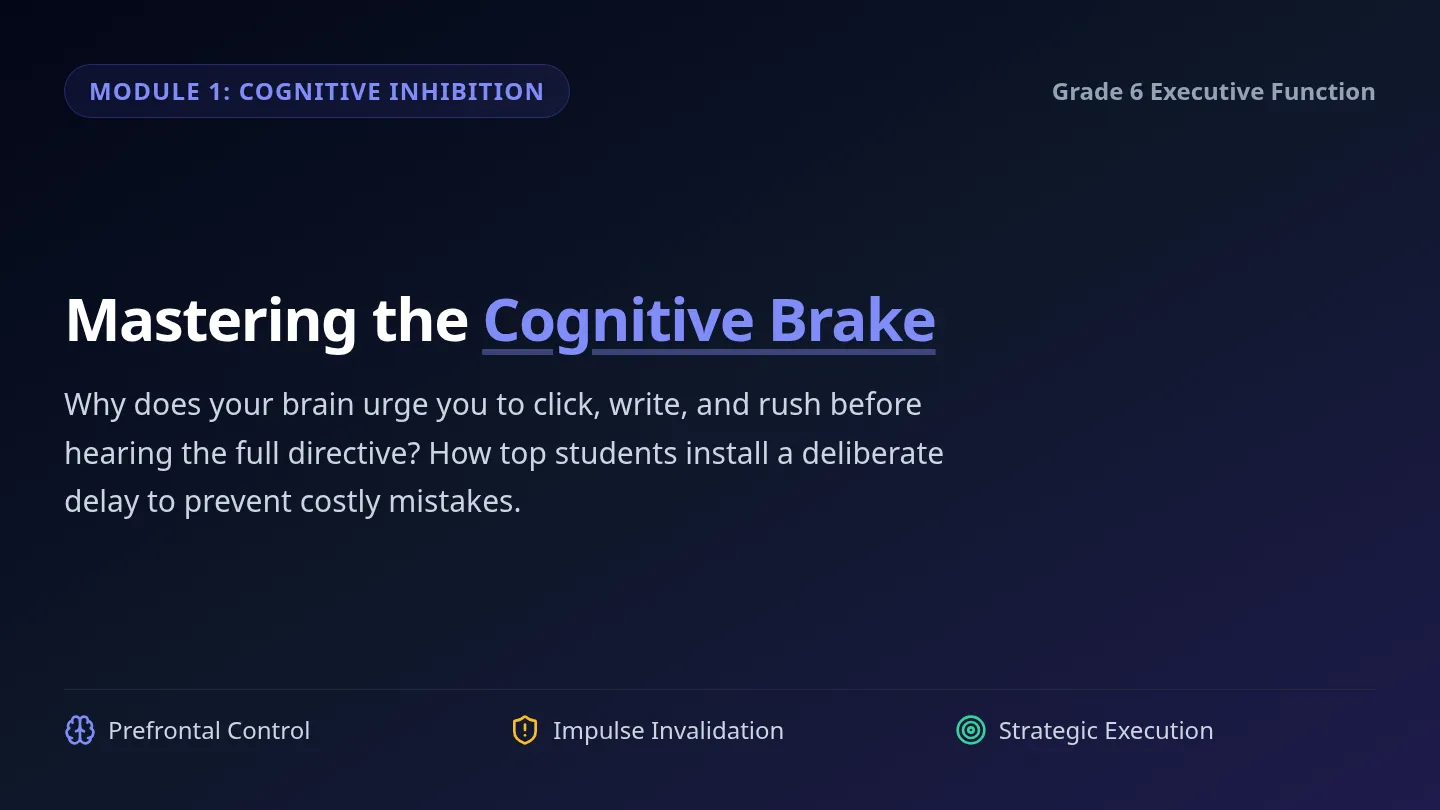
Executive Functioning: Mastering the Control Center of Your Brain
Session 1: Introduction
What is Executive Functioning?
1
Your brain's 'control center'
2
Helps you plan, organize , and get things done
3
Skills we use every single day
Why It Matters
School Power
Helps with big projects, homework, and keeping your grades up.
Life Skills
Keeps you organized, reduces stress, and helps you reach goals.
"It makes life a whole lot smoother!"
Your EF Toolkit
Planning & Prioritizing
Organization
Task Initiation
Focus & Attention
Self-Control
Emotional Regulation
Problem-Solving
Flexible Thinking
Session 2
Planning Power!
"Thinking ahead"
"Deciding steps"
"Getting ready"
Steps to Success
01
Identify the main goal
02
List all the small steps needed
03
Put them in order
04
Estimate time for each step
Prioritize Like a Pro
Urgent
Needs to be done NOW!
Important
Matters a lot to your goals.
Wait
Less urgent or important.
Session 3
Organized Oasis
Find things easily
Reduce stress
Feel calm and ready to work
Tips & Tricks
Everything has a home
A designated spot for every single item.
Label everything
Helps you and others know where things go.
Declutter regularly
Get rid of things you don't need or use.
10-Minute Reset
Spend a few minutes each day tidying up.
Session 4
Task Start-Up
Starting is often the hardest part. Once you start, the momentum builds and it gets easier!
Warm Up Activities Guide Warm Up Activities
Quick 5-minute activities for every session
Executive Functioning
Brain CEO Program
SESSION 1
Daily Task Challenge
Instructions: Ask students to quickly list three things they need to do before the end of the school day. Then, ask them to identify which one they think is most important.
SESSION 2
The Best Plan
Instructions: Present a simple scenario: "You need to bake cookies for a class party tomorrow." Ask students to briefly outline the steps they would take to make sure the cookies are ready on time.
SESSION 3
The Messy Locker
Instructions: Describe a locker that is so full of papers you can't even close the door. Ask students for the very first step they would take to start organizing it.
SESSIONS 4-9
Skill Spotlights
Session 4: Procrastination Buster
Ask students to share one thing they have been putting off. Have them identify just one tiny, 10-second step to start it.
Session 5: Distraction Detectives
Give students 30 seconds to look around the room and find three things that might pull their attention away from work.
Session 6: The Quick Response
Give a prompt: "Someone cuts you in line." Ask for the first impulsive reaction, then the 'Stop & Think' reaction.
Session 7: Mood Check
Ask students to use one word or an emoji to describe their mood right now. Discuss why naming it matters.
Session 8: Roadblock Race
Present a small problem: "You forgot your lunch." Ask for three different solutions as quickly as possible.
Session 9: Growth Mindset
Ask students to name one executive functioning skill they've used since the first session.
Cool Down Reflections Guide Cool Down Reflections
End-of-session exit tickets and reflections
Executive Functioning
Brain CEO Program
Session 1: One New Idea
What is one new thing you learned about your brain's 'CEO' today?
Session 2: Planning Practice
Describe one thing you will try to plan better this week. It can be small!
Session 3: Organize This!
What is one small area you will try to organize before our next session?
Session 4: Start Small
What is the smallest step you can take on a task you've been putting off?
Session 5: Distraction Detective
What is one distraction you will try to minimize in your study or homework space?
Session 6: My Pause Button
Think of a situation where you might use the 'Stop & Think' strategy this week. What is it?
Session 7: Emotion Check-in
What is one healthy way you can respond when you feel a strong emotion?
Session 8: A New Path
What is one new idea you have for solving a problem you're currently facing?
Session 9: My Top EF Skill
Of all the skills we discussed, which one improved the most for you, and why?
Brain Basics Worksheet S1 Brain Basics
Session 1: Understanding Your Brain's CEO
Name:
Date:
Based on our discussion, answer the following questions to help you understand your brain's amazing executive functions.
1 What does the term "Executive Functioning" mean in your own words? Why is it like your brain's CEO?
2 List three executive functioning skills we talked about today.
a.
b.
c.
3 Why is developing strong EF skills important for a 6th grader? Give one example.
4 How much do you feel like your brain's CEO is in charge right now?
Not at all
1
2
3
4
5
Very much
Why did you choose that number?
Planning Power Worksheet S2 Planning Power
Session 2: Mastering Your Steps to Success
Name:
Identify Your Task
What task do you need to complete soon?
(e.g., a homework assignment, cleaning your room, preparing for a family event)
S1 Identify the Main Goal
What exactly do you want to achieve?
S2 Break It Down
List all individual actions you need to take (don't worry about order yet).
S3 Order & Time
Order Action Step Time Est. 1 2 3 4 5
S4 Prioritize
If you have other tasks, where does this fit in terms of importance and urgency? Why?
Reflection
How does breaking down this task into smaller steps make it feel different? Do you feel more or less overwhelmed?
Organized Oasis Activity S3 Organized Oasis
Session 3: Design Your Perfect Productive Space
Name:
The Challenge
Imagine you have the chance to completely organize one space in your life (e.g., your desk, locker, backpack, a folder on your computer). Design your ideal version of that space below.
Item "Homes"
Labels & Folders
Zero Clutter
Oasis Vibes
Draw or describe your organized space here
Use labels and arrows to show where everything goes!
Reflection
What was the most challenging part of designing your organized space?
What makes an organized space feel like an "oasis" to you?
Task Start Up Guide S4 Task Start-Up
Session 4: Overcoming Procrastination
Name:
The Wall of Starting
My Challenging Task
What is one thing you need to do but have been putting off?
Why have I been avoiding it?
Be honest! Is it too big? Too boring? Too scary?
Start-Up Strategies
1. The 5-Minute Rule
If you only worked on this task for 5 minutes, what would you do? Write that tiny action here:
2. Smallest Step First
What is the absolute easiest, quickest part? (e.g., "Open my laptop"). Write it here:
3. Plan a Small Reward
What small treat will you give yourself immediately after you finish your "Start-Up" step?
My Launch Plan
Choose ONE strategy above (or combine them!) and write exactly how and when you will start.
How do these strategies change how you feel about starting? Focus Force Field Activity S5 Focus Force Field
Session 5: Building Immunity to Distractions
Name:
Part 1: Distraction Detectives
List 5 common distractions you face when trying to focus on schoolwork or a task:
01
02
03
04
05
Part 2: Building My Force Field
For each distraction you listed above, brainstorm a specific strategy or tool you can use to minimize its impact.
Distraction My Force Field Strategy Example: Phone Pings Put phone in another room or turn off notifications. 1. 2. 3. 4.
Final Reflection
Which strategy are you most excited to try this week to boost your focus? Why?
Stop & Think Scenario Cards S6 Stop & Think
Session 6: Practice Your Brain's Pause Button
Name:
Read each scenario below. Imagine you are in that situation. Use the STOP & THINK strategy to decide how you would respond.
Scenario 1: The Frustrating Game
Level: Social
"You are playing a video game with a friend, and they keep beating you. You're starting to get really angry and want to yell or throw your controller."
STOP
How do you pause?
THINK
Options & Consequences?
ACT
Best choice?
Scenario 2: The Tempting Treat
Level: Self-Control
"You're at a party. Your parents said no more sugar, but there's a huge bowl of candy and no one is watching. You want 5 more pieces."
STOP
THINK
ACT
Scenario 3: The Annoying Sibling
Level: Regulation
"Your younger sibling won't stop bugging you while you're doing homework. You've asked nicely, but they won't stop. You're about to snap."
STOP
THINK
ACT
Scenario 4: The Impulsive Buy
Level: Decision Making
"You see a new item that all your friends have. You have savings for something big, but you really want this now. The urge to buy is strong."
STOP
THINK
ACT Emotion Explorer Journal S7 Emotion Explorer
Session 7: Understanding & Managing Your Feelings
Name:
Use this journal to reflect on your emotions and how you manage them. Be honest with yourself – there are no right or wrong feelings!
1. What emotion have you felt most strongly recently?
(e.g., happiness, frustration, sadness, excitement, anger, anxiety)
2. Where did you feel this emotion in your body?
(e.g., knot in stomach, racing heart, tense shoulders, light feeling)
3. What do you think caused you to feel this emotion?
4. How did you react or respond?
(e.g., talked to someone, kept it to yourself, got quiet, got louder)
5. Looking back, was your response helpful or unhelpful? Why?
Future Explorer Strategy
What is one healthy coping strategy you can try next time you feel a strong emotion?
Deep Breaths
Talk It Out
Move Body
Creative Art
Problem Solving Pathways Worksheet S8 Problem-Solving Pathways
Session 8: Navigating Through Challenges
Name:
Identify the Challenge
My Problem:
(Think of a problem you are currently facing at school, home, or with friends.)
S State the Problem Clearly
Describe it in one or two sentences. What exactly is going on?
T Think of Solutions
Brainstorm at least 3-5 different ways you could try to solve this.
O Outcome - Pros and Cons
Solution 1
Pros
Cons
Solution 2
Pros
Cons
P Pick the Best Solution
Which one will you try first? What is your very first action step?
My EF Toolkit Project Guide S9 My EF Toolkit
Session 9: Capstone Project & Portfolio
Name:
Objective
Create a personalized resource of your favorite EF strategies to use throughout middle school.
Brain CEO Certified
Choose Your Format
Mini-Book / Binder Section
Digital Slide Deck
Index Card Ring
My Choice:
Toolkit Requirements
Five Skill Cards
Each card needs: Skill Name, Why it helps, Top 1-2 Strategies, and a Visual/Emoji.
Introduction Page
Explain what executive functioning is and why this toolkit is helpful for YOU.
Final Reflection
Which skill improved the most? How will you use this toolkit daily?
Toolkit Reflection
Which EF skill do you feel you've improved on the most during this curriculum?
How do you plan to use your EF Toolkit in your daily life at school?
Congrats, CEO! Practice makes permanent.