Dark Zone Slides ABYSS EXPLORERS
DAY 1 SENSORY JOURNEY
Into the Dark
Let's explore the scientific light layers of the ocean from the sunlit surface to the pitch-black abyss.
Today's Focus: Scientific Ocean Layers
Get ready to explore!
01. THE EPIPELAGIC ZONE DEPTH: 0 to 200 METERS
The Sunlight Layer
This top layer receives lots of sunlight. Marine plants grow here using photosynthesis!
Bright & Warm: Heated by direct solar rays.High Biodiversity: Dolphins, coral reefs, and sea turtles live here.
Sensory Connection
How do you feel in bright, warm sunlight? It gives plants the energy to grow!
Photosynthesis Warm Light
Plants thrive in this layer! Ready to head deeper?
02. THE MESOPELAGIC ZONE DEPTH: 200 to 1,000 METERS
The Twilight Layer
Sunlight quickly fades here. It is dim, cool, and shadowy. Plants cannot grow.
Fading Light: Like late evening or twilight.Hiding Zone: Predators hide in the deep shadows.
Sensory Connection
Squint your eyes to simulate twilight. Can you see colors as easily when the light is dim?
Dim Shadows Cooler
The last rays of sun slip away... Going into the total dark!
03. THE BATHYPELAGIC ZONE DEPTH: 1,000 to 4,000+ METERS
The Midnight Layer
Absolutely no solar light reaches here. It is completely black, cold, and quiet.
Total darkness: Zero solar penetration.
Extreme cold: Water stays just above freezing.
Sensory Connection
How do creatures navigate with no eyes, or survive in extreme pitch-black water? Let's check out their special tricks!
Extreme conditions call for extreme adaptations. How do they glow?
04. SPECIAL ADAPTATION CHEMICAL LUMINESCENCE
Bioluminescence!
Animals mix special body chemicals to create a glowing neon light!
Predator Lures: Anglerfish use glowing lanterns to attract food.
Defense: Jellyfish flash bright light to scare predators.
Chemical Glow
Have you seen glow sticks glow? That is a chemical reaction, just like bioluminescence!
Chemical Glow Adaptation
Self-made lighting systems in the deep. Let's try it ourselves!
CLASS EXPERIMENT SENSORY DEMONSTRATION
The Glow Experiment!
Let's turn the classroom into the Bathypelagic Zone!
Step 1
The classroom lights are turned completely off.
Step 2
Crack open a glow stick to activate the chemical light.
Step 3
Notice how the chem-light pierces through the dark space!
Bioluminescence uses chemical luminescence. How cool is that light?
REVIEW TIME CHECK YOUR UNDERSTANDING
Deep Sea Scientific Check-In
1
Which zone supports plants and photosynthesis?
Answer together: Epipelagic (Sunlight Zone)!
2
What chemical adaptation glows in the dark?
Answer together: Bioluminescence!
Outstanding scientific focus, explorers! Now let's complete our worksheets!
Dark Zone Worksheet ABYSS EXPLORERS
Day 1: Ocean Light Zones & Scientific Terms
Modified Science
NAME:
DATE:
Vocabulary Matching Challenge
Draw a line from each Scientific Ocean Zone to its descriptive features!
A
Epipelagic Zone
Sunlight Zone (0-200m)
Bright, warm & has photosynthesis
B
Mesopelagic Zone
Twilight Zone (200-1000m)
Dimly lit, cold & full of shadows
C
Bathypelagic Zone
Midnight Zone (1000m+)
Pitch black, freezing cold & has glowing life
Short Answer Question:
Why can't green plants grow down in the Bathypelagic (Midnight) Zone?
Adaptation & Bioluminescence
Day 1 Review and Word Bank Fill-in
Page 2 of 2
WORD BANK
Bioluminescence Bathypelagic Epipelagic
Fill in the blanks using the Word Bank:
1. Warm sunlight supports marine plants and coral reefs inside the warm, top ________________________ Zone.
2. The deepest, freezing-cold ocean floor with zero sun is called the ________________________ Zone.
3. Deep-sea animals make their own chemical glow, an adaptation called ________________________.
Draw a Bioluminescent Organism Adaptation:
Draw a predator lure or glowing spots:
💡 Label your glowing parts using arrows!
Signed by student for grading
Ready for grading!
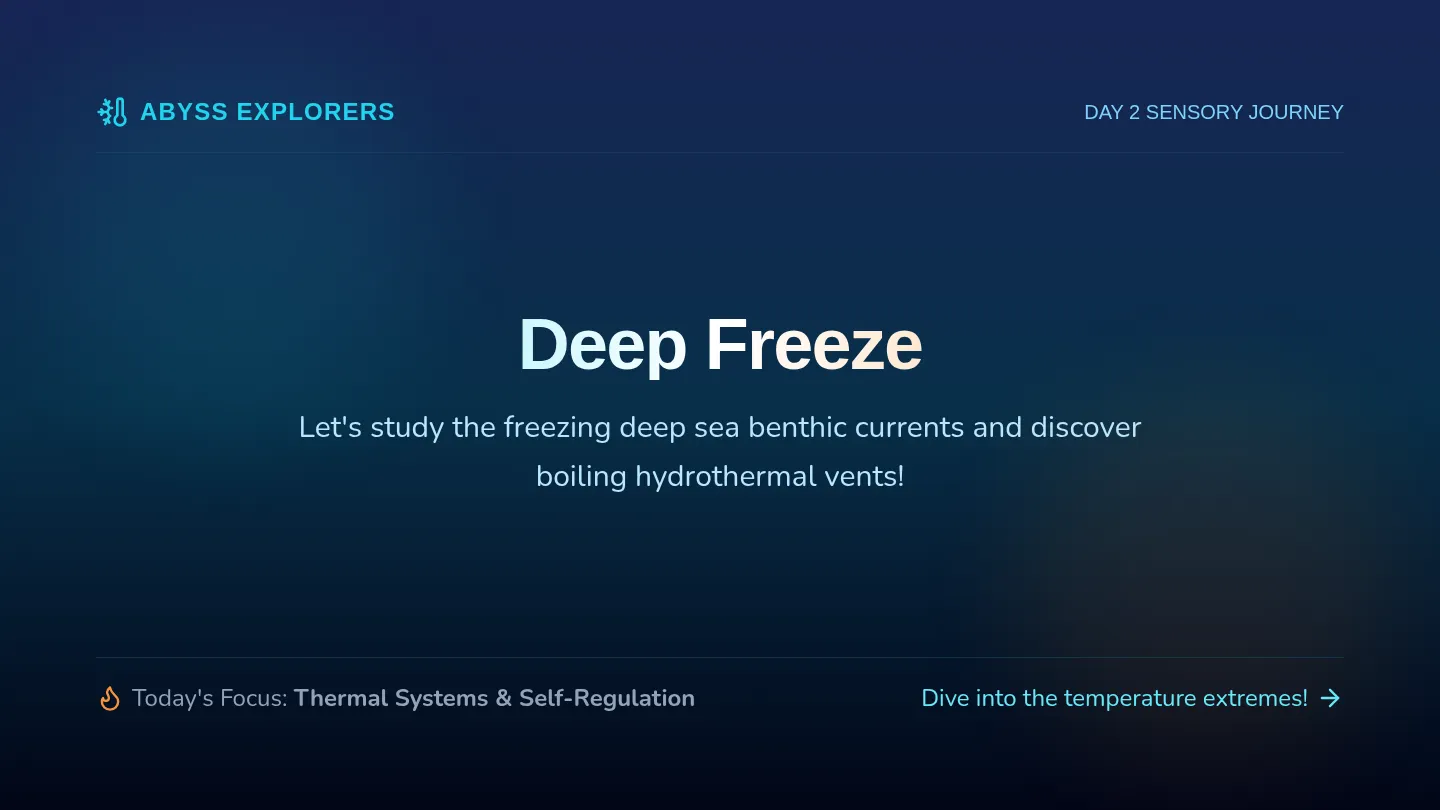
Deep Freeze Slides ABYSS EXPLORERS
DAY 2 SENSORY JOURNEY
Deep Freeze
Let's study the freezing deep sea benthic currents and discover boiling hydrothermal vents!
Today's Focus: Thermal Systems & Self-Regulation
Dive into the temperature extremes!
01. BENTHIC CURRENTS ABYSSAL TEMPERATURE: 35°F
Freezing Benthic Water
Without solar rays, deep ocean water sinks to near-freezing temperatures.
Abyssal Chill: Sinking water from polar ice caps creates a freeze.Metabolism Adaptation: Animals move slowly to survive on less food.
Sensory Demo
Briefly touch an ice cube. Notice how it feels numb. Deep-sea animals live in this sub-freezing benthic layer!
Freezing Layer Abyssal Chill
How do animals find warm refuge? Undersea geysers! Let's explore.
02. HYDROTHERMAL SYSTEMS HOT UNDERSEA CHIMNEYS
Boiling Geysers
Tectonic cracks release mineral fluid heated by underground magma chambers.
700°F Fluids: Super-heated water shoots out like underwater smoke.Mineral Towers: Black smokers are made of metals and sulfur.
Magma Heat
This hot fluid warms up the surrounding cold ocean, creating a rare sanctuary of life.
Magma Heated Hot Chimney
Extreme survival: super hot meets super cold! Who lives here? Let's check!
03. ADAPTATION & SELF-REGULATION THERMAL COPING SKILLS
The Yeti Crab
Has furry, bacteria-trapping arms. It stays close to the chimney to survive.
It relies on hydrothermal fluids to keep from freezing.
Stays in the safe zone: not too hot, not too cold!
Self-Regulation
How does your body warn you when you are too cold? Look for: shivering , goosebumps , and cold hands . Use blankets or coats to regulate your heat!
Shivering Coats Regulate
Understand your body's temperature signals. Let's check our learning!
REVIEW TIME SCIENTIFIC THERMAL REVIEW
Extreme Thermal Review
1
The deep benthic layer temperature is usually:
Answer together: Freezing Cold (35°F)!
2
What warms up hydrothermal fluids?
Answer together:
Deep Freeze Worksheet ABYSS EXPLORERS
Day 2: Undersea Thermal Systems
Modified Science
NAME:
DATE:
Extreme Thermal Systems Sorting
Match each scientific ocean item to its correct temperature category: COLD or HOT .
ABYSS COLD (35°F)
VENT HOT (700°F)
1
Polar Meltwater
Icy water sinking from poles
2
Hydrothermal Fluid
Mineral water warmed by magma
3
Magma Chambers
Molten rock under seabed
4
Benthic Current
Deep flow near freezing point
Critical Thinking:
Why must Yeti Crabs live directly next to the hydrothermal chimney?
Thermal Regulation & Safety
Daily Life Skills Integration
Page 2 of 2
Listening to Your Body!
Just like ocean animals adapt to temperature extremes, we must listen to our body's physical signs to stay safe.
Identify the physical symptoms of being cold vs. hot:
Shivering & Chattering
Your body shakes to produce heat.
Sweating & Red Face
Your body releases moisture to cool off.
Self-Advocacy & Action:
If you are inside your home or classroom and start to feel very cold, what are TWO actions you can take to warm up?
Action 1:
Action 2:
Teacher grading check-off
Ready for grading!
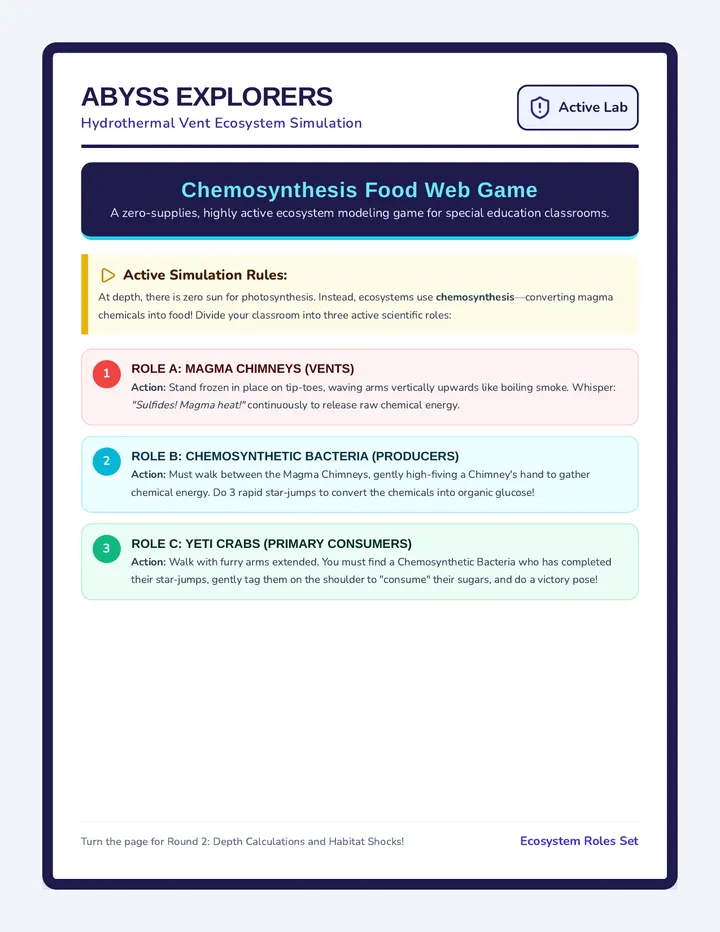
Abyss Roleplay Activity ABYSS EXPLORERS
Hydrothermal Vent Ecosystem Simulation
Active Lab
Chemosynthesis Food Web Game
A zero-supplies, highly active ecosystem modeling game for special education classrooms.
Active Simulation Rules:
At depth, there is zero sun for photosynthesis. Instead, ecosystems use chemosynthesis —converting magma chemicals into food! Divide your classroom into three active scientific roles:
1
Role A: Magma Chimneys (Vents)
Action: Stand frozen in place on tip-toes, waving arms vertically upwards like boiling smoke. Whisper: "Sulfides! Magma heat!" continuously to release raw chemical energy.
2
Role B: Chemosynthetic Bacteria (Producers)
Action: Must walk between the Magma Chimneys, gently high-fiving a Chimney's hand to gather chemical energy. Do 3 rapid star-jumps to convert the chemicals into organic glucose!
3
Role C: Yeti Crabs (Primary Consumers)
Action: Walk with furry arms extended. You must find a Chemosynthetic Bacteria who has completed their star-jumps, gently tag them on the shoulder to "consume" their sugars, and do a victory pose!
Turn the page for Round 2: Depth Calculations and Habitat Shocks! Ecosystem Roles Set
Ecosystem Pressure & Habitat Shocks
Interactive Environmental Events
Page 2 of 2
Round 2: Depth & Pressure Challenge
The teacher calls out different depth numbers. Students must instantly calculate the pressure level and adjust their physical stance to match the depth layer:
Depth: 100 Meters
Stand Tall: Low pressure zone. Move freely, walk with light footsteps, and breathe easily.
Depth: 3,000 Meters
Crushing Squat: Crushing high pressure (300 atmospheres). Drop into a low crouch, tensing muscles to resist the weight.
Round 3: Ecological Tectonic Shocks
Deep-sea ecosystems are highly fragile. The teacher calls out a tectonic event, and students must adapt instantly:
💥 "EARTHQUAKE!" Vents shut down! All Magma Chimneys must drop to one knee. Bacteria have 5 seconds to run to the one designated "Backup Vent" (the teacher or helper) or they freeze!
🌿 "CHEMO-BOOM!" Excess chemical release! Vents wave arms furiously. Bacteria double their star-jumps to represent an algal bloom. Consumers must run quickly to tag them!
Grading check: [ ] Active roleplay executed successfully