Daily Effort Rubric English NYS Life Science Routine
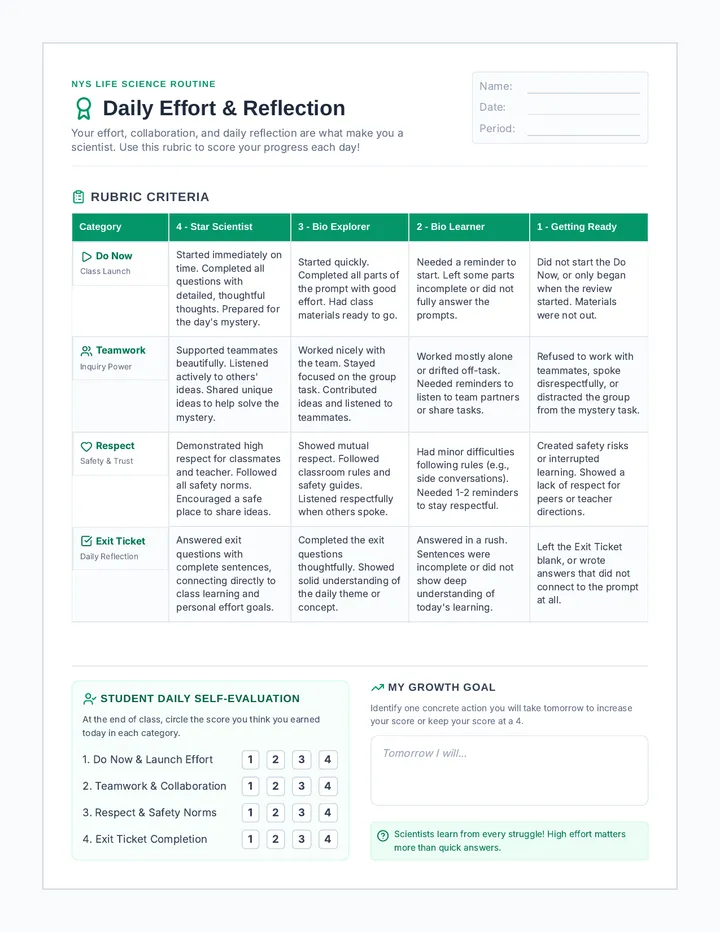
Daily Effort & Reflection
Your effort, collaboration, and daily reflection are what make you a scientist. Use this rubric to score your progress each day!
Name:
Date:
Period:
Rubric Criteria
Category 4 - Star Scientist 3 - Bio Explorer 2 - Bio Learner 1 - Getting Ready Do Now Class Launch Started immediately on time. Completed all questions with detailed, thoughtful thoughts. Prepared for the day's mystery. Started quickly. Completed all parts of the prompt with good effort. Had class materials ready to go. Needed a reminder to start. Left some parts incomplete or did not fully answer the prompts. Did not start the Do Now, or only began when the review started. Materials were not out. Teamwork Inquiry Power Supported teammates beautifully. Listened actively to others' ideas. Shared unique ideas to help solve the mystery. Worked nicely with the team. Stayed focused on the group task. Contributed ideas and listened to teammates. Worked mostly alone or drifted off-task. Needed reminders to listen to team partners or share tasks. Refused to work with teammates, spoke disrespectfully, or distracted the group from the mystery task. Respect Safety & Trust Demonstrated high respect for classmates and teacher. Followed all safety norms. Encouraged a safe place to share ideas. Showed mutual respect. Followed classroom rules and safety guides. Listened respectfully when others spoke. Had minor difficulties following rules (e.g., side conversations). Needed 1-2 reminders to stay respectful. Created safety risks or interrupted learning. Showed a lack of respect for peers or teacher directions. Exit Ticket Daily Reflection Answered exit questions with complete sentences, connecting directly to class learning and personal effort goals. Completed the exit questions thoughtfully. Showed solid understanding of the daily theme or concept. Answered in a rush. Sentences were incomplete or did not show deep understanding of today's learning. Left the Exit Ticket blank, or wrote answers that did not connect to the prompt at all.
Student Daily Self-Evaluation
At the end of class, circle the score you think you earned today in each category.
1. Do Now & Launch Effort
1 2 3 4
2. Teamwork & Collaboration
1 2 3 4
3. Respect & Safety Norms
1 2 3 4
4. Exit Ticket Completion
1 2 3 4
My Growth Goal
Identify one concrete action you will take tomorrow to increase your score or keep your score at a 4.
Tomorrow I will...
Scientists learn from every struggle! High effort matters more than quick answers.
Daily Effort Rubric Spanish Rutina de Ciencias de la Vida de NYS
Esfuerzo y Reflexión Diarios
Tu esfuerzo, colaboración y reflexión diaria te convierten en científico. ¡Usa esta rúbrica para evaluar tu progreso cada día!
Nombre:
Fecha:
Periodo:
Criterios de la Rúbrica
Categoría 4 - Estrella 3 - Explorador 2 - Aprendiz 1 - Preparándose Inicio (Do Now) Comienzo Comenzó rápido a tiempo. Completó todas las preguntas con ideas detalladas. Listo para el misterio del día. Comenzó rápido. Completó el calentamiento con buen esfuerzo. Tenía los materiales listos. Necesitó un recordatorio para comenzar. Dejó algunas partes incompletas o cortas. No comenzó o lo hizo tarde cuando ya se revisaba. Materiales guardados. Colaboración En Equipo Apoyó a su equipo de forma excelente. Escuchó activamente y aportó ideas valiosas para resolver el misterio. Trabajó bien con su equipo. Se mantuvo enfocado en la tarea grupal y respetó las opiniones de otros. Trabajó solo o se distrajo. Necesitó recordatorios para colaborar y escuchar a los demás. No quiso trabajar en grupo, interrumpió la colaboración o actuó sin respeto. Respeto Normas y Trato Respetó al máximo las reglas y a todos. Siguió de forma segura todas las normas. Creó un espacio de confianza. Mostró respeto mutuo. Siguió las reglas del salón y normas de seguridad. Escuchó con atención. Le costó seguir las reglas (ej. hablar fuera de turno). Necesitó 1-2 recordatorios. Creó riesgos o interrumpió la clase. No respetó las normas o las indicaciones dadas. Boleto Salida Reflexión Respondió con oraciones completas y profundas, uniendo su aprendizaje con sus metas personales. Completó las preguntas con esfuerzo y seriedad. Demostró que entendió el concepto del día. Respondió rápido. Las oraciones quedaron muy cortas o no mostraron suficiente análisis. Dejó el boleto en blanco o sus respuestas no tenían relación con el tema de la clase.
Autoevaluación Diaria
Al final de la clase, marca con un círculo el puntaje que crees haber obtenido hoy en cada sección.
1. Esfuerzo en el Inicio
1 2 3 4
2. Trabajo en Equipo
1 2 3 4
3. Respeto y Normas
1 2 3 4
4. Boleto de Salida
1 2 3 4
Day 1 Do Now and Exit Ticket General English Day 1: Bio Launchpad Handout
Day 1: Start & Finish
Name
Date
Period
Part 1: The Do Now (First 5 Minutes)
Write Your Thoughts
Welcome to Biology! To kick off today, let's look at who we are as scientists. In the space below, write down a detailed description of what you think a biologist looks like . (What do they wear? Where do they work? What are they doing?)
I think a biologist looks like...
*Tip: Think about scientists in real life, in books, or on TV!
Fold or Cut Here
Part 2: The Exit Ticket (Last 5 Minutes)
Show What You Know
Lab Evidence Dossier: The "Mystery Blob" Attributes
● Appearance: Dry, beige, wrinkled granules that look completely inactive.
● Nutrition: Needs warm water and sugar (food) to activate.
● Metabolism: Produces carbon dioxide gas bubbles and expands over time.
● Cell View: Under microscope, reveals millions of round, single-celled units.
Review the lab evidence dossier above and answer these questions honestly to close out today:
1. Based on the attributes above, is the Mystery Blob living or non-living? Support your choice with one specific attribute:
My claim & evidence...
2. How did working in a team of 4 help you discuss and understand these attributes today?
Working together helped us...
Reflecting on My Effort How would you rate your team participation today based on our new rubric?
1 (Getting Ready) 2 (Learner) 3 (Explorer) 4 (Star)
NYS Next Generation Science Standards (LS1) Topic: Community & Collaborative Inquiry Page 1 of 1
Day 1 Do Now and Exit Ticket General Spanish Día 1: Folleto Bio Launchpad
Día 1: Inicio y Cierre
Nombre
Fecha
Periodo
Parte 1: El Calentamiento (Primeros 5 Minutos)
Escribe Tus Pensamientos
¡Bienvenidos a la Biología! Para empezar hoy, veamos quiénes somos como científicos. En el espacio de abajo, escribe una descripción detallada de cómo crees que se ve un biólogo . (¿Cómo se viste? ¿Dónde trabaja? ¿Qué está haciendo?)
Creo que un biólogo se ve como...
*Pista: ¡Piensa en los científicos que ves en la vida real, en libros o en la televisión!
Doblar o Cortar Aquí
Parte 2: El Boleto de Salida (Últimos 5 Minutos)
Demuestra lo Aprendido
Expediente de Evidencia: Atributos de la "Masa Misteriosa"
● Aspecto: Gránulos secos, de color beige y arrugados; completamente inactivos.
● Nutrición: Necesita agua tibia y azúcar (alimento) para poder activarse.
● Metabolismo: Produce burbujas de gas (CO₂) y se expande con el tiempo.
● Células: Bajo el microscopio se observan millones de unidades unicelulares redondas.
Revisa el expediente de evidencia de laboratorio arriba y responde estas preguntas con honestidad:
1. Basándote en los atributos de arriba, ¿la Masa es un ser vivo o inerte? Apoya tu elección con un atributo específico:
Mi afirmación y evidencia...
2. ¿Cómo te ayudó trabajar en un equipo de 4 a discutir y comprender estos atributos hoy?
Trabajar juntos nos ayudó a...
Reflexión sobre mi esfuerzo ¿Cómo calificarías tu esfuerzo hoy según la nueva rúbrica?
1 (Preparándose) 2 (Aprendiz) 3 (Explorador) 4 (Estrella)
Estándares de Ciencias de la Próxima Generación de NYS (LS1) Tema: Comunidad e Indagación Colaborativa Página 1 de 1
Day 1 Do Now and Exit Ticket Regents English NYS Regents Biology: Launchpad Routine
Day 1: Regents Start & Finish
Name
Date
Period
Part 1: Regents Do Now (First 5 Minutes)
Activate Brain
Regents Biologists are like forensic investigators. They look at clues to solve mysteries about the living world. Consider this question: What is one skill a crime detective has that a biologist also needs to use every day?
My Scientific Claim:
I think a biologist and a detective both need...
*Tip: Detectives use fingerprints. What evidence do biologists look for?
Regents Mindset
In Regents Biology, we do not just memorize facts. We gather evidence , find patterns , and build arguments. Today, we start our first investigation!
Mistakes are expected here!
Fold or Cut Here
Part 2: Regents Exit Ticket (Last 5 Minutes)
Evidence Board
Lab Evidence Dossier: The "Mystery Blob" Attributes
● Appearance: Dry, beige, wrinkled granules that look completely inactive.
● Nutrition: Needs warm water and sugar (food) to activate.
● Metabolism: Produces carbon dioxide gas bubbles and expands over time.
● Cell View: Under microscope, reveals millions of round, single-celled units.
Let's wrap up "The Case of the Sleeping Blob" using our scientific thinking. Fill out your mini-evidence board below:
My Claim:
Is the Blob living or non-living? State your answer.
My Evidence:
Cite one specific attribute from the dossier above.
3. Community Reflection: Name one way you and your team supported each other's ideas during this mystery today.
In my team, we...
Self-Reflective Effort Score Rate your active participation based on today's rubric.
1 (Beginning) 2 (Developing) 3 (Proficient) 4 (Exemplary)
NYS Regents Life Science (Life Science: Biology) Topic: Science Practices (CER) & Collaboration Page 1 of 1
Day 1 Do Now and Exit Ticket Regents Spanish NYS Regents Biology: Rutina Bio Launchpad
Día 1: Inicio y Cierre (Regents)
Nombre
Fecha
Periodo
Parte 1: Calentamiento Regents (Primeros 5 Minutos)
Activar Cerebro
Los biólogos de Regents son como investigadores forenses. Analizan pistas para resolver misterios sobre el mundo vivo. Considera esta pregunta: ¿Cuál es una habilidad que tiene un detective de crímenes que un biólogo también necesita usar todos los días?
Mi Afirmación Científica:
Creo que un biólogo y un detective necesitan...
*Pista: Los detectives usan huellas. ¿Qué evidencias crees que buscan los biólogos?
Mentalidad Regents
En Biología de Regents, no solo memorizamos datos. Reunimos evidencias , buscamos patrones y armamos argumentos. ¡Hoy iniciamos!
¡Aquí se esperan errores!
Doblar o Cortar Aquí
Parte 2: Boleto de Salida Regents (Últimos 5 Minutos)
Tablero de Evidencias
Expediente de Evidencia: Atributos de la "Masa Misteriosa"
● Aspecto: Gránulos secos, de color beige y arrugados; completamente inactivos.
● Nutrición: Necesita agua tibia y azúcar (alimento) para poder activarse.
● Metabolismo: Produce burbujas de gas (CO₂) y se expande con el tiempo.
● Células: Bajo el microscopio se observan millones de unidades unicelulares redondas.
Vamos a cerrar "El Caso de la Masa Dormida" usando nuestro pensamiento científico. Completa tu mini-tablero de evidencias:
Mi Afirmación (Claim):
¿Es la Masa un ser vivo o inerte? Explica con claridad.
Mi Evidencia (Evidence):
Cita un atributo específico del expediente arriba.
3. Reflexión de la Comunidad: Nombra una forma en que tú y tu equipo apoyaron las ideas de los demás durante la indagación.
En mi equipo, nosotros...
Autoevaluación del Esfuerzo Califica tu esfuerzo hoy según la nueva rúbrica.
1 (Preparándose) 2 (Desarrollo) 3 (Competente) 4 (Sobresaliente)
Examen de Ciencias de Regents de NYS (Biología) Tema: Prácticas de Ciencia (CER) y Colaboración Página 1 de 1
Day 1 Lab Community Presentation Do Now / Inicio
Time: 5 Minutes
Welcome to Biology!
¡Bienvenidos a la Biología!
Your Task / Tu Tarea:
On your handout, write down a detailed description of what you think a biologist looks like .
En tu folleto, escribe cómo crees que se ve un biólogo.
Find your assigned seat and get your pencil ready! NYS Science Launch
Quick Presentation
Time: 5 Minutes
We Are Biologists
Todos Somos Biólogos
In this room, we do not just memorize. We work in teams of 4 to investigate life. We grade ourselves on daily effort, teamwork, and respect !
Daily Effort Standards:
4 - Star Scientist: Active, positive teamwork
3 - Bio Explorer: Prepared, on-task, respectful
You will self-assess your score at the end of class every day!
Class Routine: Launch, Investigate, Reflect Rúbrica de Esfuerzo Diario
Team Investigation
Time: 10 Minutes
THE CASE OF THE SLEEPING BLOB
Is the Blob Alive?
¿La Masa está viva?
Group of 4 Task:
Read the clues on your paper. Work together with your teammates to decide: Is it a living thing or a non-living thing? Write your evidence.
Tarea de Grupo de 4:
Lean las pistas en su papel. Decidan juntos en su mesa: ¿Está viva o no viva? Escriban su conclusión con pruebas.
Collaborate nicely—everyone's opinion matters! 10 Minutes on Timer
Group Discussion
Time: 5 Minutes
Share & Compare
Comparte y Compara con Otros Grupos
Turn to the group of 4 sitting next to yours. Take turns sharing your team's ideas about the mystery blob!
Ask the other group:
"What clue was the most important to your team, and why?"
Pregunta al otro grupo:
"¿Qué pista fue la más importante para tu equipo, y por qué?"
Practice active listening and respectful sharing! Inter-Group Sharing
Exit Ticket / Reflexión
Time: 5 Minutes
Class Wrap-Up
Complete the Exit Ticket section at the bottom of your handout. Then, rate your effort on the rubric!
Completa el Boleto de Salida en la parte inferior de tu folleto. ¡Luego evalúa tu esfuerzo!
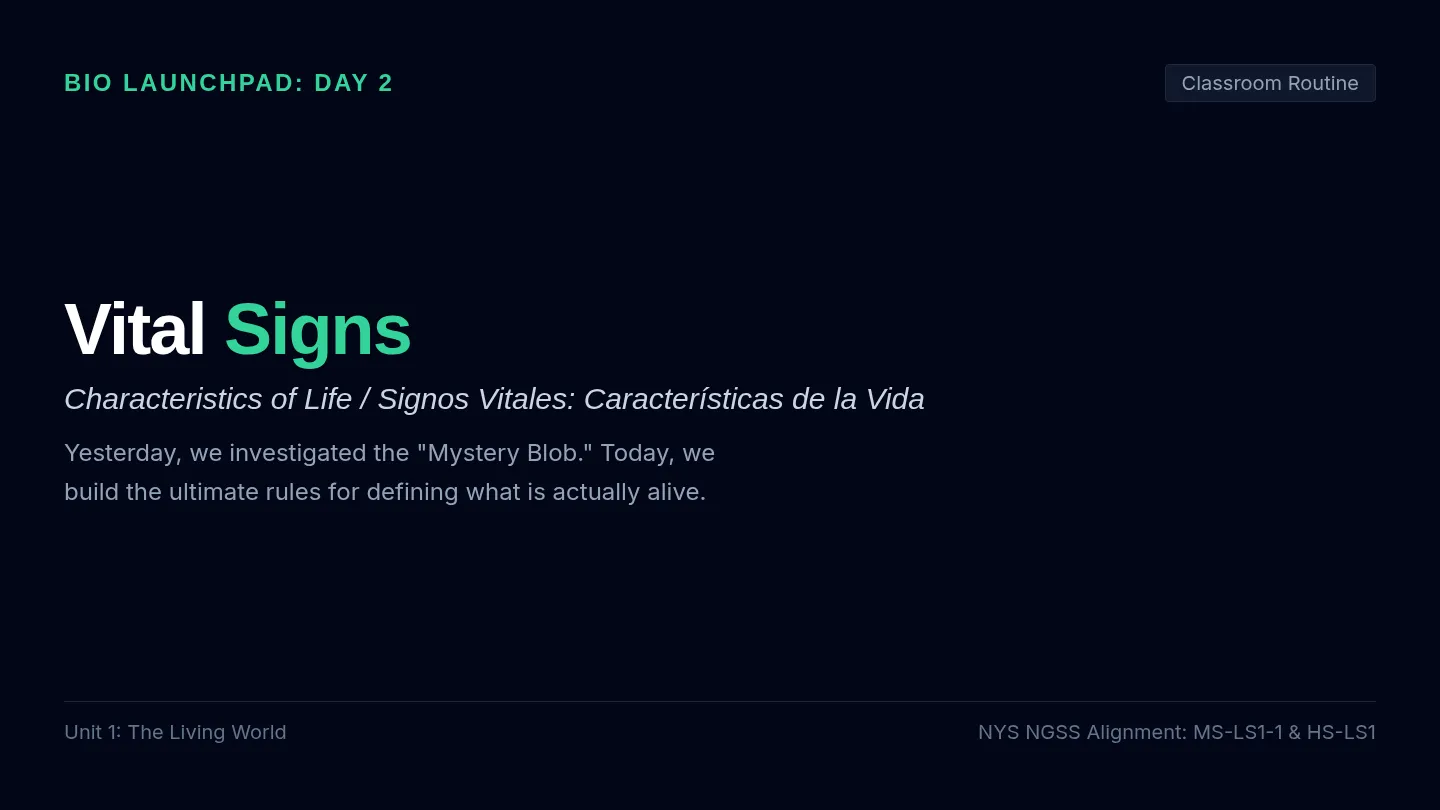
Day 2 Lab Presentation Bio Launchpad: Day 2 Classroom Routine
Vital Signs
Characteristics of Life / Signos Vitales: Características de la Vida
Yesterday, we investigated the "Mystery Blob." Today, we build the ultimate rules for defining what is actually alive.
Unit 1: The Living World NYS NGSS Alignment: MS-LS1-1 & HS-LS1
Our Mission / Nuestra Misión
Student Learning Target:
"I will learn to identify and define the characteristics of life by evaluating evidence from mystery specimens to determine what is truly alive."
Objetivo de Aprendizaje:
"Aprenderé a identificar y definir las características de la vida evaluando la evidencia de especímenes misteriosos para determinar qué está realmente vivo."
Goal-Driven Biology Practice NYS Life Science Standards
Do Now / Inicio
Time: 5 Minutes
Scaffolding: The Mystery Blob
1. Recall Day 1 Clues:
Yesterday, the "Mystery Blob" did nothing until it was fed warm water and sugar . Under a microscope, we saw it is made of millions of tiny cells .
2. Today's Question:
Based on that, does an organism have to be active all the time to be considered alive? Explain your thoughts on your handout.
Connecting Day 1 Community Inquiry to Day 2 Concepts Scaffolded Warm-up
Phenomenon #1: The Seed
Evidence File
Specimen A: The Dry Bean Seed
Is a dry seed alive? Let's look at the scientific evidence:
🔬 Observation 1:
Inside the hard shell is an embryo made of highly organized plant cells .
🧪 Observation 2:
The seed uses extremely small amounts of oxygen to break down stored food (metabolism ), even when dry.
🌱 Observation 3:
When given water and light, the seed responds to its environment and grows into a seedling .
Student Handout: Evaluate Specimen A Characteristics: Cellular Organization, Growth, Metabolism
Phenomenon #2: The Virus
Evidence File
Specimen B: The Influenza Virus
Is a virus a living organism? Let's check the scientific data:
🔬 Observation 1:
It contains genetic material (DNA or RNA) but has no cell membrane, cytoplasm, or organelles .
🧪 Observation 2:
It cannot process nutrients or create energy on its own (
Day 2 Do Now and Exit Ticket General English Day 2: Bio Launchpad Handout
Day 2: Vital Signs
Name
Date
Period
Part 1: Do Now (First 5 Minutes)
Scaffolded Check
Scaffolding Day 1: Yesterday, we observed that our "Mystery Blob" did not show any activity until we fed it warm water and sugar. Under the microscope, we saw it is made of millions of tiny cell structures.
Based on this, does an organism have to be active all the time to be considered alive? Why or why not? Explain your thoughts.
I think an organism doesn't/does have to be active because...
*Think about a seed or a hibernating bear!
Fold or Cut Here
Part 2: Exit Ticket (Last 5 Minutes)
Formative Check
Characteristics of Life Reference
🧬 Cellular Structure (Organized cells)
🧪 Metabolism (Obtains & uses energy)
🌱 Growth & Dev. (Changes & grows)
🌡️ Homeostasis (Maintains balance)
🧬 Reproduction (Passes down DNA)
⚡ Response (Reacts to stimuli)
Choose one of today's slide specimens (A: Seed, B: Virus, or C: Fire ) and assess whether it is alive based on the characteristics of life.
Selected Specimen:
A / B / C (Circle One)
My Claim (Is it living or non-living?):
I claim that this specimen is...
Provide two specific lines of evidence from the lesson observations to support your claim:
Evidence 1: _______________________________________________________________________________
Reflecting on My Effort How would you rate your team participation today based on our new rubric?
1 (Getting Ready) 2 (Learner) 3 (Explorer) 4 (Star)
NYS Next Generation Science Standards (LS1) Topic: Vital Signs (Characteristics of Life) Page 1 of 1
Day 2 Do Now and Exit Ticket General Spanish Día 2: Folleto Bio Launchpad
Día 2: Signos Vitales
Nombre
Fecha
Periodo
Parte 1: El Calentamiento (Primeros 5 Minutos)
Andamiaje
Andamiaje del Día 1: Ayer observamos que nuestra "Masa Misteriosa" no mostró actividad hasta que la alimentamos con agua tibia y azúcar. Bajo el microscopio, vimos que está hecha de millones de pequeñas estructuras celulares.
Basándote en esto, ¿un organismo tiene que estar activo todo el tiempo para ser considerado vivo? ¿Por qué o por qué no? Explica tus pensamientos.
Creo que un organismo no tiene / sí tiene que estar activo porque...
*¡Piensa en una semilla o en un oso que inverna!
Doblar o Cortar Aquí
Parte 2: Boleto de Salida (Últimos 5 Minutos)
Evaluación Formativa
Referencia de Características de la Vida
🧬 Estructura Celular (Células organizadas)
🧪 Metabolismo (Obtiene y usa energía)
🌱 Crecimiento/Des. (Cambia y crece)
🌡️ Homeostasis (Mantiene equilibrio)
🧬 Reproducción (Transmite el ADN)
⚡ Respuesta (Reacciona a estímulos)
Elige uno de los especímenes de las diapositivas de hoy (A: Semilla, B: Virus, o C: Fuego ) y evalúa si está vivo.
Espécimen Elegido:
A / B / C (Circula Uno)
Mi Afirmación (¿Está vivo o inerte?):
Afirmo que este espécimen está...
Proporciona dos líneas específicas de evidencia de las observaciones de hoy para apoyar tu afirmación:
Evidencia 1: _______________________________________________________________________________
Reflexión sobre mi esfuerzo ¿Cómo calificarías tu participación hoy según la nueva rúbrica?
1 (Preparándose) 2 (Aprendiz) 3 (Explorador) 4 (Estrella)
Estándares de Ciencias de la Próxima Generación de NYS (LS1) Tema: Signos Vitales (Características de la Vida) Página 1 de 1
Day 2 Do Now and Exit Ticket Regents English NYS Regents Biology: Launchpad Routine
Day 2: Regents Vital Signs
Name
Date
Period
Part 1: Regents Do Now (First 5 Minutes)
Scaffolded Link
Scaffolding Day 1: Yesterday, we gathered evidence that the "Mystery Blob" had millions of cell structures under a lens, and exhibited metabolic responses (released CO₂ gas) when given water and sugar.
Do you think cell structure and gas release are enough on their own to prove something is alive? Why or why not? Explain your reasoning.
I think those attributes are/are not enough because...
*Tip: Consider whether a fizzy soda or a bubbling pool of hot water might share some of these attributes!
Fold or Cut Here
Part 2: Regents Exit Ticket (Last 5 Minutes)
Evidence Board
Characteristics of Life Checklist
🧬 Cellular Organization (Made of organized cells)
🧪 Metabolism (Synthesizes/uses energy)
🌱 Growth & Development (Organized growth)
🌡️ Homeostasis (Regulates internal state)
🧬 Reproduction (Self-replicates with DNA/RNA)
⚡ Stimulus Response (Reacts to surroundings)
Formative Assessment: Use today's slide data to evaluate Specimen A, B, or C under a Claim-Evidence-Reasoning (CER) structure.
Selected Specimen:
A: Seed / B: Virus / C: Fire
My Claim (Is it living or non-living?):
I claim that this specimen is...
My Evidence:
Identify two specific lines of evidence from the slides.
My Reasoning:
Connect your evidence to the characteristics of life checklist.
Self-Reflective Effort Score Rate your active participation based on today's rubric.
1 (Beginning) 2 (Developing) 3 (Proficient) 4 (Exemplary)
NYS Regents Life Science (Life Science: Biology) Topic: Science Practices (CER) & Characteristics of Life Page 1 of 1
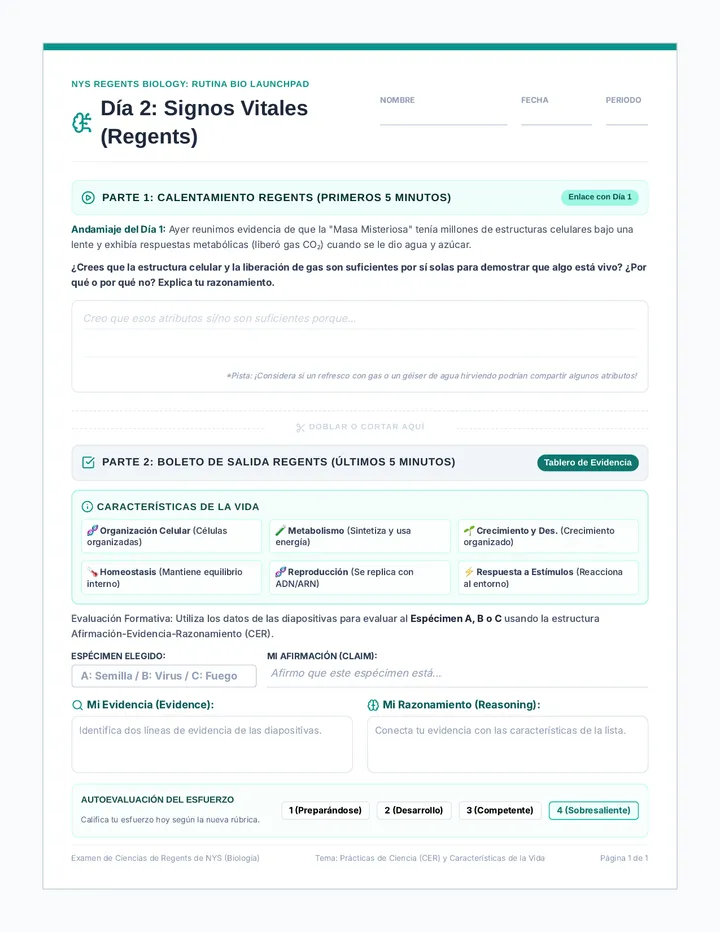
Day 2 Do Now and Exit Ticket Regents Spanish NYS Regents Biology: Rutina Bio Launchpad
Día 2: Signos Vitales (Regents)
Nombre
Fecha
Periodo
Parte 1: Calentamiento Regents (Primeros 5 Minutos)
Enlace con Día 1
Andamiaje del Día 1: Ayer reunimos evidencia de que la "Masa Misteriosa" tenía millones de estructuras celulares bajo una lente y exhibía respuestas metabólicas (liberó gas CO₂) cuando se le dio agua y azúcar.
¿Crees que la estructura celular y la liberación de gas son suficientes por sí solas para demostrar que algo está vivo? ¿Por qué o por qué no? Explica tu razonamiento.
Creo que esos atributos sí/no son suficientes porque...
*Pista: ¡Considera si un refresco con gas o un géiser de agua hirviendo podrían compartir algunos atributos!
Doblar o Cortar Aquí
Parte 2: Boleto de Salida Regents (Últimos 5 Minutos)
Tablero de Evidencia
Características de la Vida
🧬 Organización Celular (Células organizadas)
🧪 Metabolismo (Sintetiza y usa energía)
🌱 Crecimiento y Des. (Crecimiento organizado)
🌡️ Homeostasis (Mantiene equilibrio interno)
🧬 Reproducción (Se replica con ADN/ARN)
⚡ Respuesta a Estímulos (Reacciona al entorno)
Evaluación Formativa: Utiliza los datos de las diapositivas para evaluar al Espécimen A, B o C usando la estructura Afirmación-Evidencia-Razonamiento (CER).
Espécimen Elegido:
A: Semilla / B: Virus / C: Fuego
Mi Afirmación (Claim):
Afirmo que este espécimen está...
Mi Evidencia (Evidence):
Identifica dos líneas de evidencia de las diapositivas.
Mi Razonamiento (Reasoning):
Conecta tu evidencia con las características de la lista.
Autoevaluación del Esfuerzo Califica tu esfuerzo hoy según la nueva rúbrica.
1 (Preparándose) 2 (Desarrollo) 3 (Competente) 4 (Sobresaliente)
Examen de Ciencias de Regents de NYS (Biología) Tema: Prácticas de Ciencia (CER) y Características de la Vida Página 1 de 1
Day 3 Lab Presentation Bio Launchpad: Day 3 Classroom Routine
Scope of Life
Microscopy Scale & Safe Lab Routines / El Alcance de la Vida
Cells are the basic units of life, but they are invisible to our eyes. Today we learn to use lenses safely to unlock their secrets.
Unit 1: Scientific Inquiry NYS NGSS: HS-LS1-1 / MS-LS1-1 & Safety Routine
Today's Target / Objetivo
Student Learning Target:
"I will learn to safely handle a compound microscope and compare specimen scale using standardized laboratory safety protocols."
Objetivo de Aprendizaje:
"Aprenderé a manipular con seguridad un microscopio compuesto y comparar la escala de los especímenes usando protocolos estándar de laboratorio."
NYS Science Practice: Safety and Use of Tools Standards Aligned Target
Do Now / Inicio
Time: 5 Minutes
Scaffolding: Invisible Structures
1. Recall Day 2 Clues:
In our last lesson, we found that dry seeds contain highly organized cells , but viruses have no cells at all. Neither cell can be seen with the naked eye!
2. Connect to Safe Tools:
Why is it essential to have strict safety rules when working in groups with delicate glass slides and expensive magnifying tools? Answer on your sheet.
Scaffolded Warm-up: Linking Specimen Observations to Tools Classroom Routines
Microscopic Scale
Scientific Evidence
Specimen Sizes: The Invisible Spectrum
How do cells, bacteria, and viruses compare in size? Here are the facts:
🧫 Human Cheek Cell:
Measures about 60 micrometers (µm) . Easily visible at low power (100x total magnification).
🧫 E. coli Bacterium:
Measures about 2 micrometers (µm) . Requires high-power focus (400x magnification) to see clearly.
🧫 Influenza Virus:
Measures about 0.1 micrometers (µm) . Cannot be seen with a classroom microscope! (Requires electron microscope).
Unit Comparison: 1 micrometer (µm) = 1/1,000th of a millimeter (mm) Characteristics: Cellular Scale
Lab Safety Routines
Critical Protocol
Handling rules: Microscope Care
📋 Carrying Protocol
Always hold the microscope with two hands : one hand firmly grasping the arm, and the other supporting the flat base.
Day 3 Do Now and Exit Ticket General English Day 3: Bio Launchpad Handout
Day 3: Scope of Life
Name
Date
Period
Part 1: Do Now (First 5 Minutes)
Scaffolded Check
Scaffolding Day 2: In yesterday's lesson, we identified that both living seeds (made of highly organized plant cells) and non-living viruses (having no cell structure) are completely invisible to our naked eyes.
Why is it absolutely critical to establish strict handling routines and safety protocols in our team of 4 before we handle delicate glass slides and expensive compound microscopes?
Strict handling rules are critical because...
*Think about glass breakage, lens damage, and fair team participation!
Fold or Cut Here
Part 2: Exit Ticket (Last 5 Minutes)
Formative Check
Microscope Lab Quick Reference
🔬 Safe Handling Checklist:
Carry with two hands (arm and base).
Start focusing on low power (4x) first.
Roll stage down before placing a slide.
📏 Specimen Scale (1 µm = 1/1000th mm):
Human Cheek Cell: ~60 micrometers (µm)
E. coli Bacterium: ~2 micrometers (µm)
Influenza Virus: ~0.1 micrometers (µm)
1. Formative Check: Rank the specimens (Bacterium, Human Cheek Cell, Virus) from LARGEST to SMALLEST:
Largest:
➔
Middle:
➔
Smallest:
2. Formative Check: Assess Slide Scenario #2 (carrying with one hand). State a claim if it is safe/unsafe and cite one specific rule:
This is unsafe / safe because...
Reflecting on My Effort How would you rate your team participation today based on our new rubric?
1 (Getting Ready) 2 (Learner) 3 (Explorer) 4 (Star)
NYS Next Generation Science Standards (LS1) Topic: Scope of Life (Microscopy & Safety Protocols) Page 1 of 1
Day 3 Do Now and Exit Ticket General Spanish Día 3: Folleto Bio Launchpad
Día 3: El Alcance de la Vida
Nombre
Fecha
Periodo
Parte 1: El Calentamiento (Primeros 5 Minutos)
Andamiaje
Andamiaje del Día 2: En la lección de ayer, identificamos que tanto las semillas vivas (hechas de células vegetales muy organizadas) como los virus no vivos (que no tienen estructura celular) son completamente invisibles a simple vista.
¿Por qué es absolutamente crítico establecer rutinas estrictas de manejo y protocolos de seguridad en nuestro equipo de 4 antes de manipular portaobjetos delicados y costosos microscopios compuestos?
Las reglas estrictas de manejo son críticas porque...
*¡Piensa en la rotura de vidrios, el daño a los lentes y la participación justa del equipo!
Doblar o Cortar Aquí
Parte 2: Boleto de Salida (Últimos 5 Minutos)
Evaluación Formativa
Referencia Rápida de Laboratorio
🔬 Lista de Control Seguro:
Sostén con dos manos (brazo y base).
Inicia a enfocar en potencia baja (4x).
Baja la platina antes de colocar un portaobjetos.
📏 Escala (1 µm = 1/1000 mm):
Célula de la Mejilla: ~60 micrómetros (µm)
Bacteria E. coli: ~2 micrómetros (µm)
Virus de la Influenza: ~0.1 micrómetros (µm)
1. Evaluación Formativa: Clasifica los especímenes (Bacteria, Célula de la Mejilla, Virus) de MAYOR a MENOR tamaño:
Mayor:
➔
Medio:
➔
Menor:
2. Evaluación Formativa: Evalúa el Escenario #2 (cargar con una mano). Establece si es seguro/inseguro y cita una regla específica:
Esto es inseguro / seguro porque...
Reflexión sobre mi esfuerzo ¿Cómo calificarías tu esfuerzo hoy según la nueva rúbrica?
1 (Preparándose) 2 (Aprendiz) 3 (Explorador) 4 (Estrella)
Estándares de Ciencias de la Próxima Generación de NYS (LS1) Tema: El Alcance de la Vida (Microscopía y Seguridad) Página 1 de 1
Day 3 Do Now and Exit Ticket Regents English NYS Regents Biology: Launchpad Routine
Day 3: Regents Scope of Life
Name
Date
Period
Part 1: Regents Do Now (First 5 Minutes)
Scaffolded Link
Scaffolding Day 2: In our previous lesson, we analyzed living plant seeds (containing organized eukaryotic cells) and non-living viruses (completely lacking cell structure). Both are totally invisible without complex optical lenses.
Why are standardized, strict carrying and focusing routines necessary when high school science students operate compound light microscopes? Explain.
Standardized optical routines are essential because...
*Tip: Think about slide-to-lens mechanical impact and physical tool stability!
Fold or Cut Here
Part 2: Regents Exit Ticket (Last 5 Minutes)
Formative Safety Check
Microscope Lab Quick Reference
🔬 Safe Handling Checklist:
Carry with two hands (arm and base).
Start focusing on low power (4x) first.
Roll stage down before placing a slide.
📏 Specimen Scale (1 µm = 1/1000th mm):
Human Cheek Cell: ~60 micrometers (µm)
E. coli Bacterium: ~2 micrometers (µm)
Influenza Virus: ~0.1 micrometers (µm)
1. Formative Check: Rank the specimens (Bacterium, Human Cheek Cell, Virus) from LARGEST to SMALLEST:
Largest:
➔
Middle:
➔
Smallest:
My Claim & Evidence:
Is Slide Scenario #1 (fast focusing on high power) safe or unsafe? Support with one checklist rule.
My Reasoning:
Explain how this behavior could physically damage the slide or the lens.
Self-Reflective Effort Score Rate your active participation based on today's rubric.
1 (Beginning) 2 (Developing) 3 (Proficient) 4 (Exemplary)
NYS Regents Life Science (Life Science: Biology) Topic: Science Practices (CER) & Microscopy Safety Page 1 of 1