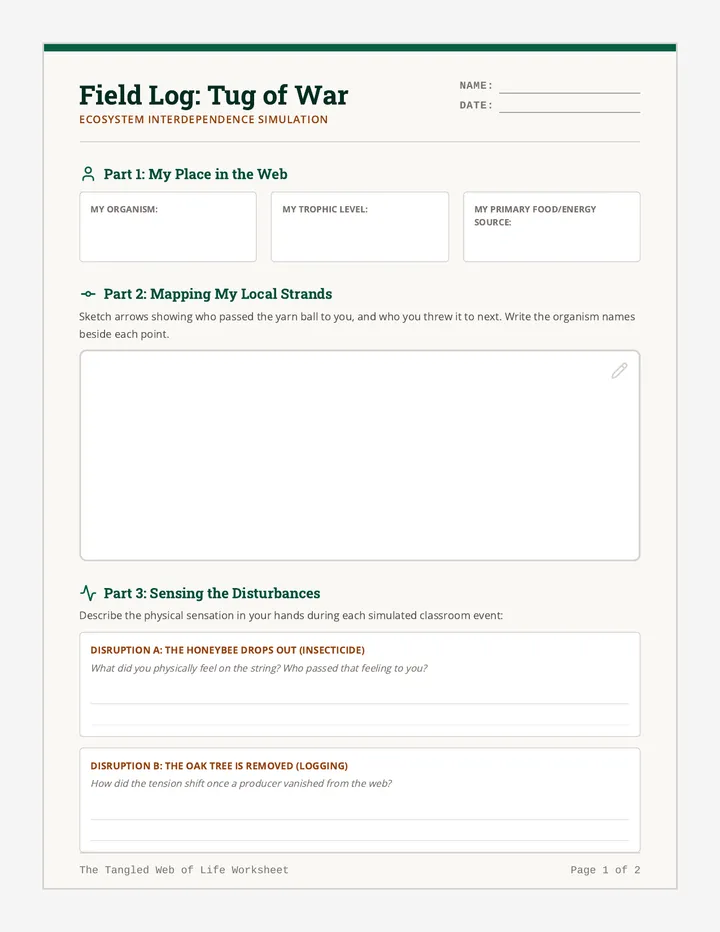
A comprehensive, high-engagement middle school science sequence introducing photosynthesis through leaf anatomy, cellular structures, chloroplasts, and the chemical equation. Combines rich interactive slides, guided worksheets, hand-on lab investigations, teacher planning resources, and exit tickets.
1. Explain what is happening to the stomata during this windstorm, and what state (open/closed) they are in.
2. Dr. Ramirez states: "By saving its life, the plant has paused its food manufacturing." Interpret this statement using scientific reasoning.
3. Why don't tomato plants simply leave their stomata open all the time to make maximum sugars? What is the core survival trade-off?
Sun Eaters Sequence • Lesson 1 Worksheet Page 2 of 2
• Packed with chloroplasts: B (Palisade)
• Waxy, waterproof seal: A (Cuticle)
• Openings on leaf surface: D (Stomata)
• Loose, airy cell layer: C (Spongy)
Part 3: Chloroplast Structure
1. Stack of disks: Granum (individual disk is a thylakoid)
2. Single fluid space: Stroma
3. Capture pigment: Chlorophyll
Part 4: Guard Cell Regulation & Scenarios Key
Q1: Windstorm & Stomata state
Model Answer: The stomata are closed. Due to the high heat, intense wind, and dry clay soil, the guard cells lose turgor pressure (shrink/go limp) which seals the stomatal pore shut to prevent dehydration and water loss.
Q2: "Saving life vs Pausing food manufacturing" statement
Model Answer: To survive, the plant must close its stomata to keep its water inside. However, by closing the pores, the plant blocks carbon dioxide (CO₂) from entering. Because CO₂ is an essential raw material for photosynthesis, the plant cannot manufacture glucose (sugars), meaning food production has stopped.
Q3: Why not open stomata always?
Model Answer: It is a trade-off between starving and dehydrating. If stomata are open 100% of the time, the plant will run out of water and dry up, killing the entire cell structure. Closing stomata acts as an emergency brake to conserve water, even if it delays energy production.
Sun Eaters Sequence • Lesson 1 Teacher Guide Page 2 of 2
Common baking soda dissolved in water splits into carbon dioxide and water molecules.
NaHCO₃ + H₂O → Na⁺ + OH⁻ + H₂O + CO₂
Feeding the Disks Dissolved Air
Plants in water cannot inhale gaseous carbon dioxide easily. Dissolved sodium bicarbonate (baking soda) serves as our liquid CO₂ reservoir.
Beaker 1: Experimental
Water + Baking Soda + Bright Light.
Prediction: Fast floaters!
Beaker 2: Control
Plain water (No Baking Soda) + Bright Light.
Prediction: Sunken disks!
Sun Eaters Sequence • Lesson 2
05 / 06
05. Guided Practice Variable Predictor
Predicting Photosynthetic Rates
How do changes in variables influence our floating leaf disks?
Light Intensity
If we move the light source 3 times closer to the beaker, what happens to the rate of floating? Why?
Temperature
If we use ice-cold water, what will happen to the metabolic speed of chloroplast enzymes?
Complete Dark
If the beaker is left under a dark box, will the disks ever rise? Explain using reactants.
Sun Eaters Sequence • Lesson 2
06 / 06
6 Min
____ disks
____ disks
8 Min
____ disks
____ disks
10 Min
____ disks
____ disks
12 Min
____ disks
____ disks
15 Min (End)
____ disks
____ disks
Part 2: Scientific Argument Structure (CER) (10 pts)
CLAIM: Does the presence of bicarbonate (dissolved carbon source) increase the rate of plant photosynthesis?
EVIDENCE: Cite specific numeric data from your table above (comparing Beaker A & Beaker B at key timestamps) to support your claim.
REASONING: Connect your evidence back to the biological inputs of the chemical formula. Why did Beaker A's disks rise while Beaker B's did not? What specific byproduct gas was produced inside the spongy mesophyll cell spaces?
Sun Eaters Sequence • Lesson 2 Lab Guide Page 2 of 2
Beaker B (Control): Zero disks should float throughout the entire 15 minutes. If disks in Beaker B float, the water may have been pre-aerated or contaminated with bicarbonate.
CLAIM Answer Key:
Yes, the presence of dissolved sodium bicarbonate (carbon source) dramatically increases the rate of plant photosynthesis compared to plain distilled water.
EVIDENCE Answer Key:
In Beaker A (with bicarbonate), 0 disks were floating at minute 2, but 4 disks were floating by minute 6, and a total of 9 disks floated at minute 15. In Beaker B (plain water), 0 disks floated at all intervals from minute 0 through minute 15.
REASONING Answer Key:
Photosynthesis requires water, light, and carbon dioxide to produce sugar and oxygen gas. Beaker A provided all three inputs. As the cells performed photosynthesis, they released oxygen gas as a product. Since gas is less dense than water, the oxygen bubbles inflated the spongy mesophyll layer, restoring buoyancy and lifting the disks. Beaker B lacked carbon dioxide, stopping the chemical reaction.
Sun Eaters Sequence • Lesson 2 Teacher Guide Page 2 of 2